What Is Stella Point on Kilimanjaro?
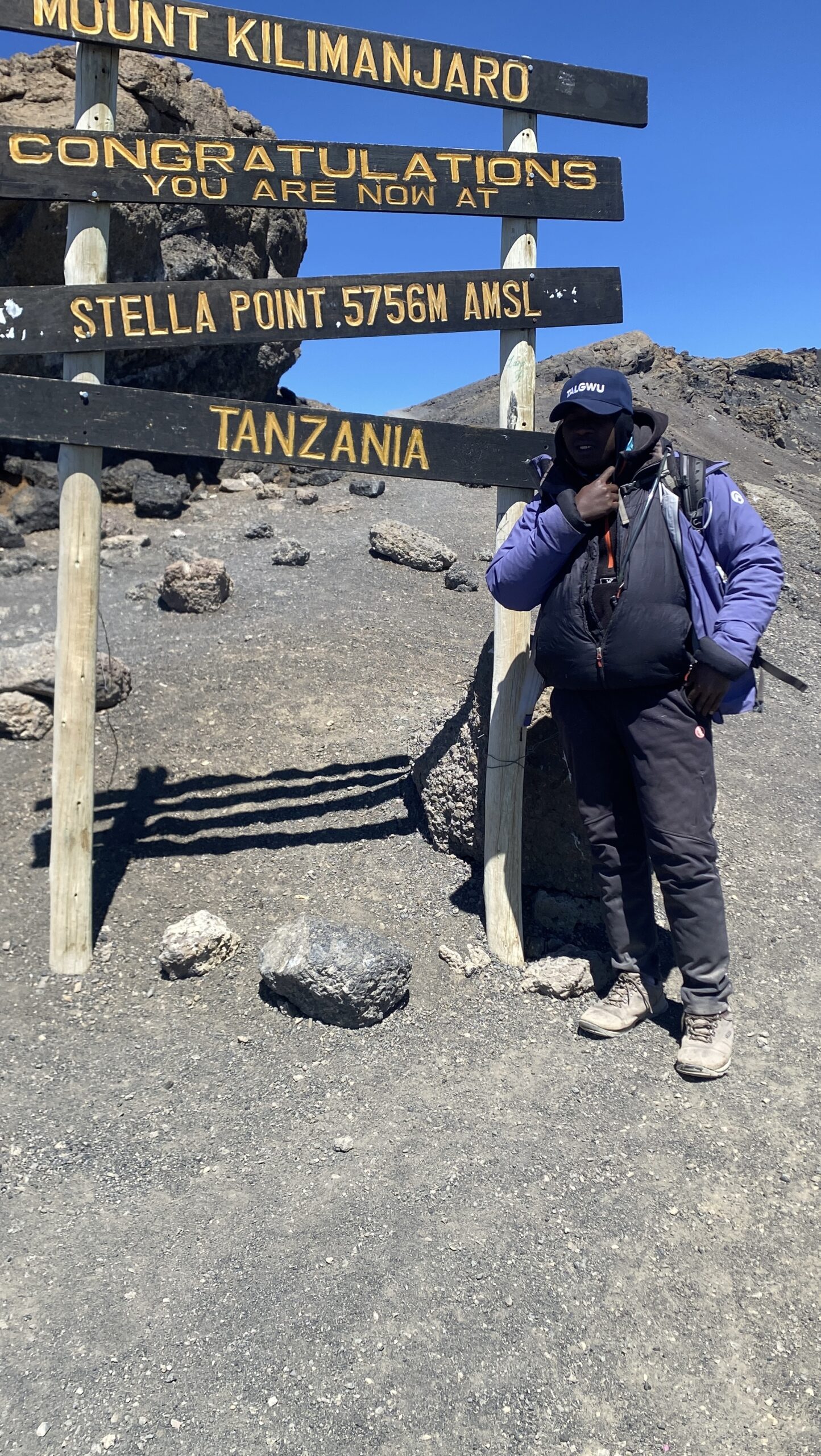
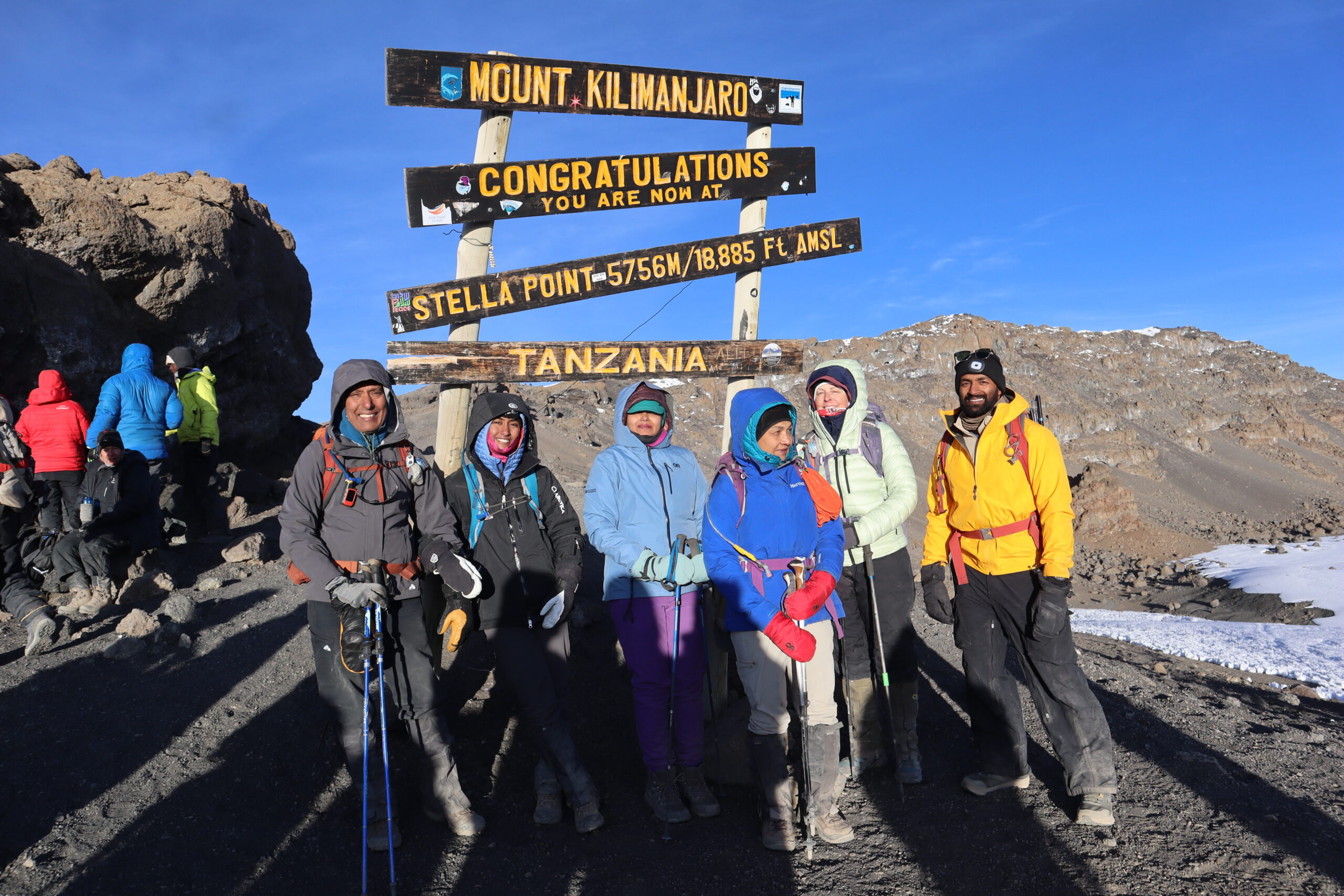
Stella Point, 5,756m — the crater rim decision point on Kilimanjaro summit night. Photo: Kilimania Adventure. Last updated: 21 August 2026.
Stella Point (5,756m / 18,885ft) is the point where Kilimanjaro’s summit night trail reaches the crater rim. It sits 139 vertical metres below Uhuru Peak — the true summit — and requires another 45–90 minutes of walking along the crater rim to reach the top. Every route targeting Uhuru Peak passes through Stella Point. It is also where the majority of turnarounds on Kilimanjaro happen, making it the most consequential 15 minutes of the entire climb.
📋 Key Takeaways What Is Stella Point on Kilimanjaro
- Stella Point (5,756m) is on Kilimanjaro’s southern crater rim — not the summit
- Uhuru Peak is 139m higher and 45–90 minutes further along the crater rim
- Blood oxygen at Stella Point is typically 75–82% SpO₂ — roughly half of sea level
- More turnarounds happen here than anywhere else on the mountain
- Climbers who reach Stella Point but not Uhuru receive a green TANAPA certificate
- Route length determines your condition at Stella Point — 8-day routes produce dramatically stronger arrivals than 5-day routes
(18,885ft)
Uhuru Peak
Uhuru Peak
Window
Planning Your Kilimanjaro Summit Night?
Our guides assess every climber at Stella Point personally. Your route choice now determines your condition at 5,756m on summit night. See which routes give you the strongest arrival.
View Kilimanjaro ClimbsWhy Stella Point Matters More Than You Think
Stella Point is not the summit. It is the most consequential location on the entire mountain. Every Kilimanjaro route targeting Uhuru Peak passes through Stella Point — the junction where the steep switchback ascent from Barafu Camp (4,673m) ends and the crater rim begins. What happens in the 15 minutes after you arrive here determines the outcome of your entire expedition.
The terrain shifts at Stella Point: loose scree gives way to a relatively flat path along the southern crater rim of Kibo. The gradient eases. But the altitude does not. Blood oxygen at 5,756m sits at roughly 75–82% SpO₂ — the air is approximately 47% thinner than at sea level. Every step requires deliberate focus.
Stella Point sits at GPS coordinates 3.0764° S, 37.3539° E on the southern rim of Kibo’s summit crater. The Rebmann Glacier hangs off the crater wall 200 metres to the south. The ash pit of Kibo — the volcanic crater interior — is visible to the north. On clear mornings between 5am and 6:30am, the triangular shadow of Kilimanjaro projects across the cloud layer below, stretching dozens of kilometres over the Tanzanian plains.
Route length is the dominant factor in your Stella Point performance. Because climbers on 8-day Lemosho Route or Northern Circuit expeditions have more acclimatisation days, they arrive at Stella Point with higher blood oxygen levels and meaningfully lower fatigue. This is why Lemosho and Northern Circuit produce substantially higher summit success rates than 5-day Marangu or 6-day Umbwe climbs. The difference plays out at Stella Point — not at Uhuru Peak. See our complete Kilimanjaro guide for the full breakdown.
📈 Summit Night Elevation Profile
▲ Summit night elevation gain: 1,222m over 4–7 hours. Stella Point to Uhuru Peak: 139m over 45–90 minutes.
Where Stella Point Is and What Happens There
Stella Point sits on the southern crater rim of Kibo — the volcanic cone that forms Kilimanjaro’s summit. It is accessible via all major routes: Machame, Lemosho, Shira, Umbwe, and the Northern Circuit all arrive here directly from the scree ascent. Marangu and Rongai route climbers reach Gilman’s Point (5,681m) on the eastern crater rim first, then walk the rim to Stella Point and on to Uhuru Peak.
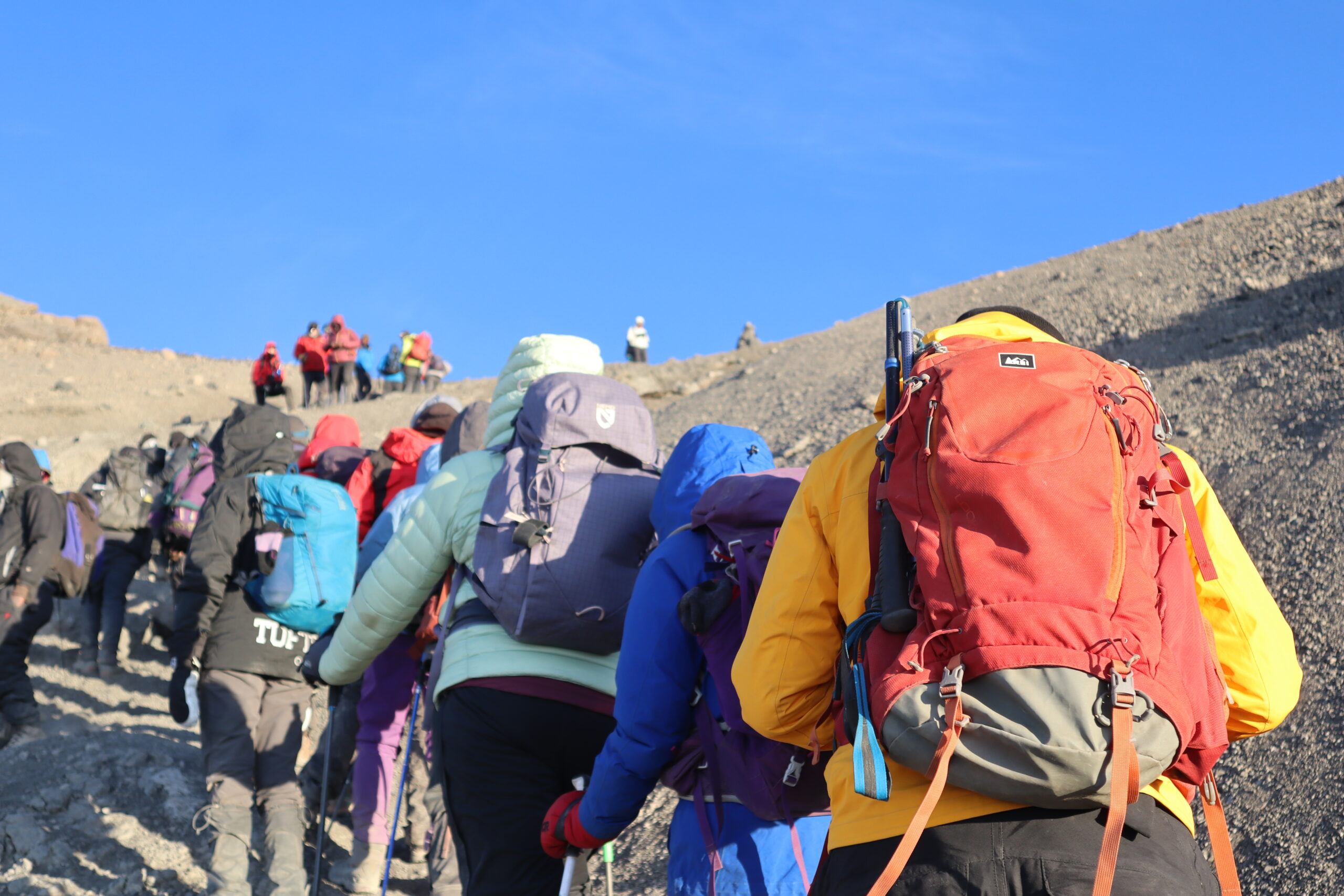
Most climbers depart Barafu between 11pm and midnight. Arrival at Stella Point falls between 3am and 6am depending on pace and group fitness. Temperatures on the ascent range from -8°C to -15°C with wind chill — cold enough to freeze water bottles in mesh side pockets within the first two hours.
The path from Stella Point to Uhuru Peak is not technical. There is no scrambling, no exposed ridge, no fixed ropes. It is a flat walk along the southern crater rim covering 139m of elevation gain. At 5,756m–5,895m, however, “flat” is relative. Blood oxygen drops to approximately 50% of sea level at Uhuru Peak. Every 50 metres, guides enforce a rest. Every step is deliberate. The Rebmann and Ratzel glaciers hang visibly off the crater walls to the south as you walk.
Why Most Turnarounds Happen at Stella Point
Data from Sabinus Msimba’s 1,247+ guided climbs shows that more turnarounds happen at Stella Point than at any other location on the mountain. The reasons are specific and compounding:
- Altitude physiology: At 5,756m, blood oxygen levels are 75–82% SpO₂. Sea-level SpO₂ is 95–99%. At these levels, cognitive function slows, coordination deteriorates, and the body prioritises core functions over voluntary effort.
- 4–7 hours of uninterrupted output: No breaks longer than 5 minutes since Barafu. No food that appetises. Continuous uphill movement in darkness and cold.
- Sub-zero cold: Hands stiff inside gloves. Water bottles partially frozen. The body diverts energy to thermoregulation — less available for climbing.
- The visual reality: Uhuru Peak is now visible for the first time — and it appears further than expected when your legs have nothing left. This visual shock breaks more climbers than the physical difficulty itself.
- AMS symptoms peaking: Acute Mountain Sickness headaches are at their worst at this altitude. Nausea, dizziness, and severe fatigue compound the physical challenge. See our Diamox guide and altitude safety overview for how guides manage this.
At Stella Point, Kilimania guides check gait stability, speech coherence, and pupil response. If any indicator falls outside safe parameters, the decision to descend is made at Stella Point — not at 5,800m, not at 5,850m, not at a point where safe descent becomes harder. This is not a commercial decision. It is a medical one. The Kilimanjaro National Park Authority (KINAPA) mandates that registered guides assess climber safety throughout the ascent, with particular attention at altitude thresholds.
What Climbers Say About Arriving at Stella Point
Choose a Route That Gets You to Stella Point Strong
Longer routes mean more acclimatisation and a meaningfully stronger arrival at 5,756m. Compare all 7 Kilimanjaro routes by success rate, days, and difficulty.
Compare Kilimanjaro RoutesRoute Comparison: Condition at Stella Point
The table below shows how route length directly affects climber condition at Stella Point, based on Sabinus Msimba’s observations across 1,247+ guided climbs. These figures represent typical outcomes — individual fitness, prior altitude history, and health status all affect results.
| Route | Days | Typical SpO₂ at Stella | Condition at Stella Point | Summit Success | Turnaround Risk |
|---|---|---|---|---|---|
| Northern Circuit | 9 | 80–85% | Strong — energy reserves largely intact | 95%+ | Low |
| Lemosho (8 days) | 8 | 79–83% | Strong — fatigued but functional | 90–95% | Low |
| Machame (7 days) | 7 | 77–81% | Moderate — tired but stable | 85–90% | Moderate |
| Rongai (6–7 days) | 6–7 | 76–80% | Moderate — slightly under-acclimatised | 80–85% | Moderate |
| Marangu (6 days) | 6 | 74–78% | Weak — significantly fatigued | 70–80% | High |
| Marangu (5 days) | 5 | 72–76% | Very weak — highest turnaround risk | 55–65% | Very High |
| Umbwe (6 days) | 6 | 74–78% | Weak — rapid ascent causes under-acclimatisation | 70–75% | High |
Source: Kilimania Adventure climb data, 1,247+ guided expeditions, 2004–2026. SpO₂ figures are typical ranges; individual variation applies. TANAPA does not publish route-specific success data.
Stella Point vs Uhuru Peak: Key Differences
| Feature | Stella Point | Uhuru Peak |
|---|---|---|
| Elevation | 5,756m (18,885ft) | 5,895m (19,341ft) |
| TANAPA Certificate | Green — crater rim reached | Gold — summit reached |
| Elevation Difference | 139m — 45–90 minutes on crater rim path | |
| Terrain | Crater rim junction — flat, exposed to wind | Summit sign and plaque — slight mound |
| Typical Arrival | 3:00–6:00am | 5:00–8:00am |
| Temperature (2–6am) | -8°C to -15°C with wind chill | -10°C to -18°C with wind chill |
| Blood Oxygen (SpO₂) | 75–82% (~53% of sea-level pressure) | 70–78% (~50% of sea-level pressure) |
| Turnaround Risk | Highest on the mountain | None — you are at the summit |
| Routes Passing Here | All 7 summit routes | All 7 summit routes |
| What You See | Crater view, glacier walls, sunrise shadow, plains below | Summit sign, 360° panorama, full crater interior |
Stella Point vs Gilman’s Point: What’s the Difference?
Stella Point (5,756m) is on the southern crater rim, reached via Machame, Lemosho, Shira, Umbwe, and Northern Circuit routes. Gilman’s Point (5,681m) is on the eastern crater rim, reached first by Marangu and Rongai route climbers. Gilman’s Point is 75 metres lower than Stella Point. Both receive a green TANAPA certificate. Marangu and Rongai climbers pass through Gilman’s Point, then walk the crater rim to Stella Point, then continue to Uhuru Peak — passing through both points on the same summit day.
| Certificate | Colour | Elevation | Routes | What It Confirms |
|---|---|---|---|---|
| Gilman’s Point | Green | 5,681m | Marangu, Rongai | Eastern crater rim reached |
| Stella Point | Green | 5,756m | All routes | Southern crater rim reached — 139m below Uhuru |
| Uhuru Peak | Gold | 5,895m | All routes | Summit of Kilimanjaro and Africa |
The Stella Point to Uhuru Peak Walk
The crater rim path from Stella Point to Uhuru Peak is flat and non-technical. There is no scrambling, no fixed ropes, no exposure. It is, physically, the least demanding section of the entire climb. Physiologically, it is the most demanding — because the altitude reduces oxygen delivery to muscles by approximately 47% compared to sea level.
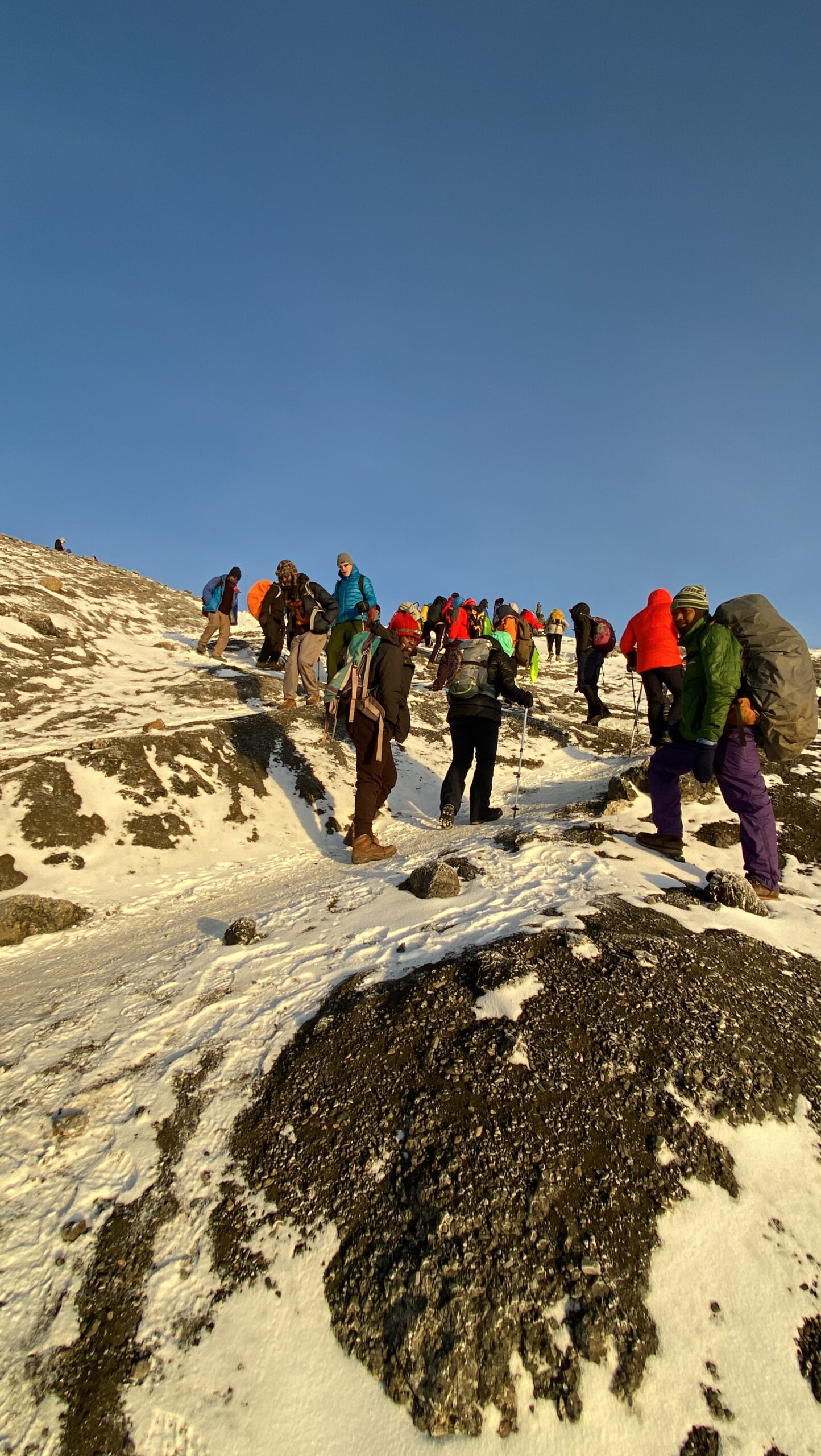
Kilimania guides enforce pole pole — Swahili for “slowly, slowly” — on this section. One step every 2–3 seconds. A deliberate pause every 50 metres. Rushing triggers nausea within minutes at this altitude. Climbers who try to accelerate toward the summit sign invariably slow dramatically or require emergency stops.
- Rest at Stella Point (5 minutes): Drink 200–400ml of water. Eat something small if possible. Your guide reassesses your condition before you continue.
- Walk the southern crater rim northwest: The path is marked and clear. Wind may be significant — keep your face shield up. No navigation required.
- Pass the Rebmann Glacier view (20–30 min from Stella): The glacier face is to your left. Many climbers pause here for a photograph. Keep moving — cold increases with static time.
- Final approach (last 100m): A slight mound. The summit sign becomes visible. Do not rush. One step at a time.
- At Uhuru Peak: Sign the register. Photograph. Limit time to 15–20 minutes. Descend immediately.
What You See From Stella Point
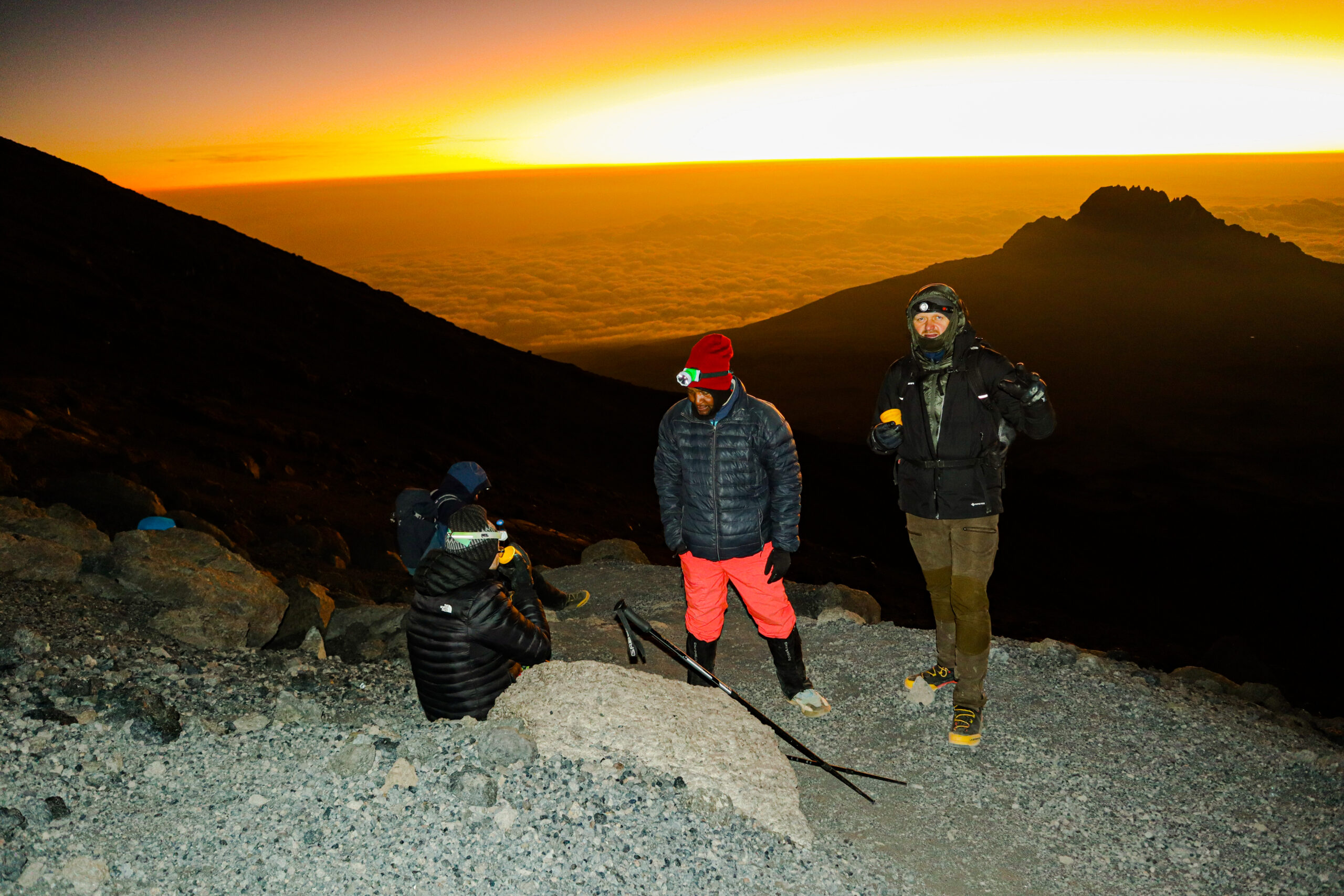
The view from Stella Point arrives at the exact moment most climbers are too exhausted to fully register it. Arrive between 5am and 6:30am on a clear morning and you will see:
- The African plains — visible to the south and east, 3,000m below, often above the cloud line
- Kilimanjaro’s triangular shadow — at sunrise, the mountain casts a silhouette across the cloud layer that stretches dozens of kilometres
- The Kibo crater interior — the ash pit is visible to the north, a wide volcanic depression inside the crater rim
- The Rebmann and Ratzel glaciers — hanging off the crater wall to the south, dramatically reduced from their 1970s extent but still visually striking
- Uhuru Peak — to the northwest along the crater rim, 139m above you and clearly visible for the first time
The Stella Point Certificate
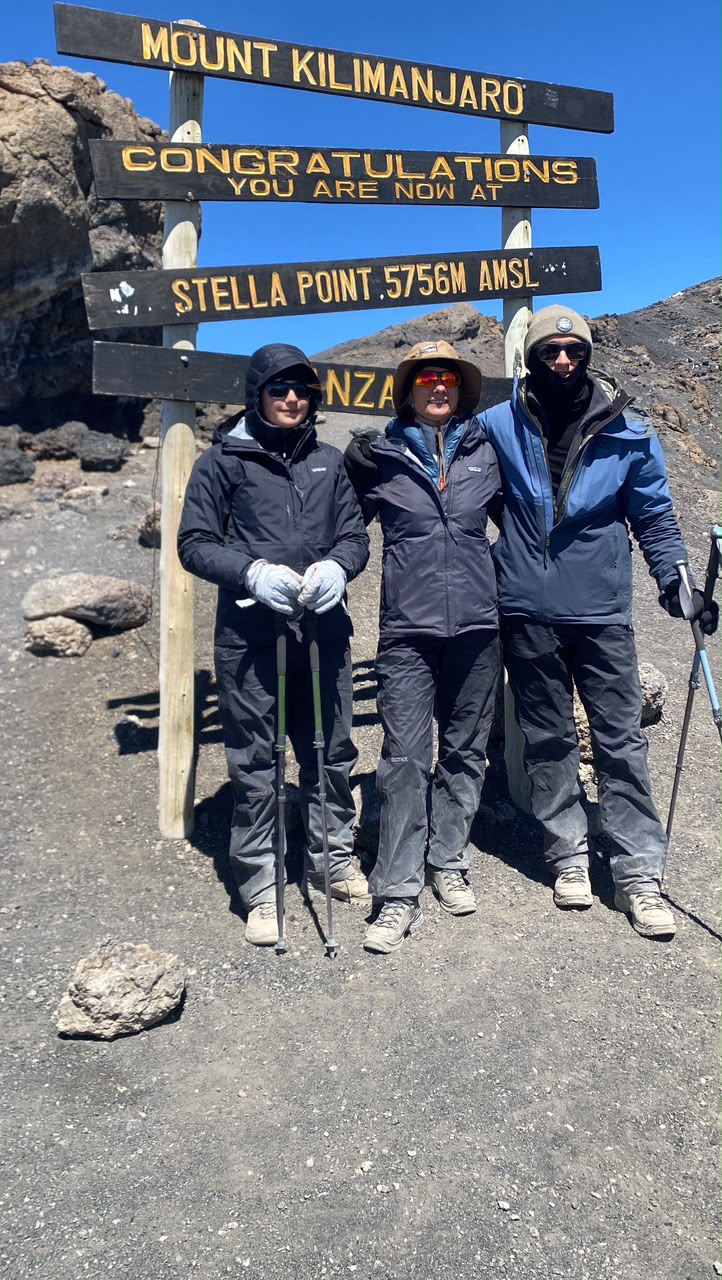
Climbers who reach Stella Point (5,756m) but do not continue to Uhuru Peak receive a green TANAPA certificate from the Tanzania National Parks Authority, confirming they reached Kilimanjaro’s crater rim. Climbers who reach Uhuru Peak (5,895m) receive a gold TANAPA certificate confirming they reached the summit of Africa’s highest mountain. Both certificates are issued at the park gate after descent — not on the mountain itself.
A green certificate is not a consolation prize. But the psychological weight of stopping 139m short of the summit stays with climbers for years. Kilimania guides discuss the Stella Point scenario before departure — not to discourage, but to ensure every climber understands that their guide’s assessment at 5,756m is a safety decision, not a failure. Read our full guide on what happens if you don’t summit Kilimanjaro for turnaround scenarios and what to do next.
📥 Free Download: Kilimanjaro Altitude Symptom & AMS Checklist
Used by Sabinus Msimba and the Kilimania team on every expedition. Includes:
- Normal acclimatisation symptoms above 3,000m
- AMS warning signs — when to stop ascending
- HACE and HAPE emergency indicators
- Daily SpO₂, pulse, and hydration monitoring form
- Guide assessment and self-check protocol
Prepared by Sabinus Msimba, Senior Mountain Guide, Kilimania Adventure. For educational purposes — not a substitute for professional medical advice.
How to Prepare for Stella Point Specifically
Three variables determine your condition when you step onto the crater rim at 5,756m:
1. Route Length — The Dominant Factor
The route comparison table above makes this clear. An 8-day Lemosho Route produces summit success rates above 90%. A 5-day Marangu drops below 65%. The difference is not fitness — it is the number of nights your body has to adapt to progressively higher altitude before the final push. See how many days to climb Kilimanjaro for a full comparison of day-count options.
2. Physical Training
Training for Kilimanjaro is not about speed or strength. It is about endurance: long hikes with a loaded daypack, stair climbing for 60–90 minutes continuously, and tolerance for hours of slow uphill movement in darkness. Read our 12-week Kilimanjaro training guide. Assess your current fitness level with our Kilimanjaro fitness assessment.
3. Pacing on Summit Night
Starting too fast on the Barafu-to-Stella ascent is the most common guide-observable error. Climbers who feel strong in the first two hours and push the pace invariably arrive at Stella Point with no reserves. Guides set the pace — not the climber. For the full hour-by-hour breakdown, see our Kilimanjaro summit night guide.
4. Altitude Medication and Insurance
Whether to use Diamox (acetazolamide) is a medical decision to make with a physician before departure. Our Diamox guide covers the evidence, dosing, and side effects. Ensure your travel insurance covers high-altitude trekking to 6,000m — providers such as World Nomads and Allianz Travel Insurance offer policies covering high-altitude mountaineering specifically.
Are You Well Positioned for Stella Point? An Honest Assessment
✅ Strong Position If:
- You have chosen a 7-day or longer route
- You have trained with long hikes and pack weight
- You are comfortable with endurance over speed
- You trust your guide’s assessment at altitude
- You have discussed Diamox with a physician
- Travel insurance covers 6,000m trekking
⚠️ Higher Turnaround Risk If:
- You are on a 5-day Marangu or 6-day Umbwe
- Training has been minimal or gym-only
- You have had AMS symptoms below 4,000m
- You plan to override your guide’s assessment
- You have an unmanaged cardiovascular condition (see medical conditions guide)
Why Is It Called Stella Point?
According to Kilimanjaro guiding tradition and colonial-era survey records, Stella Point is named after “Stella” — a name associated with early 20th-century climbing expeditions active on Kibo. The precise origin is not definitively documented in public records. The name has been in consistent use since the 1960s when Kilimanjaro National Park was formally established by the Tanzanian government, and is maintained as an official geographic designation by TANAPA. Gilman’s Point — the eastern crater rim landmark — is similarly named after a colonial-era expedition member.
📥 Free Download: Kilimanjaro Route Comparison Cheat Sheet
All 7 routes compared — including which routes get you to Stella Point in the strongest condition:
- Success rates by route and day count
- Difficulty, scenery, and crowd levels at each
- Acclimatisation profile comparison
- Expert route recommendations by fitness level
Prepared by Sabinus Msimba, Senior Mountain Guide, Kilimania Adventure. Updated for the 2026 climbing season.
Frequently Asked Questions About Stella Point
Is Stella Point the same as the summit of Kilimanjaro?
No. Stella Point (5,756m) is the point where the summit trail reaches the crater rim — not the summit. Uhuru Peak (5,895m) is the summit, located 139m higher and 45–90 minutes of walking along the crater rim from Stella Point. Climbers who reach Stella Point but not Uhuru receive a green TANAPA certificate confirming they reached the crater rim; those who reach Uhuru receive a gold certificate confirming they reached the summit of Kilimanjaro and Africa.
Do all Kilimanjaro routes go through Stella Point?
All routes targeting Uhuru Peak pass through Stella Point. Machame, Lemosho, Shira, Umbwe, and Northern Circuit climbers arrive directly from the Barafu scree ascent. Marangu and Rongai route climbers reach Gilman’s Point (5,681m) on the eastern crater rim first, then walk the crater rim to Stella Point and on to Uhuru Peak — passing through both points on the same summit day.
What certificate do you get if you reach Stella Point but not Uhuru Peak?
Climbers who reach Stella Point (5,756m) but do not continue to Uhuru Peak receive a green TANAPA certificate confirming they reached Kilimanjaro’s crater rim. This is issued at the park gate after descent, not on the mountain. The gold certificate is issued only to climbers who reach Uhuru Peak at 5,895m. Read our full guide on what happens if you don’t summit Kilimanjaro for more detail.
How long does it take from Stella Point to Uhuru Peak?
The walk from Stella Point to Uhuru Peak covers 139m of elevation gain and takes 45–90 minutes depending on pace and individual condition. At 5,756m–5,895m, blood oxygen levels are 50–53% of sea level. Guides enforce a slow, deliberate pace — one step every 2–3 seconds with pauses every 50 metres. Rushing triggers nausea and accelerates fatigue at this altitude.
What is the difference between Stella Point and Gilman’s Point?
Stella Point (5,756m) is on the southern crater rim, reached via Machame, Lemosho, Shira, Umbwe, and Northern Circuit routes. Gilman’s Point (5,681m) is on the eastern crater rim, reached first by Marangu and Rongai route climbers. Gilman’s Point is 75m lower than Stella Point. Both receive a green TANAPA certificate. Marangu and Rongai climbers pass through Gilman’s Point, then walk the crater rim to Stella Point, and continue to Uhuru Peak.
Why do most turnarounds happen at Stella Point?
By the time most climbers reach Stella Point, they have been ascending for 4–7 hours in darkness at sub-zero temperatures with blood oxygen levels of 75–82% SpO₂. The legs are spent, the altitude headache is at its worst, and Uhuru Peak — though visible — appears distant. This combination of physical depletion, AMS symptoms, and psychological reality makes Stella Point the tipping point of the climb. Guides assess gait, speech, and pupil response here. If any indicator falls outside safe parameters, descent is initiated immediately.
Ask a Kilimanjaro Guide Directly
Still have questions about summit night and Stella Point? Message Sabinus Msimba on WhatsApp — straight answers from someone who has assessed climbers at 5,756m over 1,200 times.
💬 Message on WhatsAppStella Point Is the Decision Point — Prepare for It
Stella Point is not a footnote on the way to Uhuru Peak. It is the most consequential 15 minutes of your Kilimanjaro climb. The decision made at 5,756m — with your guide, in darkness, at -12°C, after 5 hours of climbing — determines whether you stand on the roof of Africa or descend with a green certificate and years of wondering.
That decision is shaped weeks before you leave home: the route you choose, the weeks you spend training, and the guide you trust to tell you the truth at 5,756m — and the guide you trust to keep walking when the truth is that you can.
Choose a route of 7 days or longer. Train for endurance, not speed. Pack correctly. Climb with guides who are KPAP-compliant and TATO-registered. And climb with guides who make the safety call at Stella Point without ego and without hesitation.
We walk with you. — Kilimania Adventure