Language
Currencies
How to Train for Kilimanjaro: The Complete 12-Week Preparation Plan
How do I Train to Climb Kilimanjaro?
Most training guides for Kilimanjaro are written by people who climbed it once. This one is built from watching 1,247 climbers prepare — some well, most adequately, and a meaningful number badly enough that they turned around at Stella Point, 295 vertical metres short of Uhuru Peak.
Quick Answer:
The minimum effective Kilimanjaro training period is 12 weeks for someone with a moderate existing fitness base. The plan needs three things in this order: sustained walking endurance over 5–8 hours, hiking with a loaded pack on uneven terrain, and back-to-back training days that simulate cumulative mountain fatigue. Running alone does not produce any of the three.
The single most common error we see is training for cardiovascular fitness instead of sustained muscular endurance. Running 5km three times a week builds a strong heart. It does not prepare your hip flexors, quads, and lower back for eight hours of walking on loose volcanic ash above 4,000m, where every movement costs roughly 30% more energy than the same movement at sea level. Climbers arrive having “trained” — and find on Day 3 that fitness and mountain-readiness are not the same thing.
Kilimanjaro Training Essentials
Before starting your Kilimanjaro preparation, remember these six principles:
Train for at least 12 weeks if you have a moderate fitness base.
Prioritize hiking and walking endurance over running.
Carry a 5–8kg daypack during training to simulate mountain conditions.
Include back-to-back hiking days to prepare for cumulative fatigue.
Test all boots, clothing, and equipment before arriving in Tanzania.
If underprepared, choose a longer route such as the 8-Day Lemosho Route or 9-Day Northern Circuit for additional acclimatisation.
The climbers most likely to summit Kilimanjaro are not necessarily the fittest. They are the ones who arrive with strong walking endurance, tested gear, and experience hiking on tired legs.
Key Stats
- 30% — extra energy cost per movement above 4,000m
- 5–8kg — daypack weight you carry yourself
- 94% — Kilimania’s success rate on the 8-day Lemosho Route
- 12 weeks — minimum training period for a moderate fitness base
- 1,247 — climbs this plan is built from
- 8–10 hrs — minimum boot break-in time before departure
The Bottom Line: Twelve weeks of the right kind of training — sustained walking, loaded pack, back-to-back days — will get a moderately fit adult ready for Kilimanjaro. It will not guarantee a summit; altitude affects people unevenly regardless of fitness. What it does is remove the preventable causes of failure: exhausted legs, untested boots, and a body that has never carried weight for eight straight hours.
What Kilimanjaro Actually Demands From Your Body
“Moderate to strenuous hiking” — the phrase nearly every operator uses — tells you nothing useful. Here is what the mountain actually requires, with numbers instead of adjectives.
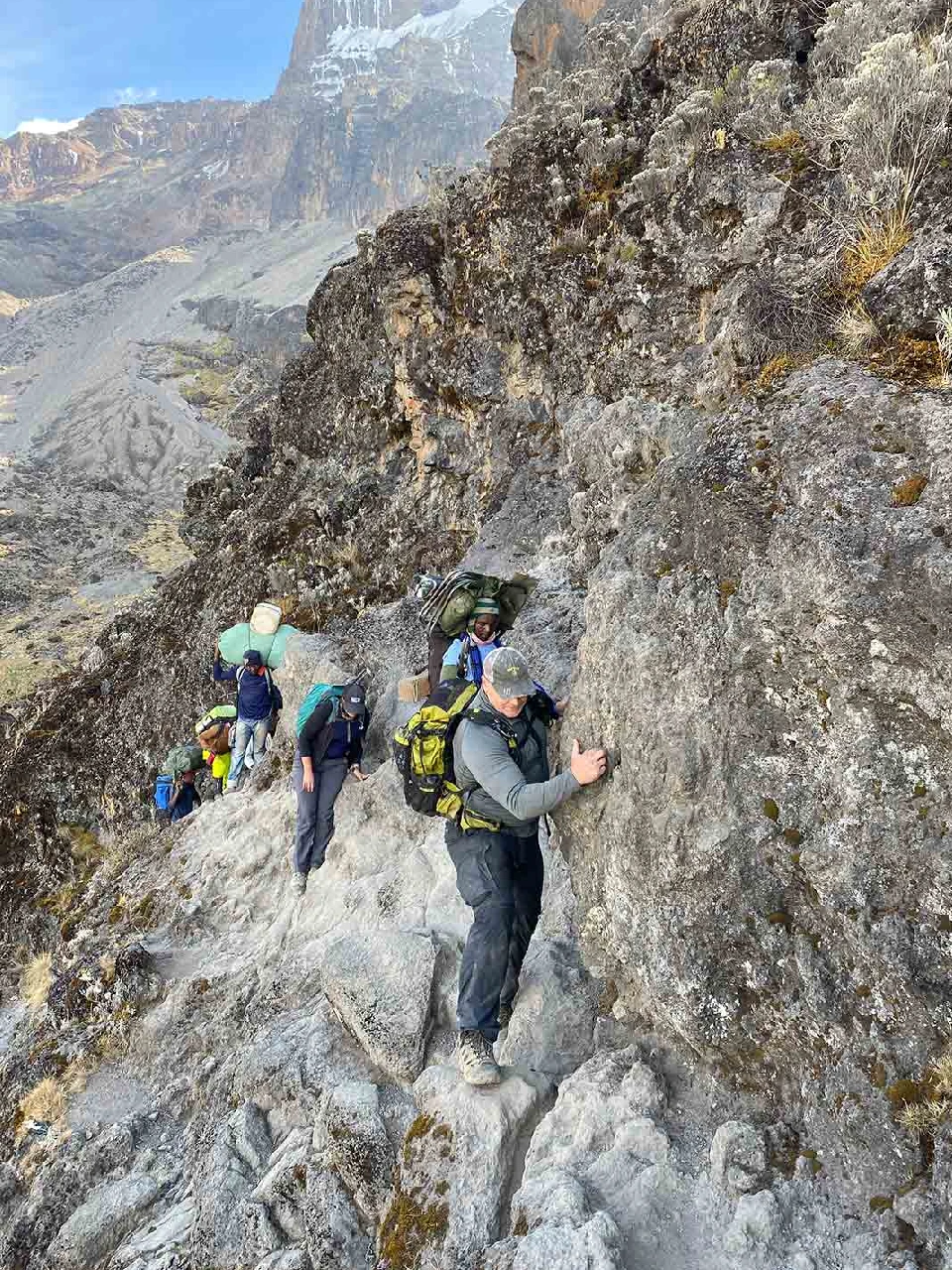
You will walk 5 to 8 hours a day, every day, for 6 to 9 consecutive days, with no rest day built into the itinerary. The terrain changes constantly and without warning: dense forest root systems on Day 1, open moorland on Day 2, loose volcanic scree by Day 4, compacted glacial ash near the summit. On the Lemosho Route, climbers cross all four in a single week.
Summit night is the outlier. From Barafu Camp (4,681m) to Uhuru Peak (5,895m), you gain roughly 1,200 metres between midnight and sunrise — on a body that has already hiked six hours the previous afternoon, in temperatures that drop from -12°C to -18°C with wind chill. You carry a 5–8kg daypack the entire time; porters carry your main bag, but water, layers, and snacks are yours to manage at altitude, where reaching into a pack and zipping a jacket both take noticeably more effort.
That 30% figure isn’t decoration. Above 4,000m, reduced oxygen pressure means your heart works harder, your breathing rate rises, and the same incline that felt easy at sea level now requires real concentration. TANAPA altitude data and published high-altitude physiology research agree on this consistently — it doesn’t matter how aerobically fit you are at sea level; the mountain changes the arithmetic.
There’s a second factor most training advice ignores entirely: sleep quality at altitude. Above 3,500m, even acclimatised climbers sleep less efficiently — lighter, more fragmented, with more waking. That means by Day 4 or 5, you’re not just carrying the physical fatigue of consecutive hiking days; you’re carrying a sleep deficit on top of it. Training cannot fully replicate this, but it explains why climbers who arrive with strong baseline endurance still feel the cumulative weight of the route differently than they expected. It’s one more reason the back-to-back training days in Month 2 matter more than any single long hike — they teach your body what moving on incomplete recovery actually feels like, which is the closest simulation available before you’re on the mountain itself.
Worth saying plainly: two climbers with identical training plans and identical fitness can respond to altitude differently for reasons that have nothing to do with preparation. Genetics play a real role in how individuals tolerate reduced oxygen, and no amount of training changes that baseline. What training does change is everything else — the muscular endurance, the gear familiarity, the mental reference points — which is precisely why this plan focuses there instead of promising outcomes it can’t control.
The conclusion is blunt: training that doesn’t simulate sustained output, on varied terrain, with pack weight, over consecutive days, is incomplete preparation. Everything in this plan exists to fix that gap.
Not sure where your starting fitness sits? Take our free Kilimanjaro fitness assessment before you read further — it tells you which week of this plan to actually start on.
The Five Mistakes Our Guides See Most Often
These come from 22 years of watching the same patterns repeat, not from a textbook.
1. Training cardio, not endurance. A runner’s heart rate recovers fast. Their hip flexors and lower back have never carried weight for six hours. We have watched marathon-fit clients struggle by Day 3 while a 58-year-old who walked for two hours daily with a loaded pack finished strong. One client in 2025, a competitive triathlete, told Sabinus on Day 2 of the Machame Route that her legs felt “borrowed” — fit in every measurable way, but never asked to do this specific, repetitive, weighted task before.
2. Skipping the pack. A 6kg daypack changes your biomechanics after about four hours — load shifts to your hips, your lower back compensates, your knees absorb descent differently. Train without weight and the mountain introduces a new variable at 4,000m, which is the worst possible place to discover it. We’ve seen climbers who hiked extensively in their home country, pack-free, arrive shocked at how differently their shoulders and lower back respond once weight enters the equation above 3,500m.
3. No back-to-back days. The real difficulty of Kilimanjaro isn’t any single day — it’s Day 5 on legs that never fully recovered from Days 1 through 4. Training only on isolated single days, with full recovery between them, doesn’t prepare you for cumulative fatigue at all. This is the mistake that’s hardest to self-diagnose, because each individual training hike can feel completely successful while the underlying gap — recovery under repeated load — stays invisible until summit night.
4. Starting too late. Six weeks works only for climbers already at a high fitness baseline. Below that, six weeks produces a climber who is “somewhat” ready — which on this mountain often means a guide-supported turnaround, not a slower summit. We turn away very few climbers outright, but we will tell anyone with three weeks’ notice and no hiking background exactly what their odds look like, because a wasted flight and a wasted week of leave serve nobody.
5. New gear on the mountain. Boots broken in the week before departure, or never tested with a loaded pack, are the single most preventable cause of early descent. Blisters at 4,600m don’t heal between camps; they end climbs. We have had climbers turn around at Lava Tower — physically capable of continuing in every other respect — purely because untested boots had already done irreversible damage to their feet by Day 3.
📥 Free Download: Kilimanjaro 12-Week Training Calendar
Download the same week-by-week training plan used by Kilimania Adventure guides and built from patterns observed across 1,247+ guided climbs.
Includes:
- 12-week hiking and endurance plan
- Pack weight progression
- Back-to-back training schedule
- Peak and taper strategy
- Route recommendations based on fitness level
Prepared by Sabinus Msimba, Senior Kilimanjaro Guide and Co-founder of Kilimania Adventure.
The 12-Week Training Framework
Before Week 1: The Baseline Test
Walk 6 hours on uneven terrain carrying 4kg. Note how you feel at hour 3, hour 5, and the next morning.
- Hour 5 felt manageable, woke up stiff but functional → start at Week 1 as written.
- Hour 3 already felt hard → repeat Week 1 for two weeks before moving to Week 2.
- Couldn’t finish the 6 hours → spend 4 weeks building a daily 30–45 minute walking habit before starting this plan formally.
For a fuller picture of where you stand, see Can An Unfit Person Climb Kilimanjaro?
Month 1 — Weeks 1–4: Foundation
The goal here isn’t fitness — it’s habit and load tolerance. Rushing this phase is the most common reason Month 3 goes badly. Most people who quit a training plan quit in Month 1, not because the sessions are hard, but because they’re boring relative to the climb itself, which still feels distant. Treat consistency in these four weeks as the actual training goal — the physical adaptation follows automatically if you show up.
Week 1 (~2.5 hrs total)
| Day | Session |
|---|---|
| Mon | 45-min walk, flat terrain |
| Wed | 45-min walk + 10 flights of stairs |
| Fri | 60-min walk, mixed terrain |
| Sat | Rest or gentle stretching |
Week 2 (~4 hrs total)
| Day | Session |
|---|---|
| Mon | 60-min walk, 3kg pack |
| Wed | 60-min walk + 15 flights of stairs |
| Fri | 75-min walk, hills if available |
| Sat | 60-min easy-pace walk |
Week 3 (~5.5 hrs total)
| Day | Session |
|---|---|
| Mon | 75-min walk, 4kg pack |
| Wed | 90-min incline-focused walk |
| Fri | 90-min walk, 4kg pack |
| Sat | 2-hr easy walk |
Week 4 (~9.5 hrs total) — Benchmark week
| Day | Session |
|---|---|
| Mon | 2-hr walk, 4kg pack |
| Wed | 2-hr hill walk, 4kg pack |
| Fri | 2.5-hr walk, 5kg pack (first time at 5kg) |
| Sat | 3-hr moderate hike, 5kg pack |
Week 4 Benchmark: Complete a 3-hour walk with 5kg on varied terrain. Manageable with energy left → proceed to Month 2. Difficult but finished → repeat Week 3 once more. Couldn’t finish → reassess timeline; read How Hard Is Kilimanjaro? before continuing.
Month 2 — Weeks 5–8: Building
This is where Kilimanjaro-specific training actually starts. The sessions get uncomfortable on purpose — Month 1 built the base; Month 2 builds the specific capacities the mountain will actually test. If Month 1 felt easy, that’s correct; it was supposed to. Month 2 should feel notably different by Week 7.
Week 5 — first back-to-back days
- Sat: 4-hr hike, 5kg
- Sun: 3-hr recovery hike, 4kg (slower pace — this trains active recovery, not speed)
- Following Monday: full rest, non-negotiable
Week 6 — first long day One session of 5 continuous hours, 5kg, uneven terrain. Should feel hard, not impossible. From this week onward, every hike happens in your actual summit boots — see the gear protocol below.
Week 7 — elevation focus Find any 500m+ elevation-gain route and do it twice. Weekend: first equal-duration back-to-back (4 hrs Saturday, 4 hrs Sunday).
Week 8 — Month 2 Benchmark Complete a 5-hour hike at 5–6kg on mixed terrain. The morning after, ask honestly: could I do this again today? A reluctant yes → Month 3. A clear no → repeat Month 2’s final two weeks before advancing.
Month 3 — Weeks 9–12: Peak and Taper
Week 9 — the hardest week
- Tue: 4-hr hike, 6kg, elevation prioritised
- Thu: 90-min recovery walk
- Sat: 6+ hr hike — your longest single day yet
- Sun: 4-hr hike on already-tired legs (this is the deliberate point: simulating summit-night fatigue on a body that hasn’t recovered)
Week 10 — the critical test A single day of 7–8 hours, 6kg, on the hardest terrain you can access. How you feel the next morning — not that evening — is the most accurate predictor of mountain readiness. Functional and tired: ready. Unable to walk normally: you need more time, not more intensity.
Week 11 — taper Drop volume by 30%, keep intensity on shorter sessions. This week’s job is the full gear audit — every item tested, nothing untested still in the bag. Check against the Kilimanjaro Packing List.
Week 12 — final week Light 2-hour walks only. Legs need rest, not more stress. Pack fully assembled and weighed. Boots already at 8–10 hours of use. Mental preparation matters here more than physical — read What Happens If You Don’t Summit Kilimanjaro so uncertainty isn’t a surprise on the mountain.
12-Week Kilimanjaro Training Plan Comparison Table
| Training Week | Training Phase Entity | Primary Hiking Goal | Longest Training Session | Recommended Pack Weight | Back-to-Back Hiking | Kilimanjaro Readiness Outcome |
|---|---|---|---|---|---|---|
| Week 1 | Foundation Phase | Establish consistent walking routine | 60 minutes | No pack | No | Build exercise habit |
| Week 2 | Foundation Phase | Introduce light load carrying | 75 minutes | 3 kg | No | Adapt shoulders and hips |
| Week 3 | Foundation Phase | Increase endurance duration | 2 hours | 4 kg | No | Improve aerobic base |
| Week 4 | Foundation Phase | First endurance benchmark | 3 hours | 5 kg | No | ✅ Ready to progress |
| Week 5 | Building Phase | Introduce consecutive hiking days | 4 hours | 5 kg | Yes | Develop recovery capacity |
| Week 6 | Building Phase | Transition to mountain boots | 5 hours | 5 kg | No | Break in summit footwear |
| Week 7 | Building Phase | Focus on elevation gain | 4 hours | 5 kg | Yes | Improve climbing strength |
| Week 8 | Building Phase | Second endurance benchmark | 5 hours | 6 kg | No | ✅ Mid-program readiness check |
| Week 9 | Peak Phase | Simulate demanding mountain days | 6+ hours | 6 kg | Yes | Develop summit-day stamina |
| Week 10 | Peak Phase | Complete final endurance test | 7–8 hours | 6 kg | No | ✅ Critical Kilimanjaro simulation |
| Week 11 | Taper Phase | Reduce fatigue and audit equipment | 3 hours | Full summit gear | No | Confirm gear readiness |
| Week 12 | Taper Phase | Recover before departure | 2 hours | Light pack | No | Arrive rested for Kilimanjaro |
Table: Entity-based 12-week Kilimanjaro training progression designed to prepare trekkers for multi-day ascents on Mount Kilimanjaro.
.
Training If You Have Less Than 12 Weeks
6 weeks: Only viable if you’re already at a high fitness base — regular hiker, comfortable at 4 hours. Compress Month 1 into two weeks at Week 3 intensity; run Months 2 and 3 unchanged. Accept you’ll arrive less prepared than the full 12-week version. Compensate by choosing the 8-Day Lemosho Route for extra acclimatisation.
4 weeks: Only for climbers who already hike 6+ hours comfortably. Highest-intensity version only, with the 9-Day Northern Circuit or 8-Day Lemosho to buy back acclimatisation time your fitness can’t.
Under 4 weeks: Postpone. This isn’t caution for its own sake — four weeks of rushed training doesn’t produce a “somewhat ready” climber, it produces one genuinely at risk of a guide-supported turnaround at Lava Tower or Barafu, after spending real money and real annual leave. Message us on WhatsApp before booking if your timeline is tight — we’ll tell you honestly whether your date and your fitness line up.
The Exercises Worth Your Time
Stairs are the single best supplementary exercise — nothing else available to most people replicates the quad and glute demand of ascending loose ash. Target 50–100 floors a week by Month 2: office stairwells, stadium bleachers, parking garages all work. Take stairs at a controlled, even pace rather than rushing — the mountain rewards sustainable rhythm, not speed, and training that rhythm now pays off directly on summit night when “pole pole” (slowly, slowly) is the only sustainable pace above 4,500m.
Weighted step-ups (box or bench roughly knee height, 15–20 minutes with your loaded pack, alternating lead leg every set) build the specific knee stability the descent demands — this is often the difference between climbers who finish strong and those who struggle at Barafu. Do these on a day separate from your long hikes; this exercise fatigues the same muscles you need fresh for sustained walking, so stacking them on the same day undermines both.
Core work — planks (build toward 60-second holds), dead bugs (10 controlled reps each side), single-leg balance (45 seconds per leg, eyes closed once it gets easy) — isn’t about appearance. It’s the bridge between your legs and your pack; a fatigued core makes your knees compensate, and that’s where pain starts. Three short sessions a week of 15 minutes each does more than one long session, because the goal is muscular endurance under load, not peak strength.
Skip the long runs. Distance running has limited transfer to Kilimanjaro’s actual demand — different muscle recruitment, different energy system, and meaningfully higher impact stress on joints that you need intact for nine days of walking. Cycling is a better cardiovascular base-builder for this purpose, with lower joint impact than running, but neither replaces hiking with weight on consecutive days. If you enjoy running and want to keep it, limit it to two sessions a week and never the day before a long training hike.
Kilimanjaro Training Methods Compared
| Training Method | Effectiveness for Kilimanjaro | Primary Benefit | Recommendation |
|---|---|---|---|
| Hiking with a loaded pack | ★★★★★ Very High | Simulates actual mountain conditions | Essential |
| Back-to-back hiking days | ★★★★★ Very High | Builds cumulative fatigue tolerance | Essential |
| Stair climbing | ★★★★☆ High | Strengthens climbing muscles | Strongly recommended |
| Weighted step-ups | ★★★★☆ High | Improves knee stability and descent strength | Recommended |
| Distance running | ★★★☆☆ Moderate | Builds cardiovascular fitness | Supplement only |
| Cycling | ★★★☆☆ Moderate | Low-impact aerobic conditioning | Supplement only |
| Weight training | ★★★☆☆ Moderate | Supports overall strength and injury prevention | Complementary |
Best Exercises for Kilimanjaro Training Comparison Table
| Training Method | Endurance Development | Injury Risk | Mount Kilimanjaro Transfer Value | Guide Assessment |
|---|---|---|---|---|
| Distance Running | Low | Medium | Low | Useful for fitness but does not replicate mountain trekking. |
| Stair Climbing | High | Low | High | Excellent substitute when hiking trails are unavailable. |
| Weighted Step-Ups | Very High | Low | Very High | One of the best home exercises for summit preparation. |
| Cycling | Moderate | Low | Moderate | Builds aerobic fitness but lacks hiking-specific adaptation. |
| Back-to-Back Hiking | Very High | Medium | Essential | Closest simulation of consecutive days on Mount Kilimanjaro. |
Table: Comparison of common Kilimanjaro training methods based on endurance development, injury risk, and mountain-specific transfer.
Eating and Drinking During Training — and Why It Matters Later
This is the part of preparation most guides skip entirely, and it costs climbers more than they realise. Your training period is when you learn what your body needs to sustain hours of effort — information you’ll rely on directly during the climb itself.
Practice eating while moving, not just before or after. On the mountain, you’ll eat small amounts regularly throughout each walking day — dried fruit, nuts, energy bars — rather than large meals. If your stomach has never been tested with food intake during exertion, Week 5 onward is the time to find out what sits well and what doesn’t. Some climbers discover during training that certain energy gels or bars cause stomach upset under sustained exertion; far better to learn this on a local trail than at 4,500m.
Hydration follows the same logic. Aim to drink roughly 500ml per hour of hiking during your longer training sessions — noticeably more than most people drink during ordinary exercise. Train yourself to drink on a schedule rather than waiting for thirst, because at altitude, thirst signals become unreliable and dehydration compounds altitude symptoms in ways that are hard to distinguish from acute mountain sickness itself. Carrying water at training-realistic weight (2–3 litres, roughly 2–3kg of your pack total) is part of why the pack-weight progression in this plan matters — your “5kg pack” by Week 4 should already include real water weight, not theoretical padding.
If you currently use caffeine heavily, consider how that interacts with your sleep and hydration during the climb itself — Kilimanjaro’s effect on sleep quality is real even before caffeine enters the picture, and managing your intake during training gives you a more honest baseline for what to expect.
Training for Older Climbers or Joint Issues
The mountain doesn’t demand less from a 58-year-old than a 28-year-old — but a 58-year-old’s body recovers differently, and the smart plan accounts for that rather than ignoring it. We’ve guided climbers in their 60s and 70s to the summit, including a 71-year-old British client on the Lemosho Route in 2025 who completed this exact plan extended to 16 weeks. The pattern that works is consistent across all of them.
Add a mandatory full rest day after every back-to-back hiking weekend in Months 2 and 3 — non-negotiable, not optional extra caution. Where a younger client might tolerate three consecutive demanding days without issue, the recovery curve for climbers over 50 is measurably longer, and training through that without adequate rest produces overuse injuries rather than fitness gains. Pool walking (waist-deep, 45 minutes) gives comparable muscular benefit to a land walk with zero joint impact, and is worth substituting for one land session a week if you have access to a pool — it’s particularly useful in Month 1, before pack weight becomes a daily factor.
Three knee exercises matter most: wall sits (3 sets of 45–60 seconds, back flat against the wall, thighs parallel to the ground) for descent-specific quad endurance, calf raises (3 sets of 20, slow and controlled rather than bouncing) for ankle stability on scree, and terminal knee extensions with a resistance band (3 sets of 15 each leg) to strengthen the VMO — the muscle that stabilises the knee under descending load, and the one most often weak in older climbers regardless of overall fitness level.
Train with trekking poles from Week 1, not Week 4 as the general plan suggests. Poles shift load from knees to arms and the gait adjustment takes real practice — for older climbers specifically, this adjustment period is worth the extra weeks, since pole technique under fatigue on summit night is where descent-related knee injuries most often happen. Consider also extending the entire 12-week plan to 16 weeks if you’re starting from a sedentary or lightly active baseline; the extra month costs nothing and meaningfully reduces injury risk. Full route-specific modifications are in Climbing Kilimanjaro Over 50.
Gear Testing Protocol
From Week 6 onward, every hike over two hours happens in the exact boots you’re taking to Kilimanjaro. A boot problem that shows up in Week 8 is fixable — you can change socks, adjust lacing, or swap boots entirely with weeks to spare. A boot problem that shows up at Stella Point at 5am, ten hours into summit night, is not — it’s a turnaround, and we’ve seen it happen to climbers who were otherwise more than capable of finishing.
The same logic applies to every other item you’ll carry. Training isn’t just physical conditioning; it’s a dress rehearsal for everything that touches your body during the climb. Treat the checklist below as part of the training plan itself, not a separate task to handle the week before departure.
| Item | Test From | What to Check | Minimum Before Departure |
|---|---|---|---|
| Hiking boots | Week 6 | Hot spots, heel lift, toe pressure on descent | 8–10 hours |
| Daypack | Week 3 | Hip belt position, shoulder strap pressure | 10+ hours |
| Trekking poles | Week 4 | Length for ascent vs descent, wrist strap fit | 6+ hours |
| Gaiters | Week 9 | Seal against ash, no ankle bunching | 2+ hours wet conditions |
| Headtorch | Week 11 | Battery life under continuous use | 4+ hours |
| Layering system | Week 9–11 | Warmth-to-weight, no chafing under pack | Cold-condition test if possible |
Full specifications and what to look for when buying or renting each item are in the Kilimanjaro Gear Guide and Kilimanjaro Boots guide.
Mental Preparation: The Part No Exercise Plan Covers
Physical training builds the capacity to keep moving. It doesn’t automatically build the willingness to keep moving when your body is telling you to stop, which is a genuinely different skill and one that summit night specifically tests.
The closest you can get to rehearsing this in training is deliberately finishing sessions when you don’t want to — not by pushing through injury or genuine exhaustion, but by continuing through the specific mental low point that shows up roughly two-thirds into a long hike, when motivation drops before the finish is in sight. Climbers who’ve never experienced and pushed through that low point in training are often surprised by how strong it feels at altitude, where it arrives earlier and more intensely. Those who’ve felt it on a 6-hour training day and kept walking anyway have a reference point: “I’ve been here before, and it passed.”
It’s also worth deciding in advance how you’ll think about turning back, if it comes to that. A meaningful share of climbers across the industry don’t reach Uhuru Peak, most often due to altitude sickness rather than fitness — and a guide’s decision to turn a client around is a safety call, not a verdict on their preparation. Climbers who’ve thought this through beforehand handle a turnaround, if it happens, with far less distress than those for whom it’s a total surprise. This isn’t pessimism; it’s the same realism this entire plan is built on.
Which Route Matches Your Training Result
| Week 10 Result | Recommended Route | Why |
|---|---|---|
| 7–8 hrs completed, felt strong | Machame, 7 days | Rewards a well-prepared, fit climber |
| 7–8 hrs completed, felt depleted | Lemosho, 8 days | Extra acclimatisation day offsets borderline fitness |
| Only reached the 5-hr benchmark | Lemosho 8-day or Northern Circuit 9-day | Longer acclimatisation compensates for the fitness gap |
| Over 50 or managing joints | Marangu (hut comfort) or 8-day Lemosho | Slower ascent profile, less recovery demand |
| Compressed 6-week training | Lemosho 8-day | Extra days buy back what training time couldn’t |
See the full comparison in our Kilimanjaro Routes Guide, with success-rate data from all 1,247 climbs.
Training in Extreme Heat or Cold at Home
If you live somewhere with a climate very different from Kilimanjaro’s range, the plan above still works — but a few adjustments make it noticeably more effective.
Training in heat (Gulf states, parts of Australia, the southern US): Shift long sessions to early morning or late evening to avoid heat-related fatigue masquerading as cardiovascular fatigue — the two feel similar but train different systems. Increase hydration beyond the 500ml-per-hour guideline above; in genuinely hot conditions, 750ml–1L per hour during long hikes is more realistic. Indoor stair climbing in air conditioning is a legitimate substitute for outdoor hiking volume during the hottest months, provided you still complete at least one genuinely long outdoor session weekly to maintain heat tolerance and gear familiarity.
Training in cold or low-light winters (Northern Europe, Canada, the northern US): Daylight-limited training is a real constraint, not a minor inconvenience — don’t underestimate how much shorter days reduce total weekly volume if you only train outdoors when it’s light. A good headtorch, used deliberately during some training sessions, doubles as both a practical solution and gear testing for the headtorch you’ll use on summit night. Treadmill incline sessions are a reasonable substitute for outdoor distance in genuinely severe weather, but treadmills cannot replicate uneven terrain, so prioritise outdoor sessions whenever conditions allow even moderate safety.
Training in humid heat (Southeast Asia, parts of the Gulf coast): Humidity compounds heat stress in ways dry heat doesn’t, and recovery between back-to-back days in Month 2 may need to be longer than the plan’s default. If two consecutive demanding days in humid heat leave you depleted in a way the plan doesn’t anticipate, it’s reasonable to space back-to-back sessions slightly further apart rather than abandoning the concept entirely — the goal is cumulative fatigue training, and a Saturday-Monday pairing achieves nearly the same effect as Saturday-Sunday if your local climate makes same-weekend pairing impractical.
FAQ: Kilimanjaro Training
How long before Kilimanjaro should I start training? Twelve weeks minimum at a moderate fitness base; 16–20 weeks if you currently exercise infrequently or manage a health condition. Starting later than 8 weeks out isn’t recommended for most people attempting this for the first time. If your departure date is already fixed and falls inside that window, it’s worth an honest conversation with your operator about whether to shift the date rather than compress the plan.
Can I train without access to hills or mountains? Yes — duration matters more than elevation. A flat 6-hour walk with a loaded pack does more for you than a steep 2-hour hike. Stairs are your elevation substitute: 50–100 floors weekly by Month 2 covers the gap. Climbers training in flat coastal cities have summited successfully using exactly this substitution.
Should I do altitude training beforehand? Not necessary for most climbers. The bigger lever is route choice — an 8-day itinerary with built-in acclimatisation days does more for summit success than pre-trip altitude tents or masks, which have limited evidence behind them for a climb of this duration. If you do have genuine access to altitude (a holiday in the Andes or Alps, for example) in the months before your climb, it can help, but it’s a bonus, not a requirement.
Is running good preparation? It’s better than nothing but not a substitute for hiking. Running trains speed; Kilimanjaro demands sustained, slow, loaded endurance over hours. Keep running as a supplement, not your primary method, and never run the day before a long training hike — the residual fatigue undermines the session that actually matters more.
Do I need to train differently for Marangu versus Lemosho or the Northern Circuit? The training plan itself doesn’t change by route, but your margin for error does. Marangu’s compressed 5–6 day itinerary gives your body less time to acclimatise, which makes a strong training base matter more, not less. Lemosho and the Northern Circuit build in extra acclimatisation days that can partially offset a slightly under-trained body — which is why this plan recommends longer routes specifically for climbers working with compressed training timelines.
What should my last hard training session look like before I taper? Week 10’s 7–8 hour test should be your final genuinely hard effort. Resist the urge to add “one more long hike” in Week 11 to feel more prepared — at that point, additional volume produces fatigue without meaningful fitness gain, and arriving at Kilimanjaro with tired legs from over-training in the final two weeks is a more common problem than arriving undertrained.
Is it safe to climb without a guide? No — TANAPA requires all climbers to be accompanied by a licensed guide, and this is enforced at every gate. Beyond the legal requirement, altitude-related medical decisions on summit night are exactly where guide judgment matters most.
What’s the fixed cost every operator must charge, training aside? Park fees, guide and porter wages, and camping equipment form a real cost floor regardless of training readiness — see our Kilimanjaro Cost Breakdown for the full 2026 figures.
What happens if I miss training weeks? Miss one week: resume where you left off, don’t try to compress two weeks into one. Miss two weeks in Month 2 or 3: be honest about whether your departure date still makes sense, and talk to us before assuming it does.
How do I know I’m actually ready? Three signals, all required: you completed the Week 10 test and woke up functional the next morning; you can hike 5+ hours at 6kg and repeat it the following day; your boots have 8+ hours of use with zero hot spots.
Still unsure where you stand? WhatsApp us at +255 756 449 990 with your current fitness level and departure date — we’ll tell you honestly whether you’re on track, and which route gives you the best odds.
Conclusion
Twelve weeks of the right training won’t make you superhuman, and it won’t guarantee a summit — altitude affects people unevenly no matter how prepared they are, and even genuinely fit climbers occasionally turn around for reasons no training plan could have prevented. What it removes is everything preventable: legs that have never carried a loaded pack for eight hours, boots untested before departure, a body that’s never experienced cumulative fatigue and learned to keep moving through it, and the specific mental low point that summit night brings out in everyone, prepared or not.
The climbers we’ve watched succeed most consistently aren’t always the fittest in the conventional sense. They’re the ones who showed up already knowing how their body responds to a long day, because they’d deliberately given themselves one — more than once, with a loaded pack, on tired legs, in boots they trusted. That knowledge is worth more on Day 6 than any amount of treadmill cardio. Pair this plan with our 8-Day Lemosho Route, built specifically around the acclimatisation profile this training prepares you for — the extra day on the mountain buys back margin that even excellent preparation can’t fully replace.
📥 Free Download: Kilimanjaro 12-Week Training Calendar
Download the same week-by-week training plan used by Kilimania Adventure guides and built from patterns observed across 1,247+ guided climbs.
Includes:
- 12-week hiking and endurance plan
- Pack weight progression
- Back-to-back training schedule
- Peak and taper strategy
- Route recommendations based on fitness level
Prepared by Sabinus Msimba, Senior Kilimanjaro Guide and Co-founder of Kilimania Adventure.
In the Final 48 Hours Before You Fly
Two things matter more than any training session at this point. First, sleep — arrive in Tanzania having slept properly for at least two nights running; jet lag stacked on top of altitude adjustment is a genuinely harder start than most climbers expect. Second, stop second-guessing your gear. The audit happened in Week 11; re-checking everything the night before departure tends to create anxiety rather than catch real problems, and a calm, rested climber on Day 1 outperforms an anxious, sleep-deprived one regardless of fitness level.
Disclosure: This article is written by Kilimania Adventure, a TATO-registered safari and Kilimanjaro operator based in Moshi, Tanzania. All data reflects our own 2026 operations and 1,247+ guided climbs (2019–2025). We encourage you to compare this plan against at least two other TATO-registered operators’ advice before booking.
Written by: Sabinus Msimba, Senior Kilimanjaro Guide and Co-founder, Kilimania Adventure — 22 years guiding on Mount Kilimanjaro, 300+ personal summits, KINAPA-licensed. Last reviewed: June 2026. Reviewed annually each November following TANAPA’s tariff and route data update.
Data verification notice: Training benchmarks and physiological figures in this article come from Kilimania’s own climb records and published altitude-medicine guidance. Individual fitness varies. Always confirm any new exercise program with a doctor, particularly if you manage an existing heart, lung, or joint condition.
We Walk With You.
Plan Your Kilimanjaro Climb — Get a Fast Quote
WhatsApp (Moshi, Tanzania): wa.me/255756449990 Email: info@kilimania.co.tz Call: +255 756 449 990 (7 days a week, EAT/UTC+3 — messages after 6pm EAT get a reply the next morning)
Tell us your fitness level, timeline, and preferred route. We reply within 12 hours with an honest assessment — not a sales pitch.
Verify our registration: tatotz.org | Official park authority: kilimanjaranationalpark.go.tz | Park fees: tanzaniaparks.go.tz
Related Reading
Climbing Kilimanjaro Guide 2026 · How Hard Is Kilimanjaro? · Can An Unfit Person Climb Kilimanjaro? · Climbing Kilimanjaro Over 50 · Kilimanjaro Success Rate By Route · Kilimanjaro Routes 2026 · Kilimanjaro Gear Guide · Senior Guide Sabinus Msimba · Mount Kilimanjaro Climbing
Our Happy Traveller
Unforgettable 10Days Tanzania Safari with Kilimania Adeventure
“ We had an incredible 10-day safari exploring some of Tanzania’s most iconic parks, and it was an experience we'll never forget! Kilimania Adventure organized the entire trip seamlessly, and our safari guide, Kanti, made the journey even more special with his vast knowledge and passion for wildlife.“
Ready to Explore? Let's Chat About Your Dream Trip
Let your wanderlust soar! Start exploring today and let unforgettable experiences await!