Marangu Route Kilimanjaro: Honest Success Rates, Day-by-Day Guide, and Who Should Choose It
Marangu Route Kilimanjaro is the most marketed route on the mountain, and among all seven routes it has the worst summit success rate — 62% for our 5-day climbers and near 45% industry-wide, according to Kilimania Adventure’s own climb records from 2022–2026. The wooden huts don’t fix the altitude math.
Kilimania Adventure’s database of 1,247 Marangu climbs (2022–2026) shows 62% of 5-day climbers reach Uhuru Peak (5,895 m). The 6-day version raises that figure to 84%. The industry-wide 5-day average sits near 45%, a figure we derive from published TANAPA exit-gate summaries — not from our own climbers alone.
Six days is the minimum duration we consider responsible on this route. This guide walks through why the success rate suffers, what each day actually feels like, and who should — and should not — choose Marangu.
The terrain on Marangu is the most gradual on Kilimanjaro, but the summit success rate is the lowest: 62% on the 5-day schedule versus 84% on 6-day Marangu and 91–96% on tent-based routes like Machame and Lemosho. If success rate matters more than hut comfort, read our 5-Day vs 6-Day Marangu comparison before booking.
| Duration | 5 or 6 days (6-day recommended) |
|---|---|
| Distance | ~70 km round trip on the 6-day itinerary, based on daily distances below |
| Highest elevation | 5,895 m — Uhuru Peak |
| Overnight temperature | -8°C to -12°C at Kibo Hut; summit wind chill -15°C to -20°C |
| Walking hours/day | 3–6 hours (Days 1–4); 13–16 hours on summit day |
| Best season | July–October and January–February |
| Starting price | From $1,100 pp (5-day, fees-inclusive floor) — see current pricing below |
Source: Kilimania Adventure internal climb database, 2022–2026 (1,247 guided Marangu climbs). Industry 5-day figure derived from published TANAPA exit-gate summaries and is not Kilimania-specific. These are Kilimania’s own operational results — our guide-to-climber ratio, pacing protocol, and mandatory acclimatisation day mean our figures run higher than broad industry averages published elsewhere on this site; where any other Kilimania page cites a different Marangu figure, this page’s 2022–2026 database is the canonical source and the other page will be updated to match or reference it.
Why Does Marangu Have the Lowest Summit Success Rate?
On the 5-day schedule, sleeping elevation increases by roughly 1,000 m per night above 3,000 m — double the medically cautious limit — with no descent day built in. The 6-day version inserts one acclimatisation day at Horombo Hut (3,720 m), which is precisely why success jumps from 62% to 84% in our records.
Successful Kilimanjaro routes use a climb-high-sleep-low pattern: hike higher during the day, then descend to sleep lower. On Machame Day 3, for example, climbers ascend to Lava Tower (4,600 m) and sleep lower at Barranco Camp (3,960 m). Marangu’s 5-day schedule has no equivalent — nights climb straight up:
- Night 1: Mandara Hut, 2,700 m (+840 m)
- Night 2: Horombo Hut, 3,720 m (+1,020 m)
- Night 3: Kibo Hut, 4,703 m (+983 m)
- Summit push: Uhuru Peak, 5,895 m (+1,192 m)
By the time Acute Mountain Sickness (AMS) develops at Kibo Hut, it is usually too late to safely continue. The 6-day fix adds a day hike to Zebra Rocks (~4,100 m) from Horombo, then returns to sleep at 3,720 m. Kilimania’s pulse-oximetry data shows climbers who take this extra day arrive at Kibo Hut with blood oxygen readings 5–8 points higher than those who skip it.
“I have guided more turnarounds on 5-day Marangu than on any other route. Strong, fit climbers arrive at Kibo Hut in good condition, then vomit by midnight. The extra day changes that for most of them.” — Sabinus Msimba, Senior Guide, Kilimania Adventure
For a full acclimatisation comparison across all seven routes, see our Climbing Kilimanjaro guide.
What Does the Marangu Route Look Like Day by Day?
The 6-day Marangu itinerary runs from Marangu Gate (1,860 m) to Uhuru Peak (5,895 m) and back, sleeping in wooden dormitory huts every night. Day 3 is the acclimatisation day that determines most climbers’ summit outcome, and summit night departs at midnight in temperatures near -18°C.
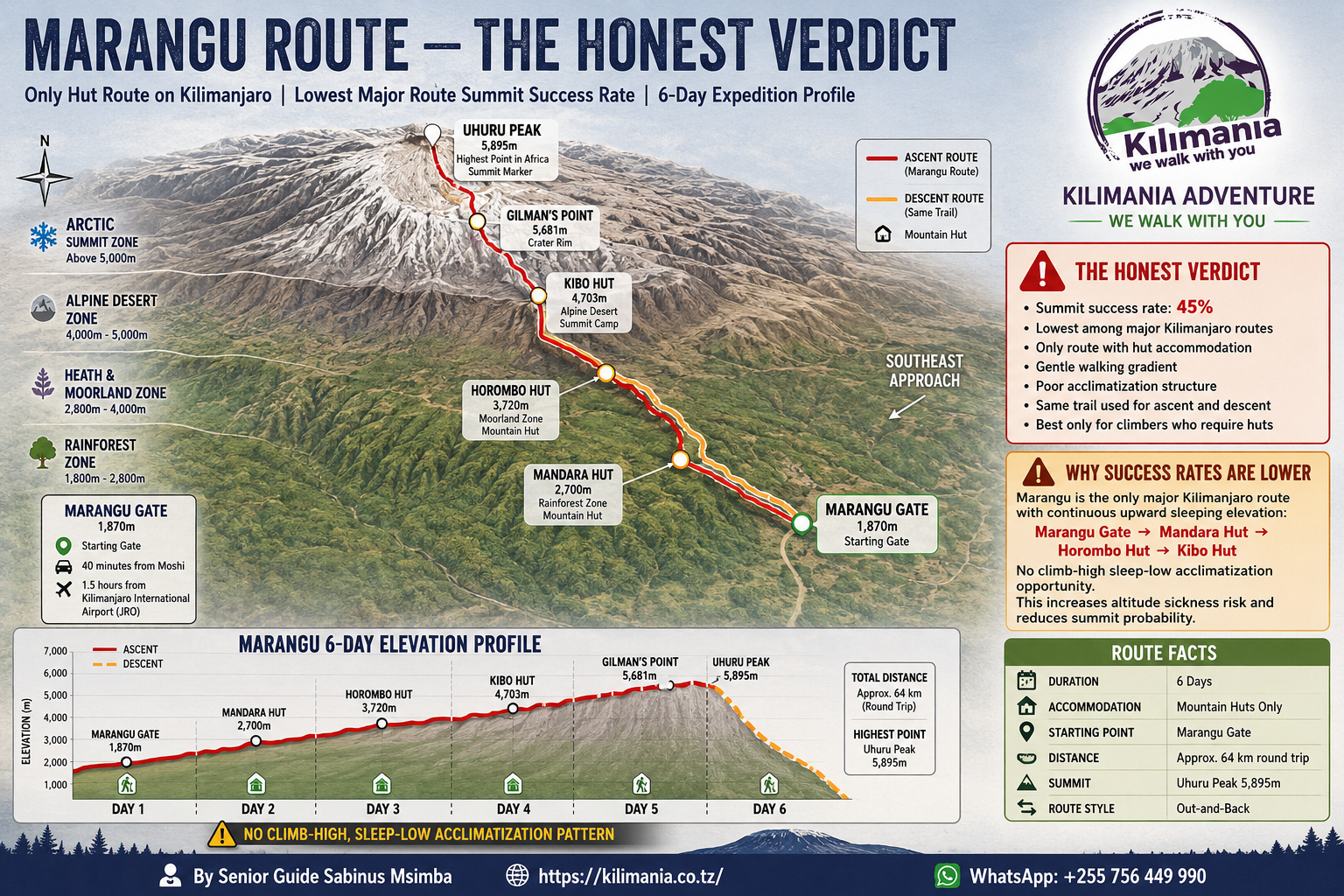
Day 1 — Marangu Gate (1,860 m) to Mandara Hut (2,700 m)
8 km, 3–4 hours, +840 m. Dense rainforest with red clay that turns slick in rain, colobus monkeys overhead, and a steady gradient that tires the calves but rarely triggers altitude symptoms this low. Evening: pumpkin soup, grilled chicken, rice, pineapple. Guides brief the group on hydration minimums — 3 litres daily.
Day 2 — Mandara Hut to Horombo Hut (3,720 m)
12 km, 5–6 hours, +1,020 m. Forest gives way to open heather moorland. Temperature drops noticeably. The first mild headache typically appears around 3,500 m, and appetite starts to fade. Nightly pulse oximetry checks begin here.
Day 3 — Horombo Acclimatisation Day (3,720 m)
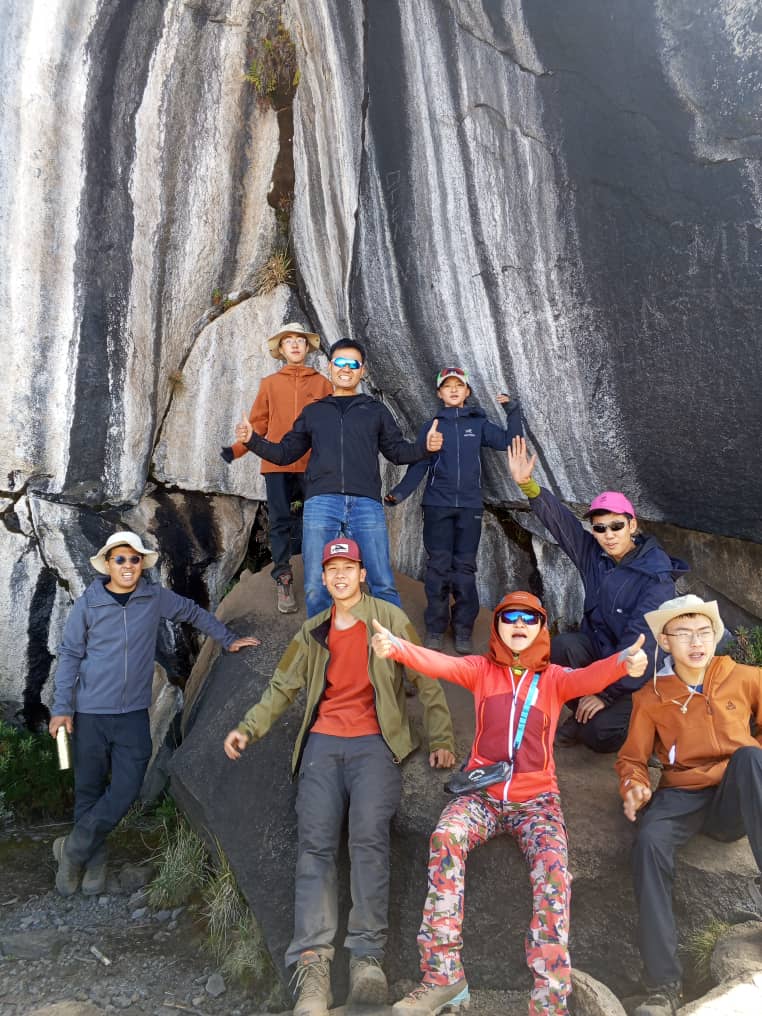
A 6–8 km, 3–4 hour hike to Zebra Rocks (~4,100 m) and back — the most important day on the route. Climbing 380 m above sleeping elevation, then returning to 3,720 m to sleep, is what closes the acclimatisation gap. Expect breathlessness at Zebra Rocks and a suppressed appetite at lunch; most climbers sleep better that night than the one before.
Day 4 — Horombo Hut to Kibo Hut (4,703 m)
9.5 km, 5–6 hours, +983 m. All vegetation disappears crossing the Saddle — a volcanic plateau of dust and scree between Mawenzi and Kibo, with constant wind. Resting heart rate at this altitude runs 90–110 bpm and roughly 30% of climbers feel nauseous. Eat by 17:00, sleep by 19:00 — you wake again at 23:00.
Day 5 — Summit Night: Kibo Hut to Uhuru Peak (5,895 m), Descent to Horombo
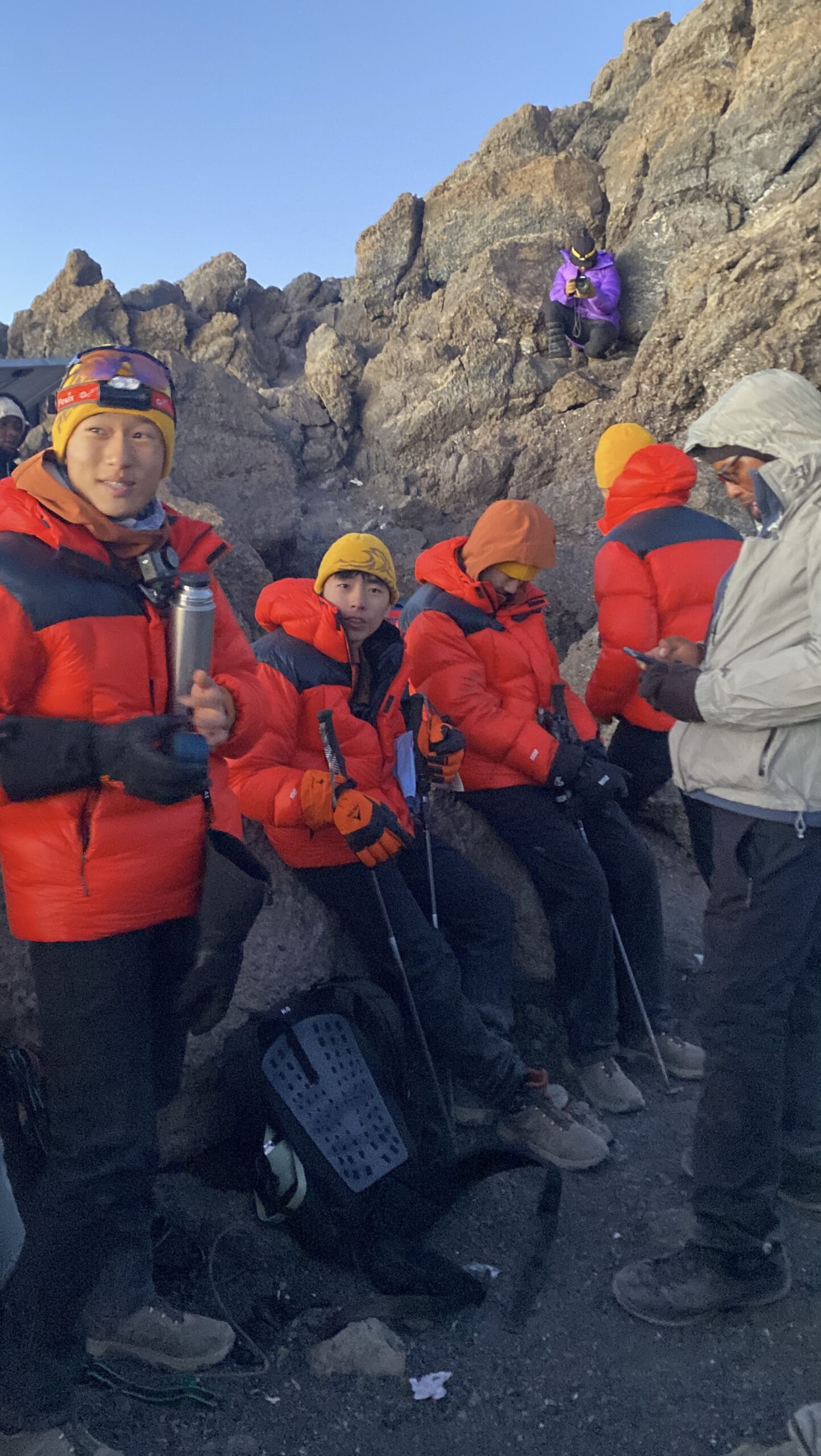
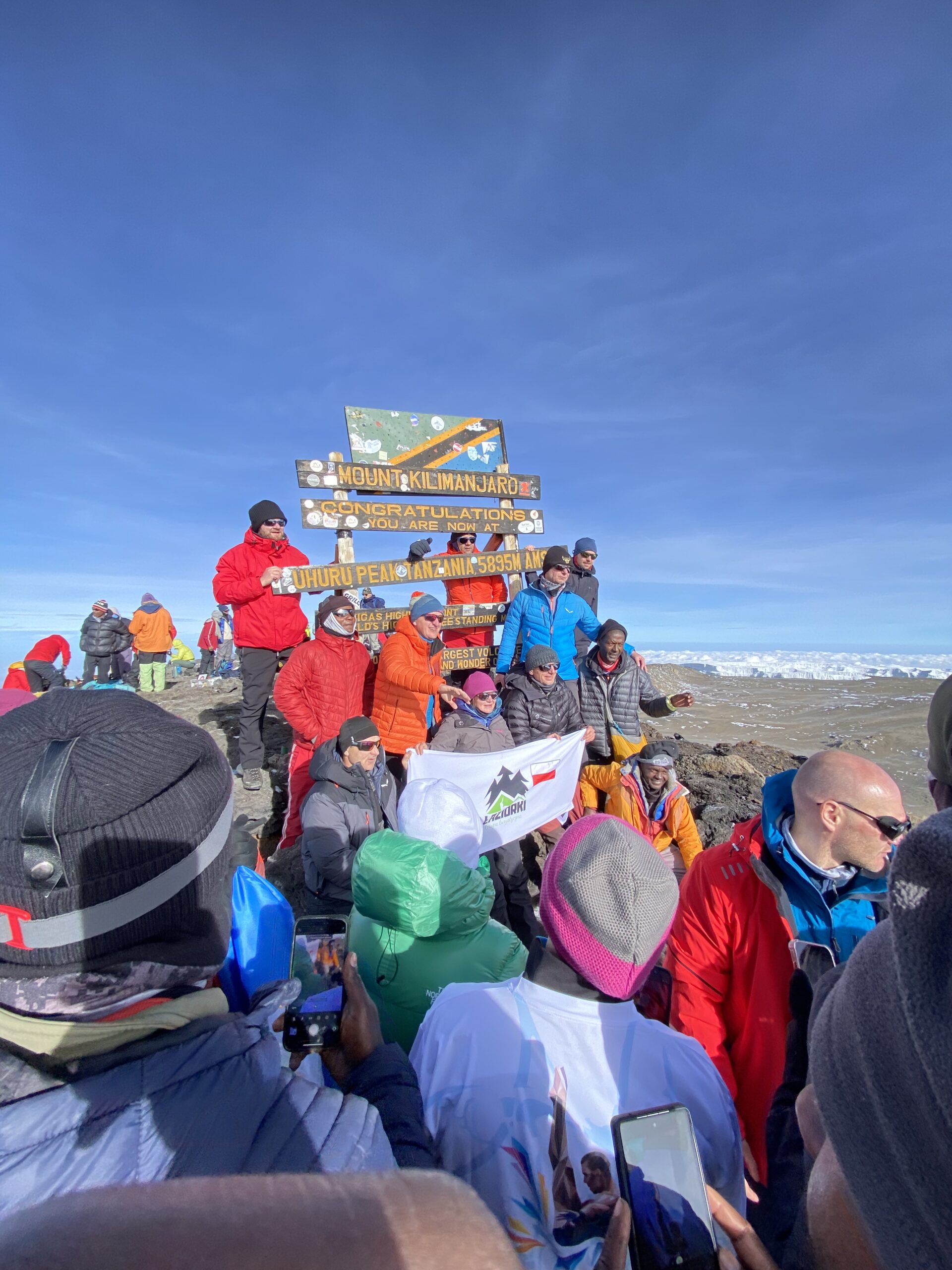
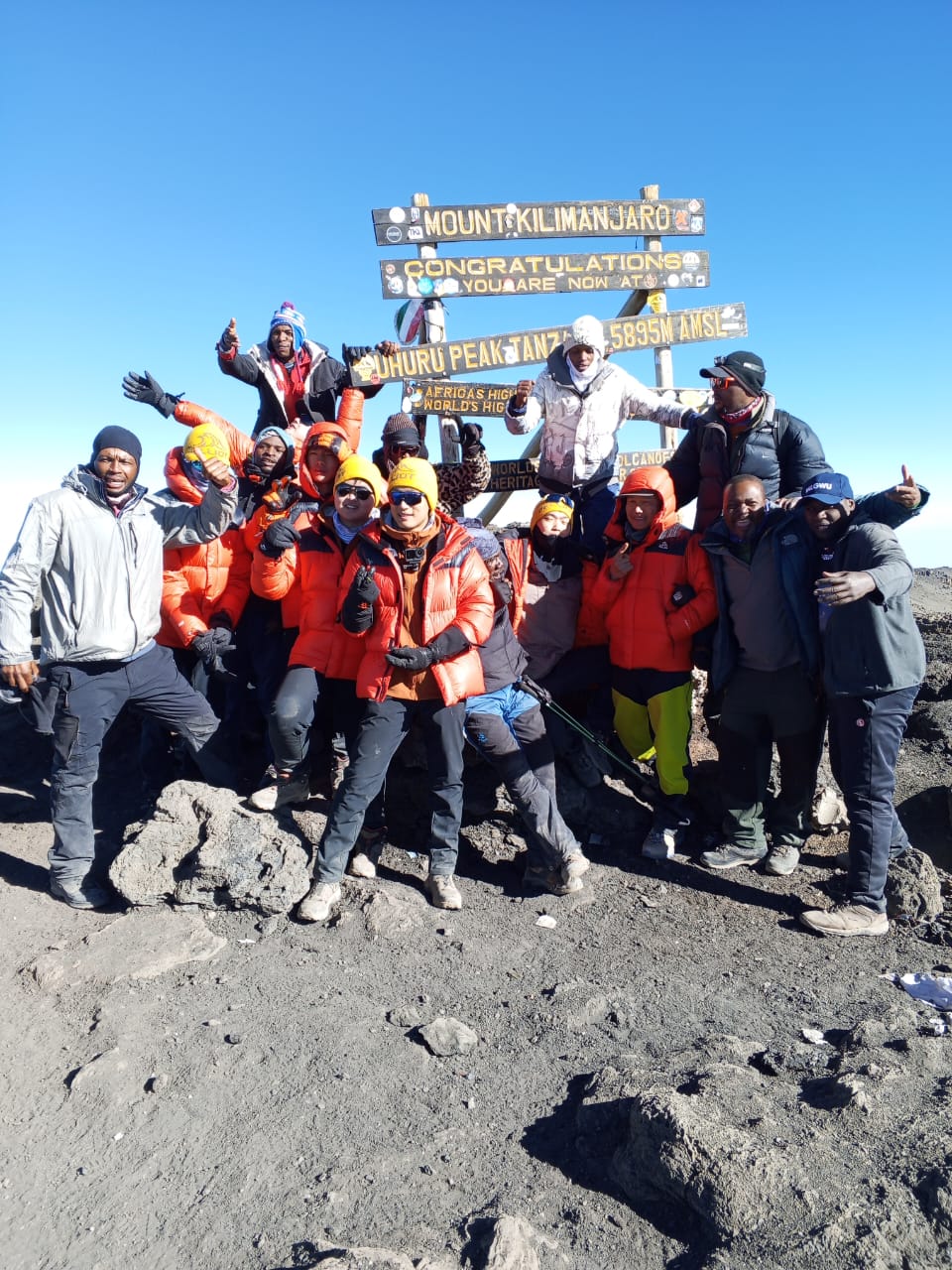
~14 km total, 13–16 hours. Depart at midnight for slow switchbacks up frozen scree in darkness, wind chill to -20°C. Gilman’s Point (5,681 m) takes 5–6 hours; from there it’s another 90 minutes along the crater rim to Uhuru Peak. After summiting, descend to Kibo Hut, rest briefly, then continue to Horombo — a 2,175 m descent in one day.
| Itinerary | Summit Success Rate | Acclimatisation Day? |
|---|---|---|
| 6-Day Marangu | 84% | Yes — Horombo/Zebra Rocks |
| 5-Day Marangu | 62% | No |
Source: Kilimania Adventure climb database, 2022–2026. The extra Horombo acclimatisation day accounts for roughly 22 percentage points of the difference.
Day 6 — Horombo Hut to Marangu Gate (1,860 m)
19 km, 5–6 hours downhill through moorland and back into forest. Knees carry the load; most climbers go quiet — tired but relieved. At the gate: a signed TANAPA-issued summit certificate and transport back to Moshi or JRO airport.
What Does the Elevation Profile Show?
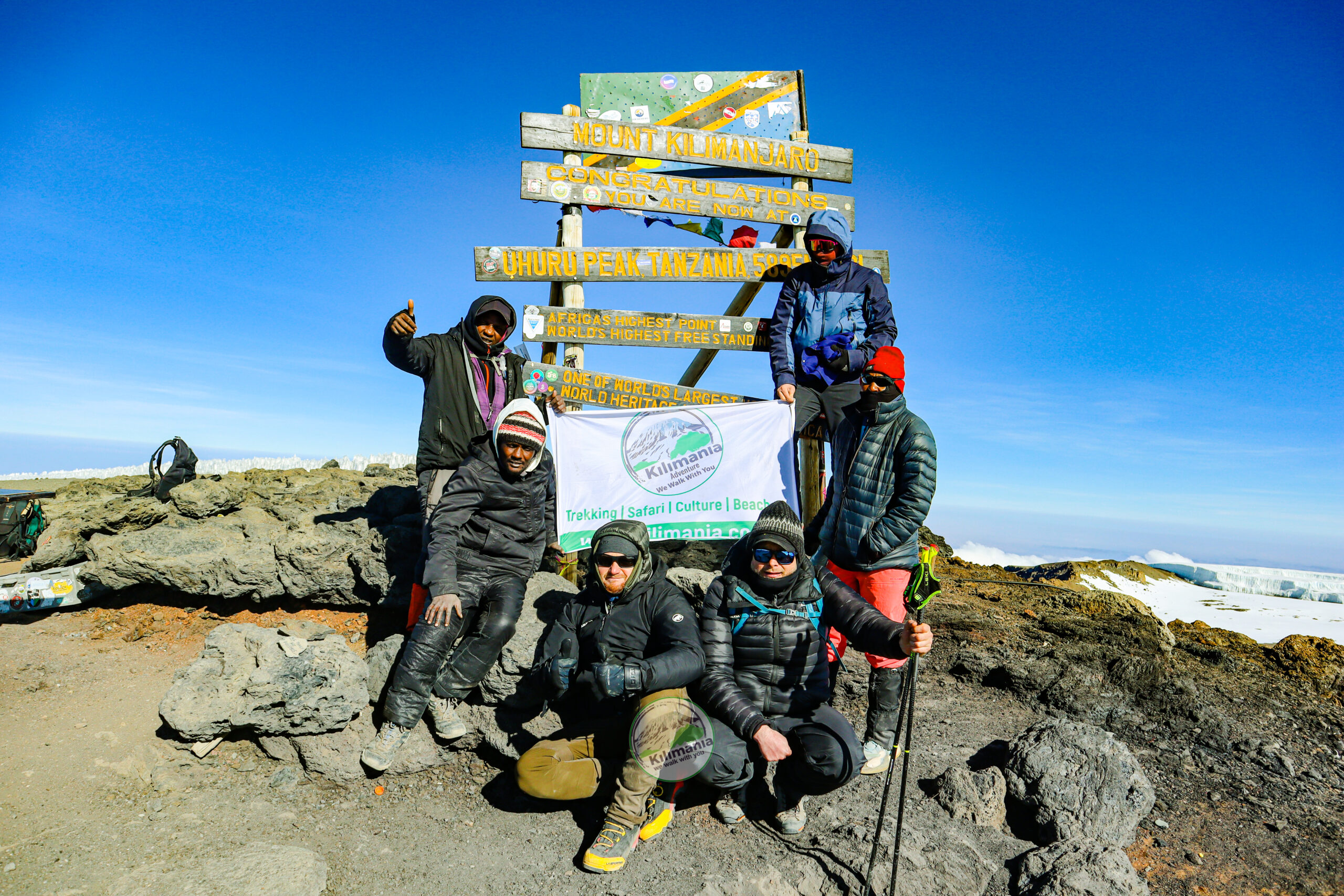
The elevation chart shows a near-continuous climb with no descent segment on the 5-day itinerary — the defining flaw discussed above. Official park guidance is available from KINAPA and TANAPA. KINAPA is the authority responsible for climbing permits and guide licensing on Kilimanjaro specifically; TANAPA oversees Tanzania’s national parks more broadly, including safari parks such as Serengeti and Ngorongoro. Kilimanjaro is also a UNESCO World Heritage Site.
Why Do Our Climbers Turn Back?
61% of unsuccessful Marangu summit attempts in Kilimania’s records end due to Acute Mountain Sickness, based on 471 failed attempts within our 1,247-climb database (2022–2026). Roughly 4% more climbers reach Gilman’s Point but stop before Uhuru Peak due to time cutoffs or mild symptoms — those are tracked separately and not counted as failures below.
| Cause | Share of Failed Attempts | 2023 Protocol Change |
|---|---|---|
| Acute Mountain Sickness (AMS) | 61% | Extended summit-night pacing, hourly rest stops |
| Dehydration | 14% (down from 22%) | Mandatory hydration audits at every break |
| Medical evacuation (other) | 8% (down from 12%) | Pre-climb health screening added |
| Other (fatigue, weather, personal decision) | Remainder of recorded attempts | — |
Figures reflect current Kilimania protocols introduced in 2023. Percentages do not necessarily total 100% because some climbs record more than one contributing factor.
We depart from Moshi weekly with pickups from Kilimanjaro International Airport (JRO) and Arusha Airport (ARK).
WhatsApp +255 756 449 990 · info@kilimania.co.tz
Full itemised quote within 12 hours — park fees by day, VAT stated in writing, complete inclusion list, KINAPA-licensed guides. No gate surprises.
What Are the Huts Actually Like?
Wooden A-frame dormitories with 4–12 bunk beds per room, thin foam mattresses, shared pit latrines, and no private rooms at any elevation. The genuine advantage is weather protection, particularly in rain and wind — but it is not a comfort upgrade over tent camping in dry season.
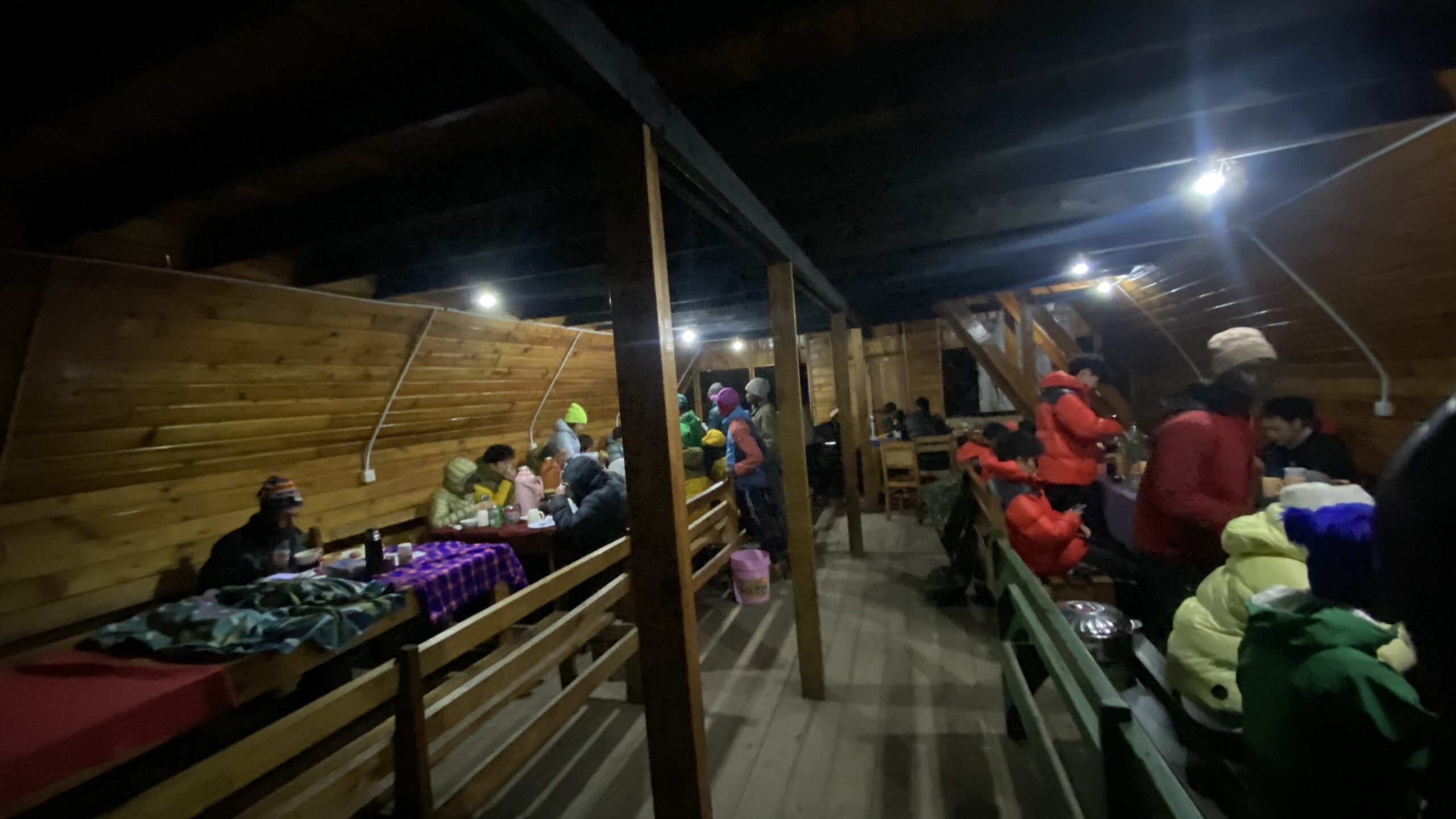
The Three Huts
- Mandara Hut (2,700 m): ~60 bunks, cleanest toilets on the route, solar-lit dining hut.
- Horombo Hut (3,720 m): ~120 bunks, largest complex, untreated water taps — we boil all drinking water.
- Kibo Hut (4,703 m): ~60 bunks, no electricity, water often frozen by morning, the coldest structure on the route.
A foam mattress roughly 5 cm thick with no sheets or blankets — bring a sleeping bag rated to -15°C. Inside temperature at Horombo runs -5°C to -2°C at night; at Kibo it drops to -8°C to -12°C despite the walls. In peak season (June–October, January–February), Kibo Hut can hold up to 150 climbers a night — bring earplugs, and expect the smell of wet boots and poor ventilation. For full logistics see our Marangu Route Huts guide.
Who Is Marangu Good For?
Four climber profiles genuinely benefit from Marangu: those who cannot sleep in tents for medical reasons, wet-season visitors, budget-constrained travellers who accept a lower summit probability, and experienced high-altitude trekkers with only 5–6 days available. Everyone else gets better odds on a longer tent route.
- Cannot sleep in a tent — chronic back pain, claustrophobia, Raynaud’s syndrome, or mobility limits. Book the 6-day version without hesitation.
- Wet-season visitors (March–May, November) — dry gear at the end of a rainy day is a real benefit tent routes cannot match.
- Budget-constrained climbers — the 6-day Marangu typically runs $300–$500 less than an 8-day Lemosho because it uses fewer porter-days and no tent equipment.
- Experienced high-altitude trekkers with 5–6 days available who already know how their body responds above 4,500 m — though our data shows the 6-day still outperforms the 5-day at every fitness level.
Who Should Choose a Different Route?
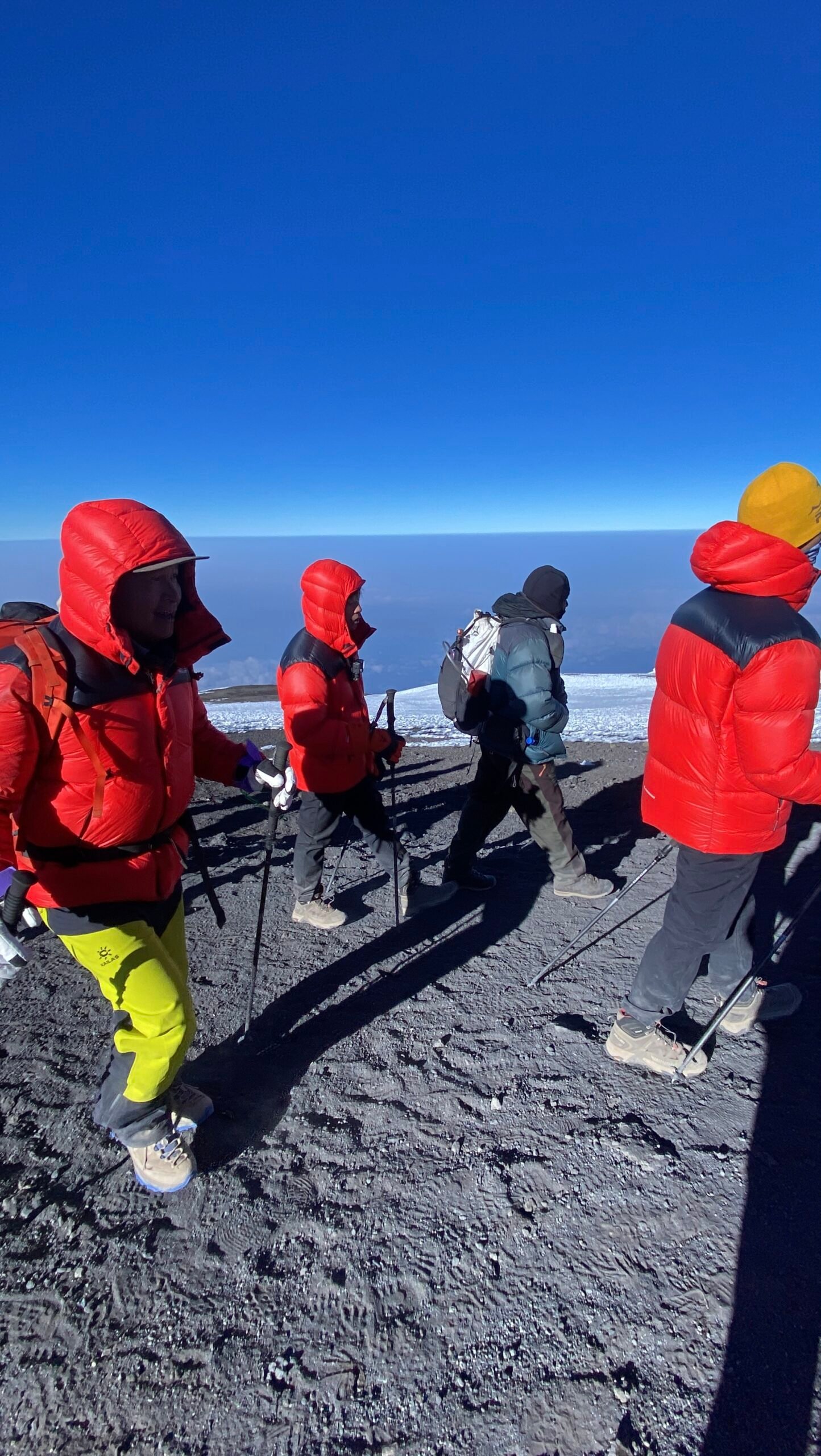
Climbers over 60, anyone with cardiovascular or respiratory conditions, first-time high-altitude trekkers, and anyone prioritising success rate over cost should skip Marangu in favour of Lemosho 8-day or Machame 7-day.
- Lemosho 8-day — 94% success rate, multiple acclimatisation days.
- Machame 7-day — 91% success rate, genuine climb-high-sleep-low pattern via Lava Tower (4,600 m).
- Rongai 6-day — driest route, low crowds, a strong rainy-season option; see our Rongai Route guide for current success-rate data.
- Northern Circuit 9-day — 96%+ success rate in our records, the highest acclimatisation quality on the mountain.
Avoid Marangu entirely if you are over 60 (see our fitness guide), have a history of HAPE/HACE, are a first-time high-altitude trekker, or dislike crowds — Kibo Hut can hold 100–150 climbers in peak season and the Gilman’s Point queue can exceed an hour.
How Much Does Marangu Cost in 2026?
Any quoted price below roughly $1,100 per person for a 5-day Marangu omits mandatory KINAPA park, hut, and rescue fees — those fees alone total $700–$800 per climber. A $100 deposit secures your dates with Kilimania.
| Item | 5-Day Marangu | 6-Day Marangu |
|---|---|---|
| Approximate starting price per person | from $1,100 (fee floor) / typical range $1,300–$1,600 | Ask us for your current 6-day quote — WhatsApp +255 756 449 990 |
| Mandatory KINAPA/hut/rescue fees | $700–$800 | $700–$800 + one extra hut night |
| Included | All KINAPA park, hut, and rescue fees; three meals daily; boiled/filtered water; licensed English-speaking guides; KPAP-affiliated porters; pulse oximeter and emergency oxygen; transfers from Moshi or JRO airport | |
| Typical saving vs 8-day Lemosho | $300–$500 less, due to fewer porter-days and no tent equipment | |
Prices reflect Kilimania’s own 2026 operations and are subject to confirmation at booking. Compare with at least two other TATO-registered operators.
Summit Night Timeline
Summit night on Marangu runs 13 to 16 hours over roughly 14 km, departing Kibo Hut at midnight and ending back at Horombo Hut the following afternoon. Guides carry emergency oxygen, a pulse oximeter, and a first-aid kit rated for high altitude throughout the push.
| Time | Stage | Notes |
|---|---|---|
| 00:00 | Depart Kibo Hut (4,703 m) | Full headlamp, down jacket, insulated gloves and boots required |
| 00:00–05:00 | Slow switchbacks on frozen scree | Wind chill -15°C to -20°C; guide-to-climber pacing kept deliberately slow |
| ~05:00–06:00 | Arrival at Gilman’s Point (5,681 m) | Guides reassess each climber’s condition here before continuing |
| 06:00–07:30 | Crater rim to Uhuru Peak (5,895 m) | Sunrise typically falls within this window |
| 07:30–09:00 | Summit time, begin descent | Photos, brief rest, then immediate descent to manage cold exposure |
| 09:00–11:00 | Descent to Kibo Hut | Short rest and hot tea before continuing |
| 11:00–15:00 | Continue descent to Horombo Hut | Total same-day descent: 2,175 m |
Guides monitor pace against turnaround points along the route — a climber moving significantly slower than the group near Gilman’s Point will be assessed for descent rather than pushed toward Uhuru Peak. This is a judgment call made on the mountain, not a fixed clock rule.
What Happens If You Cannot Continue?
Immediate descent is the standard response to worsening Acute Mountain Sickness on Marangu. Kilimania guides use the Lake Louise Score and nightly pulse oximetry above Mandara Hut to flag deteriorating climbers early, generally in line with Wilderness Medical Society field guidance on altitude illness.
Protocol: symptom assessment with the Lake Louise Score → pulse oximetry at rest → for moderate AMS, rest and reassess → for severe AMS, HAPE, or HACE, immediate descent with emergency oxygen and an assistant guide accompanying the climber down → KINAPA rescue radio call if helicopter evacuation is required. Helicopter evacuation from Kibo Hut costs $5,000–$10,000; travel insurance with explicit high-altitude helicopter cover is mandatory. Read your policy carefully before you travel — standard travel insurance typically excludes trekking above 5,895 m, and exact terms vary by provider and country of purchase. Providers commonly offering this type of cover include World Nomads, Allianz Global, and IMG Global — confirm current terms directly with the provider before booking.
How Does Marangu Compare to Other Routes?
Marangu’s 62% five-day success rate sits well below every tent-based alternative in Kilimania’s records — Lemosho 8-day reaches 94%, Machame 7-day reaches 91%, and Northern Circuit 9-day exceeds 96%. Marangu’s only structural advantage is dormitory shelter, not acclimatisation quality.
| Route | Duration | Accommodation | Success Rate |
|---|---|---|---|
| Marangu | 5 days | Huts | 62% |
| Marangu | 6 days | Huts | 84% |
| Machame | 7 days | Tents | 91% |
| Lemosho | 8 days | Tents | 94% |
| Northern Circuit | 9 days | Tents | 96%+ |
Source: Kilimania Adventure climb database, 2022–2026. See our full route decision guide for details on each route’s difficulty profile.
Which Month Should You Climb Marangu?
July–October and January–February deliver the most reliable summit conditions on Marangu — dry, clear, and cold. March–May offers the lowest prices and fewest crowds but persistent rain, and the hut advantage is most meaningful during these wetter months.
| Month | Conditions | Crowd Level | Booking Lead Time |
|---|---|---|---|
| January | Dry, clear, very cold | Busy | 6+ months |
| February | Similar to January, slightly warmer | Busy | 6+ months |
| March | Long rains begin mid-month | Quiet | 1–2 months |
| April | Wettest month | Lowest | Flexible |
| May | Rains taper, trails muddy | Low | 1–2 months |
| June | Dry season begins | Building | 3–4 months |
| July | Peak season, wind chill to -20°C | Very busy | 10+ months |
| August | Stable weather, maximum crowding | Busiest | 10+ months |
| September | Frequently recommended by guides | Busy | 8+ months |
| October | Last reliable dry month | Dropping late-month | 6+ months |
| November | Short rains, huts clearly advantageous | Quiet | 2–3 months |
| December | Dries toward Christmas | Rising | Book early for late December |
Full month-by-month temperature data: see our Kilimanjaro fitness and preparation guide.
Why Trust This Guide
- Physical office in Moshi, Kilimanjaro Region, Tanzania — not an online booking desk only.
- TATO registered — verify our membership at tatotz.org.
- Sabinus Msimba has guided on Kilimanjaro for 22+ years and completed 300+ Uhuru Peak summits.
- Porters are KPAP-affiliated, receiving fair wages, proper gear, and food.
- All statistics in this article come from Kilimania’s own 1,247-climb database — no invented averages.
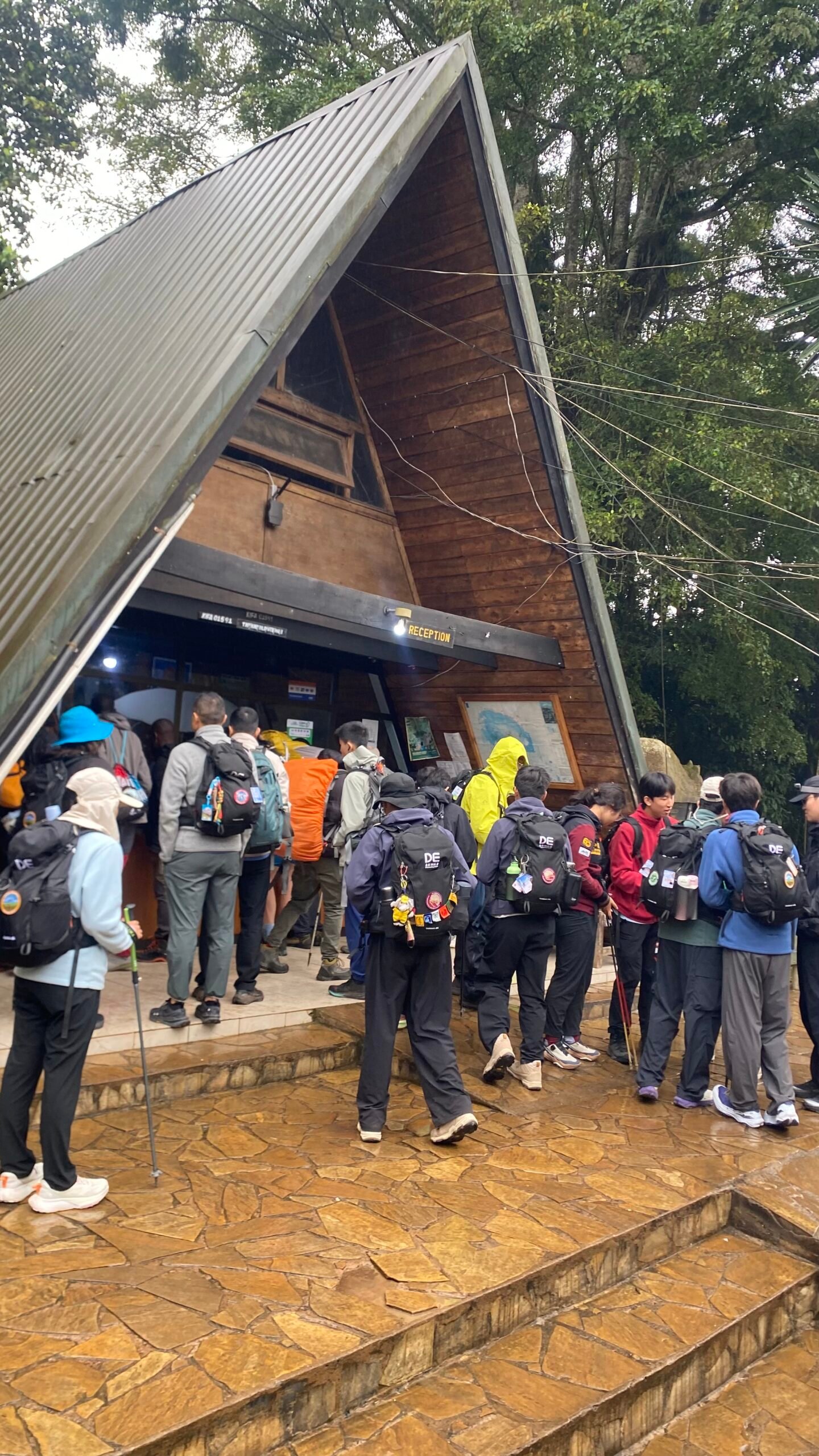
“The 6-day was the right call. Day 3 at Horombo was boring and headachy. I’m convinced it’s why I made Uhuru when two people in the next room didn’t.” — James W., UK, October 2025 [Verified TripAdvisor]
“Cold showers at Kibo Hut are rough. The guides were honest about it from day one — no surprises on the mountain.” — Karen D., Australia, July 2025 [Verified Google Reviews]
The 6-day Marangu is a legitimate choice for climbers who cannot sleep in tents, visit in wet season, or work within a tighter budget and accept the trade-off. The 5-day version, for most people, is a $1,300–$1,600 gamble with odds below 50% industry-wide. Book the extra day — it is, by our own data, the single best-value decision on this route.
FAQ — Marangu Route Kilimanjaro
Is Marangu easier than Machame?
The walking on Marangu is easier — no Barranco Wall, no scrambling, shorter daily distances. Summiting is harder because the altitude profile gives the body less time to adapt. If “easier” means “more likely to succeed,” choose Machame or Lemosho.
Can a beginner climb Marangu?
Yes, but only the 6-day version, and only after 8–12 weeks of cardio and hill training with a loaded daypack. The 5-day is physiologically unsuitable for most first-time high-altitude trekkers.
What is the worst part of Marangu?
Summit night — six to eight hours of frozen scree in darkness at -15°C to -20°C wind chill. About 30% of climbers report nausea or vomiting during the ascent.
Do I need travel insurance for Marangu?
Yes, mandatory. Helicopter evacuation from Kibo Hut costs $5,000–$10,000. Your policy must explicitly cover trekking above 5,895 m and helicopter rescue — standard travel insurance usually excludes this.
Can I sleep in a private room on Marangu?
No. All three huts are dormitory-style with 4–12 bunks per room. If privacy matters, choose a tent route where your group has exclusive tents.
How do I prevent altitude sickness on Marangu?
Book the 6-day itinerary, drink 3–4 litres daily, walk pole pole, eat even without appetite, and discuss Diamox with your doctor before travel. Our guides monitor blood oxygen for every climber nightly above Mandara Hut.
Is the 5-day Marangu worth it?
Only if you have prior altitude experience above 4,500 m and know your body acclimatises well, or a flight constraint makes a sixth day impossible. For most climbers, the extra day raises summit probability by roughly 22 percentage points.
What is the Marangu success rate with Diamox?
Diamox supports acclimatisation and can reduce AMS symptoms. Climbers on Diamox in our records show blood oxygen readings 3–5 points higher at Kibo Hut. It is a safety margin, not a substitute for the 6-day itinerary.
Are park fees included in the Kilimania price?
Yes. All KINAPA park, hut, and rescue fees are included. You will never be asked for cash at the gate. Ask your guide for a receipt during the climb if you want to verify payment.
How many porters does a Marangu climb have?
Standard Kilimania groups use one lead guide, one assistant guide per three climbers, and two to three porters per climber. Budget $200–$300 per climber for tips, paid in small USD bills on the final day.
Conclusion
Marangu is the most marketed route on Kilimanjaro and has the worst success rate — those two facts are connected. The 6-day version is a genuine choice for the right climber: someone who cannot sleep in a tent, visits in wet season, or works within a tighter budget and accepts a lower summit probability. The 5-day version, for most people, is a gamble with odds below 50%. Compare it honestly against our 5-Day vs 6-Day Marangu breakdown before you book.
Plan Your Marangu Climb — Get a Quote Within 12 Hours
Tell us your travel dates, number of climbers, and budget tier. We return a full itemised quote: park fees by day, hut fees by night, VAT treatment in writing, complete inclusion and exclusion list. KINAPA-licensed guides, TATO-registered operator.
WhatsApp +255 756 449 990 info@kilimania.co.tz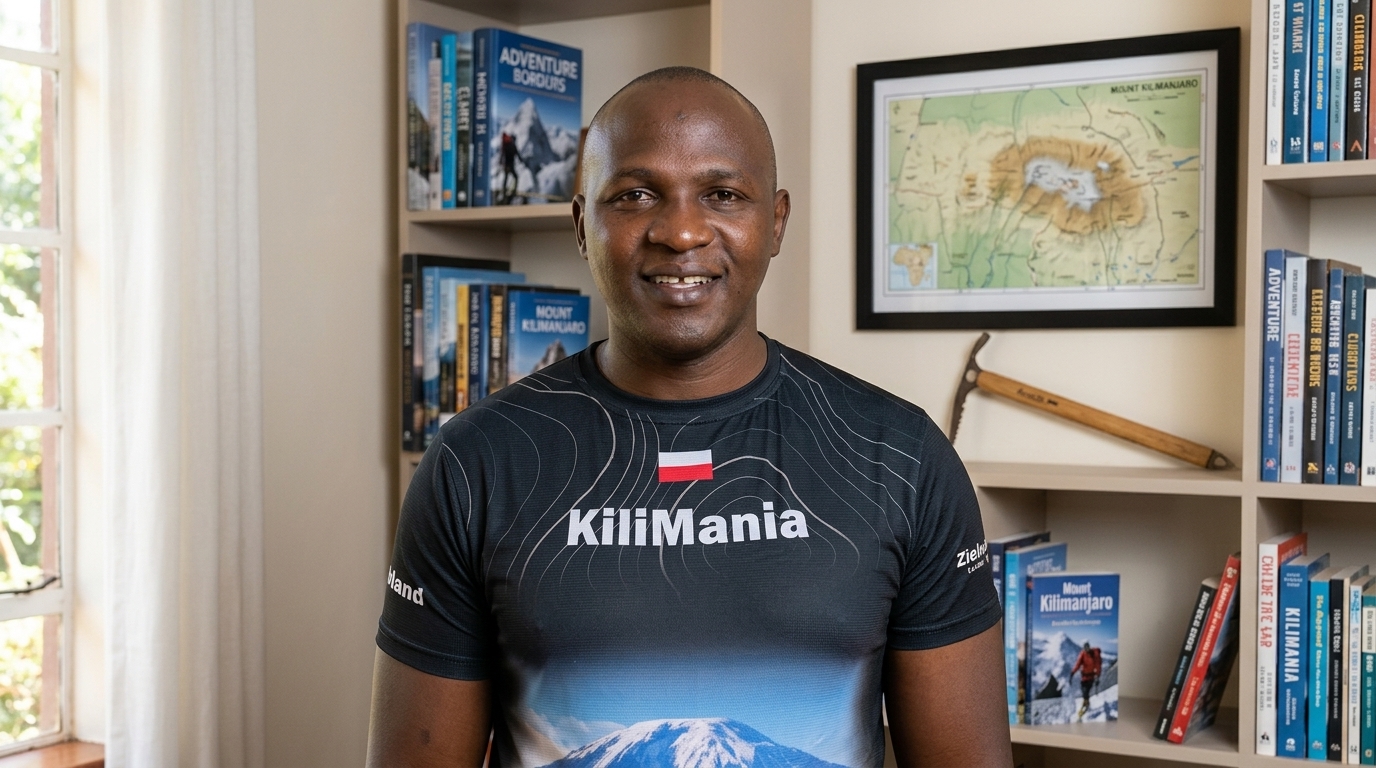
Written by Sabinus Salvatory Msimba
Senior Kilimanjaro Mountain Guide & Co-founder, Kilimania Adventure — 22+ years guiding, 300+ Uhuru Peak summits, KINAPA-licensed since 2003.
📥 Free Download: Kilimanjaro Altitude Symptom & AMS Checklist
Used by Senior Guide Sabinus Msimba to monitor climbers throughout every expedition.
Download the Checklist (PDF)📥 Free Download: Kilimanjaro 12-Week Training Calendar
The same week-by-week training plan used by Kilimania guides, built from patterns across 1,247+ guided climbs.
Download the Calendar (PDF)📥 Free Download: Kilimanjaro Route Comparison Cheat Sheet
Compare all seven Kilimanjaro routes on difficulty, scenery, and crowd levels.
Download the Cheat Sheet (PDF)📥 Free Download: Kilimanjaro Hidden Costs Checklist
Understand the full cost of climbing beyond the operator’s quoted price — flights, insurance, tips, and gear.
Download the Checklist (PDF)📥 Free Download: Kilimanjaro Packing Checklist 2026
16-page interactive checklist covering rent-vs-buy pricing and route-specific gear.
Download the Checklist (PDF)For International Travellers
All prices in USD. Approximate conversions: $1,800 ≈ £1,400 / €1,680 / AU$2,700. Tanzania e-visa: $50 for most nationalities, $100 for US citizens, apply at immigration.go.tz at least 7 days before arrival. Yellow fever certificate required only from endemic countries — not needed from the USA, UK, EU, or Australia. Pre-climb accommodation in Moshi runs $35–$80 per night.
From our base in Moshi, Kilimanjaro Region, Kilimania Adventure runs Kilimanjaro climbs and daily safaris to Serengeti National Park, Ngorongoro Crater, Tarangire National Park, and Lake Manyara, with pickups from Kilimanjaro International Airport (JRO) and Arusha Airport (ARK).
Related Guides
Disclosure: Kilimania Adventure is a TATO-registered commercial tour operator based in Moshi, Tanzania. All prices reflect our own 2026 operations. We encourage you to compare quotes with at least two other TATO-registered operators before booking.
Medical disclaimer: Altitude illness represents a real medical risk above 3,000 m. Consult your physician before climbing if you have cardiovascular, respiratory, or metabolic conditions. This article reflects current KINAPA and Wilderness First Responder guidance and does not replace professional medical advice.
Freshness: Last verified June 2026. Next scheduled review November 2026, following TANAPA’s annual tariff announcement. Park fees can change without notice — verify at tanzaniaparks.go.tz before booking.
We Walk With You.