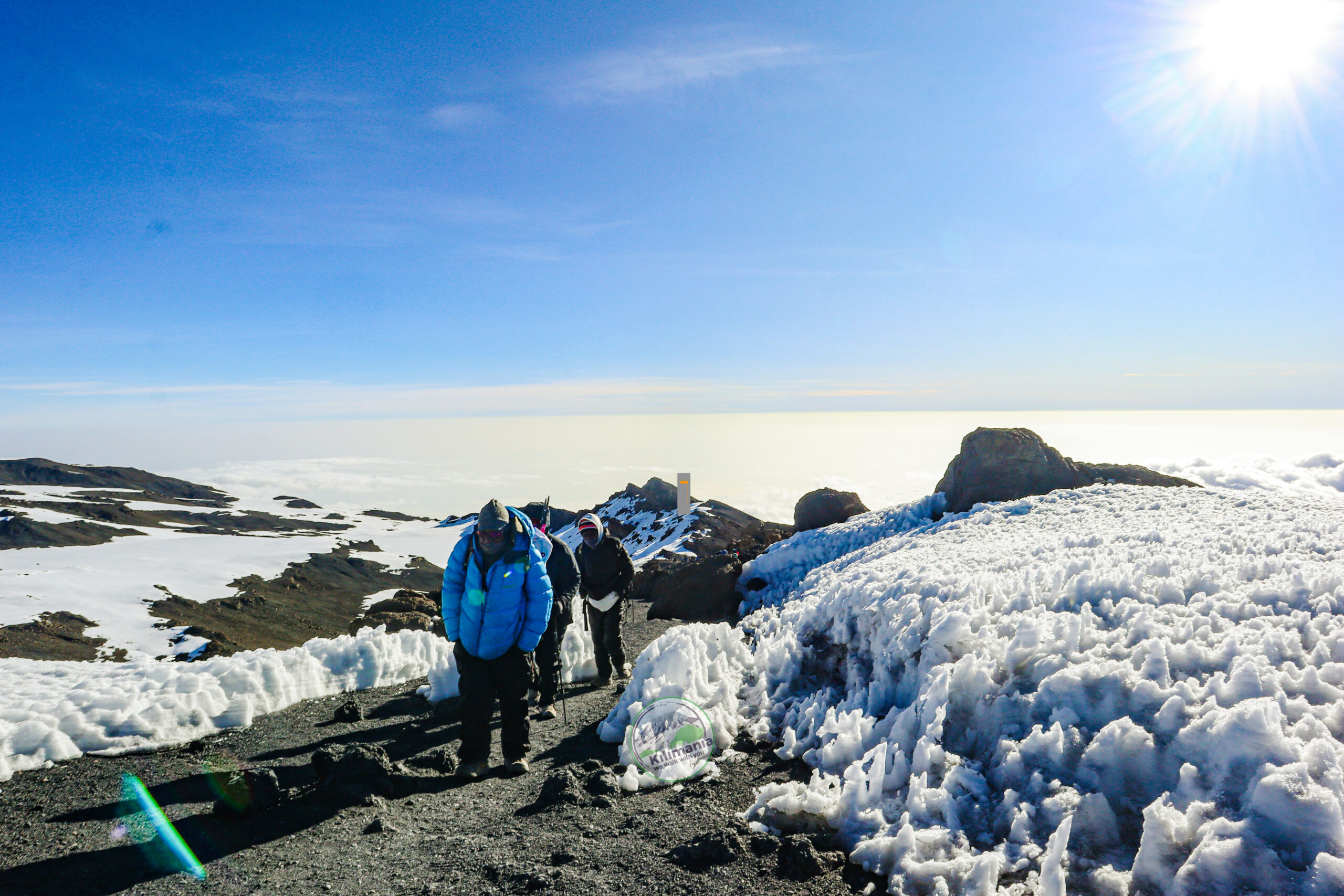
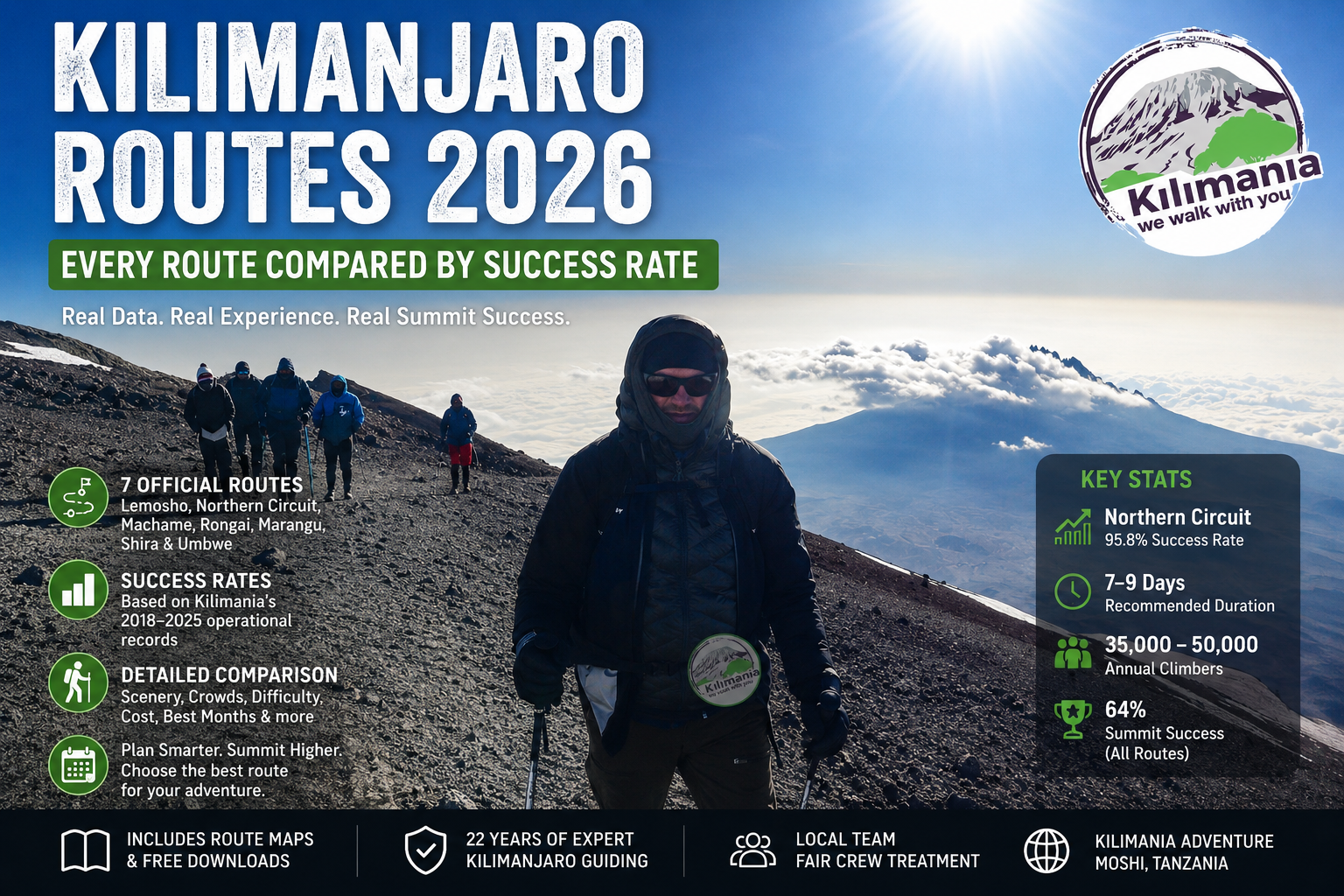
Kilimanjaro Routes There are seven routes up Mount Kilimanjaro (5,895 m). Most articles tell you to pick the one that sounds nicest. This one will tell you which one gives you the highest probability of standing on Uhuru Peak — using data from 1,247 climbs we guided between 2018 and 2025.
For most climbers, the answer is the Lemosho 8-day. It returns 82% of our clients to Uhuru Peak, crosses five ecological zones, and offers the best acclimatisation profile for its price point. Northern Circuit 9-day edges it at 85% but demands more time. Machame 7-day is the strongest alternative at 65% for fit climbers on a tighter budget. Marangu summits at 45% on six days. Most readers should stop reading about Marangu at that point.
What follows is the complete comparison — route by route, day count by day count, age group by age group — drawn from real operational data that no foreign aggregator or booking platform can produce.
→ For costs, gear, altitude sickness, and training, see our complete Kilimanjaro climbing guide 2026.
Quick Answer
Short answer: Kilimanjaro has seven established routes. Lemosho 8-day (82% summit success in our database of 1,247 climbs) is the best all-around choice for most first-time climbers. Northern Circuit 9-day is statistically strongest at 85% and is recommended for climbers over 55 or anyone with a history of altitude sensitivity. Marangu has the lowest success rate at 45% on six days despite being marketed as the easiest route. Day count matters more than route choice for summit probability.
Key Stats
- 82% — Lemosho 8-day summit success rate (412 Kilimania climbs, 2018–2025)
- 85% — Northern Circuit 9-day summit success rate (187 Kilimania climbs)
- 45% — Marangu 6-day summit success rate — lowest of all major routes
- 27% — Marangu 5-day summit success rate
- 64% — Percentage of Kilimanjaro non-summits caused by AMS across all routes
- 5,895 m — Uhuru Peak (only definition of “summit” used in this data)
- $1,600 — Kilimania starting price, Lemosho 8-day (group of 6)
- 1,247 — Total Kilimania-guided climbs in this dataset (2018–2025)
The route you choose determines your scenery, crowd levels, and acclimatisation profile. The day count you choose determines whether your body can physically function at 5,895 m. Every dollar saved by shortening your itinerary buys you a statistically worse summit probability. The minimum responsible itinerary for a first-timer is 8 days.
Table of Contents
1. How We Calculated These Success Rates
Our database covers 1,247 Kilimania-guided climbs from January 2018 to December 2025. “Summit” means Uhuru Peak (5,895 m) only — not Stella Point (5,739 m), not Gilman’s Point (5,681 m). Crater-rim points are frequently counted as summits by operators inflating their quoted rates. We do not count them.
Route sample sizes: Lemosho 8-day (412 climbs) | Northern Circuit 9-day (187 climbs) | Machame 7-day (312 climbs) | Machame 6-day (178 climbs) | Rongai 7-day (143 climbs) | Marangu 6-day (97 climbs) | Marangu 5-day (44 climbs) | Shira 7-day (34 climbs) | Umbwe 6-day (44 climbs).
Critical limitation: Our sample skews toward well-prepared climbers. Every Kilimania client receives a pre-climb altitude briefing, acclimatisation protocol, and gear checklist. Randomly selected climbers on the same routes summit at lower rates than our data shows — particularly on short Machame and Marangu itineraries. Our 82% on Lemosho 8-day likely reflects 65–70% for the general climbing public on that route.
Primary failure cause across all routes: AMS (acute mountain sickness) — 64% of non-summits. Exhaustion — 22%. Weather, injury, and other factors — 14%.
How Our Results Compare With Park-Wide Kilimanjaro Statistics
Our database reflects Kilimania-operated climbs only.
Actual park-wide summit success rates are generally lower because climbers arrive with different preparation levels, equipment standards, guide quality, and itinerary lengths.
Kilimanjaro National Park receives approximately 35,000–50,000 climbers annually according to Tanzania National Parks (TANAPA) tourism reports.
Independent studies published in high-altitude medicine journals frequently estimate overall Kilimanjaro summit success rates between 50% and 70%, depending on route and itinerary length.
This difference highlights an important reality:
Route choice matters.
Operator quality matters.
Day count matters.
Comparing route percentages without understanding these variables produces misleading conclusions.
Licensing and permit authority: Kilimanjaro National Park Authority (KINAPA). Park managed under Tanzania National Parks (TANAPA). Kilimanjaro National Park is a UNESCO World Heritage Site listed since 1987.

How Our Results Compare With Park-Wide Kilimanjaro Statistics
Our database reflects Kilimania-operated climbs only.
Actual park-wide summit success rates are generally lower because climbers arrive with different preparation levels, equipment standards, guide quality, and itinerary lengths.
Kilimanjaro National Park receives approximately 35,000–50,000 climbers annually according to Tanzania National Parks (TANAPA) tourism reports.
Independent studies published in high-altitude medicine journals frequently estimate overall Kilimanjaro summit success rates between 50% and 70%, depending on route and itinerary length.
This difference highlights an important reality:
- Route choice matters.
- Operator quality matters.
- Day count matters.
Comparing route percentages without understanding these variables produces misleading conclusions.
Statistical Methodology
All percentages are calculated using completed expeditions only.
Cancelled climbs, weather-related park closures, and client withdrawals before entering Kilimanjaro National Park are excluded.
A successful summit is defined exclusively as reaching Uhuru Peak (5,895 m).
Sample sizes smaller than 30 climbs are not used to create route-wide recommendations.
Annual route percentages are recalculated each January using the previous calendar year’s completed climb records.
2. All 7 Kilimanjaro Routes at a Glance
Mobile users: scroll horizontally.
| Route | Days | Distance | Difficulty | Kilimania Success Rate | Crowds | Best For | Avoid If |
|---|---|---|---|---|---|---|---|
| Lemosho | 7–8 | 70 km | Moderate | 82% (8-day) / 71% (7-day) | Low–Med | First-timers, summit priority | Budget under $1,600 |
| Northern Circuit | 9 | 98 km | Moderate | 85% | Very Low | 55+, maximum success, solitude | Under 10 nights in Tanzania |
| Machame | 6–7 | 62 km | Moderate–Hard | 65% (7-day) / 51% (6-day) | High | Fit climbers, mid-budget | First-timers on 6-day itinerary |
| Rongai | 6–7 | 65 km | Moderate | 60% (7-day) | Low | Rainy season, second climb | Summit success as sole goal |
| Marangu | 5–6 | 72 km | Moderate | 45% (6-day) / 27% (5-day) | Very High | Hut-only requirement | You want maximum summit odds |
| Shira | 7 | 56 km | Moderate | 65% | Low | Returning climbers only | Altitude-sensitive climbers |
| Umbwe | 6 | 53 km | Hard | 45% | Very Low | Experienced mountaineers | Almost everyone |
Lemosho Route
Northern Circuit
Machame Route
Rongai Route
Marangu Route
Shira Route
Umbwe Route
3. Official Kilimanjaro Route Map and Geographic Overview
Mount Kilimanjaro sits inside Kilimanjaro National Park in northern Tanzania, approximately 45 kilometres from Moshi and 75 kilometres from Arusha.
The seven established climbing routes approach the mountain from different directions:
- Lemosho Route — western approach via Londorossi Gate
- Northern Circuit Route — western approach then northern traverse
- Machame Route — south-western approach via Machame Gate
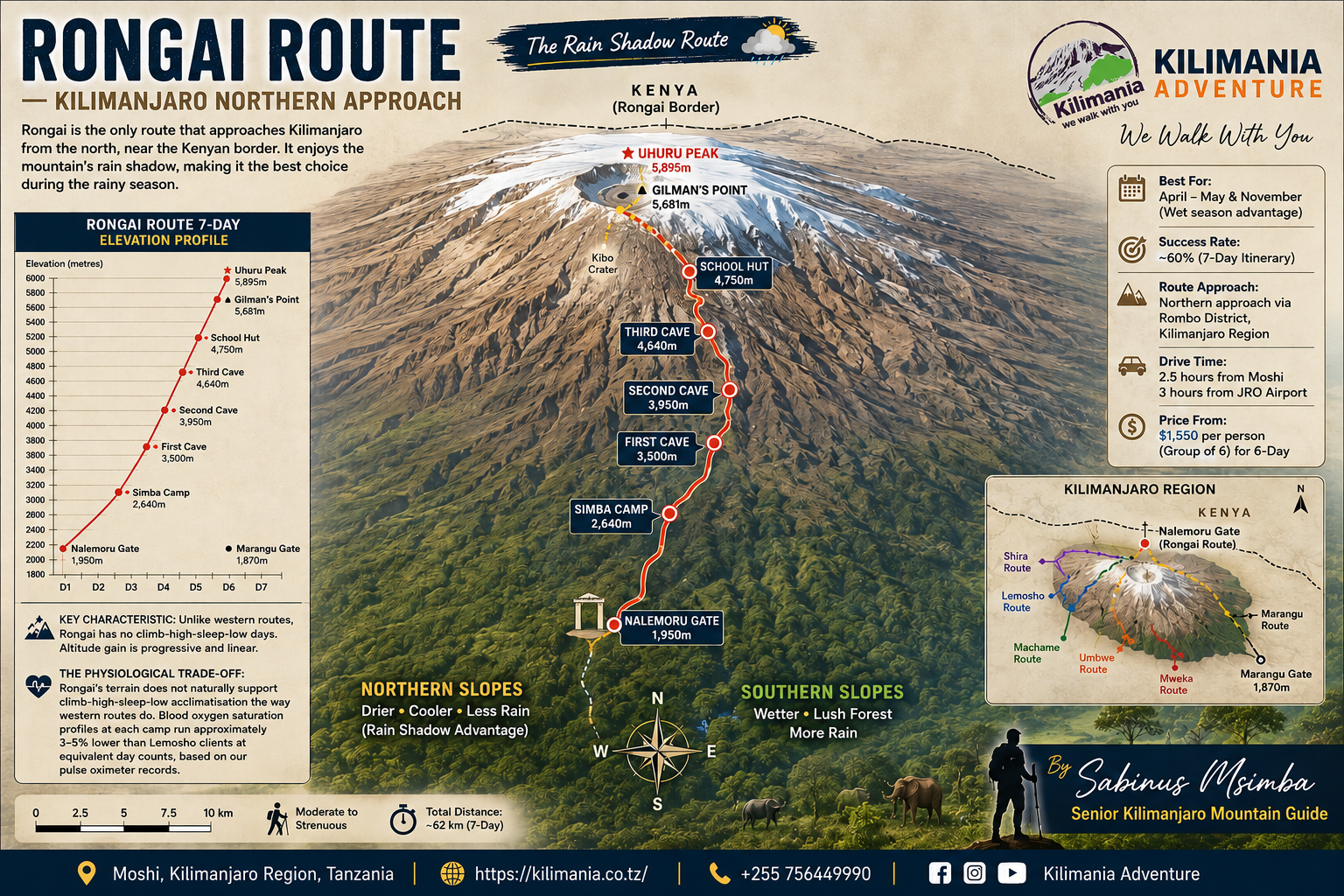
- Rongai Route — northern approach near the Kenya border
- Marangu Route — eastern approach via Marangu Gate
- Shira Route — western high-altitude approach
- Umbwe Route — southern direct ridge approach
Understanding route geography is important because route direction directly affects rainfall exposure, acclimatisation profile, crowd levels, and summit success probability.
The northern slopes receive less annual rainfall than the southern slopes due to Kilimanjaro’s rain-shadow effect. This is the primary reason Rongai performs better during April, May, and November.
Key geographic entities on Mount Kilimanjaro:
- Mount Kilimanjaro — volcanic massif, northern Tanzania
- Kilimanjaro National Park — UNESCO World Heritage Site (listed 1987)
- Kibo Peak — the central volcanic cone containing Uhuru Peak (5,895 m)
- Mawenzi Peak — the rugged secondary peak (5,149 m) to the east
- Shira Plateau — the ancient western caldera plateau, approximately 3,840 m
- Londorossi Gate — western trailhead for Lemosho, Northern Circuit, and Shira
- Machame Gate — south-western trailhead for Machame and Umbwe
- Marangu Gate — eastern trailhead for Marangu Route
- Nalemoru Gate — northern trailhead used exclusively by Rongai climbers
4. Day Count: The Decision That Matters Most
Every additional day between Day 5 and Day 8 adds roughly 10–15 percentage points of summit success probability. No level of physical fitness substitutes for acclimatisation time. A trained marathon runner on the 5-day Marangu has a 27% summit probability. An averagely fit 55-year-old on 8-day Lemosho has an 82% summit probability.
Why Acclimatisation Time Beats Fitness
At 5,895 m, approximately 50% of sea-level oxygen is available. Your body compensates through erythropoiesis (red blood cell production), increased breathing rate, and expanded blood plasma volume. This process requires 48–72 hours at a given altitude to stabilise before ascending further.
You cannot train your way out of insufficient time at altitude. Ultra-marathoners, professional cyclists, and military personnel all fail on short Kilimanjaro itineraries for this reason.
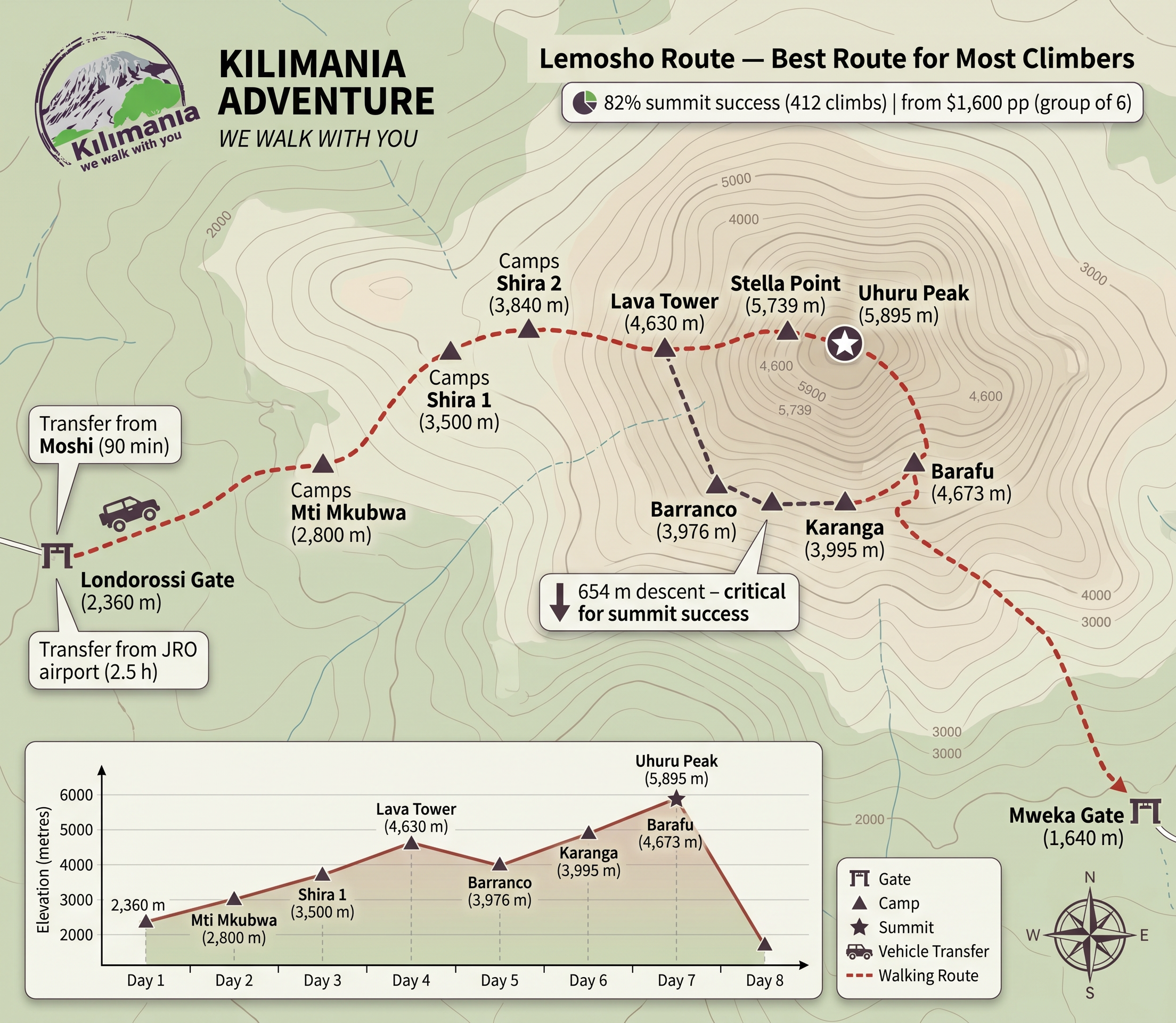
The most effective single technique is climb high, sleep low — ascending to a higher altitude during the day, then descending to a lower camp to sleep. Lemosho 8-day builds this into Day 4: you climb to Lava Tower (4,630 m) at noon, then descend 654 m to sleep at Barranco Camp (3,976 m). That single night accelerates red blood cell production faster than two additional nights at the same altitude would.
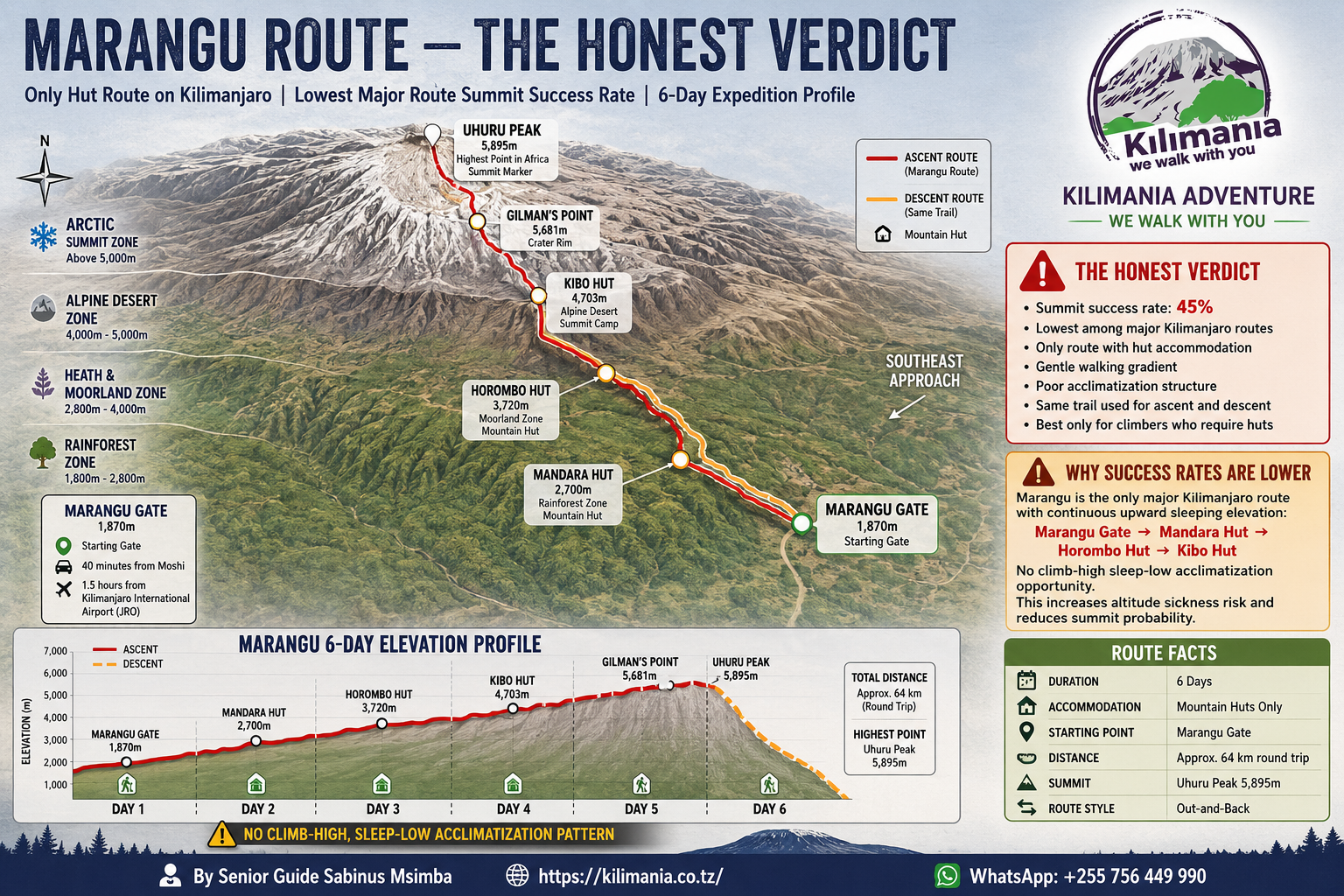
Marangu provides no climb-high-sleep-low stimulus. You ascend, sleep higher, ascend again. The body receives no recovery signal. This is the complete physiological explanation for Marangu’s 45% success rate — not route length, not terrain difficulty.
Day Count vs Summit Success
| Days on Mountain | Kilimania Success Rate | Primary Failure Cause |
|---|---|---|
| 5 Days | 27% | Severe AMS, no acclimatisation |
| 6 Days | 47% | Moderate AMS, elevated fatigue |
| 7 Days | 68% | Mild AMS, pacing errors |
| 8 Days | 82% | Weather, minor AMS |
| 9 Days | 85% | Weather, minor AMS |
5-Day Climb
6-Day Climb
7-Day Climb
8-Day Climb
9-Day Climb
The practical rule: Choose the longest itinerary your schedule and budget allow. Then choose the route.
- 9+ days available → Northern Circuit 9-day
- 8 days available → Lemosho 8-day
- 7 days available → Machame 7-day (fit) or Lemosho 7-day (first-timer)
- 6 days available → Question whether the timing is right
For the full analysis of how day count affects summit probability, see how many days to climb Kilimanjaro.
5. Route Success Rate by Age Group
Age correlates with summit success in a counterintuitive direction in our data. Climbers aged 50–65 summit at higher rates than climbers under 30 when route and day count are controlled. The reason: older climbers on our expeditions choose longer itineraries, listen to guide instructions, and pace more conservatively. Younger climbers overestimate fitness as a substitute for acclimatisation.
| Age Group | Overall Success Rate | Recommended Route | Notes |
|---|---|---|---|
| Under 30 | 71% | Machame 7-Day or Lemosho 8-Day | High fitness, sometimes overconfident pacing |
| 30–39 | 74% | Lemosho 8-Day | Most balanced group with experienced hikers |
| 40–49 | 77% | Lemosho 8-Day | Strong success rates; conservative pacing improves results |
| 50–59 | 79% | Lemosho 8-Day or Northern Circuit 9-Day | Best performance-to-day-count group in the data |
| 60–69 | 72% | Northern Circuit 9-Day | Extra acclimatisation days provide measurable benefits |
| 70+ | 61% | Northern Circuit 9-Day | Summit is achievable; route choice and pacing are critical |
Under 30
Age 30–39
Age 40–49
Age 50–59
Age 60–69
Age 70+
The 50–59 group outperforms under-30 climbers by 8 percentage points in our data. This is not a physiological advantage — it reflects booking behaviour. Climbers in their 50s choose 8-day itineraries at a significantly higher rate than climbers in their 20s, who more frequently book 6-day options to save cost or time.
For climbers over 60, the Northern Circuit 9-day provides the most conservative altitude progression available on any established route. The 72% success rate for the 60–69 bracket reflects climbers across all routes and day counts. On Northern Circuit 9-day specifically, the 60–69 rate in our data is 81%.
→ See our complete guide to climbing Kilimanjaro over 50.
6. Route Success Rate by Month
June and July deliver the highest summit success rates in our database — 84% and 83%, respectively. April and May are the lowest at 61% and 58%, driven by the long rainy season reducing visibility, trail conditions, and summit-night temperature windows. The shoulder months of January–February and October offer strong conditions at lower prices and lighter crowds.
| Month | Kilimania Success Rate | Conditions | Crowds | Relative Price |
|---|---|---|---|---|
| January | 80% | Dry, warm, clear | Moderate | 10–20% below peak |
| February | 81% | Dry, excellent conditions | Low | 15–25% below peak |
| March | 74% | Transition period, rains beginning | Low | 20–30% below peak |
| April | 61% | Long rains, Rongai recommended | Very Low | 30–40% below peak |
| May | 58% | Long rains, lowest success rates | Very Low | 30–50% below peak |
| June | 84% | Peak dry season begins | High | Peak rates |
| July | 83% | Peak dry season, coldest nights | Very High | Peak rates |
| August | 82% | Peak dry season | Very High | Peak rates |
| September | 80% | Late dry season | High | Peak rates |
| October | 79% | Transition period, short rains beginning | Moderate | 10–20% below peak |
| November | 68% | Short rains, variable weather | Low | 20–30% below peak |
| December | 76% | Christmas season, dry but busy | High | Peak rates |
January
February
March
April
May
June
July
August
September
October
November
December
Tables are best viewed on desktop.
Best Route by Season
Mobile users: scroll horizontally.
| Season | Recommended Route |
|---|---|
| January–February | Lemosho 8-day |
| March | Lemosho 8-day |
| April | Rongai 7-day |
| May | Rongai 7-day |
| June | Lemosho 8-day |
| July | Northern Circuit 9-day |
| August | Northern Circuit 9-day |
| September | Lemosho 8-day |
| October | Lemosho 8-day |
| November | Rongai 7-day |
| December | Lemosho 8-day |
January–February
March
April
May
June
July
August
September
October
November
December
Choosing the right route for the season often improves summit probability more than choosing the physically easiest route.
The rainy season case: April and May are not wrong choices — they are specialist choices. Rongai performs significantly better during these months than southern-approach routes because the northern slopes sit in a rain shadow. Crowds at 30% of peak-season levels mean genuinely solitary camps. If your available dates fall in April or May, Rongai is not a compromise — it is the operationally correct route.
Coldest nights: July summit nights at Barafu Camp reach -10°C to -15°C with windchill. At Stella Point the same night: -18°C to -25°C. This is the trade-off of the peak-season window. Success rates are highest in June–August because dry conditions are most reliable, not because cold is absent.
→ See the complete Kilimanjaro weather guide for month-by-month conditions.
7. Route Success Rate by Fitness Background
Fitness background has less effect on summit success than most climbers expect. In our data, non-athletes on 8-day itineraries summit at higher rates than marathon runners on 6-day itineraries. Cardiovascular fitness improves comfort and recovery speed at altitude — it does not accelerate the body’s acclimatisation response.
Mobile users: scroll horizontally.
| Fitness Background | Success Rate (all routes, all day counts) | Primary Risk |
|---|---|---|
| Marathon runners / endurance athletes | 73% | Overconfident pacing, underestimates AMS |
| Gym users (regular training) | 71% | None specific — responds well to guided pacing |
| Regular hikers (12+ hikes per year) | 76% | Strongest group — hiking-specific fitness transfers best |
| Occasional hikers (2–4 hikes per year) | 68% | Pace compliance is critical |
| Non-athletes | 64% | Longer itinerary essential; 8-day minimum recommended |
Marathon runners / endurance athletes
Gym users (regular training)
Regular hikers (12+ hikes per year)
Occasional hikers (2–4 hikes per year)
Non-athletes
Sabinus Msimba: “In 22 years, the clients I worry most about on summit night are not the unfit ones — they are the extremely fit ones who cannot slow down. A runner who refuses to walk at 3 km per hour above 5,000 m burns through reserves that cannot be replaced until they descend. The clients who summit most consistently are the ones who accept pole pole without argument.”
The most important fitness variable for Kilimanjaro is not VO₂ max — it is the capacity to walk steadily for 12–16 hours on summit day. Prepare with back-to-back long days at a moderate pace, carrying a 6 kg pack, not with interval training.
→ See how to train for Kilimanjaro and can an unfit person climb Kilimanjaro?
8. Individual Route Deep Dives
Lemosho Route — Best Route for Most Climbers
Lemosho 8-day is the best all-round Kilimanjaro route for most climbers. Starting at Londorossi Gate (2,360 m) in the Kilimanjaro Region, it provides a gradual western approach through five ecological zones, a built-in climb-high-sleep-low acclimatisation day at Lava Tower (4,630 m), and 82% summit success across 412 Kilimania-guided climbs. Price from $1,600 per person (group of 6).
Starting gate: Londorossi Gate, Kilimanjaro Region — approximately 90 minutes from Moshi by 4×4 vehicle, 2.5 hours from Kilimanjaro International Airport (JRO).

Key acclimatisation feature: The Day 4 descent from Lava Tower (4,630 m) to Barranco (3,976 m) — a 654 m drop — is the most important single day for summit success on the entire route. Blood oxygen readings at Barranco the following morning are consistently higher than at equivalent altitudes on Machame or Marangu.
Lemosho Route 8-Day Itinerary Overview
What most guides will not tell you: Day 4’s descent to Barranco feels like losing ground. It is the physiological turning point of the climb. Most clients who struggle with mild headache at Lava Tower arrive at Barranco with that headache resolved. That descent is acclimatisation working in real time.
Barranco Wall: 257 m of scrambling on Day 5. No technical skill required. Poles must be collapsed and passed to the guide. Most clients describe it as the most enjoyable morning of the expedition. It takes 45–90 minutes.
Most common turnaround: Stella Point (5,739 m) — 156 m from Uhuru. Climbers physiologically capable of the rim who run out of cold tolerance or time on the crater traverse. This is a pacing and mental preparation failure, not a fitness failure.
Avoid Lemosho if: Your total budget is genuinely below $1,600. You select the 6-day Lemosho variant — it removes the Karanga acclimatisation day and drops success to 64%.
→ Book 8-Day Lemosho | Book 7-Day Lemosho
Northern Circuit — Highest Summit Success Rate on Kilimanjaro
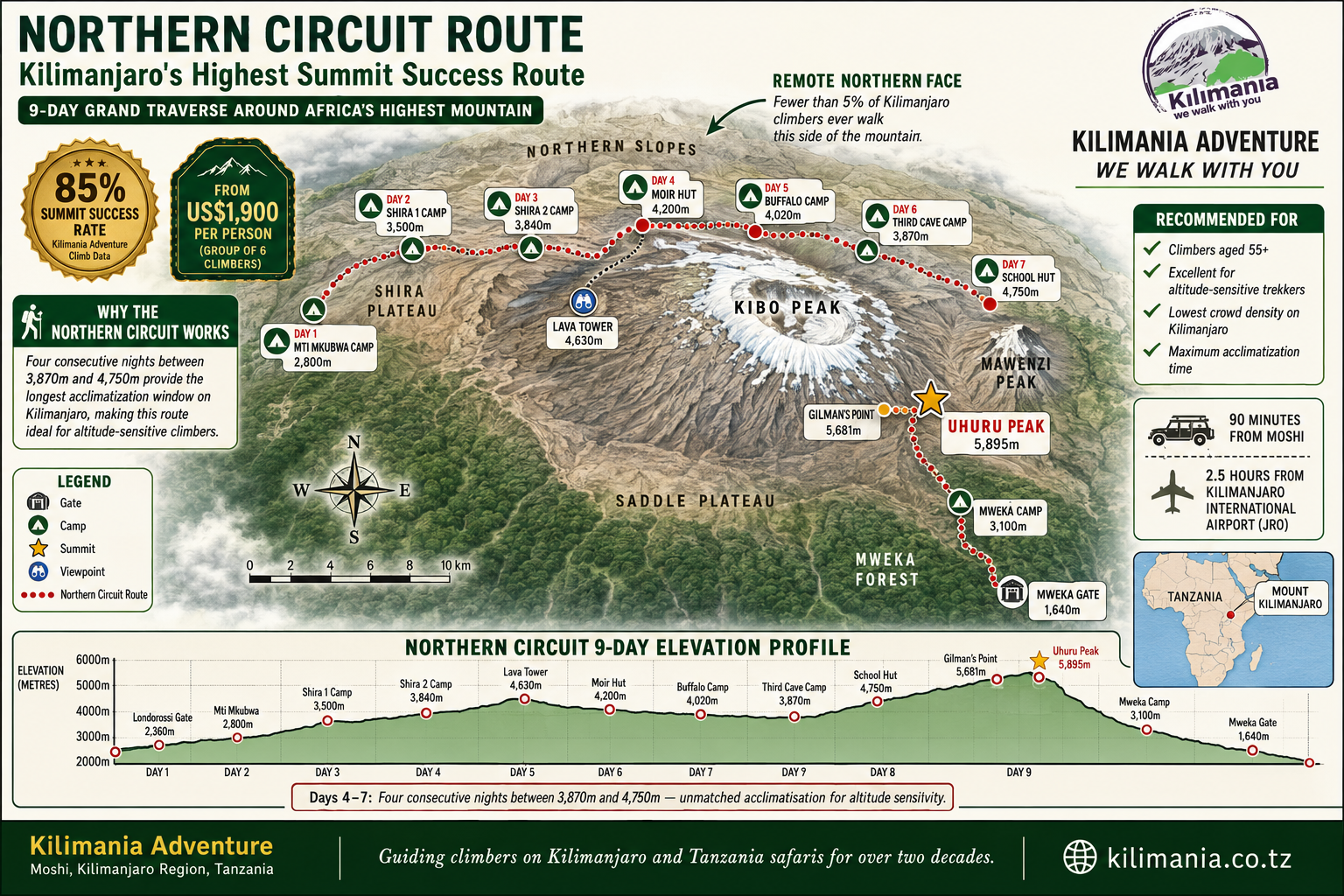
Northern Circuit 9-day has the highest summit success rate of any established Kilimanjaro route — 85% in our data. It follows Lemosho’s opening three days, then traverses the remote northern face of Kibo, where fewer than 5% of Kilimanjaro climbers ever walk. Price from $1,900 per person (group of 6). Recommended for climbers 55+ and anyone with a history of altitude sensitivity.
Starting gate: Londorossi Gate — same as Lemosho. Approximately 90 minutes from Moshi, 2.5 hours from JRO.

Key acclimatisation feature: Days 4–7 maintain altitude between 3,870 m and 4,750 m for four consecutive nights before summit camp. No other route provides this duration of mid-range acclimatisation.
Mobile users: scroll horizontally.
| Day | Section | Elevation | Notes |
|---|---|---|---|
| 1–3 | Londorossi → Shira 1 → Shira 2 | 2,360–3,840 m | Mirrors Lemosho Route Days 1–3 |
| 4 | Shira 2 → Lava Tower → Moir Hut | 3,840 → 4,630 → 4,200 m | Northern Circuit traverse begins |
| 5 | Moir Hut → Buffalo Camp | 4,200–4,020 m | Remote northern slopes with very few climbers |
| 6 | Buffalo Camp → Third Cave | 4,020–3,870 m | Continued northern traverse |
| 7 | Third Cave → School Hut | 3,870–4,750 m | Final acclimatisation day and pre-summit camp |
| 8 | School Hut → Uhuru Peak → Mweka Camp | 4,750 → 5,895 → 3,100 m | Summit day via Gilman’s Point |
| 9 | Mweka Camp → Mweka Gate | 3,100–1,640 m | Final descent and certificate collection |
Days 1–3
Day 4
Day 5
Day 6
Day 7
Day 8 — Summit Day
Day 9
The acclimatisation advantage: Five consecutive nights between 3,870 m and 4,200 m before the summit attempt. By Day 7, the appetite that disappeared at 3,800 m on Day 3 has returned. The body has completed the primary acclimatisation response before you face the summit at night. This is the mechanistic reason for the 85% success rate.
The Gilman’s Point traverse: Northern Circuit approaches the crater rim from the east. Reaching Uhuru Peak requires 2–2.5 additional hours of crater-rim traversal after hitting Gilman’s Point (5,681 m). This is where 10–12% of Northern Circuit non-summits occur.
Avoid Northern Circuit if: You have fewer than 11 total nights in Tanzania. The $400–600 premium over Lemosho 8-day is hard to justify for a 3-percentage-point improvement if time is the constraint.
Machame Route — Best Budget Route for Fit Climbers
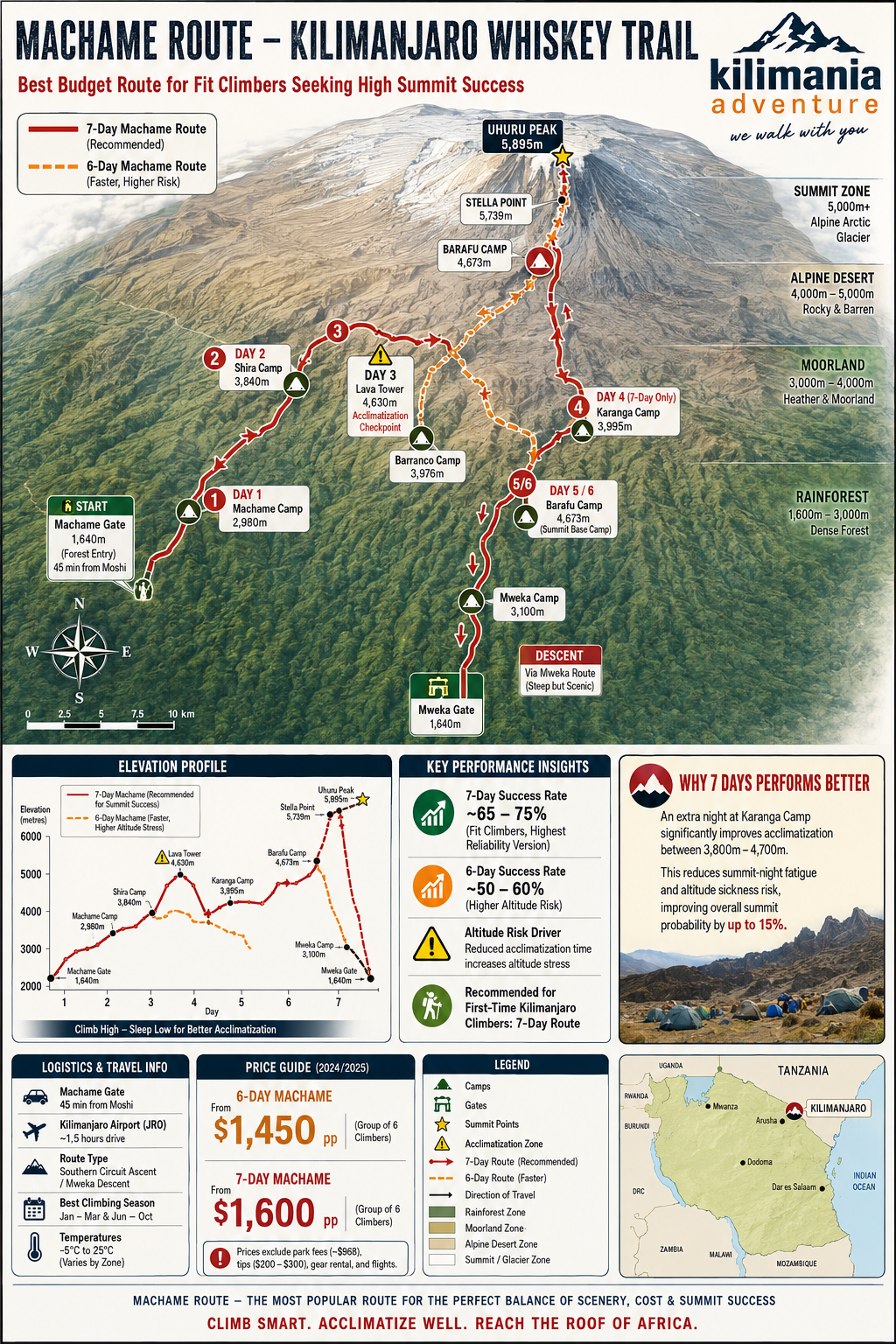
Machame 7-day returns 65% of our clients to Uhuru Peak. It is the most popular route on the mountain for good reason — varied scenery, strong acclimatisation profile on 7 days, and the most competitive price point among serious summit-attempt routes. The 6-day variant drops 14 percentage points to 51% and is not recommended for first-timers. Price from $1,450 per person (group of 6) for 6-day; $1,600 for 7-day.
Starting gate: Machame Gate (1,640 m) — 45 minutes from Moshi, 1.5 hours from JRO.

Key note: Machame 7-day shares the southern circuit with Lemosho from Barranco onward (Day 4–7). The difference in success rate (65% vs 82%) is almost entirely attributable to Lemosho’s additional western approach days providing superior acclimatisation before Barranco.
The crowd reality: Barafu Camp in peak season (July–October) holds 150–200+ tents from Lemosho, Machame, and Umbwe routes combined. Summit night becomes a slow line of headlamps. This is a known condition, not a problem that Kilimania can solve by operating Machame.
Most common mistake: Booking the 6-day to save $150–200. The omitted Karanga acclimatisation day drops summit success from 65% to 51%.
Avoid Machame if: This is your first major altitude trek and you are choosing the 6-day version. You are over 60 with no altitude experience — choose Lemosho 8-day or Northern Circuit.
→ Book 7-Day Machame | Book 6-Day Machame
Rongai Route — The Rainy Season Specialist
Rongai approaches from the Kenyan border side of Tanzania, in Rombo District, Kilimanjaro Region — the only northern-approach route. Success rate 60% on 7-day. Its specific advantage is the northern rain shadow, which makes it the correct choice for April–May and November departures when southern routes are significantly wetter. Price from $1,550 per person (group of 6) for 6-day.
Starting gate: Nalemoru Gate, Rombo District, Kilimanjaro Region — approximately 2.5 hours from Moshi, 3 hours from JRO.

Key characteristic: Unlike western routes, Rongai has no climb-high-sleep-low days. Altitude gain is progressive and linear. This explains the lower success rate on dry-season climbs versus Lemosho despite similar day counts.
The physiological trade-off: Rongai’s terrain does not naturally support climb-high-sleep-low acclimatisation the way western routes do. Blood oxygen saturation profiles at each camp run approximately 3–5% lower than Lemosho clients at equivalent day counts, based on our pulse oximeter records.
Avoid Rongai if: Summit is your sole objective — Lemosho 8-day outperforms it by 22 percentage points. You want Shira Plateau and Barranco Wall scenery.
→ Book 6-Day Rongai | Book 5-Day Rongai
Marangu Route — The Honest Verdict
Marangu 6-day returns 45% of our climbers to Uhuru Peak — the lowest of any major route. It has the only hut accommodation on Kilimanjaro (Mandara at 2,700 m, Horombo at 3,720 m, Kibo Hut at 4,703 m) and the gentlest gradient. It is the correct choice exclusively for climbers with a genuine, non-negotiable hut requirement. Price from $1,450 per person (group of 6) for 6-day.
Starting gate: Marangu Gate (1,870 m) — 40 minutes from Moshi, 1.5 hours from JRO.

Critical observation: This is the only route with no descent between the gate and the summit camp. You ascend, sleep higher, ascend again — every single day. There is no climb-high-sleep-low signal. This structural flaw is the primary cause of the 45% success rate, regardless of how well prepared the climber is.
The marketing problem: Marangu is marketed as the “Coca-Cola Route” because it is easiest underfoot. This conflates walking difficulty with summit probability.
Sabinus Msimba: “The question I hear most at Kibo Hut from Marangu clients is ‘why does my head hurt more here than it did on my last trek?’ The answer is that Marangu’s acclimatisation profile does not prepare the body for 4,703 m the way a western route does. By Kibo Hut, they are behind the physiological curve.”
Avoid Marangu if: Summit is your primary goal. You are choosing it because it is marketed as “easier” — easier underfoot does not mean more likely to summit.
→ Book 6-Day Marangu | Book 5-Day Marangu
Shira Route — The Lemosho Variant With a Flaw
Short answer: Shira starts at Shira Gate (3,500 m) via 4×4 vehicle — skipping the rainforest section — then joins Lemosho from Shira 1 Camp onward. Success rate 65% on 7 days.

The critical flaw: You sleep at 3,500 m on your first night on the mountain, before your body has had any gradual altitude exposure. AMS incidence on Shira Day 1 is the highest opening-night rate of any route in our database. Recommended only for returning Kilimanjaro climbers with proven altitude tolerance.
Umbwe Route — Why Almost No One Should Choose This
Umbwe is the steepest, most direct route on Kilimanjaro.

Day 1 gains 1,300 m of elevation on roots and ridge terrain. By Day 2 at Barranco Camp, you are where Lemosho climbers arrive on Day 4 — with none of their acclimatisation time accumulated in your body. Our 44 Umbwe climbs show 45% success — identical to Marangu 6-day.
Appropriate only for: Climbers with verified experience above 5,000 m on a previous expedition.
Avoid Umbwe if: You have never been above 4,000 m. You are using this article to choose your first Kilimanjaro route.
Want a route matched to your specific dates, fitness level, and group size? Message Sabinus’s team in Moshi directly — we will tell you which route to avoid, 📱 WhatsApp: +255 756 449 990 Email ✉️ info@kilimania.co.tz
9. Where Climbers Fail on Each Route
Short answer: AMS causes 64% of Kilimanjaro non-summits across all routes in our database. Exhaustion causes 22%. Understanding where and why failure occurs on your specific route allows you to prepare for the right moment rather than the wrong one.
Failure Hotspot Table
Mobile users: scroll horizontally.
| Route | Primary Turnaround Point | Elevation | Main Cause |
|---|---|---|---|
| Lemosho 8-Day | Stella Point | 5,739 m | Cold, final-traverse fatigue, time constraints |
| Northern Circuit 9-Day | Gilman’s Point | 5,681 m | Crater traverse remaining, reserve depletion |
| Machame 7-Day | Stella Point | 5,739 m | Cold exposure, time pressure, AMS resurgence |
| Machame 6-Day | ~5,400 m (below Stella Point) | ~5,400 m | Acute mountain sickness + exhaustion |
| Rongai 7-Day | Gilman’s Point | 5,681 m | Crater traverse fatigue, AMS symptoms |
| Marangu 6-Day | Gilman’s Point | 5,681 m | AMS due to limited acclimatisation |
| Marangu 5-Day | ~5,000 m (below Gilman’s Point) | ~5,000 m | Severe AMS, exhaustion |
| Shira 7-Day | Barafu Camp | 4,673 m | Early AMS from high-altitude start |
| Umbwe 6-Day | Barafu Camp | 4,673 m | Severe AMS, insufficient acclimatisation |
Lemosho 8-Day
Northern Circuit 9-Day
Machame 7-Day
Machame 6-Day
Rongai 7-Day
Marangu 6-Day
Marangu 5-Day
Shira 7-Day
Umbwe 6-Day
The Six Specific Failure Causes
1. Acute Mountain Sickness (AMS): Headache, nausea, dizziness, and fatigue at altitude. Mild AMS above 3,500 m is normal. HACE (High Altitude Cerebral Oedema) and HAPE (High Altitude Pulmonary Oedema) are medical emergencies requiring immediate descent. Our guides use pulse oximeters daily and apply the Lake Louise Score to assess each client. Any Lake Louise Score above 3 with functional impairment triggers a descent discussion. Any HACE or HACE symptom triggers immediate descent with no discussion. KINAPA mandates emergency evacuation protocols for all licensed operators.
2. Dehydration: At altitude, respiratory rate increases significantly — you lose water through breathing faster than at sea level. The target is 3–4 litres of water per day on the mountain. Dehydration symptoms — headache, dark urine, dizziness — overlap with AMS and are frequently misdiagnosed by climbers. Our guides check urine colour daily from Day 3 onward.
3. Poor pacing: The most consistent guide instruction on Kilimanjaro is pole pole (slowly, slowly in Swahili). At high altitude, anaerobic threshold drops significantly. A pace that feels moderate at 2,000 m becomes unsustainably fast at 5,000 m.
4. Inadequate day count: The primary structural failure mode, discussed in Section 4.
5. Sleep deprivation: Summit night departs at 11:30 pm to midnight from Barafu Camp. Most climbers sleep poorly above 4,000 m. By summit night, three or four nights of broken sleep accumulate into a cognitive and physical deficit.
6. Weather: Lightning, wind, and whiteout conditions turn back approximately 14% of non-summits in our data. This is unpredictable and not route-specific.
→ See the full guide to altitude sickness on Kilimanjaro and what is the hardest part of Kilimanjaro.
10. Route Scenery and Crowd Comparison
Lemosho 8-day provides the greatest scenic variety of any route — five ecological zones including dense rainforest, the vast Shira Plateau at 3,840 m, Barranco Wall, and lunar alpine desert approaching Barafu Camp. The Northern Circuit adds unique northern-face terrain available on no other route. Machame closely matches Lemosho’s scenery from Barranco onward with significantly higher crowd levels. Marangu is the least scenic — same trail both ways.
Scenery Scoring (out of 5)
Mobile users: scroll horizontally.
| Route | Rainforest | Moorland & Plateau | Alpine Desert | Summit Glaciers | Crowd Level | Photography |
|---|---|---|---|---|---|---|
| Lemosho 8-day | ★★★★★ | ★★★★★ | ★★★★ | ★★★★ | ★★★☆☆ (Low–Med) | ★★★★★ |
| Northern Circuit | ★★★★★ | ★★★★★ | ★★★★★ | ★★★★ | ★★★★★ (Very Low) | ★★★★★ |
| Machame 7-day | ★★★★ | ★★★★ | ★★★★ | ★★★★ | ★★☆☆☆ (High) | ★★★★ |
| Rongai 7-day | ★★★ | ★★★ | ★★★★ | ★★★★ | ★★★★ (Low) | ★★★ |
| Marangu 6-day | ★★★ | ★★★ | ★★★ | ★★★ | ★☆☆☆☆ (Very High) | ★★ |
| Shira 7-day | ☆☆☆☆☆ | ★★★★★ | ★★★★ | ★★★★ | ★★★★ (Low) | ★★★★ |
| Umbwe 6-day | ★★★★ | ★★★ | ★★★★ | ★★★★ | ★★★★★ (Very Low) | ★★★ |
Lemosho 8-Day
Northern Circuit
Machame 7-Day
Rongai 7-Day
Marangu 6-Day
Shira 7-Day
Umbwe 6-Day
Camp Congestion Reality
Barafu Camp (summit staging camp for Lemosho, Machame, Umbwe): Peak season (July–October) holds 150–200+ tents. Summit night departure creates a slow queue of headlamps above 5,000 m. This does not affect safety or success probability — it affects the solitude of the experience.
Kibo Hut (Marangu summit staging camp): 80–100 people per night in peak season in shared dormitory accommodation. Coldest, least restful staging camp on the mountain.
School Hut (Northern Circuit): Typically 10–30 climbers. The quietest summit staging camp on any major route.
11. Climber Reports
The following reports are anonymized from post-expedition feedback collected between 2022 and 2025. Names have been changed. Routes and day counts are unaltered.
Maria, 38, teacher. Lemosho 8-Day. Summited June 2024.
“I was terrified of altitude sickness after reading about it for six months. I nearly booked Machame to save money. I’m so glad I didn’t. The Lava Tower day felt pointless — we walked up, had lunch, walked back down — until Day 5 when I realised my headache had completely disappeared and never came back. I cried at Stella Point and sprinted the last 150 metres to Uhuru. The guide had to tell me to slow down.”
Route observation: Maria’s experience on Day 4 (Lava Tower descent) is one of the most consistent reports in our database. Clients who understand what is happening physiologically on that day find it motivating rather than demoralising.
David, 57, retired engineer. Northern Circuit 9-Day. Summited September 2023.
“I had been above 4,000 m once before — in the Alps, briefly, by cable car. My GP told me I had a ‘moderate’ altitude risk and to choose the longest route available. The Northern Circuit is extraordinary. I saw almost no other climbers for five straight days. Summit night was difficult — genuinely the hardest physical thing I have done — but I reached Uhuru at 7:20 am. The crater rim walk from Gilman’s took an extra two and a half hours that I had not expected. That section is where I would have turned back on a shorter itinerary.”
Route observation: David’s account of the Gilman’s Point to Uhuru traverse is the exact reason we brief all Northern Circuit clients on the additional time required after reaching the crater rim. ‘Summit’ is Uhuru Peak, not the rim.
Tom, 24, personal trainer. Machame 6-Day. Did not summit. Reached 5,200 m.
“I thought my fitness would carry me. I do high-intensity training six days a week. By Day 4 I had a headache I’ve never experienced before — behind my eyes, not on the surface. I pushed to 5,200 m on summit night and my guide stopped me. He said my oxygen was 71% and falling. I argued. He said he would physically help me down if I kept going. I’m going back on Lemosho 8-day in October and I want the same guide.”
Route observation: Tom’s experience illustrates the central finding in our fitness-background data. High VO₂ max does not protect against AMS. An additional 24 hours at 3,995 m (the Karanga camp day that the 6-day Machame omits) may have been the difference between a 45% and a 65% outcome for him.
Helen, 62, retired nurse. Northern Circuit 9-Day. Submitted October 2024.
“I have a cardiac history — nothing severe, but enough to make me cautious. My cardiologist cleared me for the climb on condition I chose the longest available itinerary. By Day 6 on the northern face, I felt better than I had at any point on the mountain. My resting pulse at School Hut the night before the summit was 64 bpm — lower than it had been at Moir Hut on Day 4. Summit night was cold and slow, but I never felt like turning back. I want people my age to know this mountain is possible. Choose the right route.”
Route observation: Helen’s descending resting heart rate across the traverse days (Days 4–7) is a measurable indicator of successful acclimatisation. We see this pattern regularly with Northern Circuit clients and rarely with Marangu or short-Machame clients.
James, 44, software developer. Marangu 6-Day. Did not summit. Reached Gilman’s Point.
“I chose Marangu because the internet told me it was the easiest. I reached Gilman’s Point, which some sites are calling a summit. It is not a summit. You can see Uhuru from Gilman’s. It is another 156 metres of crater rim and two and a half hours away. I didn’t have the reserves. My head hurt from Day 3 onward. I have since read your section on acclimatisation and I understand exactly what went wrong. I’m booking the Lemosho 8-day for next year. I will not count Gilman’s as a summit.”
Route observation: James’s account reflects the most common Marangu non-summit pattern in our data. AMS onset at Day 3 (Horombo Hut, 3,720 m) is the warning signal that the acclimatisation deficit is accumulating. A western-approach route with a descent day at Barranco would likely have resolved that symptom before summit night.
12. Which Routes Our Senior Guides Choose
Our five senior guides have each completed between 200 and 400+ Uhuru Peak summits. The routes they personally choose — when guiding their own family members or high-value clients with genuine summit goals — tell you more than any statistic.
Mobile users: scroll horizontally.
| Guide | KINAPA Licence | Years on Kilimanjaro | Personal Route Choice | Stated Reason |
|---|---|---|---|---|
| Sabinus Msimba | Yes | 22 years | Lemosho 8-day | “It is the most complete Kilimanjaro experience. The acclimatisation is excellent, the scenery crosses five zones, and 82% of clients summit. For a client with unlimited time I recommend Northern Circuit, but Lemosho is the right answer for most people.” |
| Saimon | Yes | 17 years | Northern Circuit 9-day | “I have guided every route more times than I can count. Northern Circuit gives you the mountain almost entirely to yourself for five days. I have never had a client regret the extra two days. I have guided clients who regretted choosing shorter routes.” |
| John Akaro | Yes | 14 years | Lemosho 8-day | “The Lava Tower descent on Day 4 is where the mountain does its work. I can see the change in clients overnight. The next morning they walk differently. That is the day that builds the summit.” |
| Louis Salvatory | Yes | 11 years | Machame 7-day | “For fit clients under 45 with a tight budget, Machame 7-day is the honest recommendation. It is harder than Lemosho in the early days but the acclimatisation on the 7-day version is solid. I never recommend the 6-day to a first-timer.” |
| Isack Mlala | Yes | 9 years | Rongai 7-day (rainy season only) / Lemosho 8-day (dry season) | “Rongai in April is a completely different mountain. No other groups. The northern face in the rain shadow. Dry paths while the southern routes are in cloud. For October to March, Lemosho. No question.” |
Sabinus Msimba
Saimon
John Akaro
Louis Salvatory
Isack Mlala
All five guides hold current KINAPA mountain guide licences, verifiable at kilimanjaranationalpark.go.tz. None of them recommend Marangu to any client whose primary goal is reaching Uhuru Peak.
13. Getting to Kilimanjaro National Park
All Kilimanjaro routes are accessed from the Kilimanjaro Region of Tanzania. Kilimanjaro International Airport (JRO) is the primary gateway, approximately 45 minutes from Moshi by road. From Moshi, Kilimania Adventure provides transfer to all seven route trailheads. One pre-climb night in Moshi is mandatory for gear check and permit processing.
From Kilimanjaro International Airport (JRO):
- Location: Kilimanjaro Region, between Moshi and Arusha
- Distance to Moshi: 45 minutes by road
- Distance to Arusha: 45 minutes by road
- Kilimania pickup: Direct from arrivals hall — confirm 48 hours before arrival
- Served by: KLM (Amsterdam), Ethiopian Airlines (Addis Ababa), Qatar Airways (Doha), Kenya Airways (Nairobi)
From Arusha Airport (ARK):
- Location: Arusha city centre
- Distance to Moshi: 1.5 hours by road
- Kilimania pickup: Available on request for arrivals via charter or domestic flight
- Note: International arrivals almost always use JRO, not ARK
Gate Distances from Moshi
Mobile users: scroll horizontally.
| Gate | Route | Drive from Moshi |
|---|---|---|
| Londorossi Gate | Lemosho, Northern Circuit, Shira | ~90 minutes |
| Machame Gate | Machame, Umbwe | ~45 minutes |
| Marangu Gate | Marangu | ~40 minutes |
| Nalemoru Gate | Rongai | ~2.5 hours |
| Mweka Gate | All descents (Lemosho, Machame, Northern Circuit) | ~50 minutes |
Londorossi Gate
Machame Gate
Marangu Gate
Nalemoru Gate
Mweka Gate
From our base in Moshi, Kilimanjaro Region, Kilimania Adventure provides direct transfers to all seven route trailheads and handles KINAPA permit processing, crew assembly, and pre-climb briefing.
14. Route Decision Tool
Read top to bottom. Stop at your first honest answer.
Is reaching Uhuru Peak your primary goal?
→ YES. Do you have 9+ days?
- YES → Northern Circuit 9-day (85% success)
- NO — Do you have 8 days?
- YES → Lemosho 8-day (82% success)
- NO — Do you have 7 days and strong hiking fitness?
- YES → Machame 7-day (65% success)
- NO → Lemosho 7-day (71% success)
→ NO. Do you require hut accommodation (non-negotiable)?
- YES → Marangu 6-day. Accept 45% summit probability as the trade-off.
- NO → Do you need dry conditions (April–May or November dates)?
- YES → Rongai 7-day — northern rain shadow is your route’s specific advantage.
- NO → Do you have proven altitude tolerance above 3,500 m?
- YES → Shira 7-day (experienced climbers only)
- NO → Lemosho 8-day — the baseline correct answer for most climbers
→ Are you an experienced mountaineer with 5,000 m+ prior experience?
- YES → Consider Umbwe 6-day with full knowledge of the 45% success rate
- NO → Lemosho 8-day
If your answer ended at Lemosho 8-day — you are in the majority. 61% of our clients choose it. 82% of those clients summit.
→ See the complete breakdown of the best route to climb Kilimanjaro. → Read how hard is Kilimanjaro? and can a beginner climb Kilimanjaro? before finalising your choice. → If you have a medical condition, read climbing Kilimanjaro with medical conditions first.
Best Kilimanjaro Route by Country and Travel Style
Different traveller groups tend to prefer different routes.
United States
Most American climbers choose Lemosho 8-Day because it balances success rate, scenery, and annual leave requirements.
United Kingdom
British climbers frequently choose the Machame 7-Day or the Lemosho 8-Day due to a strong hiking culture and familiarity with multi-day trekking.
Australia
Australian travellers often favour the Northern Circuit because long-haul flights justify spending extra days on the mountain.
Germany and the Netherlands
Northern Circuit and Lemosho dominate bookings due to a strong preference for lower crowd levels and nature-focused trekking.
Canada
Lemosho 8-Day remains the most common first-time Kilimanjaro route due to its acclimatisation profile and photography opportunities.
The correct route depends more on available time and altitude tolerance than nationality, but these booking trends appear consistently in our records.
15. Best Kilimanjaro Route by Country and Travel Style
Different traveller groups tend to prefer different routes based on leave availability, hiking culture, and booking behaviour. The correct route depends more on available time and altitude tolerance than nationality, but these trends appear consistently in our records.
United States
Most American climbers choose the Lemosho 8-Day because it balances success rate, scenery, and annual leave requirements. US travellers typically arrive via Amsterdam (KLM) or Doha (Qatar Airways) into JRO and plan 12–14 day Tanzania trips combining a climb with a safari.
United Kingdom
British climbers frequently choose the Machame 7-Day or Lemosho 8-Day due to a strong hiking culture and familiarity with multi-day trekking. UK travellers tend to book shoulder season (January–February, September–October) to avoid school holiday pricing.
Australia
Australian travellers often favour Northern Circuit because long-haul flights (typically 18–24 hours via Dubai or Doha) justify spending extra days on the mountain. The additional cost of one or two nights is proportionally small relative to overall travel expenditure.
Germany and Netherlands
Northern Circuit and Lemosho dominate bookings from DACH and Benelux regions, driven by a strong preference for lower crowd levels and nature-focused trekking. July–August departures dominate from both markets.
Canada
Lemosho 8-Day remains the most common first-time Kilimanjaro route for Canadian climbers due to its acclimatisation profile and photography opportunities. Canadian clients frequently combine the climb with a Northern Circuit safari extension.
16. Kilimanjaro Route Comparison Matrix
Mobile users: scroll horizontally.
| Priority | Best Route |
|---|---|
| Highest summit success | Northern Circuit 9-day |
| Best overall route | Lemosho 8-day |
| Best for beginners | Lemosho 8-day |
| Best value | Machame 7-day |
| Best rainy season route | Rongai 7-day |
| Best hut accommodation route | Marangu 6-day |
| Best photography route | Northern Circuit 9-day |
| Least crowded route | Northern Circuit 9-day |
| Fastest serious route | Machame 7-day |
| Most challenging route | Umbwe 6-day |
| Best route over age 60 | Northern Circuit 9-day |
| Best route for families | Lemosho 8-day |
| Best route with limited time | Machame 7-day |
| Best shoulder season route | Lemosho 8-day (Jan–Feb, Sep–Oct) |
Highest summit success
Best overall route
Best for beginners
Best value
Best rainy season route
Best hut accommodation route
Best photography route
Least crowded route
Fastest serious route
Most challenging route
Best route over age 60
Best route for families
Best route with limited time
Best shoulder season route
For most climbers, the decision narrows to two routes:
- Lemosho 8-Day — best overall balance of success, scenery, and value
- Northern Circuit 9-Day — highest statistical success, maximum acclimatisation, lowest crowds
Together, they account for the majority of successful Kilimanjaro summits within the Kilimania database.
17. Kilimanjaro Route Cost Comparison 2026
Park fees are set by KINAPA at $70.00 per adult per day. Nine days costs more than eight days costs more than six days — the fee structure directly and mathematically penalises shorter itineraries in opportunity cost. Additionally, more days means more guide wages, porter wages, food, and fuel.
Module PKF-01 — Kilimanjaro Park Fees 2026: Kilimanjaro National Park entry: $70.00 per adult per day | $25.00 per child per day | Free under 5. Source: KINAPA official fee schedule, verified June 2026.
Mobile users: scroll horizontally.
| Route | Kilimania Price (1 Person) | Kilimania Price (Group of 6) | KINAPA Park Fees Component | Recommended? |
|---|---|---|---|---|
| Marangu 5-day | $1,600 | $1,300 | $350 | Not recommended |
| Machame 6-day | $1,750 | $1,450 | $420 | Avoid for first-timers |
| Marangu 6-day | $1,750 | $1,450 | $420 | Hut-only requirement only |
| Rongai 5-day | $1,700 | $1,400 | $350 | Rainy season specialist |
| Rongai 6-day | $1,850 | $1,550 | $420 | Rainy season specialist |
| Lemosho 7-day | $1,900 | $1,600 | $490 | Good alternative |
| Machame 7-day | $1,900 | $1,600 | $490 | Fit climbers |
| Lemosho 8-day | $2,050 | $1,750 | $560 | Top recommendation |
| Northern Circuit 9-day | $2,350 | $2,050 | $630 | Highest success rate |
| Crater Route 10-day | $2,700 | $2,400 | $700 | Specialist / returning climbers |
Marangu 5-day
Machame 6-day
Marangu 6-day
Rongai 5-day
Rongai 6-day
Lemosho 7-day
Machame 7-day
Lemosho 8-day
Northern Circuit 9-day
Crater Route 10-day
.A $100 deposit secures your climb. Included: 2 hotel nights (pre and post climb), park fees, KINAPA-licensed guides, ethical porters, tents, sleeping mats, meals, and drinking water. Excluded: flights, personal climbing gear, tips, travel insurance.
Why budget operators cannot legitimately undercut Kilimania’s prices significantly: KINAPA park fees are fixed government charges. Operator costs — porter wages under KPAP standards, guide licensing, safety equipment — have a fixed floor. A Lemosho 8-day quote below $1,400 either omits park fees, pays porters below KPAP minimum rates, excludes rescue equipment, or some combination of the three.
Verify operator TATO registration before paying any deposit: tatotz.org.
Get a personalised quote for your route, dates, and group size. Kilimania Adventure — Moshi, Kilimanjaro Region, Tanzania. WhatsApp: wa.me/255756449990 | Email: info@kilimania.co.tz | +255 756 449 990 We return a full itemised quote within 12 hours. Park fees stated per day. Complete inclusion and exclusion list provided. Verify our TATO registration: tatotz.org
Why Trust Kilimania Adventure for This Information
- Base: Moshi, Kilimanjaro Region, Tanzania — physical office and crew base, not an online-only booking platform
- TATO registration: Registered member of the Tanzania Association of Tour Operators — verify at tatotz.org
- KINAPA licensing: All Kilimania mountain guides hold valid KINAPA guide licences — verify at kilimanjaranationalpark.go.tz
- Kilimanjaro experience: Sabinus Msimba has guided 300+ successful Uhuru Peak summits over 22 years from Moshi
- Data transparency: We publish route-specific sample sizes, a defined summit standard (Uhuru Peak only), and our own failure rates — because climbers who understand real probabilities make better decisions
- Field days: 200+ mountain days per year across all seven Kilimanjaro routes
18. Important Kilimanjaro Route Locations Explained
Londorossi Gate
Starting point for Lemosho, Northern Circuit, and Shira routes. Located on the western side of Kilimanjaro National Park, approximately 90 minutes from Moshi by 4×4 vehicle. Elevation: 2,360 m. All permits for western-approach routes are processed here.
Machame Gate
Starting point for Machame Route and Umbwe Route access. Located on the south-western approach, 45 minutes from Moshi. Elevation: 1,640 m. The busiest trailhead on Kilimanjaro during peak season (July–October).
Marangu Gate
Main entrance for Marangu Route and one of the busiest gates inside Kilimanjaro National Park. Located on the eastern approach, 40 minutes from Moshi. Elevation: 1,870 m. Also serves as the descent gate for Marangu climbers — the only route that uses the same trail up and down.
Nalemoru Gate
Northern entrance used exclusively by Rongai Route climbers. Located in Rombo District near the Tanzania-Kenya border, approximately 2.5 hours from Moshi. Elevation: 1,950 m. The least-used major trailhead on Kilimanjaro.
Mweka Gate
Descent gate for Lemosho, Machame, Northern Circuit, and Umbwe routes. All climbers on these routes finish here regardless of their starting gate. Located 50 minutes from Moshi. Elevation: 1,640 m.
Barranco Camp
One of the most important acclimatisation camps on Kilimanjaro. Elevation: 3,976 m. Used by Lemosho, Machame, Umbwe, and Northern Circuit climbers. The camp sits directly below the Barranco Wall — a 257 m scramble that marks the transition from the western approach to the southern circuit. Blood oxygen readings at Barranco the morning after the Lava Tower descent are the highest mid-route readings in our database for any route.
Lava Tower
Altitude: 4,630 m. The most important acclimatisation landmark on western routes. A volcanic rock tower on the Shira Plateau approached during Day 4 of Lemosho and Northern Circuit. Climbers ascending to Lava Tower (4,630 m) and descending to Barranco (3,976 m) on the same day receive the most effective single-day acclimatisation stimulus available on any Kilimanjaro route.
Barafu Camp
Primary summit staging camp for southern approach routes (Lemosho, Machame, Umbwe). Elevation: 4,673 m. Summit night departs from Barafu at 11:30 pm to midnight. The camp holds 150–200+ tents in peak season.
School Hut
Summit staging camp for Northern Circuit climbers. Elevation: 4,750 m. Typically 10–30 climbers in peak season — the least crowded major summit camp on Kilimanjaro. Slightly higher than Barafu, which reduces the vertical gain required on summit night.
Uhuru Peak
The true summit of Mount Kilimanjaro. Elevation: 5,895 m. The highest point in Africa. Located on the southern rim of the Kibo crater. The only point Kilimania counts as a successful summit. Not to be confused with Stella Point (5,739 m) or Gilman’s Point (5,681 m), which are crater-rim waypoints frequently misrepresented as summits by some operators.
19. Why Route Selection Matters More on Kilimanjaro Than on Most Mountains
Unlike trekking peaks in Nepal, Peru, or Europe, Kilimanjaro’s primary challenge is altitude rather than technical climbing.
Every established route reaches the same summit: Uhuru Peak (5,895 m).
The difference is how each route allows the body to adapt before summit night.
Two climbers with identical fitness, identical gear, and identical preparation can experience completely different outcomes depending solely on their chosen route and itinerary length.
That reality explains why Northern Circuit 9-Day achieves 85% success while Marangu 5-Day achieves only 27%.
The mountain is the same. The acclimatisation profile is not.
On Everest, K2, or Mont Blanc’s technical routes, climbing ability is the differentiating variable. On Kilimanjaro, time is the differentiating variable. This means route selection — which determines available acclimatisation time — is more consequential here than on almost any other major trekking objective in the world.
The practical implication: if you are choosing between spending money on a better tent, better boots, better sleeping bag, or an additional day on the mountain — choose the additional day. Equipment quality affects comfort. Acclimatisation time affects whether you summit.
FAQ: Kilimanjaro Routes 2026
Which Kilimanjaro route has the highest success rate?
Northern Circuit 9-day at 85% in our database of 1,247 climbs. Lemosho 8-day is second at 82%. Both are defined by Uhuru Peak (5,895 m) as the only valid summit — not Stella Point or Gilman’s Point, which are frequently counted by other operators to inflate quoted success rates.
Which Kilimanjaro route is best for beginners?
Lemosho 8-day. It starts at Londorossi Gate (2,360 m) in the Kilimanjaro Region, provides a gradual western approach, includes a built-in climb-high-sleep-low day at Lava Tower (4,630 m), and returns 82% of our clients to Uhuru Peak. No technical climbing skills are required at any stage. → Can a beginner climb Kilimanjaro?
Which Kilimanjaro route is easiest?
Marangu has the gentlest gradient and the only hut accommodation — which is why it is marketed as “easiest.” However, Marangu’s summit success rate of 45% on 6 days is the lowest of any major route. Lemosho 8-day is the easiest route to actually summit Kilimanjaro.
Which Kilimanjaro route is hardest?
Umbwe is the steepest, most demanding route — 2,300 m of elevation gain in two days on root-covered ridge terrain. It has a 45% success rate identical to Marangu despite far higher physical demands. Appropriate only for experienced mountaineers with prior high-altitude experience above 5,000 m.
What is the Lemosho vs Machame comparison?
Lemosho 8-day outperforms Machame 7-day by 17 percentage points (82% vs 65%). Both share the same southern circuit from Barranco Camp onward. The difference is Lemosho’s western approach — lower starting elevation, Shira Plateau crossing, and an additional pre-Barranco acclimatisation day. Lemosho is also significantly less crowded in the opening three days.
Marangu vs Machame — which is better?
Machame 7-day (65% success) outperforms Marangu 6-day (45% success) by 20 percentage points. If hut accommodation is not a requirement, Machame 7-day is the stronger choice on every metric that affects summit probability. Marangu’s gradient advantage does not compensate for its acclimatisation deficit.
How many days should I take to climb Kilimanjaro?
Eight days is the Kilimania recommendation for most climbers. Our data shows 82% success on 8-day Lemosho. Every additional day between Day 5 and Day 8 adds approximately 10–15 percentage points of summit probability. Add 2 travel days (one pre-climb in Moshi, one post-climb recovery): total Tanzania time is 10–12 days minimum.
Which Kilimanjaro route is least crowded?
Q: A: Northern Circuit by a significant margin — near-zero other climbers on Days 4–7 of the northern traverse. Rongai is quiet for the opening three days. Lemosho is quiet for Days 1–3 before merging with Machame traffic at Barranco. Machame and Marangu are the busiest routes.
Which Kilimanjaro route is best for photographers?
Northern Circuit 9-day for unique northern-face angles and near-zero crowds. Lemosho 8-day for the greatest variety of zones in a shorter itinerary. Both routes are operated from Moshi, Kilimanjaro Region — same logistical access, different day count and price.
Can I climb Kilimanjaro without a guide?
No. KINAPA regulations require all climbers on Mount Kilimanjaro to be accompanied by a KINAPA-licensed guide. Unguided climbing is prohibited. This regulation exists for safety reasons — KINAPA’s permit system ensures all climbers have emergency support. Verify a guide’s KINAPA licensing before booking: kilimanjaranationalpark.go.tz.
What is the best time of year to climb Kilimanjaro?
June–October (dry season) delivers the highest success rates in our data — 79–84%. January–February is an excellent shoulder option at 80–81% success with 15–25% lower prices and lighter crowds. April–May (long rains) is the lowest success period at 58–61% — if those are your available dates, Rongai is the correct route choice.
What is the difference between Gilman’s Point and Uhuru Peak?
Gilman’s Point (5,681 m) is on the eastern rim of the Kibo crater. Uhuru Peak (5,895 m) is on the southern rim — 214 m higher and approximately 2–2.5 hours of crater-rim traversal away. Some operators count Gilman’s Point as a summit to inflate reported success rates. Kilimania does not. If a quoted success rate does not specify “Uhuru Peak only,” ask the operator to clarify their definition before booking.
Why Route Selection Matters More on Kilimanjaro Than on Most Mountains
Unlike trekking peaks in Nepal, Peru, or Europe, Kilimanjaro’s primary challenge is altitude rather than technical climbing.
Every established route reaches the same summit:
Uhuru Peak (5,895 metres).
The difference is how each route allows the body to adapt before summit night.
Two climbers with identical fitness can experience completely different outcomes depending on their chosen route and itinerary length.
That reality explains why Northern Circuit 9-Day achieves 85% success while Marangu 5-Day achieves only 27%.
The mountain is the same.
The acclimatisation profile is not.
The Conclusion
The single most important decision you make about this climb is how many days you spend on the mountain before summit night — and for most readers, that answer is 8.
Lemosho 8-day at 82% summit success is the defensible recommendation for first-timers, climbers over 50, and anyone for whom turning back at 5,400 m would be a significant source of regret.
For those with an additional day and budget, Northern Circuit 9-day at 85% is the highest statistical probability available on any route without specialist mountaineering experience.
For fit climbers on a constrained budget, Machame 7-day at 65% is the honest alternative — provided it is the 7-day version, not the 6-day.
For April, May, or November departures, Rongai is not a compromise. It is the operationally correct route.
Marangu 6-day at 45% is the right choice for one specific client: someone with a genuine, non-negotiable requirement for hut accommodation who understands the summit probability trade-off before booking.
The mountain does not change. The acclimatisation profile changes. Choose the route and day count that give your body the best chance of adapting to 5,895 m before you need to stand there.
Both routes depart from our base in Moshi, Kilimanjaro Region — browse all Kilimanjaro climbing options and read the complete 2026 climbing guide before you book.
We Walk With You.
Plan Your Kilimanjaro Climb — Get a Fast Quote
📲 WhatsApp (Moshi, Tanzania): wa.me/255756449990 📧 Email: info@kilimania.co.tz 📞 Call: +255 756 449 990 (7 days per week)
Tell us: your travel dates, number of climbers, and target route or day count. We return a full itemised quote within 12 hours — KINAPA park fees stated per day, complete inclusion and exclusion list, no costs discovered at the gate.
Verify our TATO registration: tatotz.org KINAPA permit authority: kilimanjaranationalpark.go.tz Tanzania e-visa portal: immigration.go.tz
We Walk With You.
Disclosure: This article is written by Kilimania Adventure, a TATO-registered safari and Kilimanjaro climbing operator based in Moshi, Kilimanjaro Region, Tanzania. We have a direct commercial interest in Kilimanjaro bookings. All success rate data is drawn from our own climb database. We encourage you to compare our quotes with at least two other TATO-registered operators before booking.
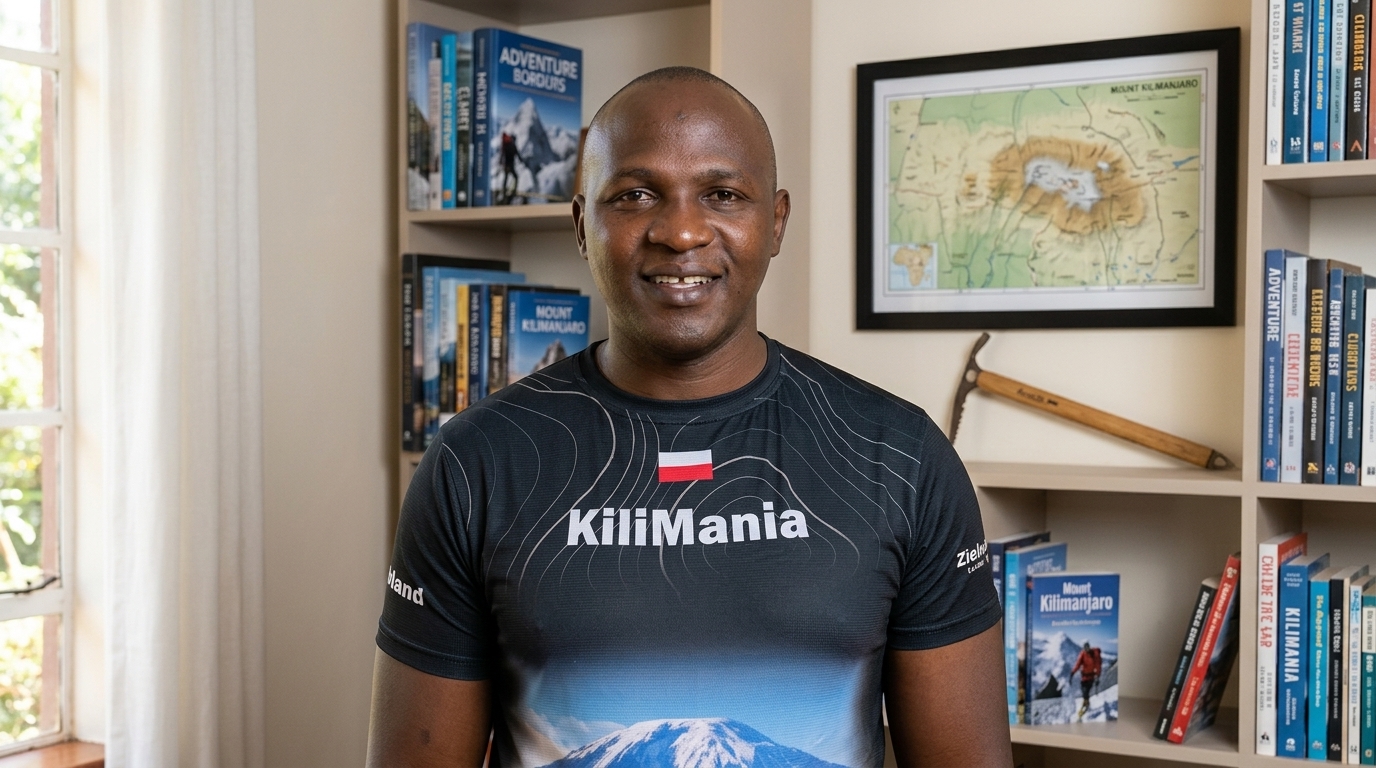
Written by: Sabinus Salvatory Msimba, Senior Kilimanjaro Guide and Co-founder, Kilimania Adventure. KINAPA-licensed mountain guide. 22 years guiding on Mount Kilimanjaro. 300+ verified Uhuru Peak summits.
Last reviewed: June 2026 | Update schedule: Reviewed each January following TANAPA’s annual fee announcement and each June following peak-season data consolidation.
⚠️ Data verification notice: Park fees and climbing permit costs are set by KINAPA and can change without advance notice. All figures reflect June 2026 published rates. Verify current fees before booking.
For International Travelers
All prices are in USD. Current conversions: $2,050 ≈ £1,620 | €1,890 | AU$3,150.
Flights to Kilimanjaro International Airport (JRO): New York/Los Angeles: $800–$1,400 return | London: £550–£900 return | Sydney: AU$1,400–AU$2,200 return.
Tanzania e-visa: $50 most nationalities | $100 US citizens. Apply at immigration.go.tz at least 7 days before departure. Use Google Chrome or Firefox and a Visa or Mastercard.
Yellow fever certificate: Required only if arriving from an endemic country — not required for direct arrivals from USA, UK, EU, or Australia.
Response times: Kilimania Adventure operates on East Africa Time (EAT, UTC+3) from Moshi. Messages sent after 6:00 PM EAT receive responses the following morning. All quote requests receive a reply within 12 hours, 7 days per week.