Northern Circuit Kilimanjaro Complete Guide 2026
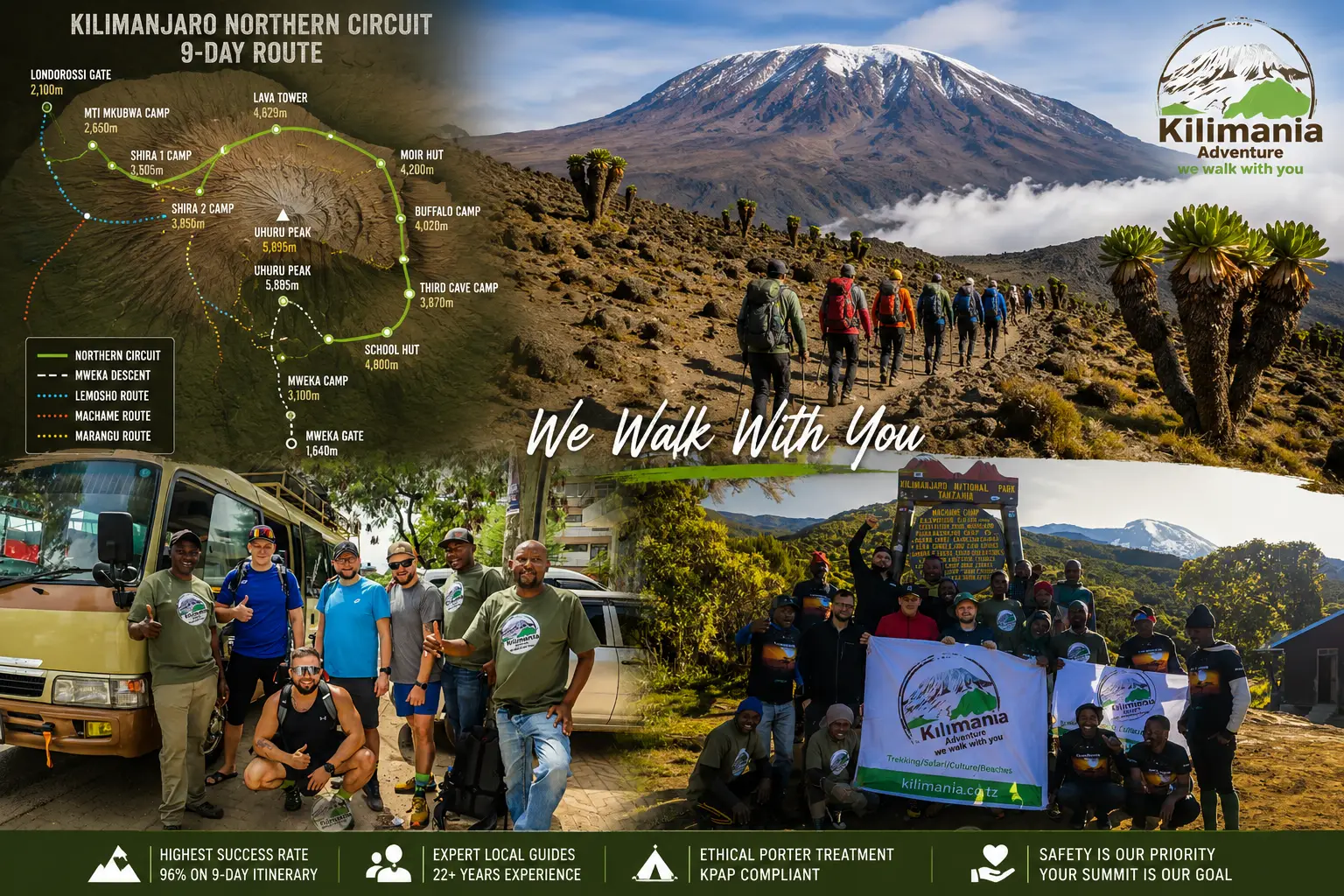
The Northern Circuit achieves a 96% summit success rate to Uhuru Peak (5,895m) — the highest of any standard Kilimanjaro route — based on Kilimania’s internal climb database of 1,247+ guided ascents from 2019 to 2025. It earns that rate by keeping you above 3,800m for longer than any other route before summit night. Nine days. The remote northern face. Almost no crowds. If standing at Uhuru Peak is your only metric, this is the route.
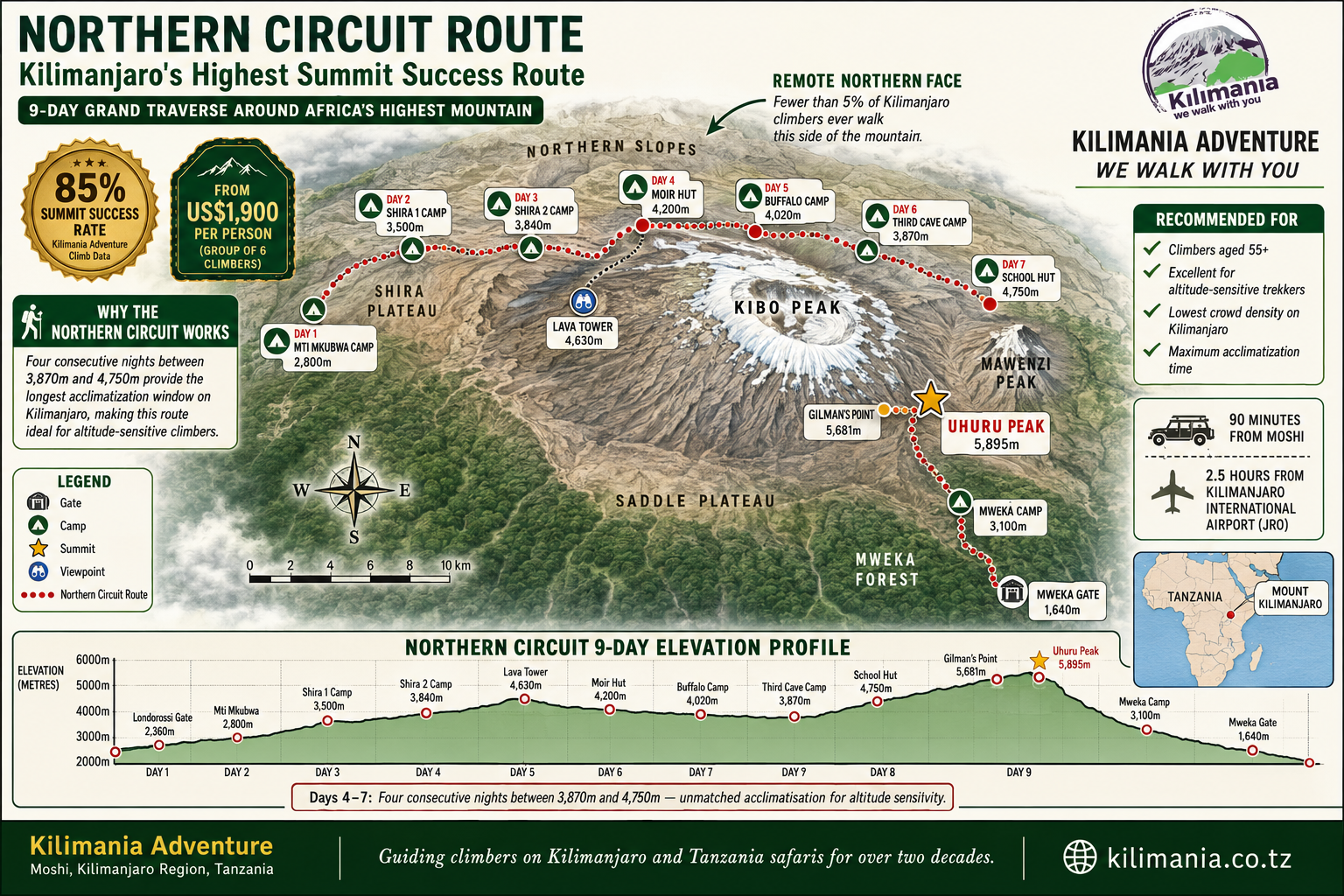
Northern Circuit — Key Numbers
Bottom Line
The Northern Circuit is not the cheapest or shortest — it is the smartest choice for climbers whose only metric is standing at Uhuru Peak.
It costs $500–800 more than a 7-day route. That premium buys a 15–20 percentage-point higher summit probability in our operational data. For a trip that took years to plan and thousands in preparation, that margin is the most cost-effective purchase on the table.
Takeaway: If summit success is your measure, the data points clearly to the Northern Circuit.
Why Does the Northern Circuit Have the Highest Success Rate?
Your body adapts to altitude through a process that takes days, not hours: increased breathing rate, higher red blood cell production, improved cellular oxygen use. These changes happen on a biological schedule that cannot be compressed by fitness or willpower — and this is the part most guides won’t spell out — the difference between a successful summit bid and a turnaround at Stella Point (5,756m) is usually not fitness. It is how long your body has been living at altitude before summit night.
The Northern Circuit gives your body roughly four consecutive nights sleeping above 3,800m (Days 4 through 7) before you start for the summit. A 6-day Machame gives roughly two. That gap is measurable in how climbers feel at School Hut at 11pm — and in whether they continue past Stella Point to Uhuru Peak.
A note on the numbers used throughout this guide: “four consecutive nights above 3,800m” refers to sleeping elevation from Moir Hut (Day 4) through School Hut (Day 7). The “three-day northern traverse” referenced elsewhere refers specifically to Days 5–7, the section that diverges from every other route. Both figures describe the same acclimatisation window from slightly different angles — they are not contradictory, but we want to be precise about what each number measures.
Independent altitude research supports this general mechanism, though we have not verified a single study specific to Kilimanjaro’s Northern Circuit. Broader research on extended acclimatisation above 3,500m is available via PubMed’s indexed studies on acclimatisation duration and AMS incidence. We present this as supporting context for a well-established physiological principle, not as a study conducted on our own climbers.
KINAPA’s official industry-wide data by duration shows: 5-day routes average 27%, 6-day routes 44%, 7-day routes 64%, 8-day routes 85%. These are averages across all operators and all routes of that duration. The 9-day Northern Circuit reaches 96% in Kilimania’s own operational records. Each additional day of acclimatisation delivers a measurable return in summit probability.
The route’s structure is what makes this possible. After Shira 2 Camp on Day 3, every other route — Lemosho, Machame, Rongai — turns south into the Barranco Valley (Rongai, approaching from the north, merges onto the same southern side near Kibo). The Northern Circuit turns north instead. You spend Days 5, 6, and 7 traversing the northern face at 3,800–4,200m, a section that sees fewer than 1,500 climbers per year. No queues. No noise. Just altitude doing its work.
On Day 4, the route applies the “climb high, sleep low” principle directly: you climb to Lava Tower at 4,629m, then descend to sleep at Moir Hut at 4,200m. That descent after the high point stresses your system enough to trigger adaptation, then allows overnight recovery. Days 5, 6, and 7 hold your sleeping elevation between 3,800m and 4,200m while your body consolidates those adaptations without the additional stress of continuous upward progression.
Guides enforce pole pole (slowly, slowly) pacing from Day 1. On the northern traverse, that discipline matters more than anywhere else — you are living at altitude, not just passing through it. The U-shaped elevation profile of Days 4–7 is the defining physiological feature of this route, and it is the reason the numbers look the way they do.
What Is the Complete 9-Day Northern Circuit Itinerary?
Day 1: Londorossi Gate → Mti Mkubwa Camp
Montane rainforest — tree ferns, moss-draped camphor trees, red-clay trail. The forest is dense and humid. Boots pick up red mud within the first kilometre.
The road from Moshi to Londorossi Gate takes 2–4 hours and can be rough and muddy in wet season. Gaiters are essential, not optional. The hiking day is short, but the journey to the trailhead is tiring before you take a single step uphill.
Black-and-white colobus monkeys move through the canopy above you. Guides occasionally spot elephant or buffalo sign in the wider western forest system — wildlife encounters that southern routes rarely offer.
Hot ginger tea on arrival at camp. Dinner: leek soup, rice with bean stew, steamed courgette, fresh mango, tea.
Day 2: Mti Mkubwa → Shira 1 Camp
Rainforest transitioning to giant heather and open moorland. The forest thins gradually; the landscape opens dramatically as you gain the plateau rim.
Guides enforce pole pole pacing on the steady climb out of the forest. Altitude starts to register — some climbers notice a tight sensation in their temples by evening. Resist the urge to push pace here; the cost shows up on summit night.
The forest stops. The Shira Plateau opens. Your first long view of Kibo’s summit cone appears across the plateau — impossibly far away. It will not stay that way.
Packed trail lunch. Dinner: tomato soup, pasta with ground beef, steamed carrots, papaya, hot chocolate.
Day 3: Shira 1 → Shira 2 Camp
Open volcanic moorland with giant groundsel trees (Dendrosenecio kilimanjari) — plants found nowhere else on Earth at this scale. The plateau is wide and fully exposed.
No shelter on the Shira Plateau. Equatorial sun above 3,500m burns through cloud cover — apply SPF 50+ every two hours. Wind can drop apparent temperature by 8–10°C without warning.
Walking with Kibo growing larger ahead and the western Breach Wall visible to the right. Photographers consistently rate this among the best light conditions on the entire route.
Soup, chapati, ugali with chicken or beef stew, cabbage, fruit, tea.
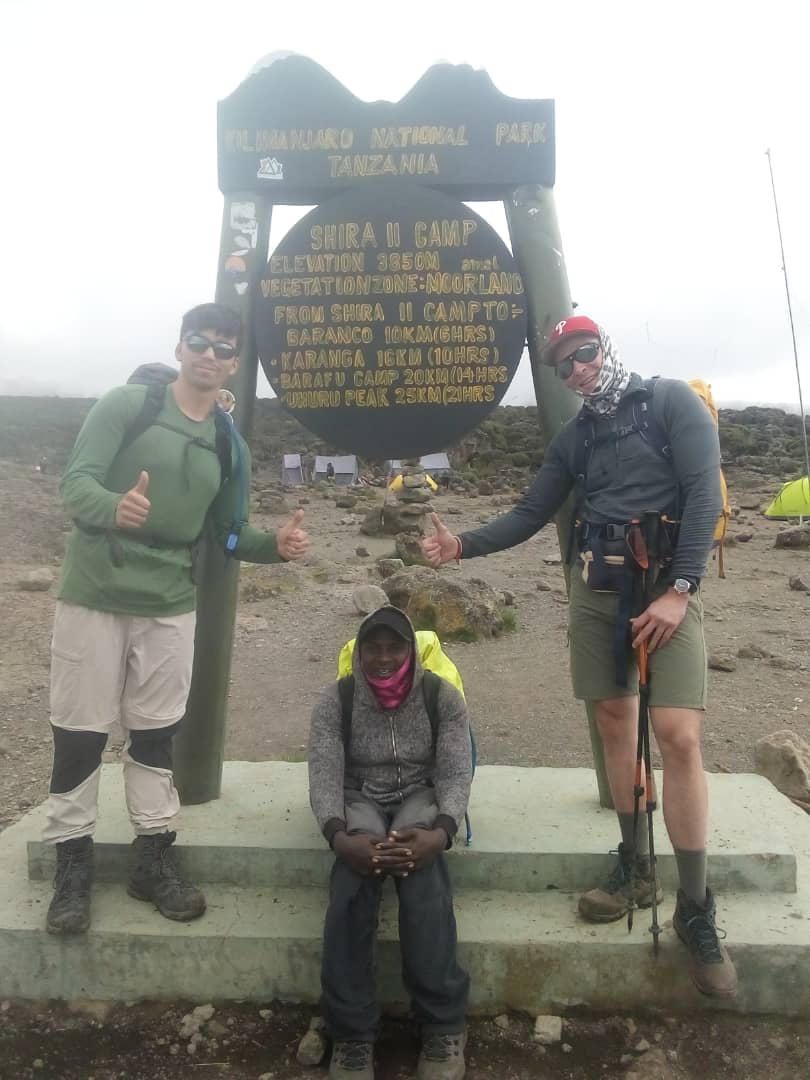
Day 4: Shira 2 → Lava Tower → Moir Hut — The Northern Pivot
Alpine desert — loose volcanic scree, rock fields, minimal vegetation. The landscape becomes stark and lunar above 4,200m.
This is your first serious altitude test. Many climbers experience pounding headaches, nausea, and exhaustion by afternoon. Some vomit at Lava Tower. This is not failure — it is your body responding normally to 4,629m. Guides monitor everyone closely. Communicate symptoms early; don’t manage them silently.
This is where the Northern Circuit becomes itself. While Lemosho and Machame climbers turn south into Barranco, you head north toward Moir Hut. The crowds disappear. The mountain changes character entirely. Climbing to 4,629m then descending to sleep at 4,200m is the “climb high, sleep low” principle in direct operation.
Light dinner — broth, small rice portion, plain chicken, ginger tea. Force yourself to eat even without appetite; fuel intake matters for tomorrow’s traverse.
The U-shaped profile of Days 4–7 is the defining feature. Sleeping elevation holds between 3,800m and 4,200m for four consecutive nights while your body lives at altitude without the stress of continuous upward progression. No other standard route replicates this consolidation window before summit camp.
Day 5: Moir Hut → Buffalo Camp — Northern Traverse Begins
High alpine desert — open rock fields, gentle ridgelines, sparse groundsel. Fully exposed on the northern face of Kibo with no shelter for hours at a stretch.
Wind. The northern traverse is fully exposed and can be relentless after five hours. Windproof shell over down jacket, full gloves, buff over the face — these aren’t optional on this day.
This is the day that makes the Northern Circuit worth every extra dollar. Kenya’s Amboseli plains open below you, with Mount Meru on the horizon behind. The silence is broken only by wind through the groundsels and a single white-necked raven circling overhead. Fewer than 1,500 climbers per year see this view. Keep watch for eland — the world’s largest antelope — on the lower northern slopes, and for lammergeiers (bearded vultures with wingspans up to 2.8m) nesting in the northern cliff faces.
Hearty stew, potatoes or rice, cooked vegetables, fruit, tea. Salt intake matters here — altitude suppresses appetite and electrolyte depletion accelerates fatigue.
Day 6: Buffalo Camp → Third Cave Camp
Sparse heath and alpine desert — barren volcanic ridges, the northern face of Kibo in an entirely different character from the southern routes. Rolling terrain without dramatic gradient.
The mentally demanding day. Terrain rolls without drama; cumulative fatigue arrives quietly. Eat on schedule whether hungry or not. Hydrate before you feel thirsty — thirst cues are unreliable at altitude.
Third Cave Camp hosts only one or two other groups even in peak season. Many climbers rate this as the evening they genuinely understood what “uncrowded Kilimanjaro” means. The northern face of Kibo at sunset is a different mountain from the one you see on the postcards.
Soup, pasta with meat sauce, vegetables, fruit, and tea. Appetite usually returns to near-normal tonight — a good sign heading into summit camp day.
Day 7: Third Cave → School Hut
Barren high alpine desert — rocky, exposed, increasingly arctic. The final approach to School Hut is steep and loose underfoot.
Sleep at School Hut is poor. At 4,800m, your brain cycles between light sleep and wakefulness. Some climbers experience Cheyne-Stokes breathing — rapid breaths followed by a pause of several seconds. This is a normal altitude response, not a symptom of serious illness. Your guide knows the difference and will tell you clearly if there is cause for concern.
Arriving at summit camp with energy remaining. Properly structured acclimatisation days mean you reach School Hut in measurably better condition than on a compressed schedule. The glaciers above glow in the last light. Early dinner at 5pm. Bed by 7pm. Wake at 11pm.
Early dinner at 5pm — soup, small rice or pasta, plain chicken or fish, ginger tea. Fluids pushed hard. Nothing heavy before summit night.
Day 8: Summit Day — School Hut → Uhuru Peak → Mweka Camp
This is the hardest day. You hike 6–7 hours in complete darkness at temperatures between -12°C and -20°C, with wind chill reaching -28°C. The scree above School Hut is steep and loose. Vomiting from altitude-induced nausea is common. Turning back at Stella Point (5,756m) — 139 vertical metres below the summit — happens on every route. What the Northern Circuit’s acclimatisation gives you is a significantly higher probability of continuing past that point.
Reaching Gilman’s Point (5,685m) just before sunrise. The horizon turns orange. The Rebmann Glacier catches the first light. One more hour to Uhuru Peak. Most people cry. Nobody is embarrassed about it.
Snacks every hour on ascent — energy bars, nuts, dried fruit, electrolytes. Force intake even without appetite. Celebration dinner at Mweka Camp on descent.
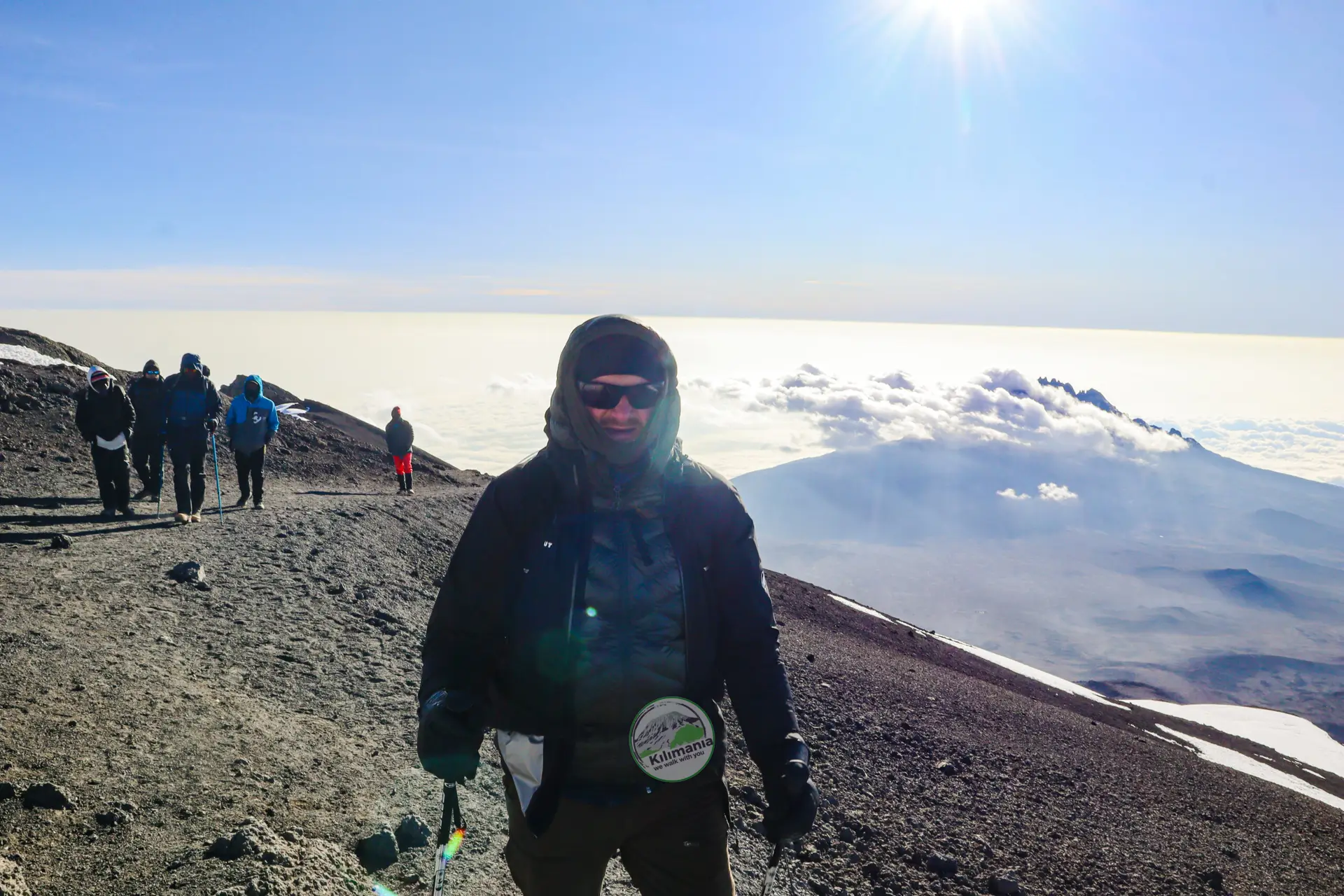
Day 9: Mweka Camp → Mweka Gate
Steep descent through heath, moorland, and rainforest. The trail is well-maintained but relentlessly downhill on legs that have worked hard for eight days.
Your knees. The steep rainforest descent is mechanically punishing on tired legs after eight days of effort. Trekking poles are mandatory. Take your time — there’s no time pressure today.
The air below 2,000m feels thick with oxygen. Your summit certificate is waiting at Mweka Gate. Your porter team sings. You have earned this.
Packed breakfast before departure. Celebration lunch or dinner back in Moshi.
Should You Choose the 10-Day Version Instead?
The structural difference is simple: instead of moving from Shira 2 directly to Lava Tower and Moir Hut on Day 4, the 10-day itinerary holds you at Shira 2 Camp for an extra night. That day is typically used for a short acclimatisation hike to roughly 4,000m and back down to sleep at 3,850m — a second “climb high, sleep low” cycle before the one at Lava Tower.
| Factor | 9-Day Version | 10-Day Version |
|---|---|---|
| Extra day location | — | Shira 2 Camp (3,850m) |
| “Climb high, sleep low” cycles before summit night | 1 (Lava Tower) | 2 (Shira 2 acclimatisation hike + Lava Tower) |
| Approximate cost difference | Baseline | +8–12% |
| Recommended for | Fit climbers with prior altitude experience | Climbers over 50, first-timers, once-only attempts |
We do not currently track a separate success-rate figure for the 10-day version at the sample size needed to publish a reliable percentage — our 96% figure is based on the 9-day itinerary specifically. What we can say from guide observation across both itineraries: clients on the 10-day version arrive at School Hut reporting fewer AMS symptoms and generally better sleep quality in the two nights before summit night. If you fall into any of the recommended categories above, the extra day is a reasonable investment.
How Does the Northern Circuit Success Rate Compare to Other Routes?
| Route | Duration | Success Rate (Kilimania) | Crowd Level |
|---|---|---|---|
| Northern Circuit | 9 Days | 96% | Very Low |
| Lemosho | 8 Days | 88% | Moderate–High |
| Machame | 7 Days | 79% | High |
| Marangu | 5–6 Days | 32% | Very High |
Marangu has a 32% success rate. That means roughly two out of three climbers who start Marangu don’t reach Uhuru Peak. That is the trade-off for hut accommodation and a shorter schedule — and it is a trade-off worth understanding before you book.
Three factors drive the Northern Circuit’s performance. First, duration: KINAPA’s own industry data shows each additional day delivers a measurable improvement, from 27% at 5 days to 85% at 8 days (industry-wide). Second, acclimatisation profile: the northern traverse at 3,800–4,200m is physiologically distinct from anything on the southern routes — no other standard route holds sleeping elevation in that band for four consecutive nights before summit camp. Third, preparation quality: climbers who choose a 9-day route tend to train and equip more seriously, which compounds the physiological advantage.
See the full route-by-route data with year-by-year breakdowns and our tracking methodology at Kilimanjaro Success Rate By Route: Data From 1,247 Climbs.
Who Is the Northern Circuit Right For?
This Route Is Right For You If:
Summit success is your absolute priority. If this is your once-only attempt and turning back at 5,000m is not an outcome you will accept, the 96% success rate makes the Northern Circuit the rational choice. You are not paying more for scenery. You are paying for a meaningfully higher probability of success compared to a 7-day route. On a trip that cost years of planning and thousands in flights, gear, and preparation, that margin matters.
You are over 50, 60, or 70. Acclimatisation capacity decreases with age — this is physiology, not pessimism. Older bodies take longer to adapt to altitude. The Northern Circuit’s extended profile is the single most effective mitigation available. Many climbers in their 60s summit this route. The 10-day version is especially recommended for climbers over 60. Read: Climbing Kilimanjaro Over 50.
You want the complete expedition experience. If you have done Everest Base Camp, the Inca Trail, or multi-day alpine routes, a rushed 6-day Kilimanjaro feels incomplete. The Northern Circuit delivers solitude, wilderness, and a genuine expedition feel. Days 5–7 on the northern traverse are a different mountain entirely from the managed southern routes.
You want genuine solitude. On Days 5–7 of the northern traverse, you may hike an entire day without seeing another group. On a peak June weekend, Machame Camp holds 200–300 climbers. Northern Circuit camps hold 15–30. This level of quiet is increasingly rare on Kilimanjaro.
Choose a Different Route If:
Budget is a real constraint. The Northern Circuit costs 20–30% more than a 7-day Lemosho. If budget is the binding constraint, Lemosho offers an 88% success rate at a lower cost — a strong alternative that shares the first three days with the Northern Circuit. We encourage you to request quotes from at least two other TATO-registered operators before booking. A list of licensed operators is available at tato.or.tz.
You have fewer than 11 total days. The Northern Circuit requires 9 days on the mountain plus travel days. If your schedule can’t accommodate this, consider the Machame Route.
You need hut accommodation. The Northern Circuit is 100% camping — no huts exist on any section. Marangu is the only hut option on Kilimanjaro, but its 32% success rate is the direct cost of that convenience. Be clear-eyed about that trade-off before booking.
You want technical terrain. This route is non-technical hiking. No ropes, ice axes, or scrambling required. If you want technical mountaineering on Kilimanjaro, consider the Western Breach — specialist operators only, not a standard commercial route.
What Does the Northern Circuit Cost in 2026?
| Item | Cost / Status |
|---|---|
| TANAPA Park Fees | $141.60/day (government-set, verify before booking) |
| KINAPA-Licensed Guide Team | Included |
| KPAP-Compliant Porters | Included (verify independently at kiliporters.org) |
| All Meals on Mountain | Included |
| Expedition Tents, Sleeping Mats, Dining Tent | Included |
| Oxygen Cylinder & First-Aid Kit | Included |
| Daily Pulse Oximetry Monitoring | Included |
| Round-Trip Transfers (Moshi/Arusha) | Included |
| Pre-Climb Hotel Briefing + 2 Hotel Nights | Included |
| Total Package (Kilimania) | $2,500–$4,000 USD |
| Exclusions | Flights · Personal climbing gear · Tips · Travel insurance |
The value calculation is straightforward. That’s a $500–800 premium over a 7-day route. It’s the gap between a 79% chance of reaching Uhuru Peak and a 96% chance in our operational data. For a trip that took years to plan, thousands in flights, and months of physical preparation — that’s not a marginal difference. It’s the gap between a roughly one-in-five chance of not summiting and something close to a near-certainty.
A note on park fees: these are set by government authorities and can change without notice. All figures reflect June 2026 rates. Verify current fees at tanzaniaparks.go.tz before booking. When you arrive at the gate, request a receipt confirming your operator paid the correct amount — this is your right as a paying client.
Ask your operator: “Is your quoted price VAT-inclusive on all components?” A correctly formatted quote states this explicitly in writing. For full cost details and price comparison guidance, see Kilimanjaro Cost 2026 and Kilimanjaro Park Fees.
What Practical Information Do I Need for the Northern Circuit?
Camping
The Northern Circuit is 100% camping throughout — no permanent huts exist on any section. Kilimania uses expedition-grade mountain tents with full rain flies. A private tent is available on request. The camp setup is done by the porter team before you arrive.
Water
Water is collected from mountain streams and springs, then boiled or chemically treated by the crew. On the northern traverse during Days 5 and 6, water sources are more limited than on southern routes — your crew carries additional supplies to bridge the gaps. Drink 3–4 litres per day regardless of thirst. Thirst cues are suppressed at altitude; dehydration accelerates altitude sickness.
Toilet Facilities
Be honest with yourself before booking. Public park toilets at Northern Circuit campsites are basic pit latrines — often poorly maintained and lacking toilet paper. On a 9-day trek, this becomes a genuine morale consideration by Day 5. Kilimania provides private portable toilet tents for all client groups. When comparing operators, ask directly: “Do you provide a private toilet tent?” Not all do.
Crowd Levels by Season
- June–October (peak dry): Southern routes hold 200–300 climbers per camp. Northern Circuit camps hold 15–30. You will see occasional other groups but never queue for anything.
- January–March (short dry): Even quieter. Excellent visibility and moderate temperatures. A strong choice for climbers who want maximum solitude.
- April–May and November (rainy seasons): Very few climbers, muddy trails, poor summit visibility. Not recommended unless complete solitude is the priority over summit probability.
Wildlife on the Northern Approach
Do not expect a safari. The lower forest on Days 1–2 offers the most wildlife chances — colobus monkeys in the canopy, occasional elephant and buffalo sign in the wider western forest. On the northern traverse, look for lammergeiers (bearded vultures with wingspans up to 2.8m) nesting in the cliff faces — a sighting practically impossible on southern routes. Augur buzzards and white-necked ravens are regular companions above 4,000m. Eland occasionally move through the northern lower slopes on Days 5–6.
What to Pack — Northern Circuit Specific
- Sleeping bag rated to -15°C — summit night at School Hut reaches -12°C inside the tent
- Insulated water bottle — hydration bladders freeze above 4,500m
- Windproof shell and down jacket — the northern traverse is fully exposed; no shelter for hours at a time
- Extra base layers — 9 days of effort require more clothing than shorter routes; plan for layers that can’t be washed on the mountain
- Trekking poles — mandatory for summit night scree and the steep Day 9 descent
- Blister treatment — pack it from Day 1, not Day 5; enough days for blisters to become serious
- Entertainment — evenings at Moir Hut and Buffalo Camp are long and remote; a book, cards, or downloaded content is worth packing
From our base in Moshi, Kilimanjaro Region, Kilimania Adventure runs Kilimanjaro climbs and daily safaris to Serengeti National Park, Ngorongoro Crater, Tarangire National Park, and Lake Manyara, with pickups from Kilimanjaro International Airport (JRO) and Arusha Airport (ARK).
How Does the Northern Circuit Compare to Lemosho, Machame, and Rongai?
| Feature | Northern Circuit | Lemosho | Machame |
|---|---|---|---|
| Duration | 9 Days | 8 Days | 7 Days |
| Success Rate (Kilimania) | 96% | 88% | 79% |
| Crowds | Very Low (15–30/camp) | Moderate–High | High (200–300/camp peak) |
| Acclimatisation | Superior — 4-night northern window | Excellent | Good |
| Cost | Higher | Moderate | Lower |
Northern Circuit vs Lemosho: The first three days are identical — rainforest, Shira Plateau, Shira 2 Camp. After Shira 2, Lemosho turns south into the Barranco Valley. Northern Circuit turns north into wilderness. Lemosho runs 7–8 days at 88% success (Kilimania operational); Northern Circuit is 9 days at 96%. The extra time and cost buy an 8-percentage-point improvement in summit probability and a fundamentally different mountain experience. If schedule or budget is the binding constraint, Lemosho is the strongest alternative. Full Lemosho Route Guide →
Northern Circuit vs Machame: Machame accounts for approximately 50% of all Kilimanjaro climbers — the most crowded camps and trails on the mountain. It runs 6–7 days at 79% success (Kilimania operational). Northern Circuit sees fewer than 5% of climbers, takes 9 days, and achieves 96% success. The trade-off is cost and time. Make your choice based on what you are actually optimising for. Full Machame Route Guide →
Northern Circuit vs Rongai: Rongai is the only other route that starts from the north side of the mountain, which leads some climbers to assume it’s similar to the Northern Circuit. It isn’t. Rongai climbs relatively directly to Kibo and joins the southern circuit near the summit approach — it does not include the 3,800–4,200m traverse that defines the Northern Circuit. Rongai typically runs 6–7 days with success rates in a similar range to Machame’s. If you specifically want the extended northern traverse and its acclimatisation benefit, Rongai will not deliver it.
For all routes compared side by side: Kilimanjaro Routes 2026: Route Comparison & Success Rates.
Planning From Outside Tanzania
Key logistics for international climbers booking the Northern Circuit from the UK, Europe, USA, or Australia.
What Climbers Say
“Sabinus and his team were exceptional. The Northern Circuit was everything they said it would be — we had the mountain almost entirely to ourselves for three days. I’m 58 and made it to Uhuru Peak. The acclimatisation schedule made all the difference.”Sarah M., UK — TripAdvisor
“I chose Kilimania after comparing five operators. The Northern Circuit was the right decision. The guides were professional, the food was far better than expected, and I reached the summit feeling stronger than I thought possible at 4,800m.”Thomas K., Germany — Google Reviews
“The northern traverse on Days 5 and 6 was unlike anything I’ve experienced in years of trekking. We saw lammergeiers, had the trail completely to ourselves, and arrived at School Hut in the best shape of the entire trip. Summit day was hard but we made it.”Marcus T., USA — Google Reviews
Reviews sourced from TripAdvisor and Google Reviews. Displayed with permission. Kilimania Adventure on TripAdvisor →
Frequently Asked Questions — Northern Circuit Kilimanjaro
Is the Northern Circuit the right Kilimanjaro route for summit-focused climbers?
For climbers whose top priority is reaching Uhuru Peak (5,895m), the Northern Circuit provides a 96% summit success rate — the highest of any standard route — along with the lowest crowd levels and the most time above 4,000m before summit night. It is not the cheapest or shortest option.
For summit-focused climbers, the data makes it the rational first choice. The 17-percentage-point gap over Machame (96% vs 79%) is the difference between a near-certainty and a roughly one-in-five chance of not reaching the summit.
How many days do you need for the Northern Circuit?
Nine days is the minimum. The 10-day version adds a dedicated acclimatisation day at Shira 2 Camp and is strongly recommended for climbers over 50, first-timers, or anyone making a once-only attempt.
Don’t attempt the Northern Circuit in 8 days — you lose the acclimatisation advantage on the northern traverse that justifies the higher cost. The extra day at Shira 2 Camp is where the 10-day version earns its value.
Is the Northern Circuit harder than Machame?
Longer, but not harsher day-to-day. Daily hiking on the Northern Circuit runs 4–6 hours versus 6–8 hours on Machame. The gradient is more gradual throughout. The northern traverse (Days 5–6) is exposed and windy, but the daily distances are manageable.
Summit night is hard on every route — but most climbers report arriving at School Hut (4,800m) in better condition via Northern Circuit because the route gave their bodies more full days to adapt. That condition at 11pm on summit night is what determines the outcome.
Is the Northern Circuit suitable for older climbers?
It is the recommended route for climbers over 50, 60, or 70. Acclimatisation capacity decreases with age — this is physiology, not pessimism — and more time at altitude is the single most effective mitigation available. Many climbers in their 60s summit this route via Kilimania.
The 10-day version is especially recommended for climbers over 60. Read Climbing Kilimanjaro Over 50 for age-specific preparation guidance before booking.
What is the success rate of the Northern Circuit?
Kilimania’s 9-day Northern Circuit achieves a 96% summit success rate across 1,247+ tracked climbers from 2019 to 2025. “Summit” is defined strictly as reaching Uhuru Peak (5,895m) — climbers who stop at Stella Point (5,756m) or Gilman’s Point (5,685m) are recorded as non-summits.
This compares to 32% on Marangu, 79% on Machame, and 88% on Lemosho in Kilimania’s operational records. The difference is acclimatisation time, not fitness. See full data and our tracking methodology at Kilimanjaro Success Rate By Route.
How does the Northern Circuit compare to Rongai?
Rongai approaches from the north side of the mountain, which leads some climbers to confuse it with the Northern Circuit. The two routes are structurally different: Rongai climbs relatively directly toward Kibo and merges with the southern circuit near the summit approach, while the Northern Circuit continues around the mountain’s remote northern face for three additional days at 3,800–4,200m.
Rongai typically runs 6–7 days with success rates similar to Machame’s. It does not replicate the extended acclimatisation window that drives the Northern Circuit’s 96% rate.
Will I see wildlife on the Northern Circuit?
More than on southern routes, but do not expect a safari. In the lower forest on Days 1–2, you may see colobus monkeys in the canopy and occasional elephant or buffalo sign in the wider western forest system.
On the northern traverse (Days 5–6), look for lammergeiers — bearded vultures with wingspans up to 2.8m — nesting in the northern cliff faces, and augur buzzards circling above 4,000m. Eland occasionally move through the northern lower slopes. These sightings are rare to impossible on southern routes.
Are there huts on the Northern Circuit?
No. The Northern Circuit is 100% camping throughout. There are no permanent huts on any section of the route, including the northern traverse. All accommodation is in expedition tents provided by your operator.
If hut accommodation is a non-negotiable requirement, Marangu is the only option on Kilimanjaro — but be clear-eyed about the trade-off: Marangu’s success rate is 32%.
Can a beginner climb the Northern Circuit?
Yes, with proper preparation. The gradual daily distances (mostly 4–6 hours) make it accessible to fit first-timers who have trained specifically for altitude hiking. The extended acclimatisation profile provides a wider safety margin than any shorter route.
There is no technical climbing involved on this route. Focus your preparation on cardiovascular fitness and altitude awareness. The challenge is always altitude, never technical difficulty.
What should I pack specifically for the Northern Circuit?
Northern Circuit-specific essentials beyond standard Kilimanjaro gear: sleeping bag rated to -15°C (School Hut reaches -12°C inside the tent on summit night); insulated water bottle rather than a hydration bladder (bladders freeze above 4,500m); windproof shell and down jacket for the fully exposed northern traverse; extra base layers for 9 days of effort.
Trekking poles are mandatory — for summit night scree and the steep Day 9 descent. Pack blister treatment from Day 1. Bring entertainment for long evenings at Moir Hut and Buffalo Camp — those camps are remote and evenings are quiet.
What is the recommended time of year to climb the Northern Circuit?
The peak dry season (June–October) offers the most reliable summit weather and clearest conditions. Even in peak season, Northern Circuit camps hold only 15–30 climbers versus 200–300 on southern routes. The short dry season (January–March) is quieter still, with excellent visibility and moderate temperatures.
Avoid the rainy seasons (April–May and November) unless complete solitude is your priority over summit probability. Trails are muddy, summit visibility is poor, and conditions on the exposed northern traverse can be genuinely difficult in sustained rain.
The Northern Circuit: A Direct Summary
The Northern Circuit achieves a 96% summit success rate across 1,247+ guided ascents because it gives your body roughly four consecutive nights above 3,800m before summit night — more than any other standard route. Nine days, the remote northern face, 15–30 climbers per camp versus 200–300 on southern routes in peak season.
The $500–800 premium over a 7-day route is not a cost to minimise — it is the mechanism. That additional time is exactly what the 96% figure reflects in our own operational data. For a trip that took years to plan, it is one of the most consequential decisions in the entire booking process.
If you are ready to discuss dates and group size, view the Northern Circuit tour page or contact us directly below.
We Walk With You.
Karibu — Ready to Climb?
Send us your preferred dates, group size, and route preference. We reply within 12 hours, 7 days/week, from Moshi on East Africa Time (EAT, UTC+3).
What to include: your preferred dates · group size · route preference (Northern Circuit 9-day or 10-day)
📥 Free Download: Kilimanjaro Altitude Symptom & AMS Checklist
Altitude illness is the leading reason climbers turn around on Mount Kilimanjaro. This practical checklist is used by Senior Guide Sabinus Msimba and the Kilimania Adventure team to monitor climbers throughout every expedition. Early symptom recognition significantly improves safety and summit success.
- Normal acclimatization symptoms above 3,000m
- Acute Mountain Sickness (AMS) warning signs
- HACE and HAPE emergency symptoms
- Daily health monitoring form (SpO₂, pulse, hydration)
- Guide reporting and self-assessment checklist