A Day in Moshi Town: Coffee, Markets and the Town Below Kilimanjaro
What to do with a free morning in Moshi before or after your climb — coffee, the central market, two small forests, and the hour when Kibo usually shows itself.
Sources for this guide: Kilimania’s own guiding in Moshi, the Tanzania Tourist Board’s Rau Forest Reserve listing, and the Tanzania Coffee Board. Figures that are estimates are marked as such.
What should you do with a free day in Moshi? Give it a focused half-day, not a full one. Start early for the clearest chance of seeing Kibo, drink coffee roasted from beans grown on the slopes above town, walk the central market while it is still cool, and finish in the shade of Rau Forest on the town’s edge. Moshi is a working town at roughly 700–950 m, not a resort — and that is exactly why a few unhurried hours here are worth taking.
What Moshi Actually Looks Like — Beyond the Guesthouse
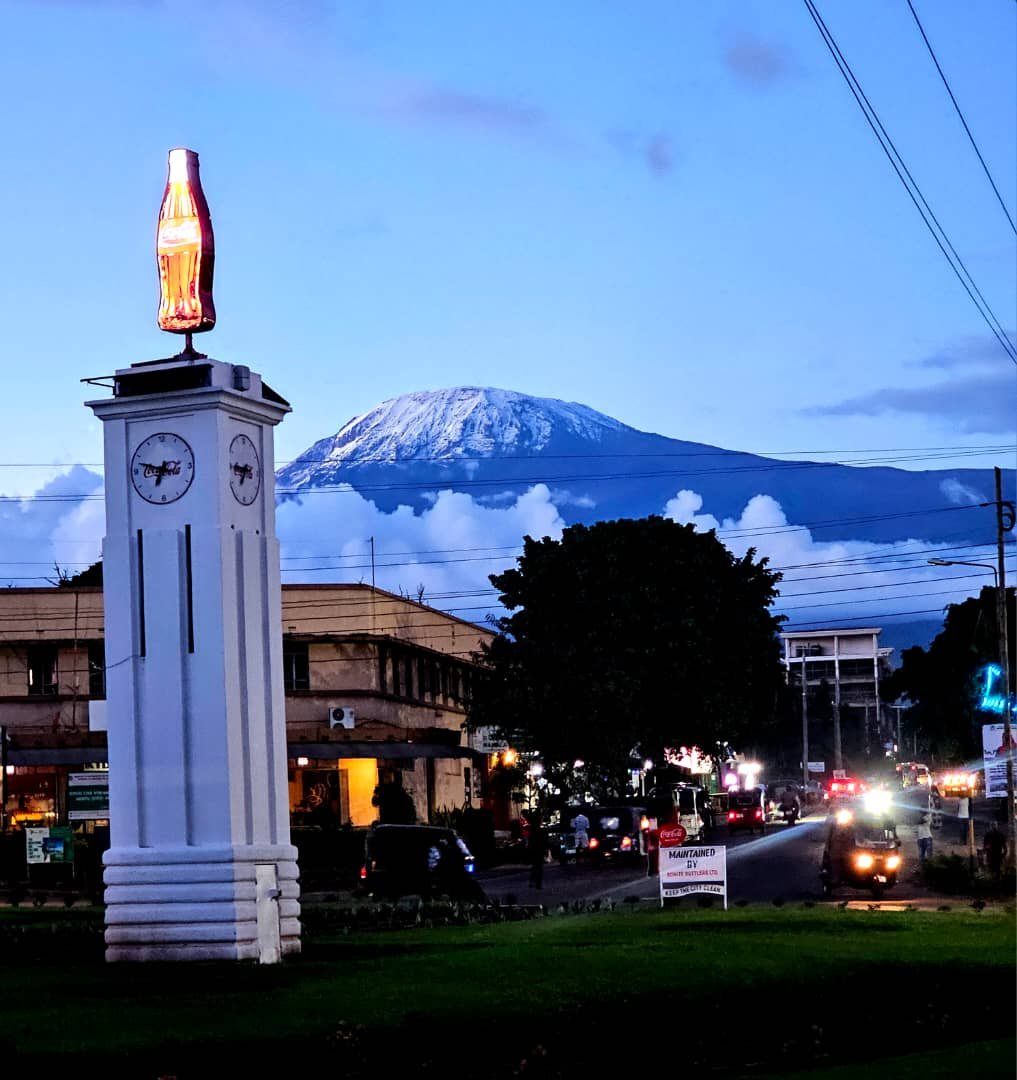
Most climbers see three things in Moshi: the airport road, a guesthouse, and the road to the park gate. That is a pity, because the town itself is easy to understand in a morning. The centre is a small grid around the clock tower roundabout you can see in the photo above. Shops sell hardware, fabric and phone credit side by side. Bodaboda motorbikes and daladala minibuses do most of the moving, and people greet you with “Karibu” — you’re welcome — because that is simply how conversations start here.
What Moshi is not: a polished old town with signposted sights and ticket booths. There is no single “attraction” to queue for. The value is in small, ordinary things done in a sensible order — which is why this guide gives you a route rather than a list. If you want the bigger excursions that leave from town, those live in our guide to the day trips that start from Moshi.
Coffee in Moshi
Moshi is a coffee town in a way most visitors never notice. The Moshi Coffee Exchange, run by the Tanzania Coffee Board, holds a weekly auction here during the selling season, and the Kilimanjaro Native Co-operative Union (KNCU), founded in 1929, collects coffee from the mountain’s smallholder farmers. The beans themselves grow higher up, in banana-and-coffee gardens on Kilimanjaro’s southern slopes.
Town coffee is not a farm tour
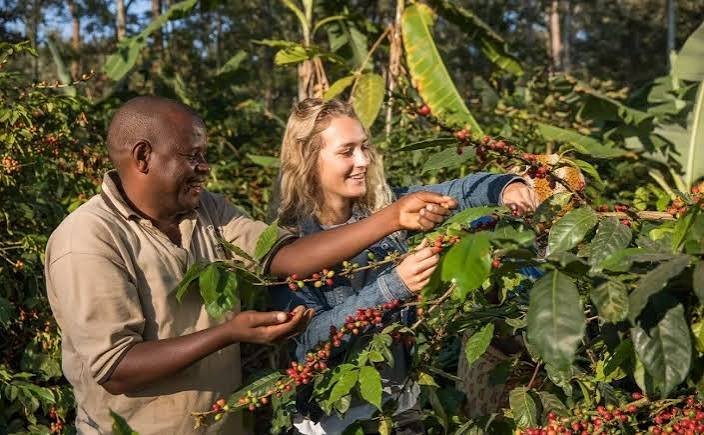
These are two different experiences, and mixing them up is the most common planning mistake I hear. In town you sit down, order, and taste what the slopes produce — roasted, brewed and served. On a farm visit you walk the gardens, pick ripe red cherries, pulp, dry, roast and pound them by hand. That second experience belongs to the villages above town; if it is what you want, read our guide to the Materuni waterfall and Chagga coffee day.
How to fit coffee into a town morning
Put it second — after the early mountain view, before the market. A cup and a bag of beans to take home costs a few dollars; you pay the café directly. Ask where the beans come from. In Moshi, people usually can tell you the area, sometimes the co-operative, and that one question tends to start a better conversation than any menu.
Have a spare morning in Moshi around your climb?
Tell us which day you’re free and what you’d like to see — coffee, market, forest or all three — and we’ll suggest a realistic plan that won’t tire you before the mountain.
The Rau Forest
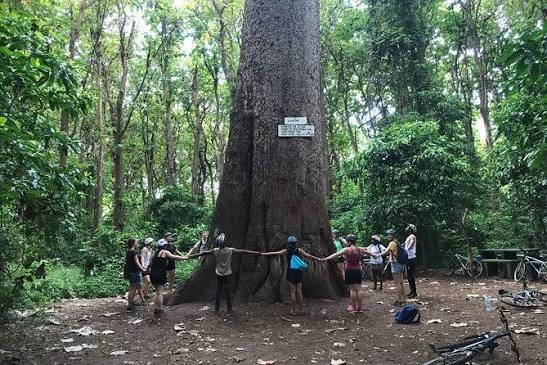
Rau is a groundwater forest: it stays green because water that falls higher on Kilimanjaro comes back to the surface here. That is why you walk out of dry, dusty streets into damp shade within minutes. The reason people come is the trees. The Tanzania Tourist Board lists more than 71 native tree species, and the reserve’s largest mvule (African teak) is recorded at 51 m tall and 3 m across, an estimated 200 years old. Some trunks are wide enough that a whole group can link arms around one, as in the photo.
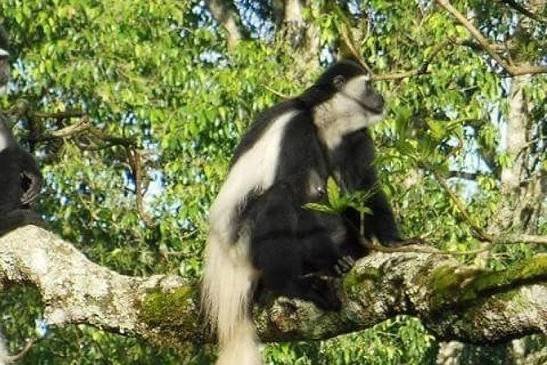
Black-and-white colobus, blue monkeys and Kirk’s dik-dik are recorded in the reserve, along with many forest birds, but this is not a wildlife trip and nobody should promise you sightings. It is a quiet, cool walk that changes the pace of a town morning.
The Local Market
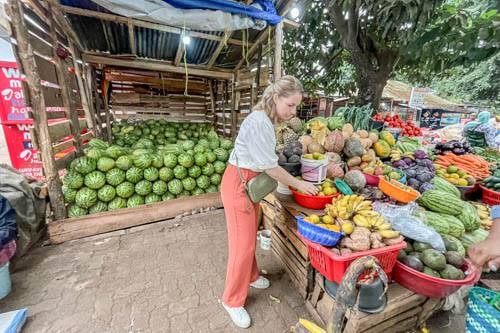
Inside the central market you’ll find stacked bananas of several kinds, avocados, passion fruit, tomatoes and onions in neat pyramids, bags of rice and beans, dried fish, and spices sold by the scoop. Around the edges, stalls sell kanga and kitenge cloth, sandals and kitchenware.
When to go
Morning. It is cooler, produce is freshest, and you can move without pressing into crowds. By early afternoon it gets hotter and fuller.
How to walk it without being in the way
- Ask before photographing a person or their stall — “Naweza kupiga picha?” (May I take a photo?). A “no” is a fair answer.
- Keep moving in the narrow aisles; traders are working, not posing.
- Buy something small. Fruit for your hotel room is the easiest way in. “Bei gani?” means “How much?”
- Carry small notes in a front pocket and leave the passport at your hotel, as in any busy market.
Getting Around Moshi
| Option | Good for | Watch out for |
|---|---|---|
| Walking | Clock tower, market, Uhuru Park, cafés | Uneven pavements, busy crossings, midday heat |
| Bajaji (tuk-tuk) | Town centre to Rau Forest and back | Not metered — agree the price first |
| Taxi | Early starts, after dark, carrying shopping | Ask your hotel to call a driver it knows |
| Bodaboda (motorbike) | Short solo trips | Highest accident risk; ask for a helmet |
| Daladala (minibus) | Very low cost, local experience | Fixed routes, crowded, slow at peak times |
Fares change with fuel prices, so ask at your hotel or guesthouse what a fair price is that week and carry small notes. After dark, take a taxi or arrange transport through your hotel rather than walking unfamiliar streets.
Kibo on a Clear Morning
Kibo is the highest of Kilimanjaro’s three volcanic cones and the one with Uhuru Peak (5,895 m) on its crater rim. From Moshi you look at it from the south, roughly the same face that climbers walk beneath on the Machame and Lemosho routes. You don’t need a special viewpoint: any open space with a clear line north works. Uhuru Park, the open green space near the centre, and the wider streets around the clock tower are easy options for a first look.
Because the mountain rises about 5,000 m above the town, cloud forms on its slopes quickly as the day warms. The practical rule is simple — if you want the view, be outside before breakfast, not after it. For month-by-month conditions on the mountain itself, see Kilimanjaro weather by month.
Njoro Forest
Think of Njoro as an add-on, not a destination. If you are staying on that side of town, or you already saw Rau on an earlier trip, it offers a short, shaded stroll. Our guides have seen colobus in the canopy on some visits, mostly early in the day, but sightings are never certain.
Check access locally on the day. Paths here are not formally managed, conditions change after rain, and some routes cross private land. A local guide or your hotel can tell you whether it is walkable that week.
| Feature | Rau Forest | Njoro Forest |
|---|---|---|
| Type | Groundwater forest reserve, ≈580 ha | Small riverside green area |
| Main reason to go | Old giant trees, incl. a 51 m mvule | Quiet walk; colobus seen by our team on some visits |
| Access | Confirm any guide or entry fee locally | Informal — confirm locally |
| Time needed | About 1–2 hours | About 1 hour |
| Choose if… | You only have time for one forest | You’re nearby or have seen Rau |
A Practical Half-Day Plan for Moshi
If you’re looking for a Moshi city tour, this half-day route keeps it simple: a Kibo view, coffee, the central market and one forest stop, with transport between stops when needed. This is the order that works, not a timetable; weather, your energy and your climb schedule can all change it. Travel times depend on where you sleep, the traffic, and whether you walk or take a taxi between stops — allow slack rather than squeezing in a fifth stop.
| Stage | What to do | Why it fits here | Practical caution |
|---|---|---|---|
| 1. First light | Look for Kibo from Uhuru Park or an open street facing north | The clearest window closes as cloud builds | Bring a light jacket — Moshi mornings are cool |
| 2. Coffee | Sit down for Kilimanjaro-grown Arabica; buy beans to take home | Breakfast break before the walking part | Allow time to sit; some cafés open later in the morning |
| 3. Market | Walk the central market; buy fruit | Cooler, calmer and freshest in the morning | Ask before photos; keep valuables secure |
| 4. Forest edge | Rau Forest (or Njoro if nearby) | Shade as the day heats up | Closed shoes, repellent; confirm access/fee on site |
What a Day in Moshi Costs
| Product | 1 Person | 2 People | 3 People | 4 People | 5 People | From Price |
|---|---|---|---|---|---|---|
| Chemka Hot Springs | $110 | $90 | $80 | $75 | $70 | From $70 pp |
| Maasai Boma | $115 | $95 | $85 | $80 | $75 | From $75 pp |
| Arusha City Day Trip | $120 | $100 | $90 | $80 | $75 | From $75 pp |
| Marangu Waterfalls | $120 | $100 | $90 | $85 | $80 | From $80 pp |
| Materuni Waterfalls | $130 | $110 | $95 | $90 | $85 | From $85 pp |
| Lake Chala | $155 | $130 | $115 | $105 | $95 | From $95 pp |
| Lake Chala Hike and Canoeing | $185 | $155 | $140 | $125 | $115 | From $115 pp |
| Shira Plateau Day Trip | $285 | $245 | $220 | $205 | $190 | From $190 pp |
| Arusha National Park Safari | $340 | $290 | $255 | $230 | $215 | From $215 pp |
| Mount Meru Day Trip | $365 | $315 | $285 | $260 | $240 | From $240 pp |
| Tarangire National Park | $410 | $335 | $290 | $260 | $240 | From $240 pp |
| Lake Manyara National Park | $410 | $335 | $290 | $260 | $240 | From $240 pp |
| Marangu Kilimanjaro Day Hike | $275 private | — | — | — | — | $275 private / $215 joining |
All prices per person in USD. Private trips from Moshi. Group size determines per-person price. Groups are not combined with other bookings, and your written quote is the final figure. For what each trip involves, see the day trips from Moshi guide.
Who This Works For
A Moshi morning suits people with a genuinely free day and low energy demands. Before climbing, walking at pole pole pace in town is a gentle warm-up; after climbing, it fills a few hours without another demanding excursion.
Good fit
- Climbers arriving a day early — use the arrival day instead of sitting in the hotel, and stay back by afternoon for your gear check.
- Post-climb rest days — easy, flat walking with no long drive or early start (see our recovery guide).
- Non-climbing partners and family — a half-day at low altitude while others are on the mountain.
- Coffee and food lovers — the town is where mountain produce comes to be sold.
- Photographers — early Kibo light, market colour (with permission), forest shade.
Choose something else if…
- You want to swim or soak — the Chemka hot springs day trip fits better.
- You want waterfalls — try the Marangu waterfalls or Materuni.
- You want wildlife — two small forests are no substitute for a Tarangire National Park day trip.
- You start your climb tomorrow at dawn and feel tired — rest instead.
- You’re blistered, ill or dehydrated after descending — sleep first; the town will still be here.
- You expect a polished, signposted sightseeing circuit — Moshi doesn’t work that way.
Sabinus’s Note From the Trail
I started on Kilimanjaro in 2001 carrying loads as a porter on the Marangu Route, and after more than two decades of guiding, Moshi is still the place every one of my climbs begins and ends. The advice I give most often about the town is not about where to go. It is about when to stop.
The day before a climb, climbers want to see everything. I tell them: see Kibo in the morning, drink one coffee, buy some fruit, and be back at the hotel by lunch. Your legs will need that energy on Day 1 more than you think. After the climb it is the opposite — the people who walk slowly through the market the day after they come off the mountain usually feel better than the ones who stay in bed.
And one small thing: greet people. “Habari za asubuhi” — good morning — costs nothing and changes how the whole town receives you. Karibu Moshi.
— Sabinus Msimba, Senior Kilimanjaro Guide
Frequently Asked Questions
The main things to do in Moshi town are watching Kibo at first light, drinking Kilimanjaro-grown coffee, walking the central market, and visiting Rau Forest on the town’s edge. Njoro Forest is a smaller add-on for colobus monkeys. Together they fill a relaxed half-day without leaving town or booking a full excursion.
Yes, for most visitors half a day is enough to see Moshi well. An early start covers the mountain view, coffee, the market and one forest before the midday heat. A full day only makes sense if you want slower forest walks, a longer coffee stop, or you are simply resting between a climb and a safari.
Yes, on clear days Kilimanjaro’s Kibo cone is visible from most open spaces in Moshi. The clearest chance is early morning, before cloud builds up on the slopes. June to October usually brings more clear mornings, but cloud can hide the mountain in any month, sometimes for several days in a row.
Central Moshi is compact and easy to explore on foot in the morning. Pavements are uneven, traffic around the clock tower roundabout is busy, and midday is hot. Walk the centre, then take a taxi or bajaji to Rau Forest if you want to save energy. After dark, use a taxi rather than walking unfamiliar streets.
Either works, but keep it short before the climb. The day before you start, a morning in town is fine if you are back by lunch for your gear check and rest. After the climb, a slow walk through the market and a coffee can be an easy way to spend a few hours without planning another demanding excursion.
For Rau Forest, a local guide is usually available at the entry point for a small fee, and walking with one helps you find the largest trees and any monkeys. For Njoro Forest, go with someone who knows the path, because access is informal, routes can cross private land, and conditions change after rain.
You can buy Kilimanjaro-grown coffee at cafés and roasters in central Moshi and in the market, usually as whole beans or ground coffee in sealed bags. Ask where the beans were grown. Moshi is an important centre for Tanzania’s coffee trade, home to the Moshi Coffee Exchange and the Kilimanjaro Native Co-operative Union, so most sellers can tell you the growing area.
Arriving in Moshi a day before your climb?
Ask our team how to use that day well — we’ll tell you honestly whether a town morning suits your schedule, or whether you’re better off resting. We reply within 12 hours, 7 days a week (EAT).
Request a Quote for Your Day in Moshi
Tell us your date, group size and what you’d like to see. We reply within 12 hours, 7 days a week (EAT), and we’ll tell you honestly if resting is the better plan.
Quote Request Received
Asante! Thank you. We’ll reply within 12 hours with a plan and price for your day in Moshi.
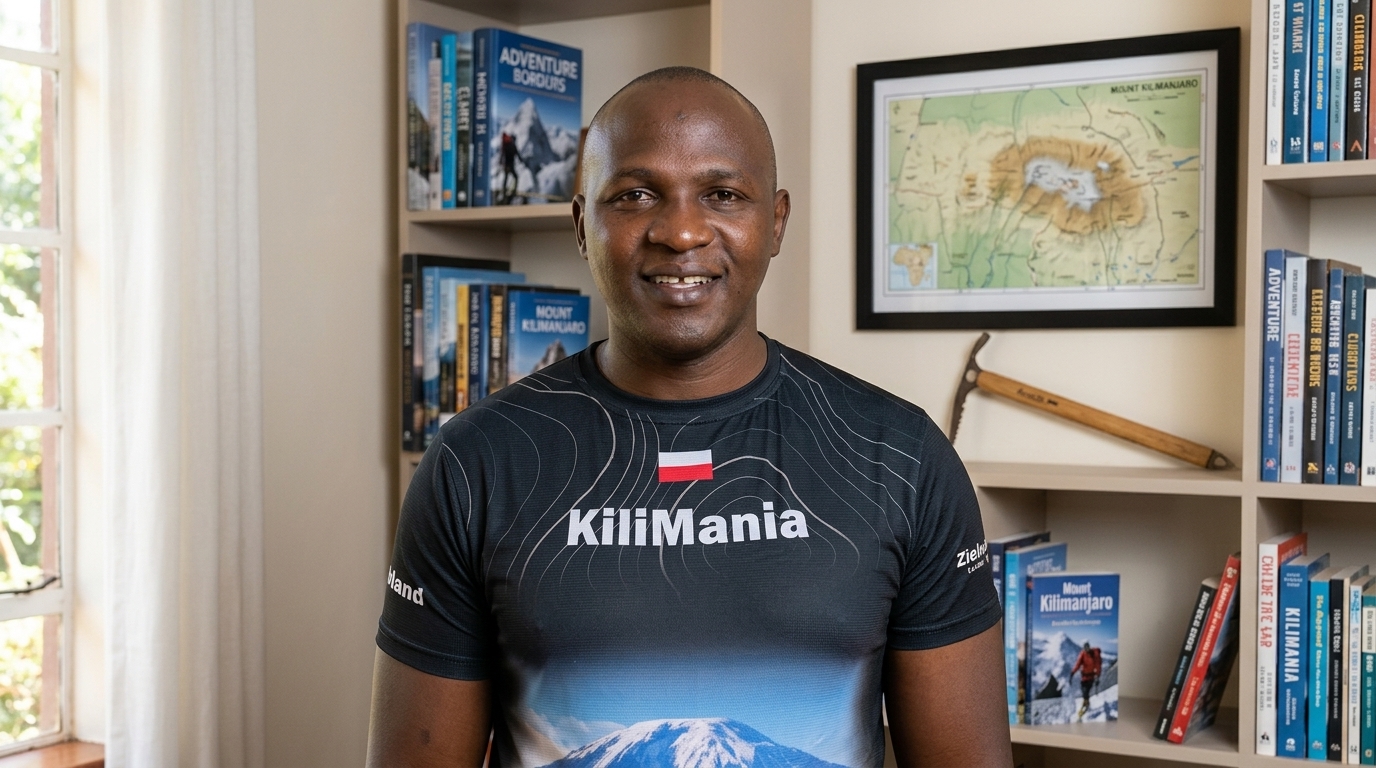
Sabinus Msimba
Sabinus began on Kilimanjaro in 2001 as a porter on the Marangu Route, became a KINAPA-licensed guide in 2003, and has 22+ years of guiding and 300+ personal Uhuru Peak summits. He lives and works in Moshi, where every Kilimania climb starts and finishes. Wilderness First Responder certified.
Full biography → · KINAPA licence (PDF) → · TripAdvisor reviews · Google reviews