What Is the Barranco Wall on Kilimanjaro?
Also called the “Breakfast Wall” — most groups tackle it first thing in the morning after leaving Barranco Camp.
Data sources cited in this article: on-mountain measurements and route timings from Kilimania’s guiding operations (2019–2026); route success-rate figures per Kilimania’s operational booking records; safety and incident context per publicly reported Kilimanjaro fatality data. See the full Kilimanjaro safety guide for sourcing on incident statistics.
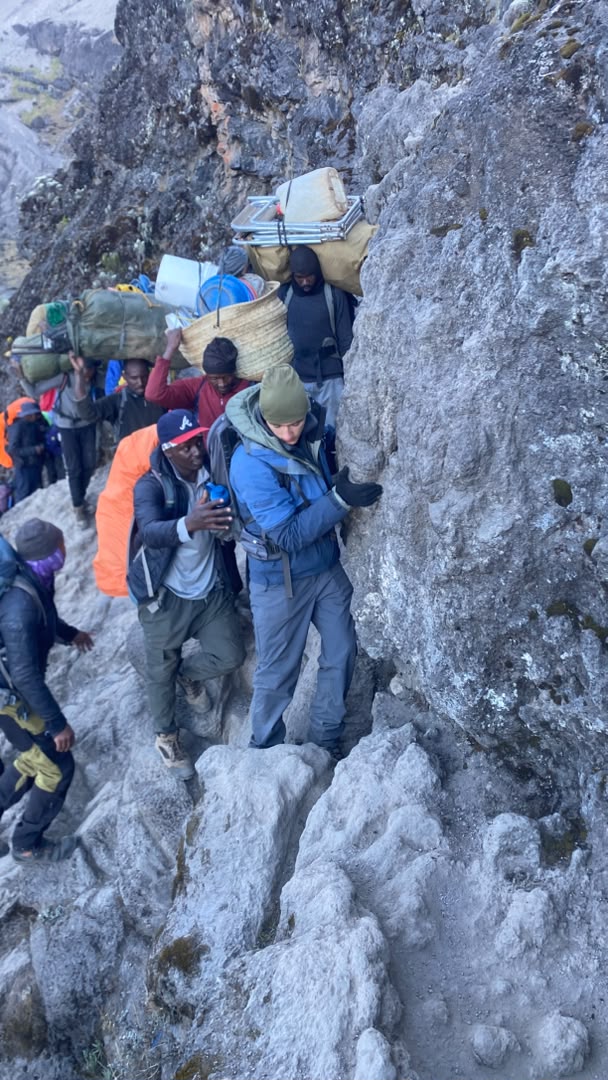
The Barranco Wall is a 257m (843ft) near-vertical rock face on Mount Kilimanjaro, crossed on the Lemosho, Machame, Shira, and Umbwe routes. On Lemosho, Machame, and Shira it is typically climbed on Day 5. On the Umbwe Route it is reached on Day 2–3 due to that route’s steep, direct approach from the south. It requires hands-on scrambling but no ropes, harnesses, or technical equipment. Most groups complete it in 45–90 minutes. The wall looks far more alarming from Barranco Camp the evening before than it feels once you are on it.
✅ Best For
- Climbers who want a hands-on, memorable scramble
- Anyone who enjoys immediate physical feedback from terrain
- First-time hikers willing to use both hands
- Children aged 10 and above with proper supervision
- Climbers over 60 who have maintained fitness
⚠️ Not Straightforward For
- Climbers with clinically diagnosed acrophobia
- Anyone unwilling to collapse poles and use both hands
- Trekkers on Marangu, Rongai, or Northern Circuit (they avoid the wall)
- Very broad frames — the Kissing Rock is narrow
What the Barranco Wall Looks Like From Below
At Barranco Camp on the evening of Day 4, the wall fills the view to the north. It is not possible to see the trail from down there. What you see is a dark face of rock rising abruptly from high-altitude moorland — all cliff and no path. Most climbers photograph it in the late afternoon light and spend part of the evening quietly calculating whether they will manage it.
This reaction is normal. It is also a misleading read of the situation.
From the camp, the wall appears sheer because the switchbacking ledge system that forms the actual route is invisible at that angle and distance. The brain reads “cliff face” and responds accordingly. The wall was first traversed by trekkers — not technical climbers — and the route has been in continuous guided use for decades. Every experienced guide on the mountain has crossed it hundreds of times.
What Climbing the Barranco Wall Actually Involves
The route up the wall follows an established series of ledges, natural steps, and scrambling holds that zigzag across the face. The path is worn smooth by decades of guided climbs. At the steepest points, you use both hands and feet simultaneously — placing your hands flat on rock for balance, stepping up from solid ledge to solid ledge.
At no point on the standard route is there a moment where you are hanging by your fingertips or exposed to a free fall with no recovery. The most technically demanding sections involve stepping up onto a ledge roughly hip-height and using a handhold above to stabilize. Your guide will demonstrate this and, where necessary, assist from below by supporting your foot or guiding your hand placement.
🧭 The Beta — What Climbers Need to Know Before They Start
- Grade: Class 2–3 scramble — non-technical, no rope required
- Exposure: Moderate — psychological rather than technically fatal
- Crux: The Kissing Rock squeeze, roughly two-thirds of the way up
- Gear needed: Grip gloves recommended; poles must be fully stowed
- Descent from wall: None — you walk off the top ridge and continue toward Karanga Valley
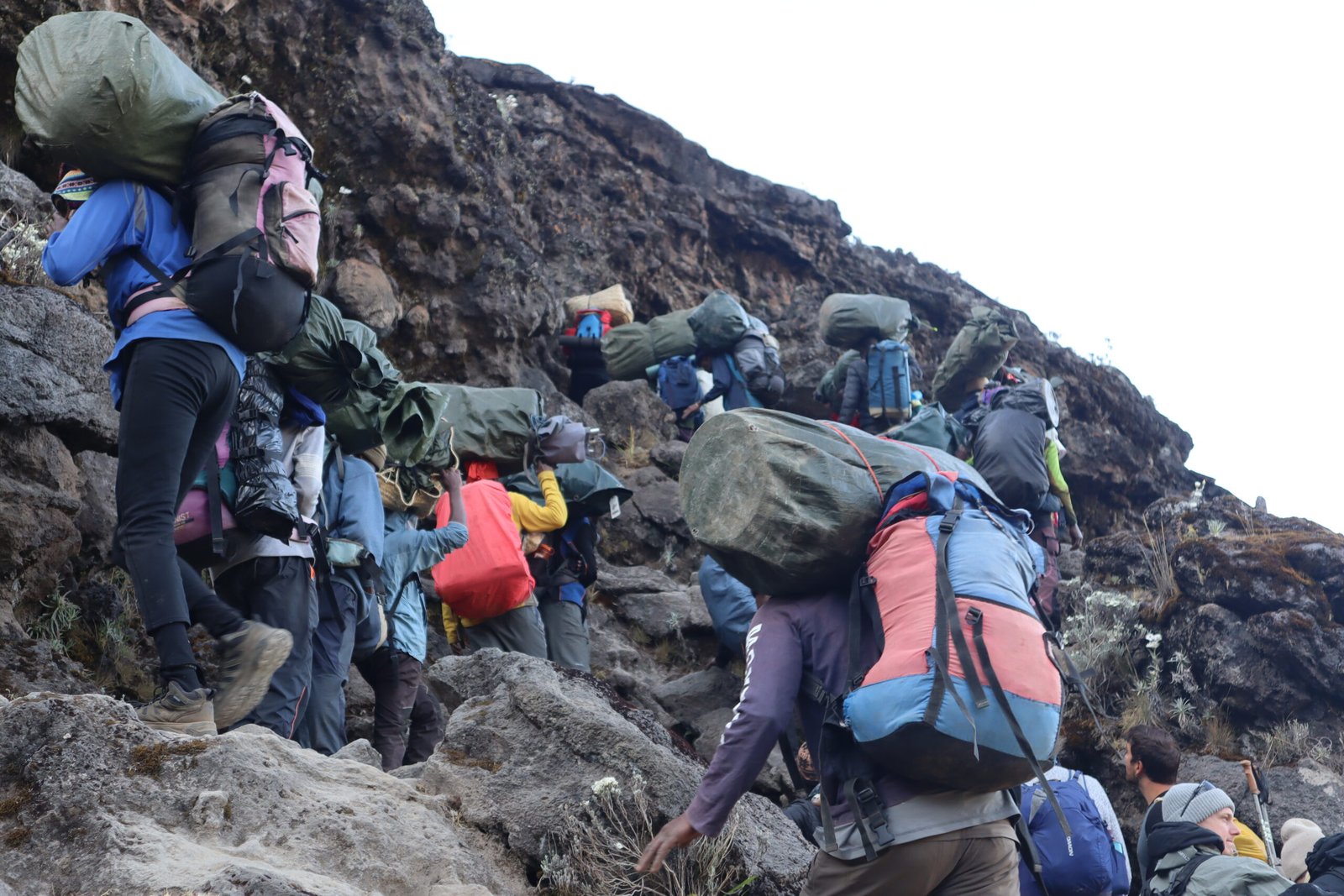
- Porter etiquette: Step aside on wide ledges; porters will pass you carrying full loads on their heads — always impressive, never dangerous
What You Must Do Before Starting
- Fully collapse and stow your trekking poles inside your daypack. Both hands are needed. Non-negotiable.
- Tighten all pack straps so nothing swings or catches on rock.
- Put on grip gloves — the rock can be rough on palms and gloves help confidence on awkward holds.
- Follow your guide’s exact line. Do not improvise an alternative path on the face.
- Tell your guide now if heights are a genuine concern. Not halfway up. Now.
If it rains overnight before the wall, the scrambling sections require more care. Wet rock reduces friction on boot soles and handholds feel different when cold and damp. Your guide may slow the pace and assist more actively at the ledge transitions. Good boot tread and grip gloves become significantly more important in these conditions. The wall is rarely cancelled due to weather — but it is always taken more carefully when wet.
The Kissing Rock: The One Section That Surprises Everyone
Roughly two-thirds of the way up, the route passes through a narrow squeeze between the rock face and a large boulder. You turn sideways, press your back or chest against one surface depending on your frame, and edge through. Taller and broader climbers notice it most. Nobody has ever been stuck there.
The name has made it the most discussed single moment on the Machame, Lemosho, Shira, and Umbwe routes. In practice it is mildly awkward for larger climbers and completely unremarkable for everyone else. Guides demonstrate the technique before you attempt it, and the passage takes less than thirty seconds once you understand the body position.
What Climbers Say About the Wall
“I was terrified the night before. The guide positioned himself behind me and talked me through every move. Within ten minutes I realised it was just stepping up. The view from the top made all that worry vanish.”— Sarah M., Machame Route, 2025
Verified reviews from Kilimania climbers: TripAdvisor · Google Reviews
“My daughter was ten and she crossed it faster than me. The Kissing Rock was the only section I even noticed. If you can get to Kilimanjaro, you can do the wall.”— David O., Lemosho Route, 2024
Verified reviews from Kilimania climbers: TripAdvisor · Google Reviews
“I kept expecting the scary part to arrive. And then we were at the top. Sabinus was calm and completely in control. The wall is not a climbing challenge — it is a psychological one. An experienced guide knows exactly how to handle it.”— Jennifer K., Shira Route, 2025
Verified reviews from Kilimania climbers: TripAdvisor · Google Reviews
The Barranco Wall is part of four Kilimanjaro routes. See the full itineraries, daily distances, and route comparisons before you decide which one fits you.
Explore Kilimanjaro Route Options →How Long Does the Barranco Wall Take?
| Group Profile | Typical Time | Notes |
|---|---|---|
| Confident, experienced hikers | 35–45 min | Move steadily, minimal hesitation at exposed points |
| Standard mixed group | 45–90 min | Typical pace for most guided groups |
| Families with children | 60–90 min | Children often outpace adults; low centre of gravity helps |
| Climbers managing acrophobia | 90–120 min | Guide positions alongside; slow but completed every time |
Times are typical ranges observed across Kilimania-guided groups; individual pace varies with weather, group size, and conditions.
After the wall, the day continues down into the Karanga Valley before climbing again to Karanga Camp at approximately 4,035m. The wall is not the hardest part of Day 5 in terms of total effort — it is the most visually dramatic. Allow approximately 5–7 hours for the full stage on the Machame route.
Departure Time and Weather on the Barranco Wall
Groups typically leave Barranco Camp between 07:00 and 08:00, reaching the base of the wall by 08:00–08:30. This early start is deliberate — not arbitrary.
By late morning, cloud builds on Kilimanjaro’s southern flanks. On the Barranco Wall, afternoon cloud means reduced visibility and, critically, rain. Wet rock demands considerably more care at every scrambling section and reduces the confidence most climbers feel on the holds. An early departure catches the wall in the clearest, driest part of the day.
Temperature at Barranco Camp before departure is typically 2°C to 8°C. Midway up the wall, physical exertion raises your body temperature considerably — most climbers remove a layer at the Kissing Rock section. At the top of the wall on a clear morning, temperatures range from 8°C to 16°C depending on season and cloud cover.
Day 5 Elevation Profile — Machame / Lemosho Route
Who Finds the Barranco Wall Difficult — and Why
The Barranco Wall is not physically hard in the way that summit night is physically hard. The challenge is psychological. Specifically:
Acrophobia (Fear of Heights)
The exposure is real. As you gain height, Barranco Camp shrinks below and the Shira Plateau stretches out to the west. If heights genuinely paralyze you — not just make you uncomfortable, but impair your ability to move — this section requires deliberate management before and during the climb.
Tell your guide before you leave camp. An experienced guide will position directly alongside you at every exposed point and use calm, specific instruction: “left hand here, right foot there, look at the rock in front of you, not down.” This has consistently worked in practice for climbers our guides have assisted across this wall over 22+ years of operations on Kilimanjaro.
Taller and Broader Climbers
Climbers over 6 feet tall and those with a broader frame find certain ledge transitions less elegant. The Kissing Rock in particular requires flexibility for larger bodies. This is not a barrier — it is something to anticipate and move through slowly with guide instruction.
What Does Not Affect Performance on the Wall
General fitness level, altitude experience, and prior hiking history make remarkably little difference to wall performance. Climbers who have struggled on long ascents often find the wall straightforward. The hands-on scrambling style provides immediate confirmation at every hold that you are secure — which many people find more reassuring than walking uphill on loose scree.
I have guided mothers with children, first-time hikers in their seventies, and climbers with real physical limitations across this wall. The common factor in success is not fitness. It is the willingness to follow the guide’s instruction and trust the holds. The wall rewards commitment. It penalizes hesitation — not weakness.
— Sabinus Msimba, 22 years guiding on Kilimanjaro
What Happens If You Cannot Complete the Barranco Wall?
This is the question most climbers are too embarrassed to ask before they book. Here is the honest answer.
Turning back is always an option. Nobody will force you to continue. Your safety and your decision are respected at every point on the mountain.
However, it is important to understand what turning back operationally means. The Barranco Wall is the only route between Barranco Camp and Karanga Camp on the Machame, Lemosho, Shira, and Umbwe routes. There is no bypass path. If you descend back to Barranco Camp, you cannot continue on those routes — your climb ends there, and your team will assist with descent to the gate.
What guides do when a climber freezes: They stop. They get alongside. They break the next ten metres into single moves. They do not rush, do not express frustration, and do not let the group continue without you. This is what proper guiding on Kilimanjaro means.
Kilimania’s guiding team has not had to leave a climber stranded on the Barranco Wall in over two decades of operations. That reflects consistent guiding practice — not a guarantee for every person in every condition.
Do not wait until Barranco Camp to raise this. Contact us before you book. We will discuss your specific situation, the actual demands of the wall, and whether a route that avoids the wall makes more sense for you. WhatsApp us directly — this conversation happens every week.
Has Anyone Died on the Barranco Wall?
There are no documented deaths caused by falling from the Barranco Wall itself. The standard scrambling route uses solid ledges and holds — not an exposed cliff edge where an unassisted fall would be fatal. The wall is a scramble, not a free climb.
Serious and fatal incidents on Kilimanjaro are overwhelmingly caused by altitude illness — specifically HACE (High Altitude Cerebral Edema) and HAPE (High Altitude Pulmonary Edema) — not by falls on the Barranco Wall or any other technical section. See our full Kilimanjaro safety guide for the complete picture on risks, deaths, and what responsible operators do differently.
That said, the exposure is real. Climbers with severe acrophobia who do not communicate with their guide before starting create a situation that requires careful management mid-wall. This is avoidable. Tell your guide before you leave camp.
Who Has Crossed the Barranco Wall?
The Barranco Wall is crossed every week by climbers of every age, background, and fitness level. Here is what consistent guiding experience confirms.
If you have a specific concern — age, fitness, a medical condition, or a fear of heights — contact us on WhatsApp before booking. We give honest assessments based on your specific situation. See also: Climbing Kilimanjaro Over 50, Family Kilimanjaro Climbing, and Can a Beginner Climb Kilimanjaro?
The View From the Top of the Barranco Wall
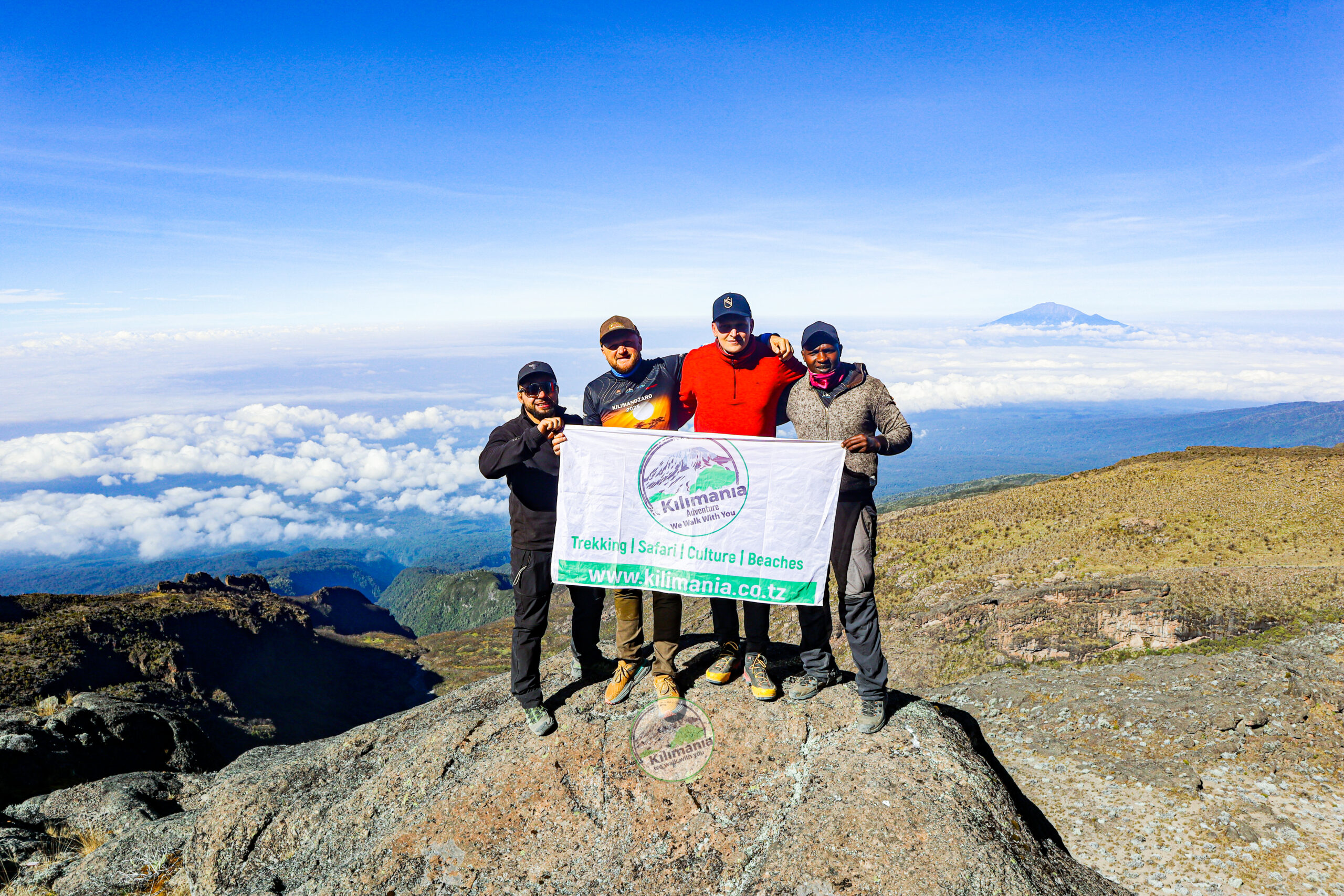
Reaching the top on a clear morning produces one of the most immediate feelings of the entire climb. You turn around and see Barranco Camp several hundred metres below. Kilimanjaro’s southern ice fields catch the early light to the north. The Shira Plateau and its lava towers stretch west. On very clear days, Mount Meru — a 4,566m peak — is visible to the southwest.
There is a specific clarity to this moment because you can see exactly what you have just climbed. Unlike the slow grinding ascent of a scree slope where progress is invisible, the wall shows you precisely where you started and where you are now. Most groups pause here for photographs and water before continuing along the ridge toward the Karanga Valley descent.
Which Kilimanjaro Routes Cross the Barranco Wall?
Four routes cross the Barranco Wall: Lemosho, Machame, Shira, and Umbwe. Three routes avoid it entirely: Marangu, Rongai, and the Northern Circuit.
| Route | Crosses Wall? | Duration | Success Rate | Wall Day | Guide |
|---|---|---|---|---|---|
| Lemosho | ✅ Yes | 7–8 days | 90–95% | Day 5 | Full Guide |
| Machame | ✅ Yes | 6–7 days | 85–90% | Day 4/5 | Full Guide |
| Shira | ✅ Yes | 7 days | 88–92% | Day 4/5 | Full Guide |
| Umbwe | ✅ Yes | 6 days | 65–75% | Day 2–3 | Full Guide |
| Marangu | ❌ No | 5–6 days | 65–75% | N/A | Full Guide |
| Rongai | ❌ No | 6–7 days | 80–85% | N/A | Full Guide |
| Northern Circuit | ❌ No | 8–9 days | 90%+ | N/A | Full Guide |
Success rates per Kilimania’s operational booking records, as of August 2026. Routes of 7+ days consistently outperform shorter itineraries. For a full analysis, see our success rate by route breakdown.
The Umbwe Route and the Barranco Wall: What’s Different
The Umbwe Route crosses the Barranco Wall, but it arrives there on Day 2–3 rather than Day 5 as on Machame or Lemosho. This is a critical difference — not in the wall itself, but in how prepared your body is when you reach it.
The Umbwe Route ascends steeply from the Umbwe Gate on the south side of Kilimanjaro via a direct ridge. It is one of the most physically demanding approach routes on the mountain. Climbers reach Barranco Camp with significantly less acclimatization time than those who approach via Lemosho or Machame — often having slept only one night above 3,000m before arriving at the wall base.
The wall crossing itself is identical regardless of which route you arrive on. You are standing at the same Barranco Camp, looking at the same 257m of rock, following the same established ledge system. The difference is entirely in acclimatization: your body has had 2–3 days to adjust on Machame and Lemosho; it has had 1–2 days on Umbwe.
This is one of the reasons the Umbwe Route has a lower summit success rate than Lemosho or Machame. The wall itself is not the failure point — altitude illness on summit night is — but arriving at 3,950m quickly makes acclimatization harder at every subsequent stage.
If crossing the Barranco Wall is your primary goal and you want the best physical preparation when you arrive at it, the 8-Day Lemosho Route is the strongest choice. If you want the wall with a slightly shorter approach, the 7-Day Machame Route is the most popular option. See our full Machame vs Lemosho comparison.
Routes That Avoid the Barranco Wall
Three routes do not cross the Barranco Wall. If the wall is your only concern about the Machame, Lemosho, or Shira routes, these are your alternatives.
How to Prepare for the Barranco Wall
No training specifically targets the Barranco Wall in isolation — but five things make a real, measurable difference.
1. Add Upper-Body Work to Your Training
Most Kilimanjaro preparation focuses on hiking and cardiovascular endurance, which is correct. But adding basic upper-body work — press-ups, pull-ups, rows — means your arms and shoulders will not tire on the wall. Sustained hand use for 45–90 minutes at altitude engages muscle groups that pure treadmill training ignores. See our Kilimanjaro fitness assessment guide for a structured approach.
2. Practice Scrambling Before You Arrive
Find a low rocky hillside or boulder field before your trip and practice moving on all fours. The goal is familiarity, not fitness. The moment you understand that hands on solid rock give you more control than feet on loose scree, the Barranco Wall logic becomes clear.
3. Learn to Stow Poles Quickly With Gloves On
Your trekking poles must be fully collapsed and secured in your pack before the wall. Practice doing this with gloves on so it does not delay the group at the base.
4. Prepare Mentally the Evening Before
The most important preparation happens at Barranco Camp — looking at the wall, talking to your guide, and understanding that what appears to be a cliff from below is a series of ledges from the inside. Tell your guide if you are nervous. This is the most important sentence you can say before Day 5.
5. Gear That Helps on the Wall
- Lightweight grip gloves: Protect palms, improve confidence. Gardening gloves with grip work perfectly.
- Fitted daypack: Nothing loose or swinging. Cinch every strap before the base.
- Well-soled boots: Standard hiking boots grip the rock well. Smooth-soled trail runners require more care on wet rock.
- Accessible camera: Put it in a chest pocket or hip belt pocket before starting. The view from the top is worth capturing.
Ensure your travel insurance covers high-altitude trekking to 6,000m and emergency helicopter evacuation. Most standard travel policies exclude this. Check your policy wording before departure. Specialist providers such as World Nomads and Allianz Travel offer appropriate high-altitude coverage. Emergency evacuation from Kilimanjaro without insurance can cost $15,000–$50,000.
📥 Free Download: Kilimanjaro Altitude Symptom & AMS Checklist
Altitude illness is the leading reason climbers turn around on Kilimanjaro — not the Barranco Wall. This checklist is used by Senior Guide Sabinus Msimba and the Kilimania team on every expedition.
- Normal acclimatization symptoms above 3,000m
- AMS warning signs — when to slow down, when to descend
- HACE and HAPE emergency symptoms
- Daily health monitoring form (SpO₂, pulse, hydration)
For educational purposes only. Does not replace professional medical advice. Consult a physician before high-altitude travel if you have pre-existing medical conditions.
Kilimania Routes That Include the Barranco Wall
| Tour | Duration | Wall Day | Itinerary |
|---|---|---|---|
| 8 Days Lemosho Route | 8 days | Day 5 | View Itinerary |
| 7 Days Lemosho Route | 7 days | Day 5 | View Itinerary |
| 7 Days Machame Route | 7 days | Day 5 | View Itinerary |
| 6 Days Machame Route | 6 days | Day 4 | View Itinerary |
| 7 Days Shira Route | 7 days | Day 4/5 | View Itinerary |
Frequently Asked Questions: Barranco Wall Kilimanjaro
The Barranco Wall is a 257m (843ft) near-vertical rock face on Mount Kilimanjaro, crossed on the Machame, Lemosho, Shira, and Umbwe routes. It requires hands-on scrambling but no ropes or technical equipment. Most groups complete it in 45–90 minutes. It sits above Barranco Camp at approximately 3,950m and tops out at around 4,200m. On Lemosho, Machame, and Shira it is typically Day 5; on Umbwe it is reached on Day 2–3.
The Barranco Wall is crossed on the Lemosho, Machame, Shira, and Umbwe routes. The Marangu, Rongai, and Northern Circuit routes do not cross the Barranco Wall. On the Umbwe Route, climbers reach the wall on Day 2–3 with significantly less acclimatization time than on the other routes. For best preparation before crossing the wall, the 8-Day Lemosho Route is recommended.
There are no documented deaths caused by falling from the Barranco Wall. The standard scrambling route uses solid ledges and holds, not an exposed cliff edge where a fall would be fatal. Serious and fatal incidents on Kilimanjaro are overwhelmingly caused by altitude illness — AMS, HACE, and HAPE — not the wall scramble. Climbers with severe acrophobia should inform their guide before starting.
The Barranco Wall is not technically dangerous for the vast majority of climbers. The established route follows solid ledges and scrambling holds with no vertical sections where a fall would be catastrophic. The exposure is real and psychological — but guides lead, demonstrate every move, and position alongside climbers who need assistance. Severe acrophobia is the most common reason climbers find the wall genuinely challenging.
Groups typically leave Barranco Camp between 07:00 and 08:00, reaching the base of the wall by 08:00–08:30. An early start avoids afternoon cloud buildup and rain that makes the rock wet and the scrambling significantly more difficult. Temperature at departure is typically 2°C to 8°C; physical effort raises body temperature considerably by the midway point.
No ropes, harnesses, or technical climbing equipment are needed. Trekking poles must be fully collapsed and stored in your pack before you start. Both hands and feet are used at the steepest sections, but every hold is solid and the route is well established. Lightweight grip gloves are helpful but not required.
On the Umbwe Route, climbers reach the Barranco Wall on Day 2–3 rather than Day 5 as on Machame or Lemosho. This means significantly less acclimatization time before crossing the wall. Umbwe approaches steeply from the south and joins the Machame route at Barranco Camp before ascending the same wall. The wall crossing itself is identical — the difference is how prepared your body is at altitude when you arrive.
Yes. The Barranco Wall is completed every week by first-time hikers with no prior scrambling experience. The guide demonstrates every move at the technical sections. Most people who are anxious beforehand find it manageable within the first five minutes. The wall is a psychological challenge more than a fitness test. See also: Can a Beginner Climb Kilimanjaro?
Standard Kilimanjaro hiking boots are the right choice. Stiff, ankle-supporting boots with good tread grip the rock ledges securely and protect your feet when stepping up onto narrow edges. Smooth-soled trail runners require more care on wet rock. See our full Kilimanjaro boots guide for specific recommendations by route and season.
Related Guides
- Kilimanjaro Routes 2026: All Route Comparisons and Success Rates
- Lemosho Route Kilimanjaro 2026: Full Guide
- Machame Route Kilimanjaro 2026: Honest 7-Day Guide
- Umbwe Route Kilimanjaro 2026: Success Rate, Cost & Itinerary
- Shira Route Kilimanjaro 2026: Success Rates, Cost and Guide
- How Hard Is Kilimanjaro? Success Rates and Altitude Reality
- Can a Beginner Climb Kilimanjaro? Honest Guide 2026
- Kilimanjaro Fitness Assessment 2026: Are You Ready?
- Worst Part of Climbing Kilimanjaro: 7 Hard Truths from a 22-Year Guide
- Kilimanjaro Summit Night: Hour by Hour
- Machame vs Lemosho: Which Route Wins 2026?
- Climbing Kilimanjaro Over 50: Advice for Ages 50, 60 and 70
- Family Kilimanjaro Climbing: Complete Guide 2026
- Kilimanjaro Safety: Deaths, Rescue & Safety Record
- Kilimanjaro Trekking Poles: Do You Need Them?
- Kilimanjaro Boots Guide 2026
The Honest Verdict on the Barranco Wall
The Barranco Wall is not a technical climbing challenge. It is a scrambling section that requires both hands and feet, good footwear, and the willingness to engage with mildly exposed terrain. It is completed every week by people who have never put their hands on rock before. The only population that consistently finds it genuinely hard are climbers with clinically severe acrophobia who have not communicated with their guide before starting — and even that is manageable with proper guidance.
The wall is crossed on the Lemosho, Machame, Shira, and Umbwe routes. If you want to experience it, those are your four options. For the best balance of wall experience and acclimatization preparation, Lemosho and Machame are the recommended choices. Umbwe crosses the same wall but arrives there on Day 2–3 with significantly less time to adapt to altitude. If the wall is your only hesitation, three solid alternatives avoid it entirely: Marangu, Rongai, and the Northern Circuit.
If you are genuinely unsure which direction is right for your fitness, your concerns, and your timeline, reach us on WhatsApp and we will give you an honest answer based on your specific situation — not a sales response.
We Walk With You.
Ready to plan a Kilimanjaro climb? Our team in Moshi answers route, preparation, and logistics questions directly — no automated responses.
Start Planning Your Kilimanjaro Climb →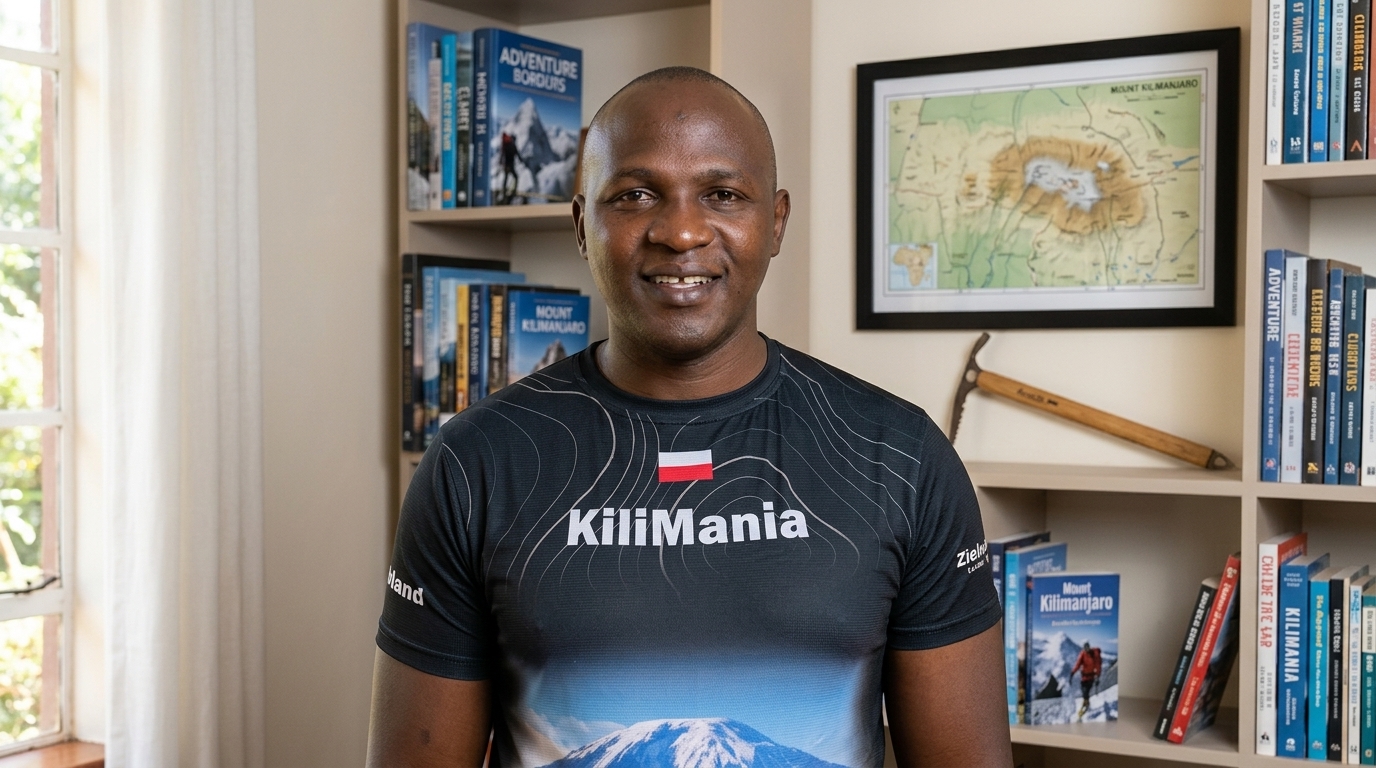
Senior Mountain Guide & Co-founder, Kilimania Adventure · KINAPA Licensed Guide (PDF)
Sabinus has guided on Mount Kilimanjaro since 2001, beginning as a porter on the Marangu Route. He has reached Uhuru Peak more than 300 times and has guided climbers of every age, background, and fitness level across the Barranco Wall on the Lemosho, Machame, Shira, and Umbwe routes. He is Co-founder of Kilimania Adventure, based in Moshi, Tanzania. Full biography →
Our guides answer questions about the Barranco Wall and every other section of the climb. No automated replies.
Verified reviews: TripAdvisor · Google Reviews
External references: KINAPA · TANAPA · KPAP · UNESCO World Heritage · World Nomads Travel Insurance
Disclosure: This article is published by Kilimania Adventure, a TATO-registered Kilimanjaro climbing and safari operator. The route, timing, and safety information above reflects our own guiding experience and operational records; where we reference figures we do not control (such as national park regulations or general Kilimanjaro fatality data), we link to the official or original source.
Climber quotes in this article are drawn from real Kilimania clients; verified reviews from past climbers are available on TripAdvisor and Google Reviews.
Mountaineering carries inherent risk, including altitude illness. This article is informational and does not replace a medical consultation or your operator’s own safety briefing. Last reviewed August 1, 2026.