Hidden Costs of Climbing Kilimanjaro: The Complete Budget You Actually Need
Last reviewed: July 2026 · Data source: 1,247+ guided ascents, 2019–2025, plus verified TANAPA, KPAP, and Tanzania Immigration fee schedules.
Quick Answer: Kilimanjaro Hidden Costs
A $2,200 Kilimanjaro package typically represents only 55–65% of your real total cost. Add gear ($595–$1,390 to buy or $155–$200 to rent), flights ($600–$1,900), crew tips ($600–$700 for a solo climber, or $200–$350 per person in a group of four sharing one crew), insurance ($150–$400), visas, vaccinations, accommodation and payment surcharges, and your realistic total lands between $4,400 and $7,500 per person for a 7-day climb from a Western departure city. See the full Kilimanjaro Cost 2026 breakdown for how package pricing itself is built.
Kilimanjaro Hidden Costs: Key Stats
| If Your Package Costs | Real Total Trip Cost |
|---|---|
| $1,800–$2,200 | $4,000–$5,500 |
| $2,200–$2,800 | $5,000–$7,000 |
| $3,000–$3,800 | $7,000–$10,000+ |
The Bottom Line
A legitimate 7-day Kilimanjaro climb, fully accounted for, rarely lands below $4,000 per person once flights, gear, tips, and insurance are included. Any “total cost” quote that stays under $3,000 has almost certainly left something out — usually tips, insurance, or park fees. It won’t say which one. That silence is the tell.
Take the checklist with you
A one-page PDF of every cost line in this guide, with blank fields for your own numbers. Fill it in as the quotes come back.
📧 Email me the checklist (PDF)
One email, no list subscription unless you ask for one. Your address stays private.
What a Standard Kilimanjaro Package Actually Includes
Short answer: Most operator packages cover park fees, licensed guides, porters, a cook, all meals on the mountain, camping equipment, and gate-to-gate transport. They do not cover flights, visas, insurance, personal gear, crew tips, or pre- and post-climb accommodation beyond one or two nights.
A $2,200 quote pays for the things that happen inside the park boundary: your guide team, your tent, your food, and the TANAPA fees that fund park operations. Everything that happens before you reach the gate or after you leave it sits outside that number. Knowing this distinction before you book is the single biggest predictor of whether you finish your trip feeling informed or feeling ambushed.
The climbers who feel blindsided are almost always the ones who treated the package price as the trip price. The two are related but never identical. If you have not yet decided what the experience itself involves, what the climb actually feels like is worth reading alongside the numbers.
Why Do Park Fees Make Up Such a Large Share of the Package?
Short answer: According to the TANAPA published fee schedule current to 2026, park entry costs $70 per person per day, plus camping or hut fees, plus a one-time rescue fee. For a 7-day climb these total roughly $820–$1,000 per person — close to half of a budget-tier package price.
| Fee Type | Rate (USD) | How Charged | 7-Day Approx. Total |
|---|---|---|---|
| Conservation / entry fee | $70 | Per person, per day | $490 |
| Camping fee | $50 | Per person, per night | $300 |
| Hut fee (Marangu only) | $60 | Per person, per night — replaces camping fee | $360 |
| Rescue fee | $20 | One-time, per person | $20 |
| Forest fee (Lemosho / Rongai) | $10–$20 | One-time, per person | $10–$20 |
| VAT | 18% | Applied by the Tanzania Revenue Authority to most fee categories | ~$148 |
| Total — 7-day camping route | — | All categories combined | $820–$1,000 |
| Total — 8 to 9 day routes | — | All categories combined | $1,100–$1,200 |
On a phone, each row stacks into its own card. Rotate your screen for the full grid view.
Because entry and camping are charged per day, route length is the single biggest lever on your park-fee total. Choosing between 6 vs 7 vs 8 days is a cost decision as much as an acclimatisation one — each extra day adds roughly $120 in fees before an operator adds anything for crew, food or transport.
These fees are identical no matter which operator you book with. TANAPA sets them nationally, and no operator receives a discount. If a quoted package price seems unusually low, park fees are the first place corners get cut. For the complete fee schedule by route and season, read our full Kilimanjaro Park Fees guide.
The Costs Before You Leave Home
What Does Kilimanjaro Gear Actually Cost?
Short answer: Buying a full cold-weather kit new runs $595–$1,390. Renting the bulky, expensive items in Moshi costs $155–$200 instead. Most first-time climbers save $300–$500 by renting what they will not use again.
Kilimanjaro’s altitude range means you need gear for both 30°C rainforest heat at the gate and −12°C wind on summit night at Barafu Camp (4,673 m above sea level). Most climbers do not already own this combination.
Must Buy — Cannot Be Rented for Hygiene or Fit Reasons
| Item | Why You Can’t Rent It | Cost (USD) |
|---|---|---|
| Moisture-wicking base layers | Hygiene | $40–$80 |
| Thermal mid-layer fleece | Personal fit for layering | $60–$120 |
| Insulated waterproof summit jacket | Summit-night safety gear | $150–$400 |
| Hiking boots, broken in | Must be worn in before arrival | $120–$300 |
| Insulated gloves | Fit and frostbite prevention | $30–$80 |
| Balaclava or thermal hat | Hygiene | $20–$40 |
| Hiking socks, 5+ pairs | Blister prevention requires fit | $60–$100 |
| Headlamp and spare batteries | Summit night begins at midnight | $25–$60 |
| Gaiters | Better owned than rented | $30–$60 |
| Daypack, 30–40 L | Personal fit | $60–$150 |
| Estimated total, buying new | — | $595–$1,390 |
Can Rent in Moshi
| Item | Rental Cost (Per Climb) |
|---|---|
| Sleeping bag, −15°C rated | $50–$80 |
| Trekking poles, pair | $20–$30 |
| Down jacket | $30–$50 |
| Duffle bag for porters | $15–$20 |
| Estimated rental total | $155–$200 |
Verdict: If Kilimanjaro is your only high-altitude trek, rent the sleeping bag, poles, and duffle in Moshi. That single decision saves $300–$500 compared with buying equivalent quality new. If you plan future high-altitude trips, buy your own sleeping bag — a good one lasts ten years.
“The two items climbers most regret cheaping out on are boots and gloves. A $50 pair of gloves fails at −10°C on summit night. A $70 pair works. That $20 difference decides whether you finish the night with full feeling in your fingers.” — Sabinus Msimba
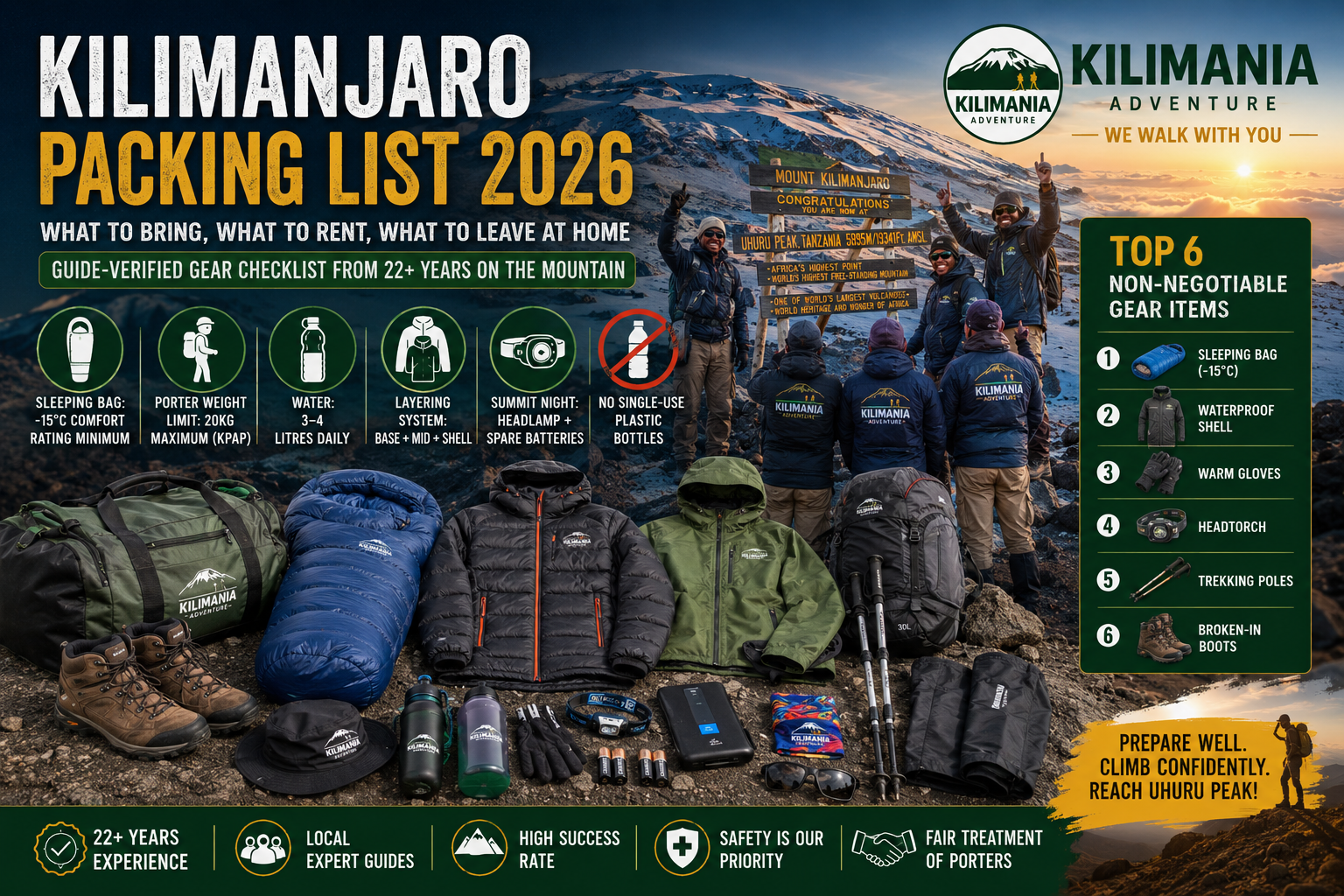
Read the complete Kilimanjaro gear guide for item-by-item buying advice, or the printable packing checklist for sleeping bag ratings, rental prices and the porter weight limit.
How Much Are Flights to Kilimanjaro?
Short answer: Round-trip flights to Kilimanjaro International Airport (JRO) run $600–$1,900 depending on departure city and season. Booking three to five months ahead typically saves 15–25% over last-minute fares.
| Departure Region | Round-Trip Cost (Economy) |
|---|---|
| Europe (London, Amsterdam, Frankfurt) | $600–$1,200 |
| USA East Coast | $900–$1,600 |
| USA West Coast | $1,200–$1,900 |
| Australia | $1,200–$1,800 |
| South Africa | $250–$500 |
Fly into Kilimanjaro International Airport (JRO), 45 minutes from Moshi. Routing through Nairobi adds four to six hours and increases the risk of a missed connection — avoid it unless it meaningfully reduces cost. Peak season flights (June–October, December–February) run 20–30% higher than shoulder months.
What Vaccinations and Medical Prep Should You Budget For?
Short answer: Yellow fever is required only if arriving from an endemic country. Most climbers budget $200–$600 for a combination of recommended vaccines, a travel clinic consultation, and a Diamox prescription for altitude.
| Item | Required or Recommended? | Cost (USD) |
|---|---|---|
| Yellow fever vaccine | Required from endemic countries only | $150–$250 |
| Hepatitis A | Recommended | $60–$150 |
| Typhoid | Recommended | $80–$140 |
| Tetanus booster | Recommended if 10+ years since last dose | $30–$80 |
| Diamox (acetazolamide) prescription | Recommended for altitude | $20–$80 |
| Travel clinic consultation | Recommended | $50–$200 |
| Total estimated medical prep | — | $200–$600 |
Get vaccinated four to six weeks before departure — several require time to take effect. Discuss Diamox with your doctor specifically in the context of your own medical history before deciding to use it. Physiology varies more than most planning guides admit; the research on how altitude affects men and women differently is worth reading before you assume your partner’s dose or pace will suit you.
Diamox reduces the likelihood of acute mountain sickness but does not eliminate the risk of HAPE or HACE at altitude. Anyone developing severe headache, confusion, or breathlessness at rest above 3,500 m should descend immediately and inform their guide — this is a medical decision, not a budgeting one. The CDC Yellow Book guidance on altitude illness sets out the recognised warning signs and ascent rates.
This article is written by mountain guides, not physicians, and is not medical advice. Discuss altitude medication and any pre-existing condition with a qualified doctor before you book.
What Does the Tanzania E-Visa Cost?
Short answer: As published by Tanzania Immigration for 2026, the e-visa costs $50 for most nationalities and $100 for US citizens, applied for online at immigration.go.tz. Processing takes five to ten business days, so apply at least two to three weeks before departure.
Pay by Visa or Mastercard through Chrome or Firefox. Common mistakes that delay approval: uploading a blurry passport photo instead of the data page, entering the wrong airport name, or using a third-party site that charges $100–$200 for the same $50 visa available directly from the government. Apply only through the official portal.
Costs During Your Climb
How Much Should You Really Tip Your Crew?
Short answer: According to KPAP tipping guidance, reviewed June 2026, budget $20–$25 per day for the lead guide, $15–$20 for an assistant guide, $15–$20 for the cook, and $8–$10 per porter per day. That works out at $600–$700 for a solo climber, or $200–$350 per person in a group of four sharing one crew.
Tips are not optional in practice, even though they are not contractually required. Base wages from the operator cover minimal living costs; tips make up a meaningful share of real income for guides, cooks, and porters who carry your gear, cook your food, and manage your safety at altitude for a week.
| Crew Role | Recommended Tip Per Day | 7-Day Total |
|---|---|---|
| Lead guide | $20–$25 | $140–$175 |
| Assistant guide | $15–$20 | $105–$140 |
| Cook | $15–$20 | $105–$140 |
| Porter (each) | $8–$10 | $56–$70 |
Why solo climbers pay more per person: a solo climber on a 7-day route still requires a lead guide, an assistant guide, a cook, and three to four porters — the same crew as a small group, but with nobody to share the tip pool. That puts a solo climber at $600–$700, while a group of four sharing one crew brings each person’s share down to $200–$350. The same arithmetic is why groups travelling together get the best value per head; our family Kilimanjaro climbing guide works through it for parents budgeting for three or four people at once. Always confirm with your operator whether their recommended tip is quoted per climber or per group before you do your own math.
Bring crisp USD bills dated 2013 or later — older or damaged notes are frequently refused by Tanzanian banks and exchange points. Cards do not work on the mountain, and ATMs in Moshi cap withdrawals around $150 per transaction. For the full ceremony, calculation tool, and group-size breakdowns, read our complete Kilimanjaro Tipping Guide.
What Personal Spending Should You Expect on the Mountain?
Short answer: Budget $30–$50 for the climb itself. There are no shops on the trail, only occasional soft drinks or snacks at gate areas for $2–$5 each.
Your operator provides all meals, water, and camp supplies, so this is a small buffer rather than a real budget line. Many climbers also bring $30–$80 of personal snacks — energy gels, electrolyte powder, protein bars — for the long push from Barafu to Stella Point and on to Uhuru Peak, when appetite drops at altitude but calorie needs do not. Guides will tell you hakuna matata about the pace on lower days; summit night is the one day that rule does not apply, and our summit night hour by hour breakdown explains exactly why.
Costs After Your Climb
Why Does Travel Insurance Matter More on Kilimanjaro Than on a Normal Trip?
Short answer: Standard travel insurance typically excludes mountaineering above 4,000–5,000 m, and Kilimanjaro’s summit sits at 5,895 m. Without altitude-specific coverage, helicopter evacuation costs $5,000–$15,000 out of pocket, and serious emergencies can exceed $30,000.
| Provider | Typical Altitude Coverage | Approx. Cost, 7-Day Trip |
|---|---|---|
| World Nomads | Up to 6,000 m | $150–$280 |
| IMG Global | 6,000 m+ with adventure rider | $150–$300 |
| Allianz | Varies, adventure sports upgrade required | $200–$350 |
Kilimania receives no commission from any insurer listed here. Verify current limits on each provider’s own policy documentation before buying.
Look specifically for a policy that names “Mount Kilimanjaro” or states coverage to 6,000 metres — vague “high-altitude trekking” language is not enough. Every reputable operator, including Kilimania, will ask for proof of this coverage before your climb.
“In August 2023 a climber developed HAPE at Barafu Camp at roughly 3am. We descended him immediately with oxygen to a lower altitude for helicopter pickup. The flight to Moshi hospital cost $8,400. His World Nomads policy covered it in full. His climbing partner had skipped the altitude rider to save $150 — had he been the one who got sick, that bill would have been entirely his.” — Sabinus Msimba
Read the full Kilimanjaro Travel Insurance guide for a complete policy comparison.
Nine Costs That Do Not Appear on Any Operator’s Exclusion List
Short answer: Card surcharges, wire fees, deposit terms, camp supplements and connectivity typically add $250–$700 to a climb, and almost no operator lists them under “exclusions” because they are transaction charges rather than services. These are the lines that turn a well-planned budget into an overspend.
| Cost | Typical Amount | Why It Catches People Out |
|---|---|---|
| Credit-card surcharge on your balance payment | 3–5% (≈ $72–$120 on a $2,400 balance) | Quoted as a payment method, not a price |
| International bank wire fee | $25–$50 at each end | Your bank and the receiving bank both charge |
| Your own card’s foreign transaction fee | ~3% of every payment | Applies to the deposit and the balance separately |
| Deposit forfeit or date-change fee | $200–$500 | Buried in terms most climbers skim |
| Crater Camp supplement | ~$100 per night plus an extra climbing day | Presented as an upgrade, priced as an add-on |
| Private toilet rental | $100–$180 per climb | Standard on premium tiers, extra on budget tiers |
| Single tent or single room supplement | $150–$350 | Applies automatically to solo travellers |
| Local SIM and data for the trek | $10–$25 | Roaming instead can cost ten times as much |
| ATM withdrawal fees in Moshi | $5–$10 per withdrawal | A ~$150 per-transaction cap means several withdrawals for a tip pool |
One distinction matters more than all nine combined. Trip cancellation cover and medical evacuation cover are two different products. Most climbers buy only the second. If you cancel eight weeks out because of a work crisis or a family illness, an evacuation-only policy pays nothing toward the deposit you forfeit. Ask your insurer which of the two you are actually holding, and ask your operator in writing what the deposit terms are before you pay it.
Add these nine lines to your working budget before you compare quotes. They are also the reason a headline price of $1,750 and a headline price of $2,100 can end up costing the same — one operator absorbs card fees and includes a private toilet, the other does not. If price is the deciding factor for you, read is a cheap Kilimanjaro climb worth it before you commit.
How to Budget for Kilimanjaro in Six Steps
Short answer: Price your gear, book flights and visa, arrange medical preparation, calculate crew tips for your actual group size, add the charges nobody lists, then add all of it to your package price. Total time: about 45 minutes with a spreadsheet open.
- Price your gear. Decide between buying new ($595–$1,390) or renting in Moshi ($155–$200), based on whether you’ll climb again.
- Book flights and visa. Budget $600–$1,900 for flights to JRO and $50–$100 for the Tanzania e-visa, applied at least two to three weeks ahead.
- Arrange medical preparation. Budget $200–$600 for vaccinations and a Diamox prescription, and confirm altitude-rated travel insurance covering at least 6,000 metres.
- Calculate crew tips correctly. Budget $600–$700 for a solo climber, or $200–$350 per person in a group of four sharing one crew, following KPAP guidance.
- Add the charges nobody lists. Add card surcharges, wire fees, deposit terms, accommodation at $25–$150 per night, and $50–$80 for a post-climb celebration.
- Total your real budget. Add your operator package price to all of the above for a realistic total, typically $4,400–$7,500 per person for a 7-day climb.
Kilimanjaro Total Trip Cost Calculator
Estimate your real Kilimanjaro budget by adding all major expenses beyond the operator package. Default values reflect a mid-range 7-day climb for a solo traveller from the United States.
Work out your own total
Is a Cheap Kilimanjaro Quote Worth the Risk?
Short answer: An operator quoting below roughly $2,000 for a 7-day climb is very likely cutting one of three things: park fee compliance, crew wages, or safety equipment. None of those are places to save money.
Park fees alone run $820–$1,000 for seven days, regardless of operator. Add minimum legal crew wages, food, transport, and basic camping equipment, and the fixed cost floor for a compliant 7-day climb sits well above $1,500 before any profit margin. A quote materially below that is mathematically unable to cover everything it claims to include.
Choosing an operator below this floor often means poorly maintained tents, guides with limited medical or rescue training, underpaid and overloaded porters, and measurably lower summit success rates. This is not a guess — it follows directly from where the missing money has to come from. For a full vetting checklist before you book with anyone, read How to Choose a Kilimanjaro Operator.
| Cheap Operator | Ethical Operator |
|---|---|
| Underpaid porters | KPAP-compliant wages |
| Old, worn tents | Modern four-season equipment |
| Limited or no oxygen | Full safety and oxygen kit |
| Minimal guide training | Wilderness First Responder-trained guides |
Cost is not the only reason to pause. There are also situations where the honest answer is that this climb is not the right trip this year — we set out ten honest reasons not to climb for anyone weighing that up.
📲 If you’d like a second opinion on a quote you’ve already received — no obligation, just a line-by-line check — WhatsApp us and we’ll tell you honestly what it does and doesn’t cover.
The Complete Hidden Cost Checklist
Print this list. Fill in your own numbers. Add your operator package price for your real total.
Pre-departure
- Gear, buying new: $595–$1,390
- Gear, renting in Moshi: $155–$200
- Flights: $600–$1,900
- Tanzania e-visa: $50–$100
- Vaccinations and medical prep: $200–$600
- Travel insurance, altitude-rated: $150–$400
- Card surcharge on deposit and balance: 3–5%
- Bank wire fees, both ends: $25–$50 each
- Your card’s foreign transaction fee: ~3%
- Single tent or single room supplement, if solo: $150–$350
During the Climb
- Crew tips: $600–$700 solo, or $200–$350 per person in a group of four
- Personal spending and snacks: $60–$130
- Local SIM and data: $10–$25
- Crater Camp supplement, if added: ~$100 per night
- Private toilet rental, if not included: $100–$180
After the Climb
- Extra accommodation nights: $25–$150 per night
- Celebration meal and drinks: $50–$80
- ATM withdrawal fees in Moshi: $5–$10 each
- Optional safari extension: $900–$1,500
- Optional Zanzibar beach extension: $400–$1,400
Total Budget by Tier
| Tier | Hidden Costs (Beyond Package) | Typical Package Price | Realistic Total |
|---|---|---|---|
| Budget | $2,000–$2,800 | $1,800–$2,200 | $3,800–$5,000 |
| Mid-range | $2,800–$4,000 | $2,200–$2,800 | $5,000–$6,800 |
| Premium | $4,500–$6,500 | $3,000–$3,800 | $7,500–$10,300 |
Client feedback
“Before contacting Kilimania, I thought my entire trip would cost around $3,000. After adding flights, insurance, gear, and tips, my final budget came to $5,600. Having the complete breakdown before booking prevented surprises.”
A Real Example: 7-Day Lemosho From New York
| Cost Category | Amount (USD) |
|---|---|
| Operator package, 7-day Lemosho | $2,400 |
| Round-trip flights, NYC–JRO | $1,100 |
| Gear (buy essentials, rent sleeping bag and poles) | $850 |
| Travel insurance, altitude-rated | $220 |
| Vaccinations and Diamox | $380 |
| Tanzania e-visa | $50 |
| Crew tips, solo climber | $650 |
| Card surcharge and wire fees | $145 |
| Snacks and personal spending | $90 |
| Extra night in Moshi pre-climb | $80 |
| Celebration dinner | $60 |
| Total trip cost | $6,025 |
The package here represents 40% of the total. Hidden costs make up the other 60% — and every line above is a real, checkable number, not a guess made after arrival.
The arithmetic shifts sharply once people travel together. For a worked comparison with shared crew, shared rooms and a shared tip pool, see an 8-day Lemosho climb with a family, where the per-person total lands well below this solo figure.
Still deciding which route fits you best? The route comparison guide lines up all seven against difficulty, scenery, and crowd levels.
Kilimanjaro Cost Facts at a Glance
Every figure below is dated and attributable. Use it to sanity-check any quote you receive.
- Park entry fee
- $70 per person per day (TANAPA, 2026)
- Camping fee
- $50 per person per night (TANAPA, 2026)
- Hut fee, Marangu route
- $60 per person per night, replacing the camping fee (TANAPA, 2026)
- Rescue fee
- $20 one-time per person (TANAPA, 2026)
- VAT on park fees
- 18%, applied by the Tanzania Revenue Authority
- Total park fees, 7-day route
- $820–$1,000 per person including VAT
- Crew tips, solo climber
- $600–$700 for 7 days (KPAP guidance, June 2026)
- Crew tips, group of four
- $200–$350 per person for 7 days (KPAP guidance, June 2026)
- Tanzania e-visa
- $50 most nationalities, $100 US citizens (Tanzania Immigration, 2026)
- Altitude-rated travel insurance
- $150–$400 for a 7-day trip, must cover 6,000 m
- Helicopter evacuation, uninsured
- $5,000–$15,000 out of pocket
- Fixed-cost floor, compliant 7-day climb
- Roughly $1,500–$2,000 before any profit margin
- Realistic all-in total, 7-day climb
- $4,400–$7,500 per person from a Western departure city
- Share of the true total covered by a package price
- 55–65%
Why Trust This Breakdown
- Base: Moshi, Kilimanjaro Region, Tanzania — a physical office, not an online-only booking desk
- TATO registration: verify Kilimania’s membership at tatotz.org
- Climbing experience: Sabinus Msimba has guided 300+ successful summit climbs over 22 years
- Transparency commitment: we publish real park fee data, tipping math, and the conditions under which a cheap quote becomes a risk
- Reach us directly on +255 756 449 990, or contact the team in Moshi seven days a week
How these figures were produced: cost ranges are derived from Kilimania’s operational records covering 1,247 guided ascents between 2019 and 2025, cross-checked against published TANAPA, KPAP and Tanzania Immigration schedules current to June 2026. Package prices reflect our own quoted rates. Third-party costs such as flights, insurance and vaccinations are sampled ranges, not quotes, and will vary by provider and departure city.
FAQ: Hidden Costs of Climbing Kilimanjaro
Some costs — flights, your own gear, home-country vaccinations — are genuinely outside an operator’s control. Others, like tips and insurance, are variable based on your choices. A transparent operator separates these clearly rather than folding a guess into the headline price.
Crew tips. Budget $600–$700 for a solo climber, or $200–$350 per person in a group of four sharing one crew. Confusing the two is the most common budgeting mistake.
You can, but you would be personally liable for the $5,000–$15,000 cost of a helicopter evacuation if you develop HAPE or HACE above 4,500 m. Every reputable operator requires proof of altitude-rated coverage before you climb.
For a 7-day climb from a Western departure city, a realistic total — package plus every hidden cost — runs $4,400–$7,500 per person, depending on your gear choices, group size, and accommodation tier.
Yes. TANAPA sets park fees nationally; no operator receives a discount. A quote that omits or understates park fees, rather than itemising the roughly $820–$1,200 they actually cost, is a warning sign.
Your gear cost can drop to $100–$200 for Kilimanjaro-specific items like a headlamp and gaiters — but verify your existing sleeping bag is rated for −15°C or colder. A three-season bag is not warm enough for Barafu Camp.
Not if the price sits below the fixed-cost floor of roughly $1,500–$2,000 for 7 days. Below that level, something is almost always being cut — usually crew wages, safety equipment, or park fee compliance.
Most do. A 3–5% card surcharge on a $2,400 balance adds $72–$120, and an international bank wire costs $25–$50 at each end. Ask which payment methods carry a surcharge before you accept a quote, and factor your own card’s foreign transaction fee on top.
Getting fit for the climb matters as much as budgeting for it. A 12-week training calendar — hiking progression, pack-weight buildup, peak and taper — is available if you want a structured plan rather than guesswork.
Conclusion
A complete Kilimanjaro budget for most international climbers lands between $4,400 and $7,500 per person once gear, flights, tips, insurance and payment charges are added to the package. The climbers who feel ambushed by costs are the ones who treated a single number as the whole picture.
- The largest line people miss: crew tips. Solo climbers pay $600–$700 because they fund an entire crew alone; a group of four pays $200–$350 each for the same service.
- The line never to cut: altitude-rated travel insurance. It costs $150–$400 and stands between you and a $5,000–$15,000 evacuation bill.
- The line most people over-buy: gear. Renting a sleeping bag, poles and duffle in Moshi saves $300–$500 if this is your only high-altitude trek.
If you are still weighing the trip itself rather than the budget, read what the climb actually feels like and our ten honest reasons not to climb before you commit a deposit. Start your route planning with the Climbing Kilimanjaro Guide 2026.
Disclosure: This article is written by Kilimania Adventure, a TATO-registered safari and Kilimanjaro operator based in Moshi, Tanzania. We have a commercial interest in Tanzania safari and Kilimanjaro bookings. We receive no commission from any insurance provider, airline or gear retailer named here. All prices reflect real 2026 costs from our own operations and verified government fee schedules. We encourage you to compare our quotes with at least two other TATO-registered operators before booking.
Last reviewed: July 2026. Review schedule: updated each November following TANAPA’s annual tariff announcement. Fee changes applied within 72 hours of official publication.
Park fees, visa costs, and conservation area charges are set by government authorities and can change without advance notice. All figures reflect published 2026 rates. Verify current fees at tanzaniaparks.go.tz before booking. Request a gate receipt during your climb to confirm your operator paid the correct published amount.
For International Travelers
All prices are in USD. Current approximate conversions: $2,000 ≈ £1,560 · €1,870 · AU$3,000. Local currency is the Tanzanian shilling (TZS), but park fees and operator balances are quoted and paid in USD.
Flights to Kilimanjaro International Airport (JRO)
- New York or Los Angeles: $900–$1,900 return
- London: £550–£900 return
- Sydney: AU$1,400–AU$2,200 return
Tanzania e-visa: $50 most nationalities, $100 US citizens. Apply at immigration.go.tz at least two to three weeks before departure. Use a Visa or Mastercard credit card, and Google Chrome or Firefox.
Yellow fever certificate: required only if arriving from an endemic country. Not required for direct flights from the USA, UK, EU, or Australia.
Pre-climb accommodation in Moshi: $25–$150+ per night depending on tier. Book one night before and at least one night after your climb.
Response times: Kilimania Adventure operates on East Africa Time (EAT, UTC+3) from Moshi, Tanzania. Messages sent after 6:00 PM EAT receive responses the following morning. All quote requests receive a reply within 12 hours, seven days per week.
Plan Your Kilimanjaro Climb — Get a Fast, Itemized Quote
Tell us your travel dates, group size, and budget tier. We return a full itemized quote within 12 hours — park fees, crew tip estimate, insurance requirement, payment charges, and a complete inclusion and exclusion list. No costs discovered at the gate.
Verify our TATO registration: tatotz.org · Official park fees: tanzaniaparks.go.tz · KINAPA · e-visa portal · KPAP porter welfare
Author
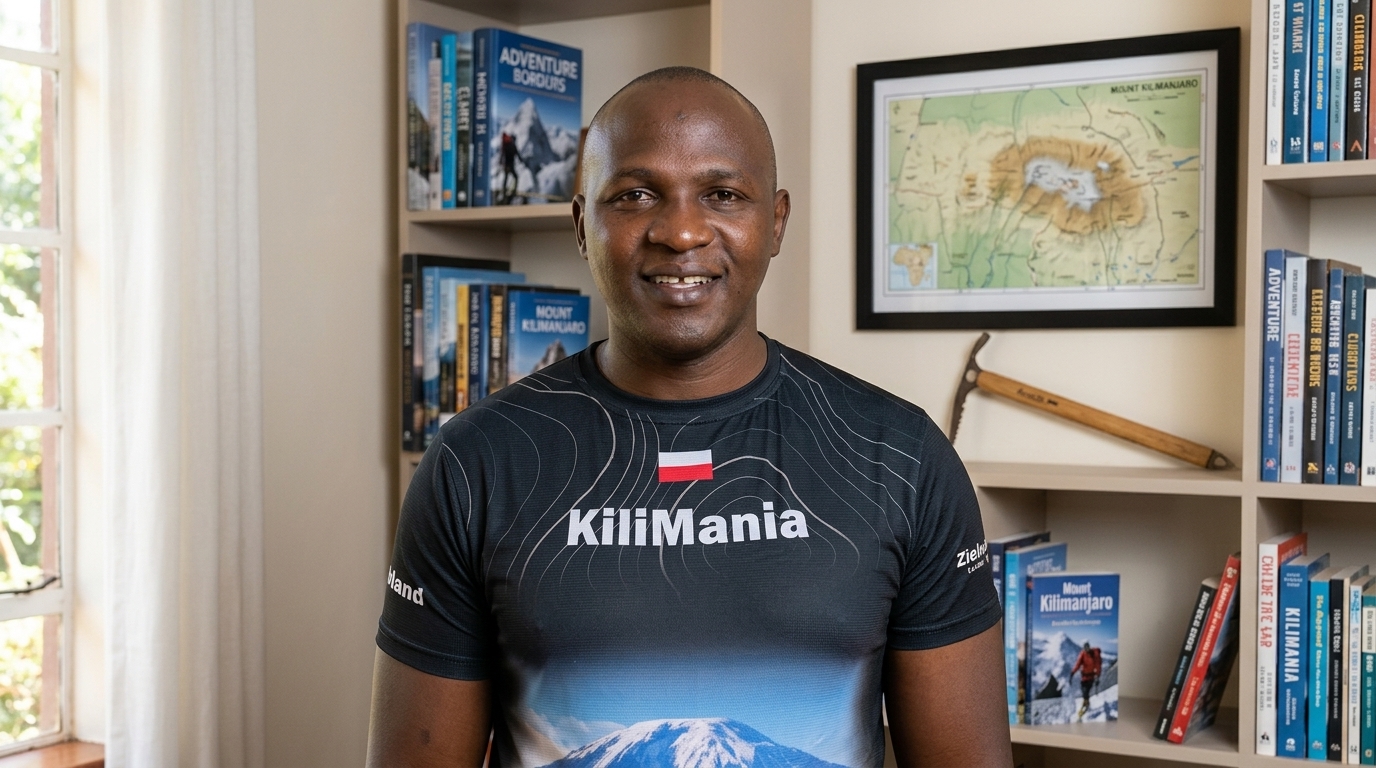
Sabinus Msimba
22+ years guiding on Mount Kilimanjaro · 300+ personal Uhuru Peak summits · KINAPA-licensed since 2003 · Wilderness First Responder certified. Career began in 2001 as a porter on the Marangu Route.
All route observations, gear recommendations, and fee data in this article are drawn from Kilimania’s operational records and verified before every departure.
We Walk With You.