Scenic Lemosho Route with high success rates & fewer crowds
Kilimania Adventure is verified and reviewed on:








Licensed and registered with:


At a Glance — 5-Day Marangu Route
- Route
- Marangu (Coca-Cola Route)
- Duration
- 5 Days / 4 Nights
- Start Point
- Marangu Gate — 1,870 m
- Summit
- Uhuru Peak — 5,895 m
- Accommodation
- Mountain Huts (not tents)
- Highest Camp
- Kibo Hut — 4,703 m
- Round-Trip Distance
- ~72 km (45 miles)
- Overall Challenge
- Challenging (altitude)
- Best Seasons
- Jan–Mar & Jun–Oct
- Joining Price
- $1,450 per person
- Private Group From
- $1,300 per person (6 pax)
- Deposit
- $100 per person
- Operator
- Kilimania Adventure, Moshi
📋 Contents of This Guide
Decision Guide
Is the 5-Day Marangu Route Right for You?
This section is here to help you make an honest decision before booking — the right route for your situation matters more than the most popular one.
✓ Choose 5 Days If:
- You have limited time and cannot extend to 6 days
- You have previous trekking experience above 3,500 m
- You strongly prefer fixed hut accommodation over camping
- You can walk 6–8 hours comfortably with a daypack
- You understand the compressed acclimatization schedule and accept the trade-off
→ Consider a Different Option If:
- You have one extra day — choose the 6-day Marangu Route instead
- You have no prior high-altitude experience
- You want the strongest possible acclimatization schedule — consider 8-day Lemosho
- You prefer varied scenery and tented camps — consider Machame
Important: Fitness ≠ Acclimatization
Physical fitness determines how well you walk. It does not determine how well you acclimatize. Some highly trained athletes turn back from Kilimanjaro due to acute mountain sickness (AMS). Individual altitude response is physiological, not predictable from fitness alone — one reason Kilimania carries emergency oxygen and monitors health daily on every climb.
Guide Perspective
The 5-day itinerary is achievable, but it gives the mountain less time to work against you. When a climber’s schedule is flexible, Kilimania’s guide team generally recommends the 6-day version for the extra acclimatization night. — Sabinus Msimba, Senior Guide & Founder, Kilimania Adventure
Comparison
5-Day vs 6-Day Marangu Route
The only structural difference is one additional night at Horombo Hut (3,720 m) in the 6-day itinerary — a difference that meaningfully changes the acclimatization profile.
5-Day Marangu
Days on mountain5
Nights in huts4
Acclimatization dayNone
Time at Horombo1 night
Recommended forLimited time, experienced trekkers
Price from$1,300 pp (6 pax)
Kilimania Recommends
6-Day Marangu
Days on mountain6
Nights in huts5
Acclimatization dayYes — Horombo
Time at Horombo2 nights
Recommended forAll experience levels
PriceView pricing
Kilimania’s recommendation: if your schedule allows, the 6-day Marangu Route gives a meaningfully better acclimatization margin. On a strict 5-day schedule, with the trade-off understood, the 5-day itinerary is a viable choice. See open dates on the Kilimanjaro Joining Calendar.
Day-by-Day Itinerary
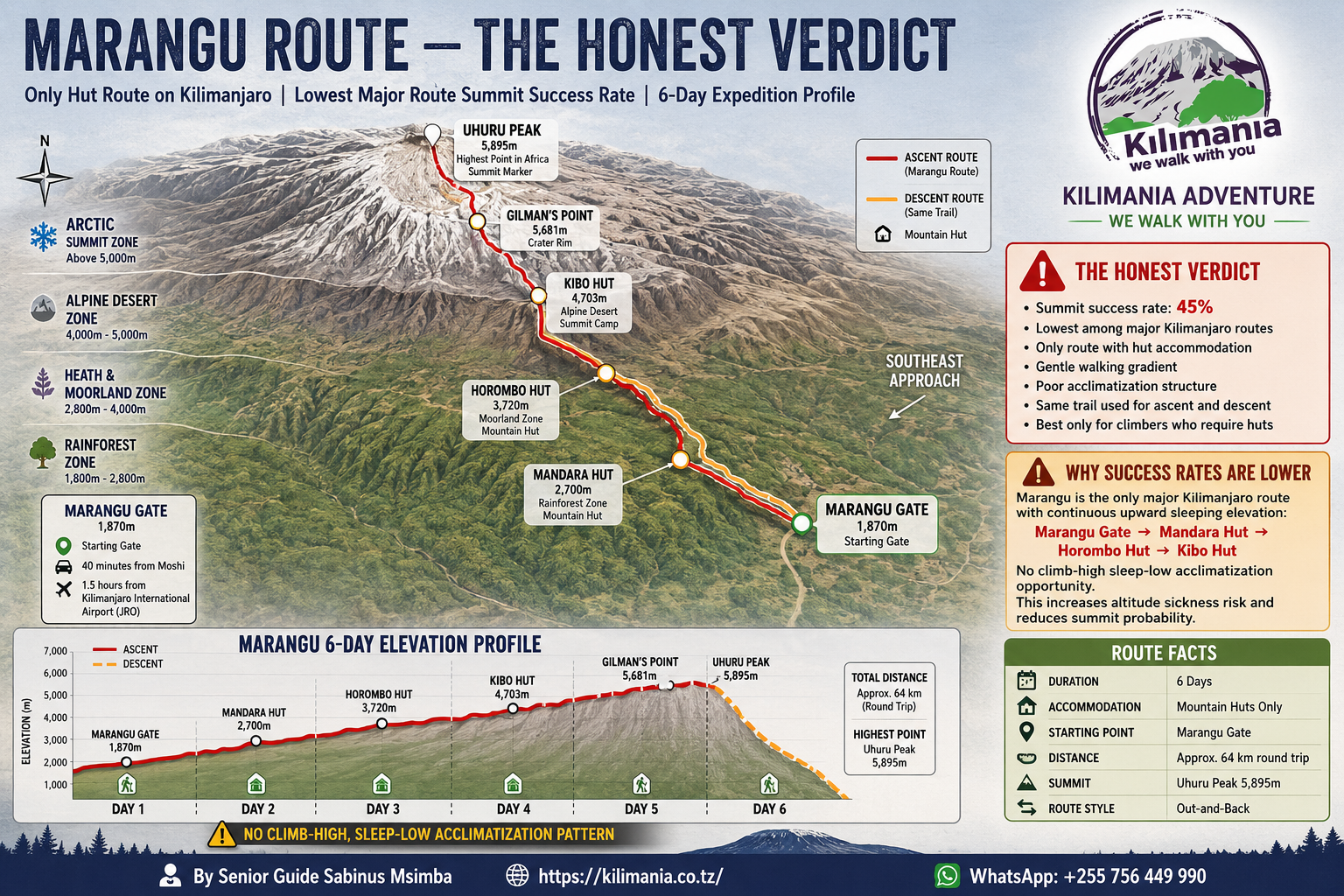
5-Day Marangu Route — Complete Itinerary
The verified 5-day itinerary as operated by Kilimania Adventure, with elevations, distances, approximate hiking times, terrain, accommodation and meals for every day.
0
Day 0 — Pre-Climb Briefing & Gear Check · Moshi
📍 Moshi Hotel🏨 Hotel accommodation
The evening before your climb, the Kilimania guide team meets you at your Moshi hotel for a complete pre-climb briefing: itinerary, altitude and safety protocols, gear inspection and a question-and-answer session.
Guide Note: Arrive in Moshi rested — this session is when we align on expectations and check your gear before you’re on the mountain.
1
Day 1 — Marangu Gate (1,870 m) → Mandara Hut (2,720 m)
⏱ 4–5 hours📏 ~8 km⬆ +850 m🌿 Rainforest🏠 Mandara Hut🍽 Lunch, Dinner
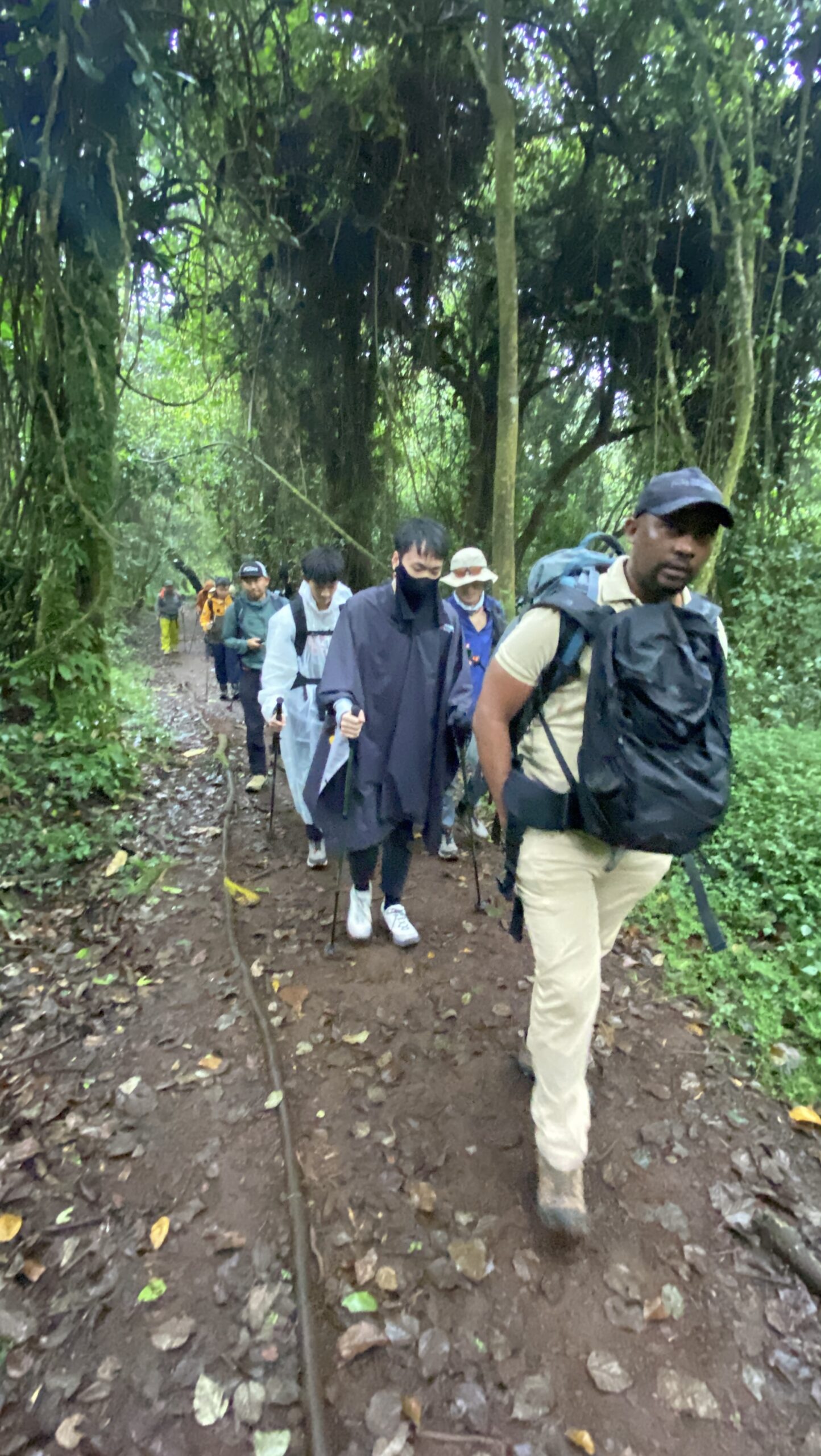
After breakfast in Moshi, a Kilimania vehicle transfers you to Marangu Gate (1,870 m) for park registration. The trek begins into dense montane rainforest where colobus and blue monkeys are commonly seen.
The trail is wide and well-marked, the gentlest of the five days. Most groups reach Mandara Hut (2,720 m) in 4–5 hours.
Guide Tip: The first day feels comfortable — use it to find your pace and drink water consistently. The mountain gets harder from Day 2 onward.
2
Day 2 — Mandara Hut (2,720 m) → Horombo Hut (3,720 m)
⏱ 6–8 hours📏 ~12 km⬆ +1,000 m🏔 Heath & Moorland🏠 Horombo Hut🍽 B, L, D
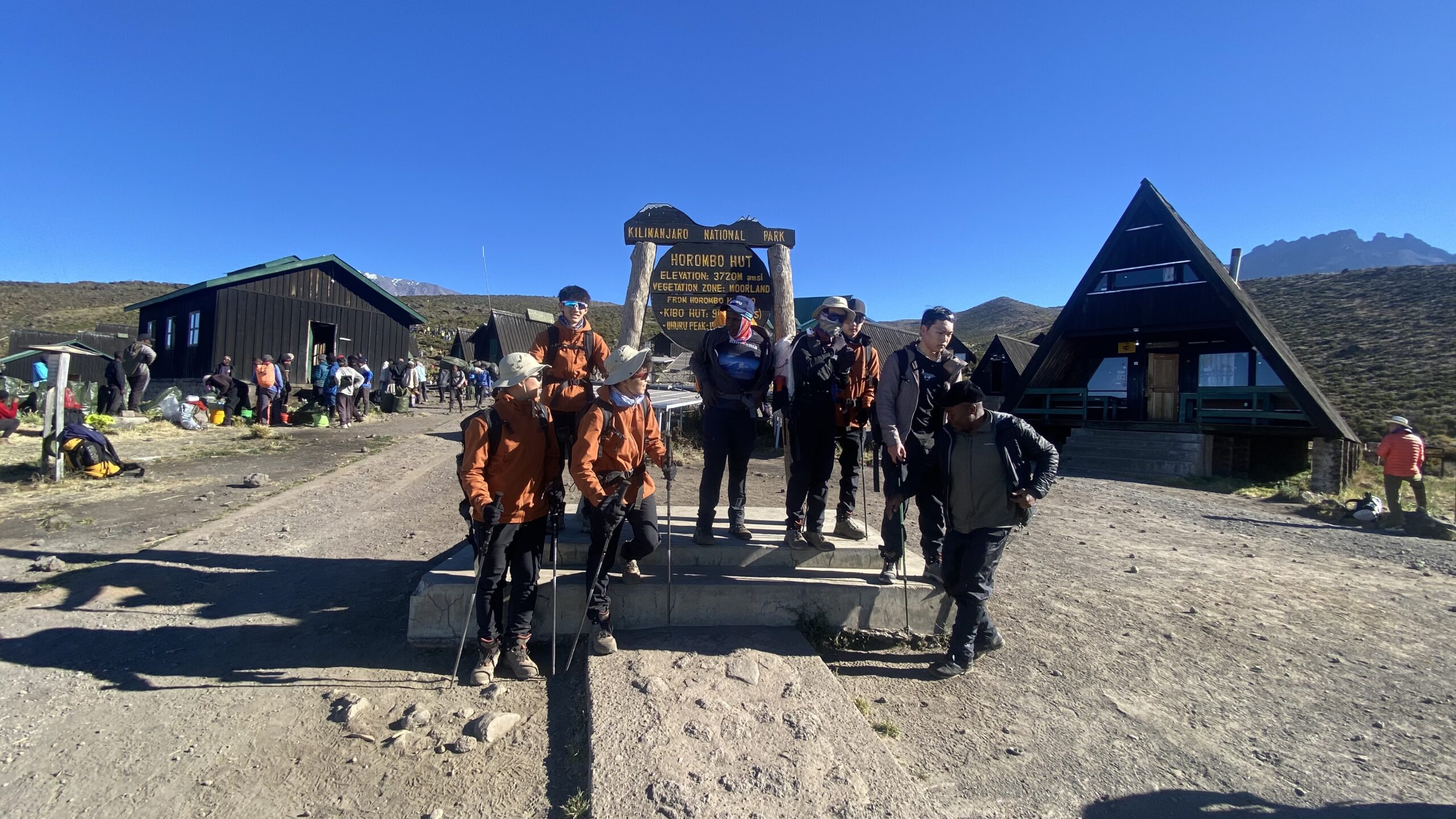
The forest gives way to open heath moorland, with Mawenzi Peak visible to the east. Mild altitude effects — headache, slight breathlessness — begin for many climbers above 3,000 m; this is a normal acclimatization response.
Kilimania guides monitor the group and check oxygen saturation on arrival at Horombo Hut (3,720 m). On the 5-day schedule you spend one night here; the 6-day version adds a second night for acclimatization.
Guide Note: Drink water, eat your dinner even with a reduced appetite, and sleep early.
3
Day 3 — Horombo Hut (3,720 m) → Kibo Hut (4,703 m)
⏱ 6–7 hours📏 ~10 km⬆ +983 m🏜 Alpine Desert🏠 Kibo Hut🍽 B, L, early D
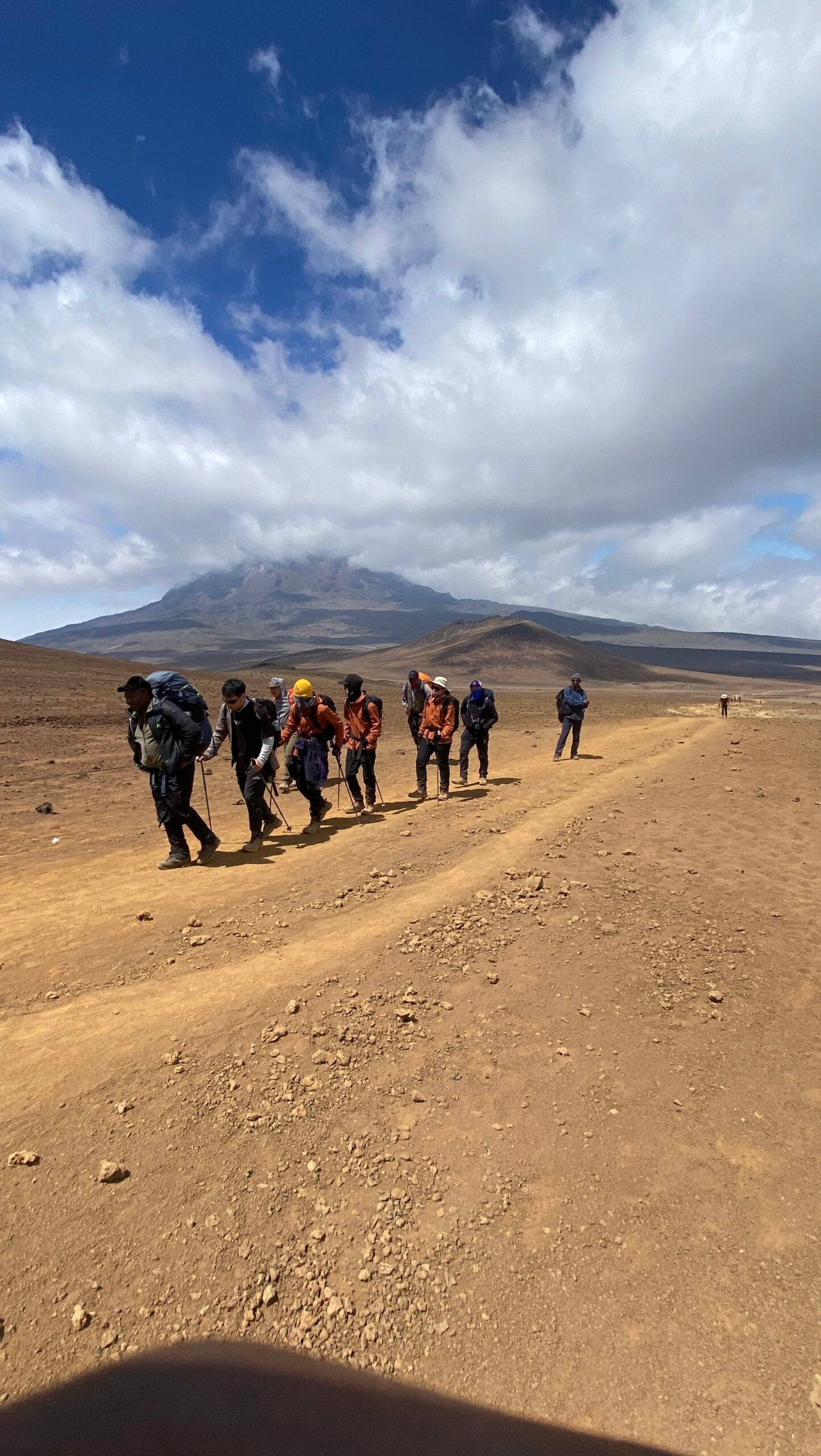
Day 3 crosses the Saddle — a wide, near-lunar alpine desert between Mawenzi Peak and the dome of Kibo. Pace slows deliberately (pole pole) as altitude effects intensify above 4,000 m.
You arrive at Kibo Hut (4,703 m) by early afternoon, with dinner around 5–6 pm. Lay out summit clothing before resting so you can dress quickly at midnight.
Guide Tip: Eat dinner even if appetite is poor — your body needs fuel for the next 12–15 hours.
4
Day 4 — Summit Night: Kibo Hut → Gilman’s Point (5,681 m) → Uhuru Peak (5,895 m) → Horombo Hut
⏱ ~12–15 hours total📏 ~23 km⬆ +1,192 m⬇ −2,175 m❄ Arctic Zone🏠 Horombo Hut
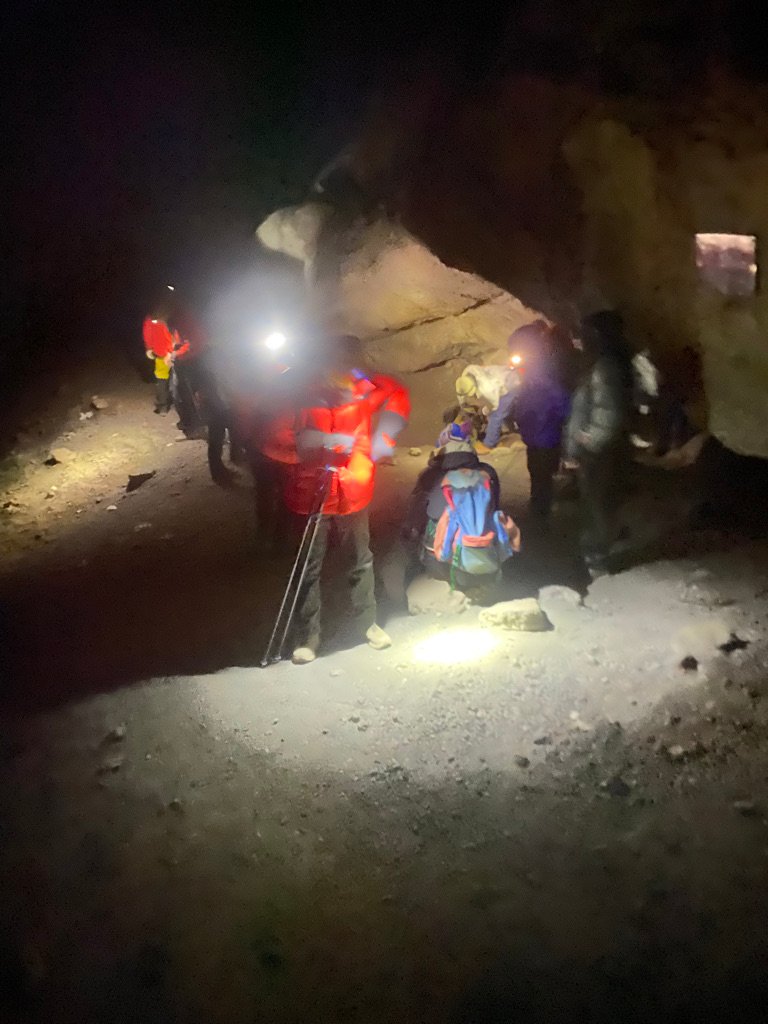
Your guide wakes you around 11:30 pm with warm tea. After dressing in summit layers, the team checks oxygen saturation and pulse for every climber. The group sets off around midnight.
Kibo Hut → Gilman’s Point (5,681 m)
The ascent climbs steep volcanic scree in complete darkness; at this altitude the air holds roughly 50% of the oxygen available at sea level. Guides set a slow, consistent pace with rest stops every 45–60 minutes, reaching Gilman’s Point after roughly 5–6 hours.
Gilman’s Point → Uhuru Peak (5,895 m)
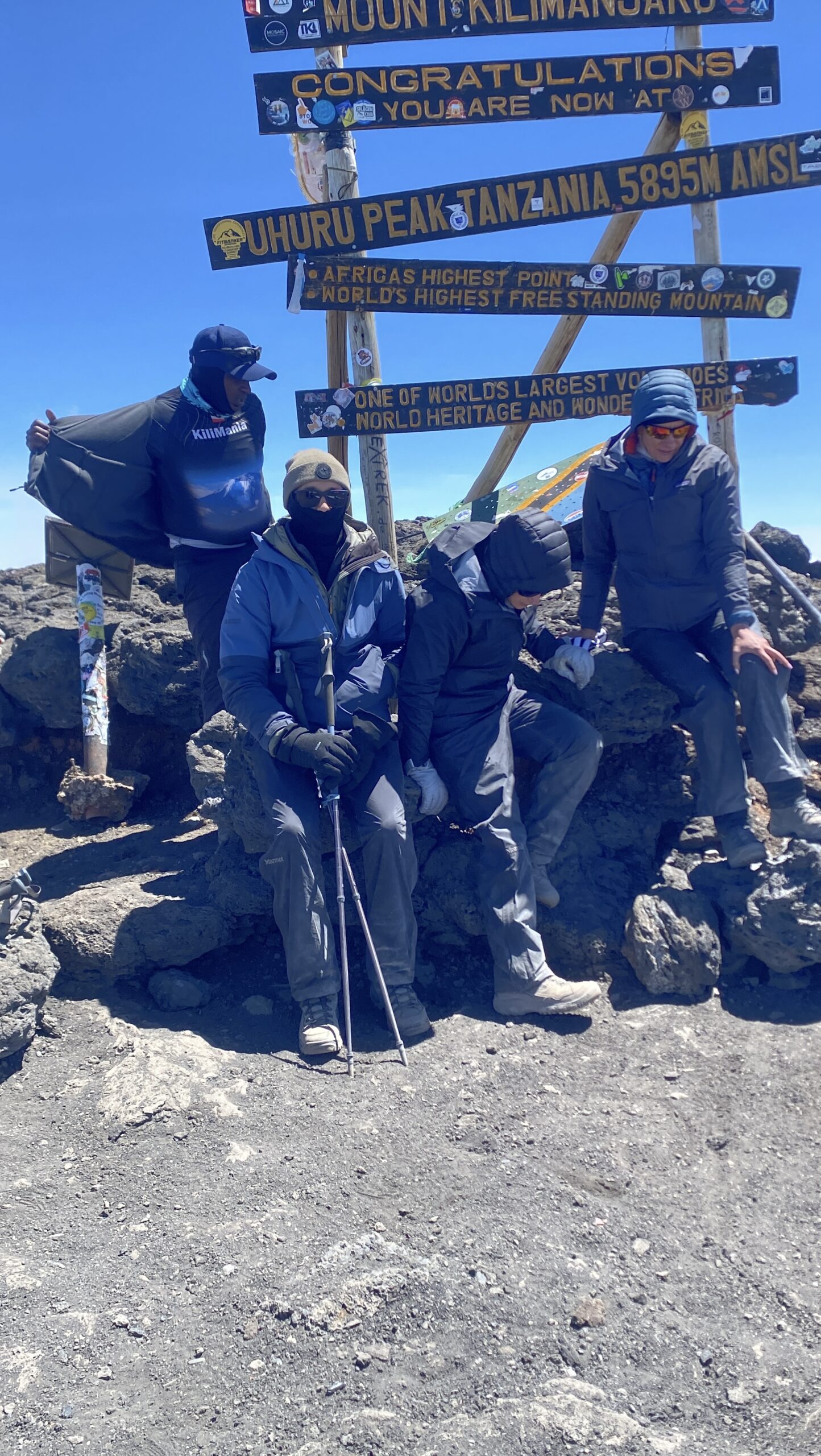
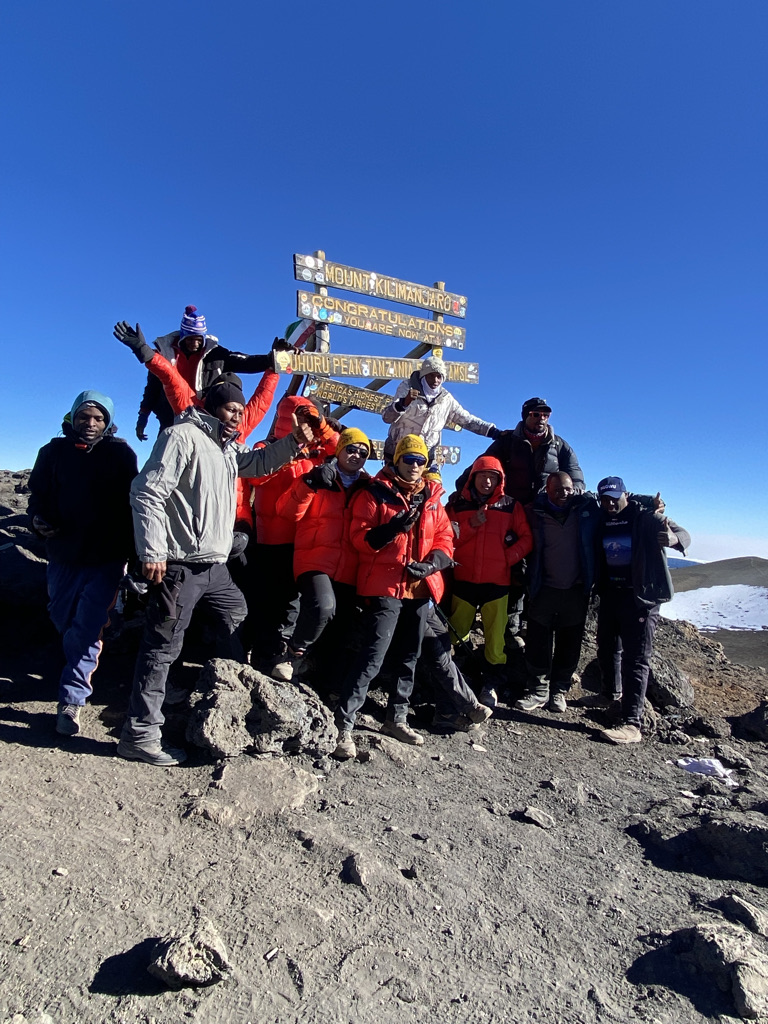
From Gilman’s Point the trail follows the crater rim to Uhuru Peak — roughly 45–90 minutes further, weather permitting.
⚠ Summit Is Never Guaranteed
If a guide assesses continuing as medically unsafe, descent is recommended immediately. Safety takes priority over summit achievement at all times.
Descent — Uhuru Peak → Kibo Hut → Horombo Hut
The descent retraces to Kibo Hut, then continues to Horombo Hut (3,720 m) for overnight — lower altitude brings immediate relief from altitude symptoms.
Guide Tip: Trekking poles protect tired knees on the long descent.
5
Day 5 — Horombo Hut (3,720 m) → Marangu Gate (1,870 m) → Moshi
⏱ 5–6 hours📏 ~20 km⬇ −1,850 m🌿 Rainforest🏨 Moshi Hotel🍽 B, L
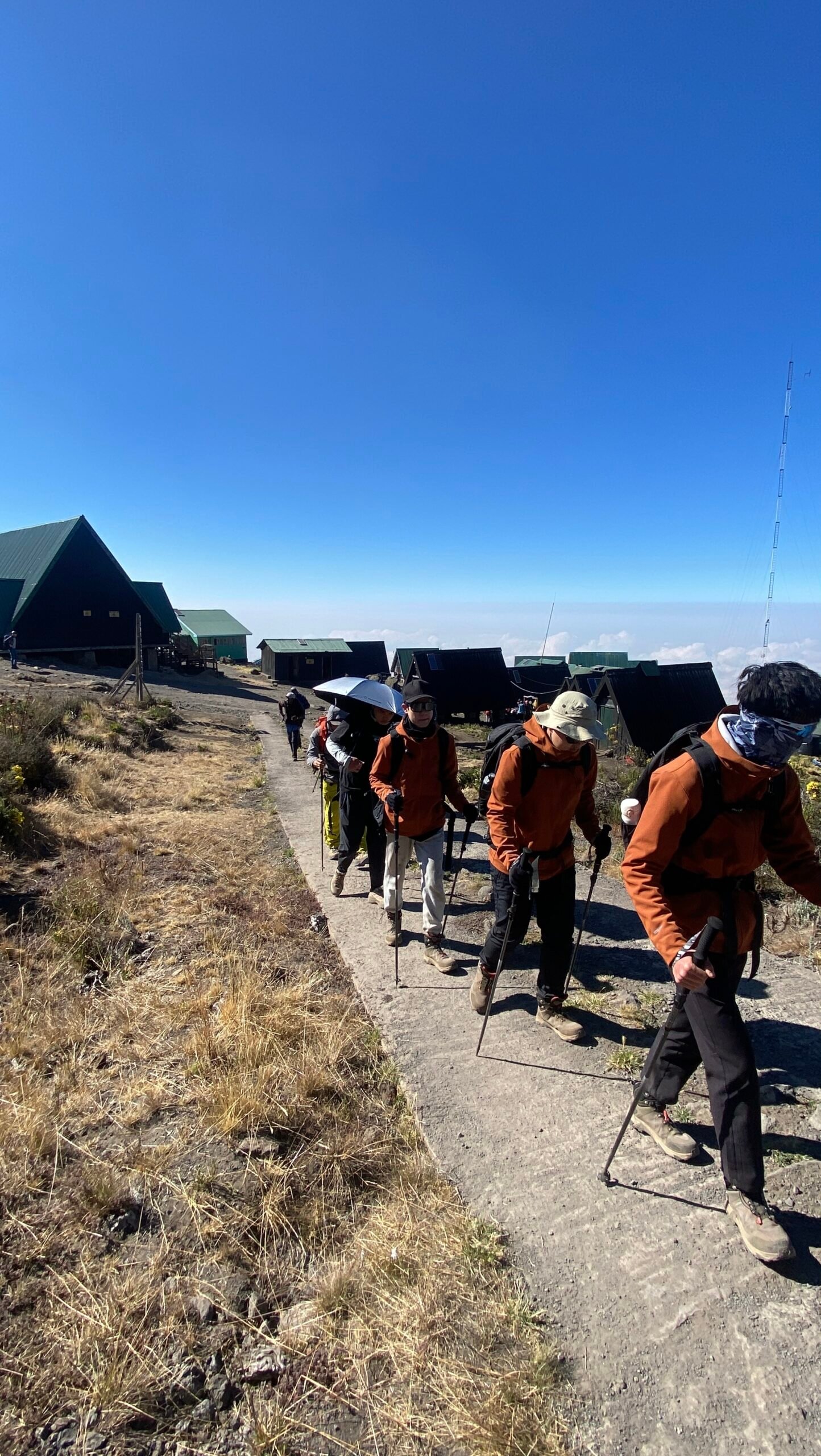
The final descent runs through heath and rainforest back to Marangu Gate (1,870 m), roughly 5–6 hours. At the gate, climbers complete exit registration and receive their official Kilimanjaro summit certificate, then transfer to Moshi.
Guide Tip: Tip your crew at Marangu Gate — porters, cook and assistant guides are essential to every climb. See Kilimania’s tipping guide.
Ready to Plan Your 5-Day Marangu Climb?
Check availability for your preferred travel dates, or browse open group departures.
Summit Night
What Summit Night Is Really Like
A factual account of what to expect — not a promotional description.
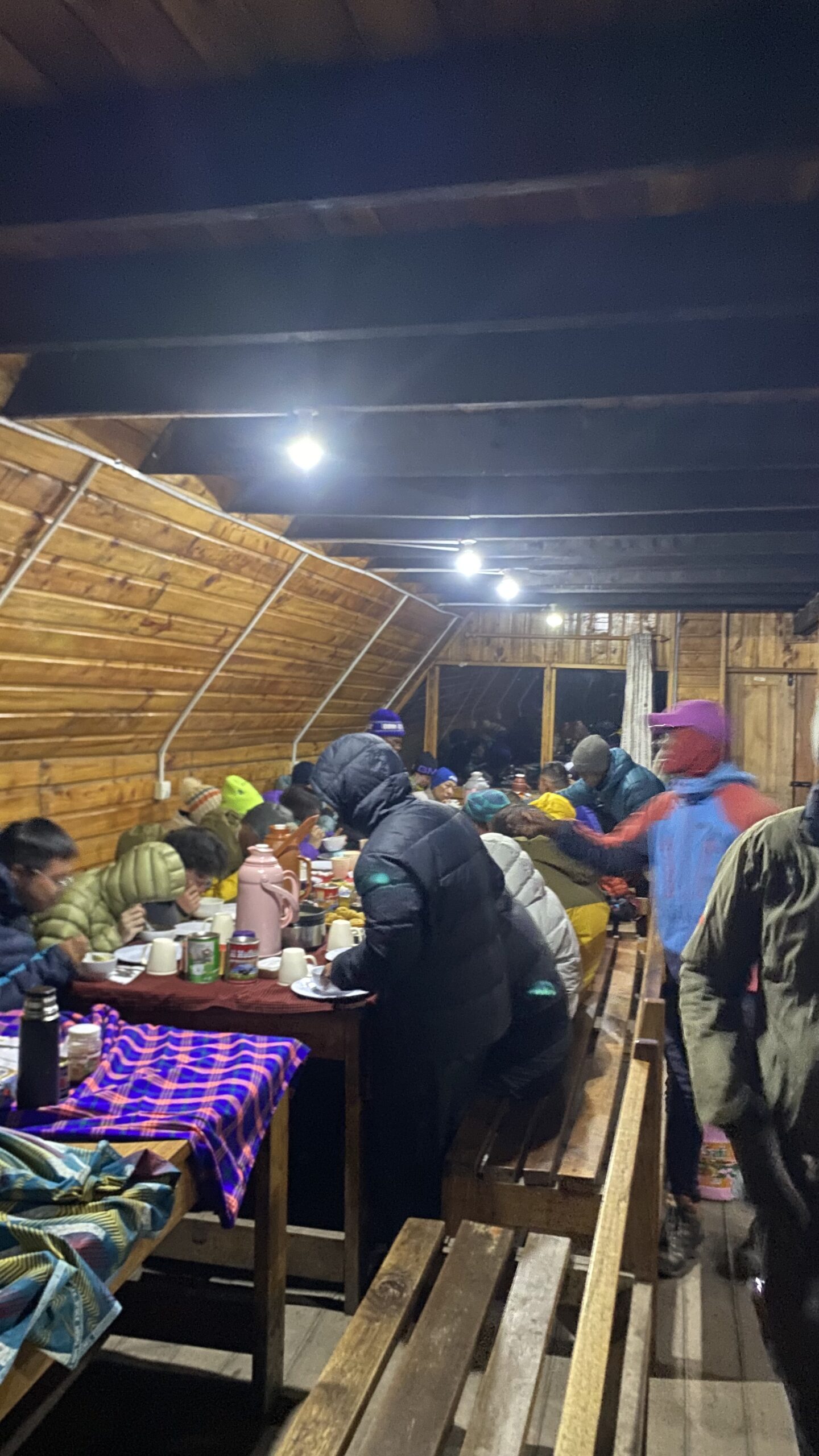
The Timeline
Wake-up call~11:30 pm
Departure from Kibo~Midnight
Gilman’s Point~5–6 hrs
Uhuru Peak~6.5–8 hrs
Arrive Horombo~5–7 pm
The Conditions
Temp at Kibo-10 to -15°C
Temp at summit-15 to -20°C
TerrainVolcanic scree + rim
Available oxygen~50% of sea level
What Kilimania Guides Do on Summit Night
- Pre-departure oxygen saturation and pulse check for every climber
- Carry emergency oxygen and a first-aid kit throughout the ascent
- Set and maintain a deliberate slow pace — pole pole
- Rest stops roughly every 45–60 minutes with brief health checks
- Final decision on whether to continue rests with the lead guide
⚠ Mental Preparation Matters as Much as Physical
Darkness, cold, thin air, fatigue and sleep deprivation make summit night psychologically demanding for most climbers. Understanding that in advance is a genuine advantage on summit day.
Altitude & Health
Acclimatization on the 5-Day Marangu Route
Why the 5-Day Itinerary Has Less Acclimatization Time
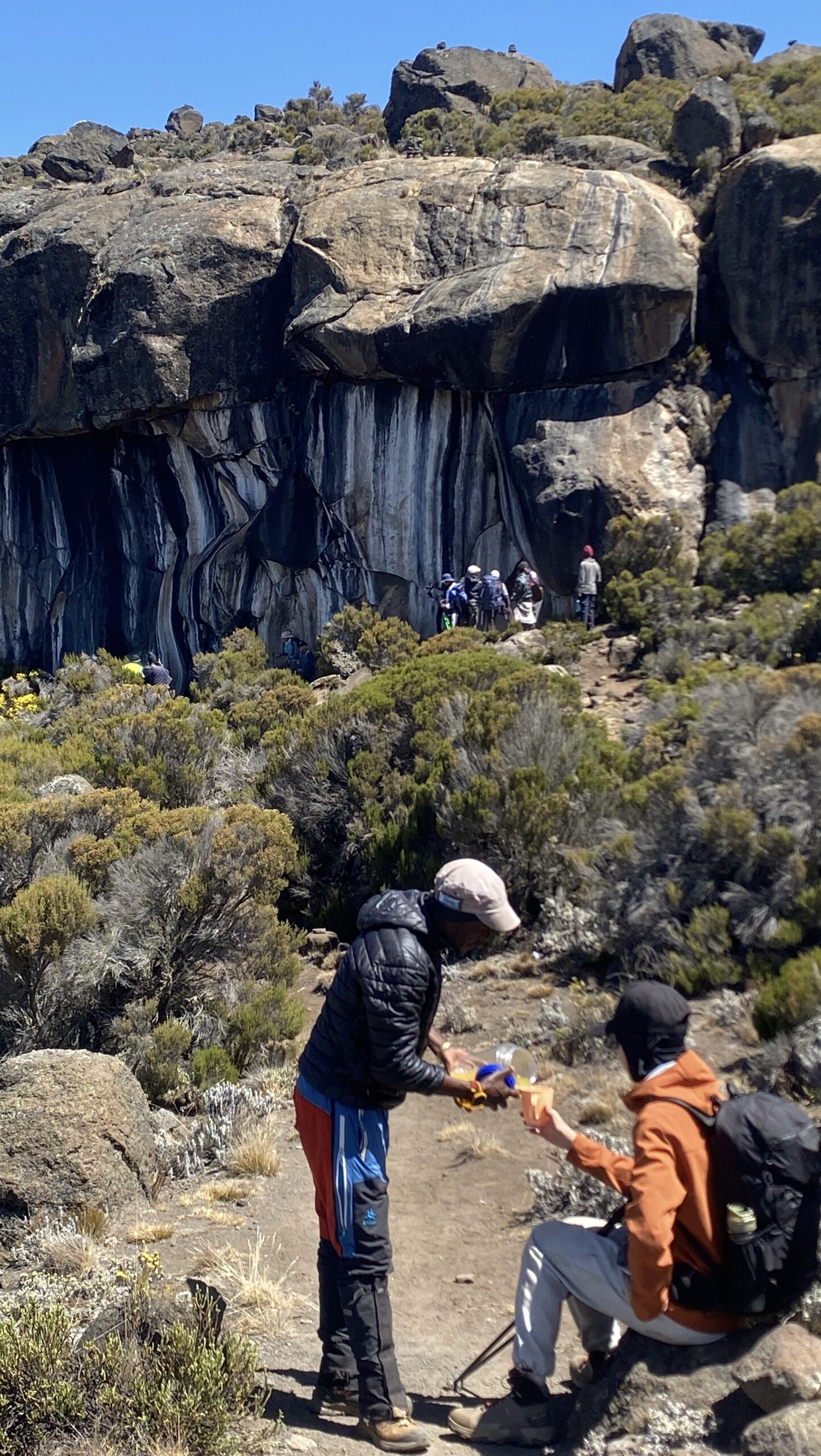
On the 5-day schedule, you move from Horombo Hut (3,720 m) directly to Kibo Hut (4,703 m) on Day 3 — nearly 1,000 m of gain with no rest day. The 6-day version adds a second night at Horombo, giving the body roughly 24 more hours to adapt.
AMS — What You Need to Know
Common AMS symptoms above 3,000 m include headache, fatigue, reduced appetite and mild nausea. Severe symptoms — intense headache unresponsive to paracetamol, vomiting, loss of coordination, confusion or difficulty breathing at rest — require immediate descent.
⚠ On Altitude Medication
Some climbers use acetazolamide (Diamox) to assist acclimatization. Discuss any altitude medication with a qualified medical professional before your trip — Kilimania does not prescribe medication. Read the altitude sickness guide →
Kilimania’s Daily Altitude Monitoring
- Pulse oximeter checks at every camp — morning and evening
- Daily health assessment using Lake Louise AMS scoring criteria
- Guide observation throughout each hiking day
- Emergency oxygen available on the mountain
- Clear descent protocol — guide safety decision is final
Difficulty Assessment
How Difficult Is the 5-Day Marangu Route?
The trail is straightforward. The altitude is not.
Overall Rating: Challenging
Marangu requires no technical climbing skills. The challenge comes almost entirely from altitude — reduced oxygen, cold, and the physical and mental demands of a 12–15 hour summit day.
Trail Difficulty
Moderate — clear, maintained path, no technical sections
Altitude Challenge
High — 5,895 m summit with compressed acclimatization
Summit-Day Demand
High — 12–15 hrs, midnight start, cold, reduced oxygen
Technical Climbing
None required under normal conditions
Acclimatization Margin
Limited — the defining constraint of the 5-day itinerary
⚠ Fitness Requirements — Be Specific
Aim to walk 6 continuous hours at a sustained pace with a 5–7 kg daypack before arriving in Tanzania — a real mountain day hike, not a flat walk. See Kilimania’s training guide.
Accommodation
Where You Sleep — Marangu Mountain Huts
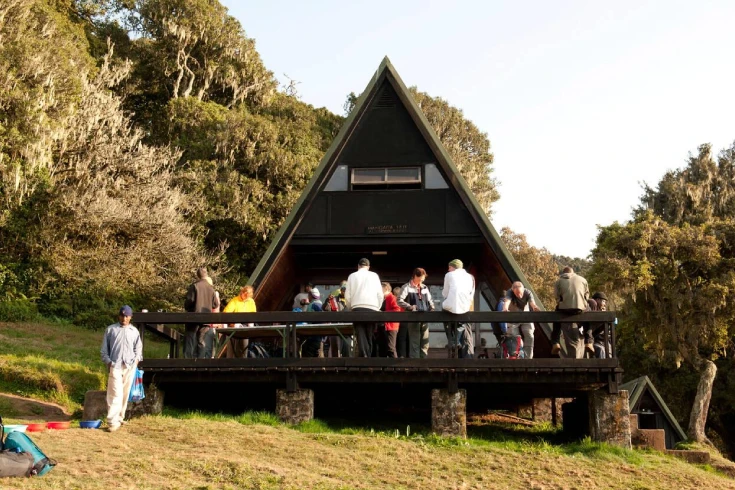
Marangu is the only Kilimanjaro route with fixed mountain hut accommodation. There are no tents on this route.
Mandara Hut
2,720 m · Night 1
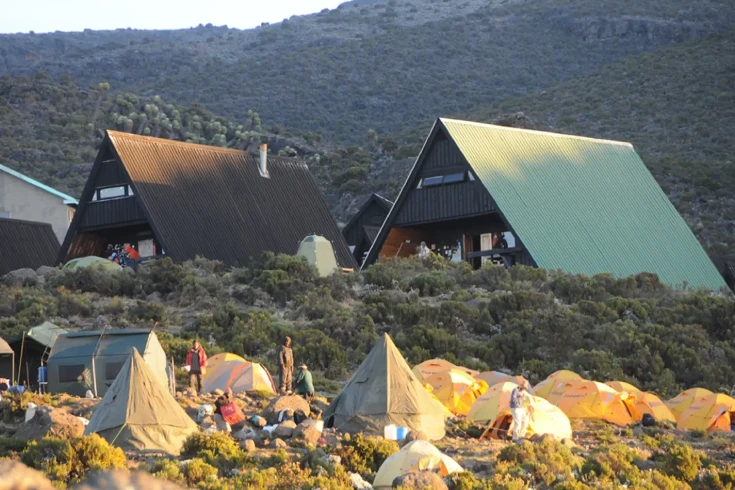
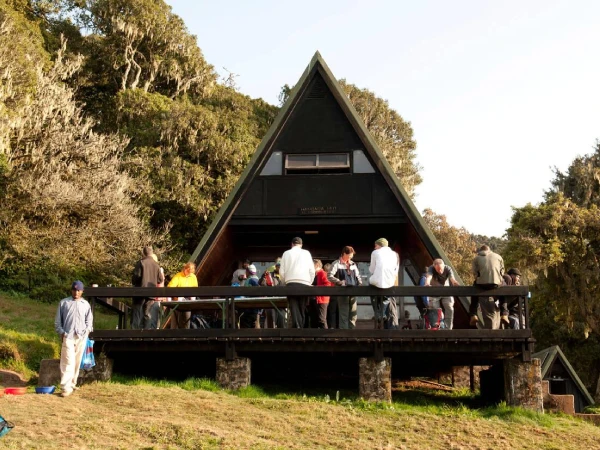
Wooden A-frame huts in a forest clearing, with shared dormitory rooms and basic toilet facilities.
Horombo Hut
3,720 m · Nights 2 & 4
The largest complex on the route, with separate sleeping huts, dining area, toilet blocks and views toward Mawenzi.
Kibo Hut
4,703 m · Night 3
A stone building at the base of the summit cone — basic dormitory rooms and the last shelter before the midnight departure.
What Hut Accommodation Means in Practice
Huts provide dormitory-style beds and mattresses. Sleeping bags are not included — bring your own four-season bag or arrange a rental in Moshi before the climb. Huts are not heated — Kibo Hut drops well below freezing at night. Bathrooms are basic squat-toilet facilities in separate blocks; there is no hot running water on the mountain.
Our Team
Your Kilimania Guide & Porter Team
Every Kilimania climb is led by KINAPA-licensed guides. Porters are employed under Kilimanjaro Porters Assistance Project (KPAP) standards — fair wages, appropriate load limits and proper sleeping equipment.
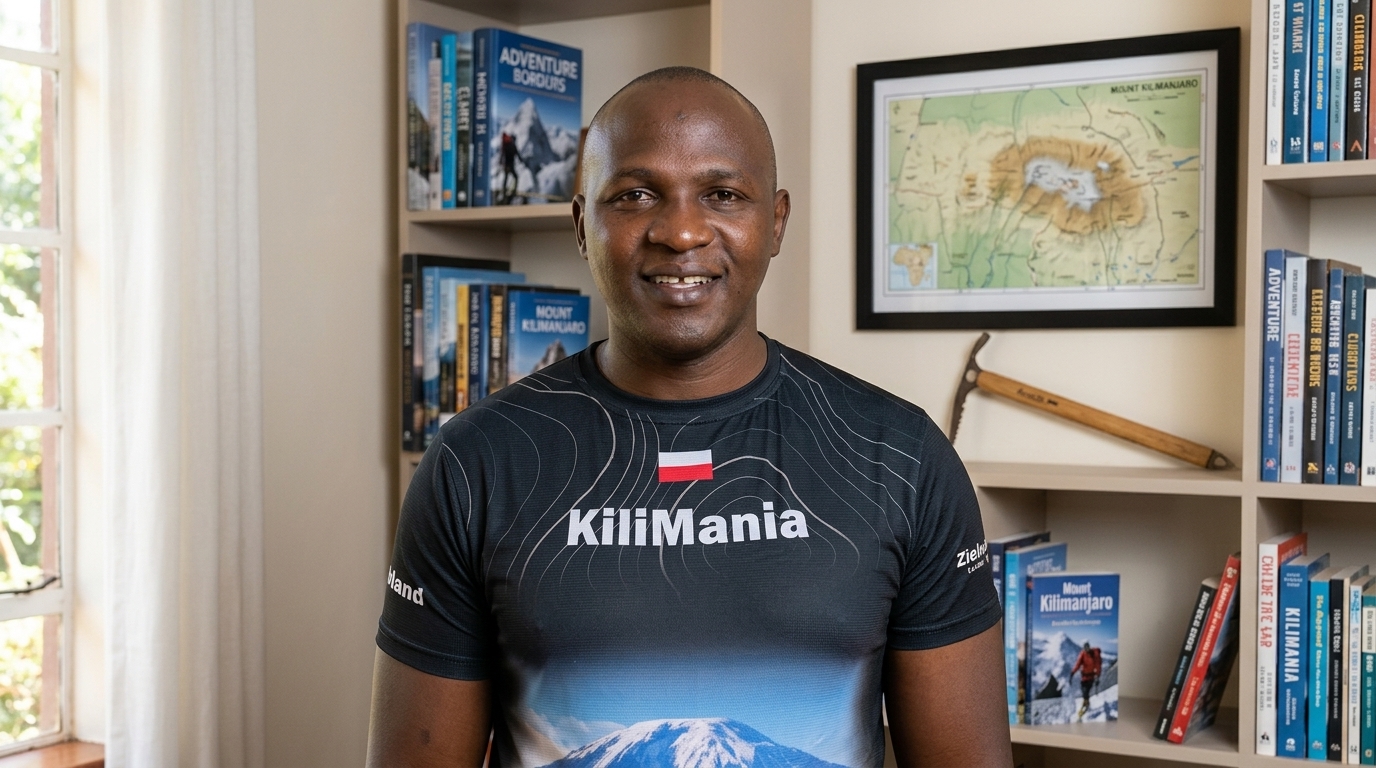
Sabinus Msimba
Founder & Senior Guide · 22+ yrs
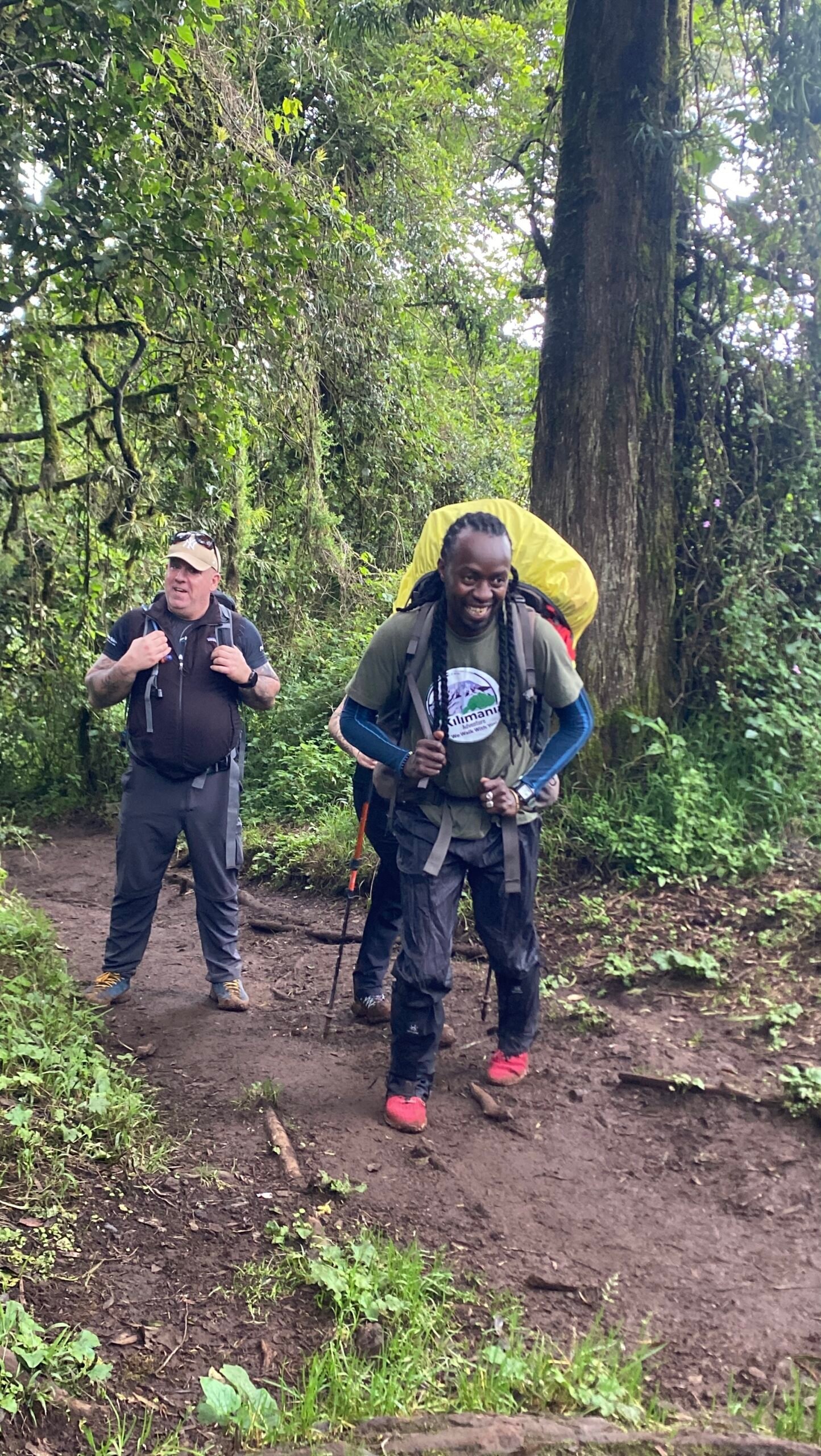
Senior Mountain Guide
KINAPA Licensed
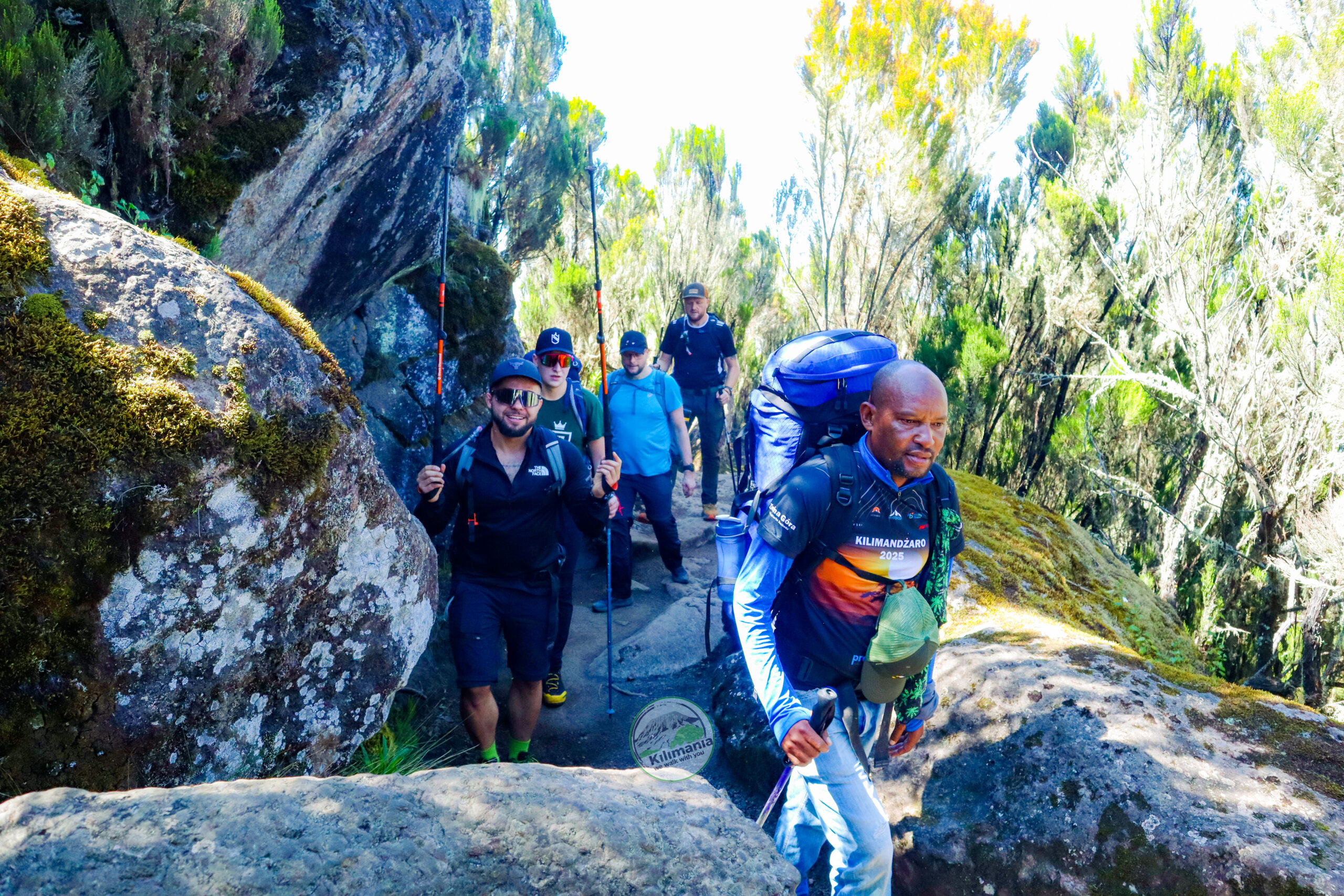
Izack Mlala
Mountain Guide
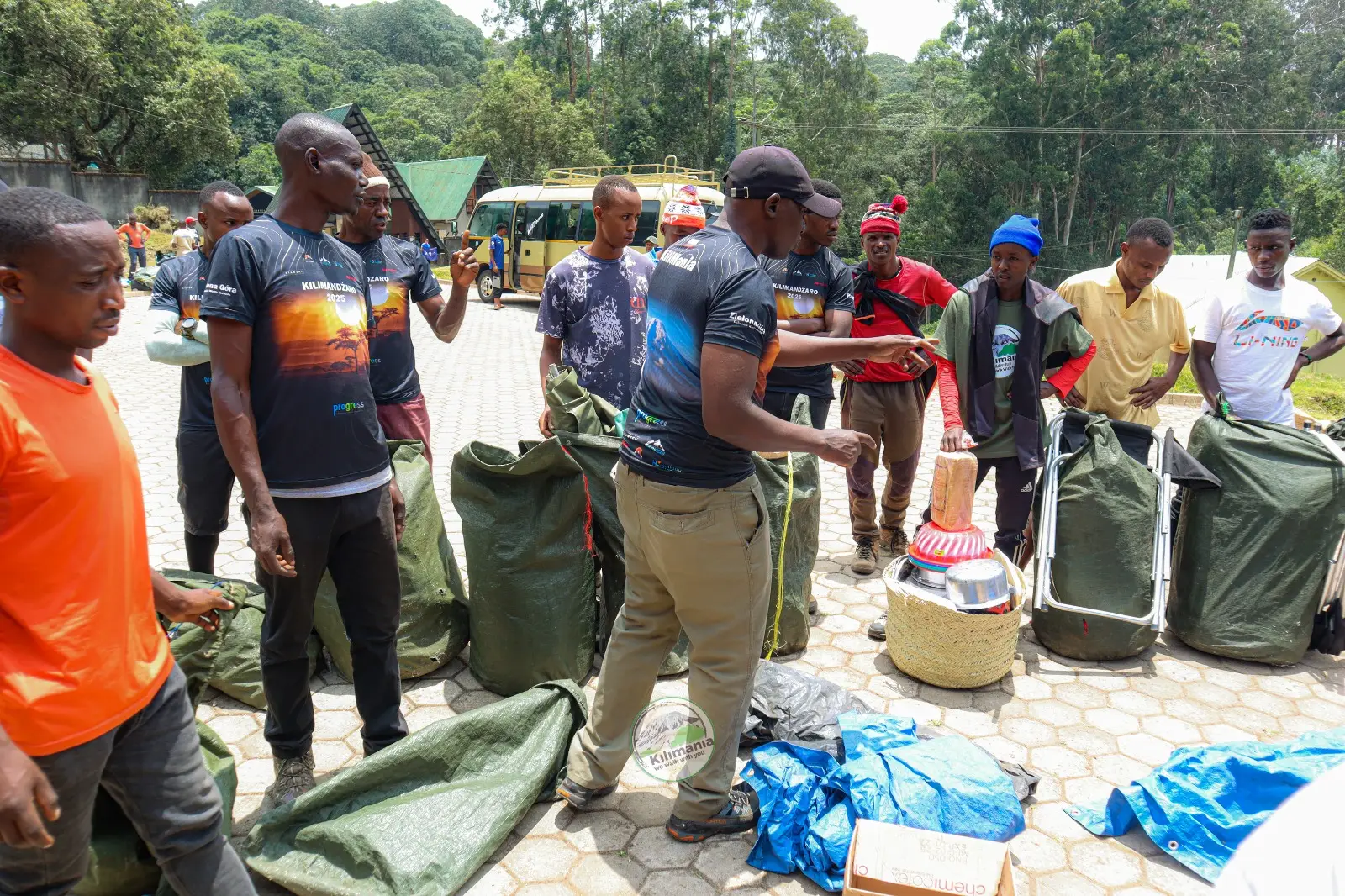
Porter Team
KPAP-Compliant · Fair Wages
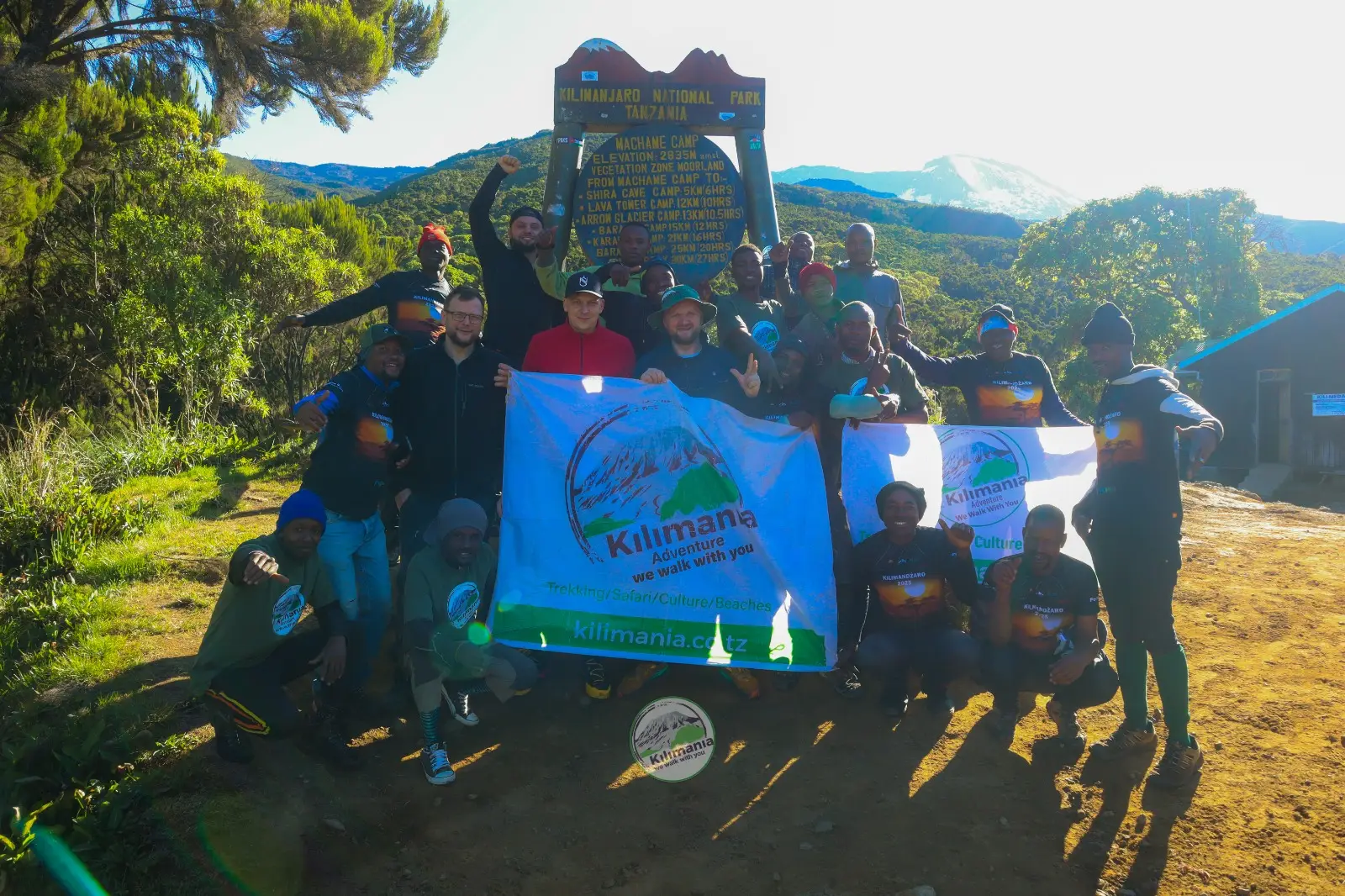
Expedition Crew
Guides · Cook · Porters
Kilimania Adventure — Moshi-based, KINAPA-licensed operator · KPAP-compliant porter welfare · 22+ years guiding experience. Every guide holds a verified Tanzania park authority license.
First-Party Perspective
Summit Outcomes on the 5-Day Marangu Route
Based on Kilimania Adventure operational experience — Moshi, Tanzania
The 5-day Marangu itinerary is the shortest standard schedule on this route. Because acclimatization time is compressed, individual summit outcomes vary more than on longer itineraries. Kilimania does not publish an unverified percentage figure for this itinerary.
What we observe in practice
- Climbers with previous high-altitude experience (above 3,500 m) generally cope better with the compressed schedule.
- Daily pulse-oximeter monitoring and conservative pacing remain the most important safety tools on this itinerary.
- When a climber’s schedule allows, our guides consistently recommend the 6-day Marangu for the extra acclimatization night at Horombo Hut.
- Weather, individual physiology and pacing on summit night influence outcomes more than any single operator statistic.
Individual summit success depends on:
- Personal altitude response — not predictable from fitness alone
- Itinerary duration and acclimatization schedule
- Consistent pacing (pole pole)
- Weather and conditions on summit night
- Guide support and daily health monitoring
- Physical preparation before arrival
No operator can guarantee any individual climber’s summit outcome. Safety always takes priority over reaching Uhuru Peak.
For current operational notes or to discuss your specific situation, contact info@kilimania.co.tz or WhatsApp +255 756 449 990.
Safety
How Kilimania Manages Safety on Kilimanjaro
Kilimanjaro carries real altitude risks. Kilimania’s role is to monitor, communicate clearly and make responsible decisions throughout every climb.
We will not tell you Kilimanjaro is safe. Altitude above 5,000 m carries genuine medical risks regardless of operator, fitness level or experience. Our job is to monitor your health, communicate honestly and make the right call when it matters.
What We Actually Do on Every Climb
- Pulse oximeter checks at every camp, morning and evening
- Lake Louise AMS assessment at each camp
- Guide observation throughout each hiking day — pace, breathing, balance, speech
- Emergency oxygen carried on the mountain throughout
- First-aid kit maintained and carried by the guide team
- Clear descent protocol — when the guide says descend, descent is non-negotiable
- Pre-climb briefing to flag health concerns before the mountain
- KINAPA rescue fee included — covers evacuation coordination where available
⚠ Travel Insurance Is Essential
Kilimania strongly advises comprehensive travel insurance covering high-altitude trekking above 5,000 m and emergency medical evacuation. This is not optional advice. Kilimania’s travel insurance guide →
Inclusions & Exclusions
What’s Included & What’s Not
✓ Included in the Price
- 2 hotel nights in Moshi (before and after the climb)
- Airport transfers — Kilimanjaro International Airport (JRO) ↔ Moshi
- Kilimanjaro National Park fees
- KINAPA rescue fee
- Mountain hut accommodation (4 nights)
- All meals on the mountain
- Drinking water on the mountain
- KINAPA-licensed lead guide + assistant guide(s)
- Cook and KPAP-compliant porters
- Emergency oxygen & pulse oximeter monitoring
- First-aid kit
- Moshi ↔ Marangu Gate transfers
- Pre-climb briefing and gear check
- Kilimanjaro summit certificate
✗ Not Included
- International flights
- Tanzania visa fees
- Travel insurance (required)
- Sleeping bag (bring your own or rent in Moshi)
- Personal climbing equipment
- Equipment rental (available on request)
- Personal medication
- Guide and porter tips
- Alcoholic beverages, soft drinks, snacks
- Additional hotel nights beyond the 2 included
- Personal expenses
Questions about a specific inclusion? Contact Kilimania directly — info@kilimania.co.tz — and we’ll confirm exactly what applies to your booking.
Transparent Pricing
5-Day Marangu Route — 2026 Pricing
All prices are per person in US dollars and include everything listed above. No hidden fees.
| Group Size | Price per Person | Notes |
|---|---|---|
| 1 Person | $1,600 | Private solo climb |
| 2 People | $1,500 | Private group |
| 3 People Joining Price | $1,450 | Private group — also the joining rate for solo/pair climbers |
| 4 People | $1,400 | Private group |
| 5 People | $1,350 | Private group |
| 6 People | $1,300 | Private group — best value per person |
Joining Price — $1,450 per person
Solo travelers and pairs can join an existing Kilimania group at $1,450 per person. Check available dates on the Kilimanjaro Joining Calendar.
Deposit
$100 per person secures your place. Contact Kilimania to confirm current payment arrangements.
Why Kilimania
Why Climb with Kilimania Adventure?
Kilimania Adventure is a Moshi-based, KINAPA-licensed Kilimanjaro operator. Every climb is planned and guided directly by our own team.
- Moshi-based operation — we live and work on Kilimanjaro
- KINAPA-licensed guides — every lead guide holds a verified license
- Transparent pricing — every group size and the joining price published clearly
- Honest route advice — we recommend the 6-day Marangu when schedules allow
- Daily health monitoring — pulse oximeter checks and AMS assessment at every camp
- Emergency oxygen on every climb
- KPAP-compliant porter welfare — fair wages and proper equipment for all crew
- Direct communication — WhatsApp, email and phone, answered by the team who will guide you
What We Will Not Claim
We do not claim to be the best operator in Africa, guarantee summit success, or overstate our safety capabilities. If we can’t honestly answer a question, we’ll say so rather than invent an answer.
Your Guide
Meet Your Guide — Sabinus Msimba
Sabinus Msimba
Senior Kilimanjaro Guide & Founder — Kilimania Adventure
KINAPA Licensed Guide
22+ Years Guiding Kilimanjaro
300+ Personal Uhuru Peak Summits
Based in Moshi, Tanzania
Sabinus has guided Kilimanjaro for over two decades and founded Kilimania Adventure to run a transparent, safety-focused local climbing business. Route observations and operational advice on this page are drawn from his guiding experience and Kilimania’s operational records.
Packing Guide
What to Pack for the 5-Day Marangu Route
Marangu uses huts, so you carry only a daypack while hiking — your main bag is carried by your porter.
Clothing — Layers
- Thermal base layers (top and bottom)
- Midlayer fleece or down jacket
- Waterproof shell jacket and trousers
- Warm summit gloves + liner gloves
- Warm hat / balaclava, neck gaiter
- 3–4 pairs of hiking socks
- Summit-rated sleeping bag (or hire from Kilimania)
Footwear & Equipment
- Waterproof hiking boots (broken in)
- Camp shoes or sandals for huts
- Trekking poles (highly recommended)
- Headlamp + spare batteries
- Daypack 20–30L
- Main duffel bag (max 15 kg for porter)
Health & Comfort
- Sunscreen SPF 50+, lip balm
- Sunglasses (UV 400+)
- Water bottles or hydration bladder (2–3L)
- Personal medications
- Blister care, wet wipes
Documents & Essentials
- Passport
- Travel insurance documents (high-altitude coverage)
- US dollars cash for tips and extras
- Camera or charged smartphone, power bank
Full equipment list and gear rental options — read Kilimania’s packing guide →
Free Resources
Free Kilimanjaro Planning Resources
Free guides prepared by Kilimania Adventure’s senior guide team, updated for 2026.
Free PDF
📥 Kilimanjaro Packing Checklist 2026
A complete packing guide covering all six routes, rent-vs-buy guidance with Moshi pricing, and an altitude safety reference.
- Tick-box checklist for every gear category
- Marangu Route hut-specific packing notes
- 2026 equipment rental pricing from Moshi
- AMS/HACE/HAPE symptom reference card
Reviewed by Sabinus Msimba, Senior Kilimanjaro Guide.
Free PDF
📥 Kilimanjaro Altitude Symptom Checklist
A practical checklist used by Kilimania’s guide team, covering normal acclimatization symptoms, AMS warning signs, and emergency HACE/HAPE symptoms.
- Normal acclimatization symptoms above 3,000m
- AMS warning signs
- HACE and HAPE emergency symptoms
- Daily health monitoring form (SpO₂, pulse, hydration)
Educational and planning purposes only — not a substitute for professional medical advice.
Free PDF
📥 Kilimanjaro 12-Week Training Calendar
A week-by-week training plan used in Kilimania Adventure’s pre-climb preparation guidance.
- 12-week hiking and endurance plan
- Pack-weight progression
- Back-to-back training strategy
- Peak and taper week structure
Prepared by Sabinus Msimba, Senior Kilimanjaro Guide and Co-founder of Kilimania Adventure.
Timing
Best Time to Climb the 5-Day Marangu Route
Kilimanjaro has two main dry seasons, which generally offer more stable weather and better trail conditions.
✓ Primary Dry Season
June to October — generally the most reliable period; clear views, drier trails, cold but stable summit-night conditions. The busiest season on the mountain.
✓ Secondary Dry Season
January to mid-March — good conditions with fewer climbers than June–October.
→ Wetter Months
April, May and November — heavier rain and reduced visibility; climbing is possible but conditions are more challenging.
→ December
December — transitional month with variable conditions. Contact Kilimania to discuss specific dates.
Kilimania operates year-round — discuss your dates with the team, or browse open group departures on the Kilimanjaro Joining Calendar. Full seasons guide: here →
Photography
Kilimania on the Marangu Route
Photographs from Kilimania Adventure operations
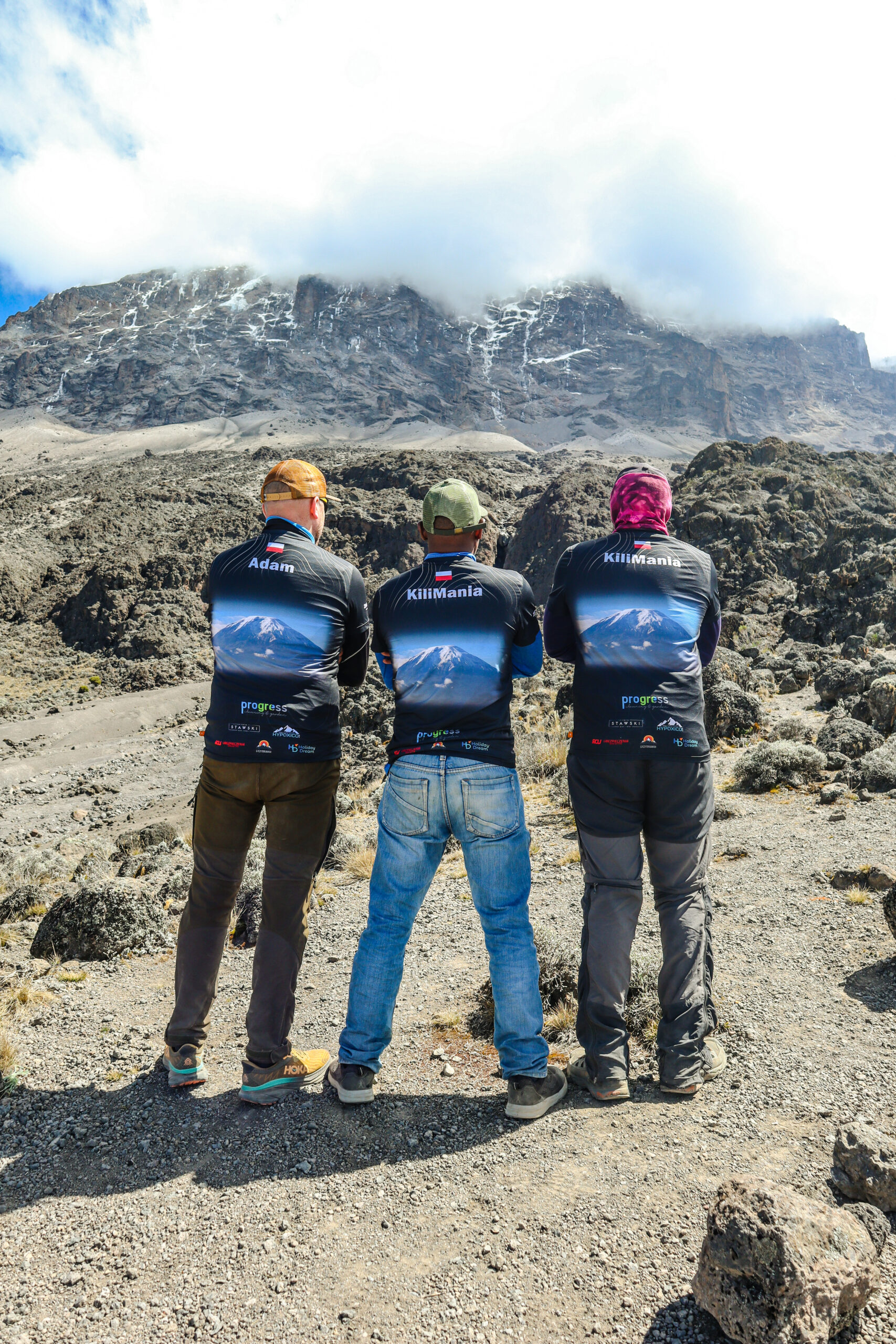
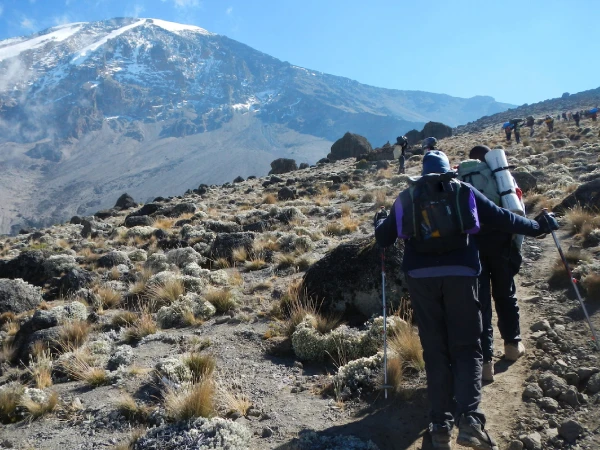
Approaching Kibo — the alpine desert above 4,000 m
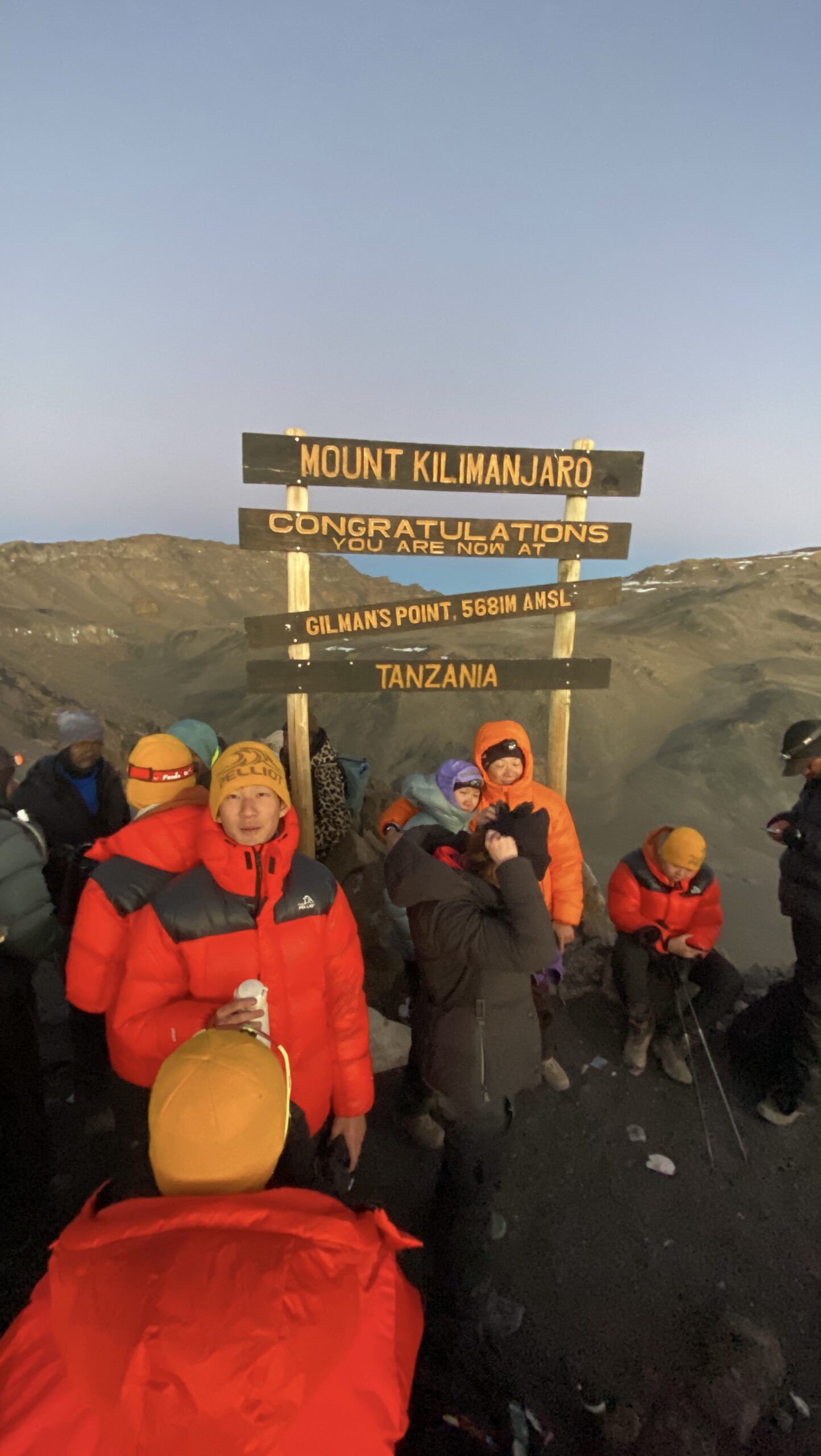
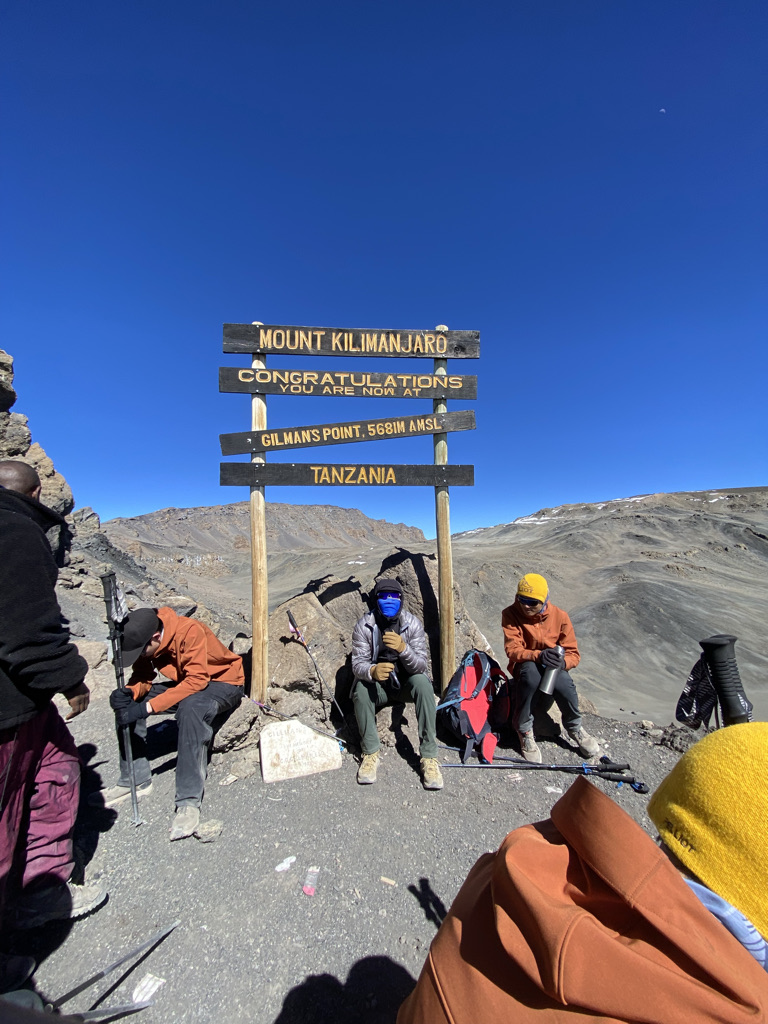
Gilman’s Point — 5,681 m crater rim
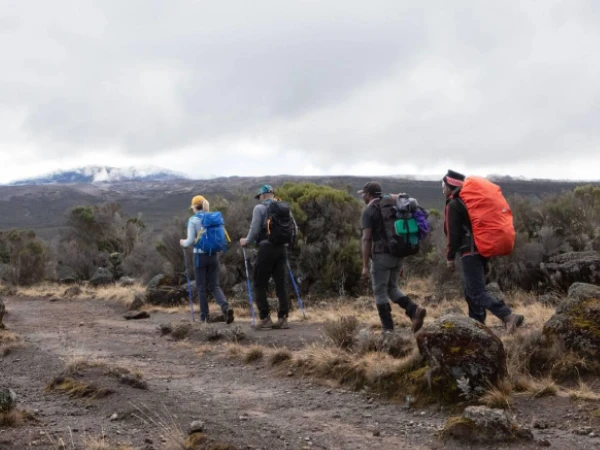
Descending from Horombo, above the clouds
Traveler Reviews
What Climbers Say About Kilimania
Read full verified reviews on TripAdvisor.
★★★★★
“Sabinus and the Kilimania team were exceptional — honest about the challenge, thorough with health checks, and supportive on summit night. We both reached Uhuru.”
Via TripAdvisor · Verified Review
★★★★★
“The 5-day Marangu was tough — I won’t pretend otherwise. The guides managed the pace well and the daily oxygen checks gave us real confidence.”
Via TripAdvisor · Verified Review
★★★★★
“What I appreciated most was the honesty — they told us the 6-day was better for acclimatization but respected our schedule. Professional on the mountain.”
Via TripAdvisor · Verified Review
★★★★★
“I joined at $1,450 and joined a group of four — had a complete private-quality experience. Summit night was the hardest thing I’ve ever done.”
Via TripAdvisor · Verified Review
FAQ
Frequently Asked Questions
The most common questions Kilimania receives about the 5-Day Marangu Route.
The shortest standard Marangu itinerary — mountain hut accommodation at Mandara Hut (2,720m), Horombo Hut (3,720m) and Kibo Hut (4,703m), aiming for Uhuru Peak at 5,895m over 5 days and 4 nights on the mountain.
It’s the minimum standard itinerary — achievable, but with more compressed acclimatization than the 6-day version. Kilimania recommends the 6-day itinerary when schedules allow.
Mandara Hut (Night 1), Horombo Hut (Nights 2 and 4) and Kibo Hut (Night 3) — dormitory-style beds and mattresses. There is no tent camping on this route.
1 person $1,600pp, 2 people $1,500pp, 3 people $1,450pp (joining price), 4 people $1,400pp, 5 people $1,350pp, 6 people $1,300pp. Deposit is $100 per person.
$1,450 per person — the rate for climbers joining an existing Kilimania group, equal to the 3-person private rate. Check open dates on the Kilimanjaro Joining Calendar.
One extra night at Horombo Hut (3,720m), giving an additional acclimatization day before Kibo Hut and the summit attempt.
Departure around midnight from Kibo Hut (4,703m), ascending volcanic scree in darkness to Gilman’s Point (5,681m), then the crater rim to Uhuru Peak (5,895m). The full round trip takes roughly 12–15 hours.
The trail is non-technical, but altitude is the main challenge regardless of experience. Climbers with no high-altitude experience are advised to consider the 6-day itinerary.
2 hotel nights in Moshi, JRO airport transfers, park fees, KINAPA rescue fee, hut accommodation, all meals, guides, cook, porters, emergency oxygen, pulse oximeter monitoring, Moshi–Marangu Gate transfers, briefing and summit certificate. Flights, visa, insurance, a sleeping bag, personal gear and tips are excluded.
The two dry seasons: January to mid-March, and June to October.
Yes — solo travelers and pairs can join at $1,450 per person. Open departures are published on the Kilimanjaro Joining Calendar.
Marangu uses mountain huts with a gentler, direct trail, but the 5-day version has less acclimatization time. Machame is a camping route with more varied scenery and a steeper profile, typically climbed over 6–7 days with a stronger acclimatization schedule. Marangu suits travelers who prefer huts and have limited time; Machame suits those prioritizing scenery and acclimatization. See Kilimania’s Machame Route page for details.
Book / Enquire
Request Availability — 5-Day Marangu Route
Tell us your preferred dates, group size and any questions. Kilimania Adventure will check availability and respond with next steps — or browse the Kilimanjaro Joining Calendar for open group departures.
Plan Your Kilimanjaro Climb
Have questions before committing? Contact Kilimania directly — we’ll give you honest advice about whether the 5-day or 6-day Marangu Route fits your schedule and experience level.