Kilimanjaro Travel Insurance 2026: What You Actually Need and What to Avoid
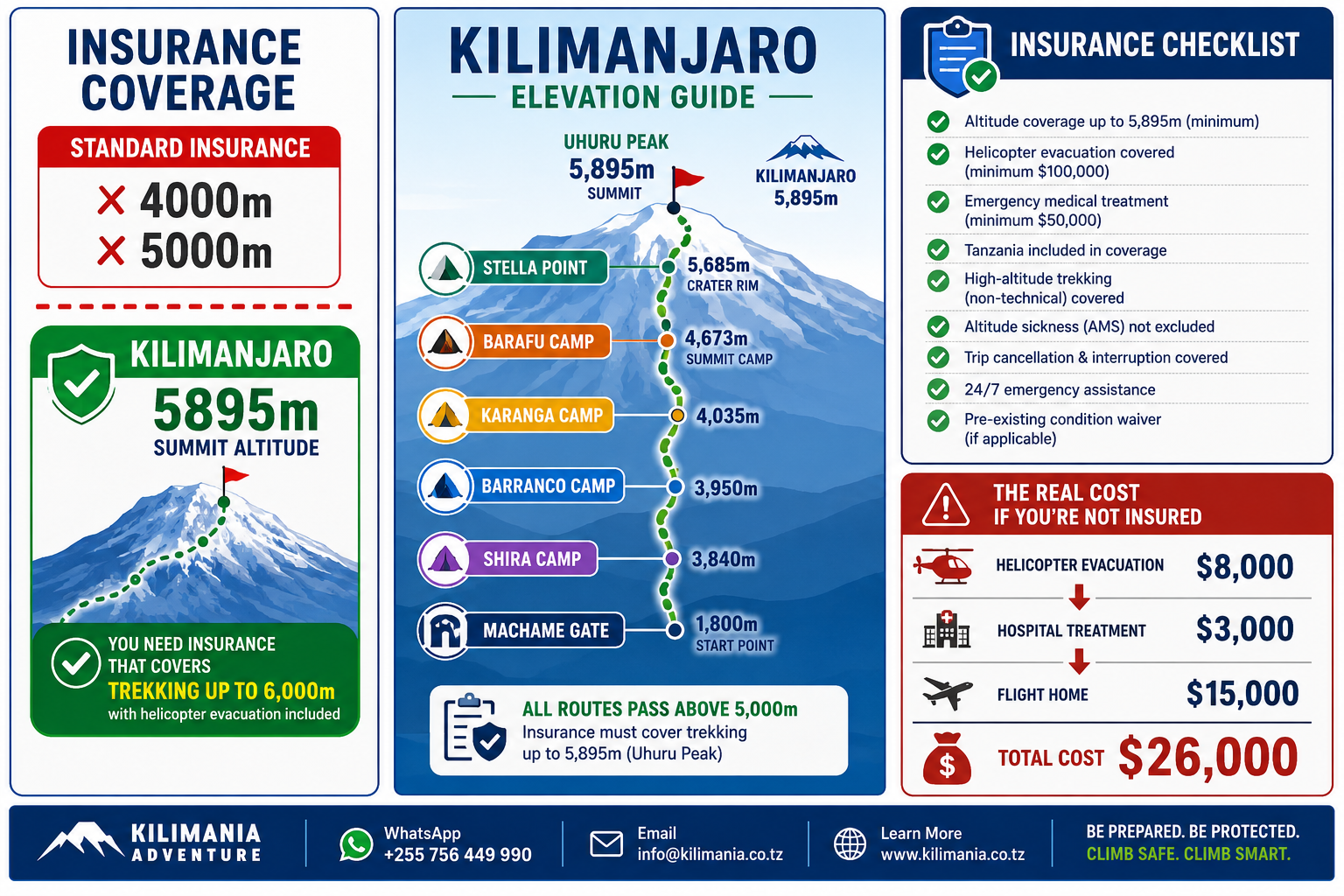
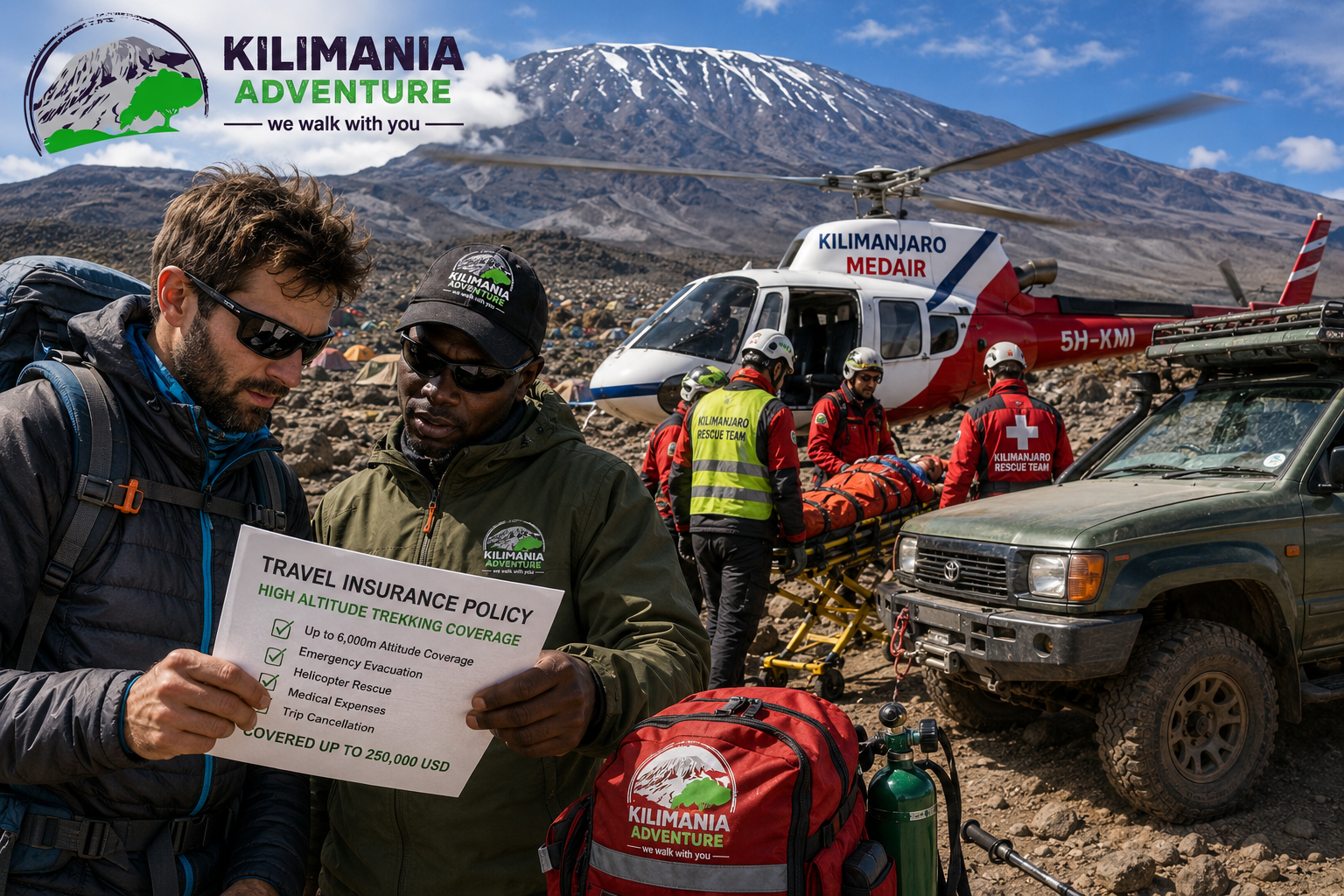
If you are evacuated by helicopter from Kilimanjaro, the bill will be approximately $5,000–$15,000. Your standard travel insurance almost certainly will not cover it. Most off-the-shelf policies exclude activities above 4,000m or 5,000m — Kilimanjaro’s summit sits at 5,895m, and even Barafu Camp, where you sleep before summit night, sits at 4,673m. This gap turns a manageable medical event into a five-figure crisis at the worst possible moment of your trip.
Quick Answer
Kilimanjaro summit reaches 5,895m (Uhuru Peak) — standard insurance often stops below this level. Barafu Camp sits at 4,673m, already beyond most basic policy limits. Only trekking-specific insurance with a high-altitude extension to 6,000m is valid for KINAPA routes. Helicopter evacuation coverage should be $100,000–$250,000 minimum. Policies must explicitly include “non-technical trekking above 4,000m” to avoid claim rejection.
Key Stats
- Uhuru Peak summit elevation: 5,895m
- Barafu Camp elevation (summit staging): 4,673m
- Typical helicopter evacuation cost: $5,000–$15,000
- Total realistic cost of an uninsured serious altitude event: $14,000–$35,000
- Recommended minimum evacuation coverage: $100,000–$250,000
- Typical premium for a 7–14 day climb: $150–$400
- AMS incidence above 3,000m: up to 50% of trekkers (WHO, 2023)
Bottom Line
The cheapest policy is not the least expensive choice if it fails on the mountain. Read the actual policy wording, confirm the altitude ceiling in writing, and buy the day you pay your deposit. Two hours of homework versus a $14,000–$35,000 exposure — that math isn’t close.
Why Standard Travel Insurance Fails on Kilimanjaro
Short answer: Most standard travel policies contain altitude exclusions, activity misclassification, or evacuation coverage caps that make them functionally useless on Kilimanjaro. The summit at 5,895m exceeds the altitude ceiling written into a significant share of off-the-shelf policies, and this exclusion rarely appears in the summary — only in the full policy document.
Three mechanisms cause this failure — and understanding them is the only way to verify whether your existing policy actually works on this mountain.
Mechanism 1: Altitude Exclusions
Many travel policies cap coverage at a specific altitude — commonly 4,000m or 5,000m — written in the small print as “activities above [X]m excluded unless an adventure rider is added.” The table below shows exactly where every standard route crosses the coverage cutoff.
| Location | Elevation | 4,000m Policy | 5,000m Policy | Insurance Risk Status |
|---|---|---|---|---|
| Shira Camp | 3,840m | ✔ Covered | ✔ Covered | Low risk — fully covered zone |
| Barranco Camp | 3,950m | ✔ Covered | ✔ Covered | Low–moderate risk zone |
| Karanga Camp | 4,035m | ❌ Not covered | ✔ Covered | First real coverage cutoff point |
| Barafu High Camp | 4,673m | ❌ Not covered | ✔ Covered | High-risk summit staging zone |
| Stella Point | 5,685m | ❌ Not covered | ❌ Not covered | Extreme altitude — oxygen depletion zone |
| Uhuru Peak | 5,895m | ❌ Not covered | ❌ Not covered | Highest-risk zone on the entire climb |
Mechanism 2: Trekking vs. Mountaineering Classification
Insurers split mountain activity into two very different categories:
- Trekking — walking at altitude on established trails, no ropes, no ice axes. Generally covered under standard adventure riders.
- Mountaineering — technical climbing, often excluded or requiring a specialist policy.
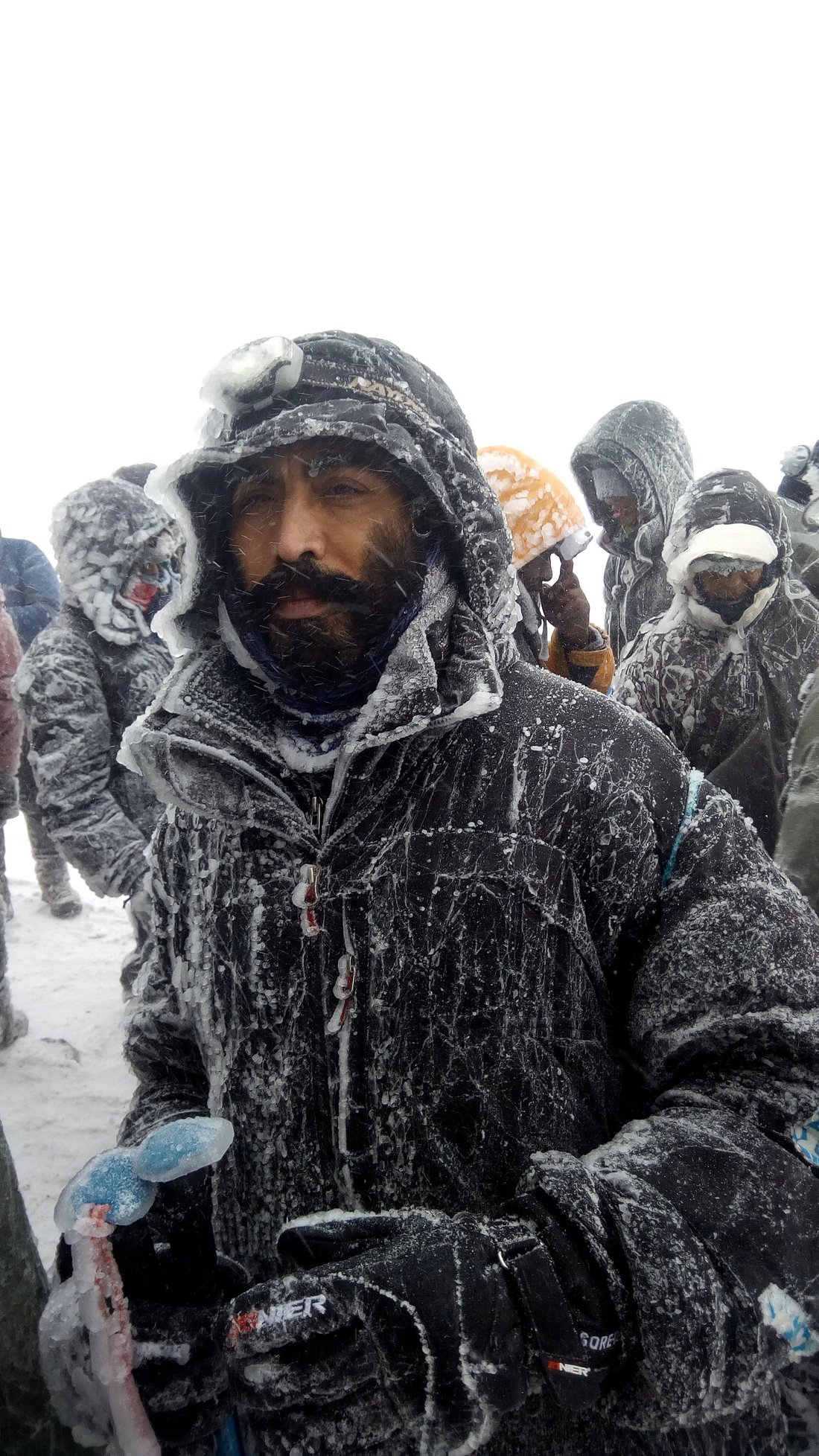
Kilimanjaro is a trekking peak. No standard route requires ropes, crampons, or technical skill. The correct classification is high-altitude trekking. However, some insurers classify any activity above 5,000m as mountaineering by altitude alone — which silently excludes Kilimanjaro from cover that otherwise looks adequate.
The exact phrase to look for: “high-altitude trekking” or “trek to summit altitude of 5,895m.” If the policy only mentions “mountaineering,” call and ask: “Is a non-technical trek to 5,895m on Kilimanjaro covered as trekking under this policy?” Get the answer in writing.
Mechanism 3: Evacuation Coverage Caps
Some policies include medical evacuation coverage but cap it well below actual costs. A helicopter lift from the mountain to Moshi costs $5,000–$15,000. A medical escort flight home can add $10,000–$30,000. A policy capped at $10,000 or $20,000 looks adequate on the page and is functionally useless in the scenario it exists for.
Minimum evacuation coverage for Kilimanjaro: $100,000. This is the floor, not a generous buffer.
Kilimanjaro Route Insurance Risk Window Comparison
| Route | Duration | Days Above 4,000m | Days Above 5,000m | Summit Window | Insurance Risk Note |
|---|---|---|---|---|---|
| Marangu | 5–6 days | 3–4 days | 1 night | Night 4–5 | High AMS risk — rapid ascent |
| Machame | 6–7 days | 4–5 days | 1 night | Night 5–6 | Balanced acclimatisation; Barafu exposure |
| Lemosho | 7–8 days | 5–6 days | 1 night | Night 6–7 | Best acclimatisation profile |
| Rongai | 6–7 days | 4–5 days | 1 night | Night 5–6 | Similar altitude risk profile to Machame |
See the full acclimatisation profile for each route: Lemosho | Machame | Marangu | Rongai.
“In over 22 years guiding Kilimanjaro, I’ve never regretted calling for an evacuation. I have seen many climbers regret arriving without proper insurance.” — Sabinus Msimba, Senior Mountain Guide, KINAPA-licensed
All routes share the same critical exposure window: Barafu Camp (4,673m) → Stella Point (5,685m) → Uhuru Peak (5,895m). Every route includes at least 6–8 hours above 5,000m. A policy capped at 5,000m provides zero coverage during summit night — on every route. According to Kilimania’s operational records across more than 1,247 guided climbs (2019–2025), approximately 78% of evacuation calls occur above 4,500m — the zone most standard policies fail to cover.
Ten Questions to Ask Your Insurer Before You Climb
Do not assume your existing policy works. Call your insurer and get written answers to every question below. A verbal assurance is worth nothing if a claim is later denied on a technicality you cannot prove was ever addressed.
- Does this policy explicitly cover trekking up to 5,895m?
- Is a non-technical Kilimanjaro ascent classified as trekking, not mountaineering?
- What is the exact dollar limit for helicopter medical evacuation?
- Is Tanzania and Kilimanjaro National Park explicitly listed as covered territory?
- Is Acute Mountain Sickness (AMS) covered, or excluded as pre-existing?
- Does using Diamox (acetazolamide) affect my claim eligibility?
- How is an evacuation triggered and approved — and how fast?
- Is a medical escort flight home included, and to what limit?
- Is a pre-existing condition waiver available if I buy within a set window after deposit?
- Can you confirm all of the above in writing, by email?
Key Field Insight
Most travelers fail claims not because they lack insurance, but because their policies don’t explicitly include trekking up to 5,895m, use mountaineering exclusion wording that catches Barafu Camp altitude, cap evacuation coverage below $100,000, or don’t clearly state Tanzania and KINAPA coverage. The failure is almost always in the detail, not the premium amount.
What Kilimanjaro-Appropriate Insurance Must Cover
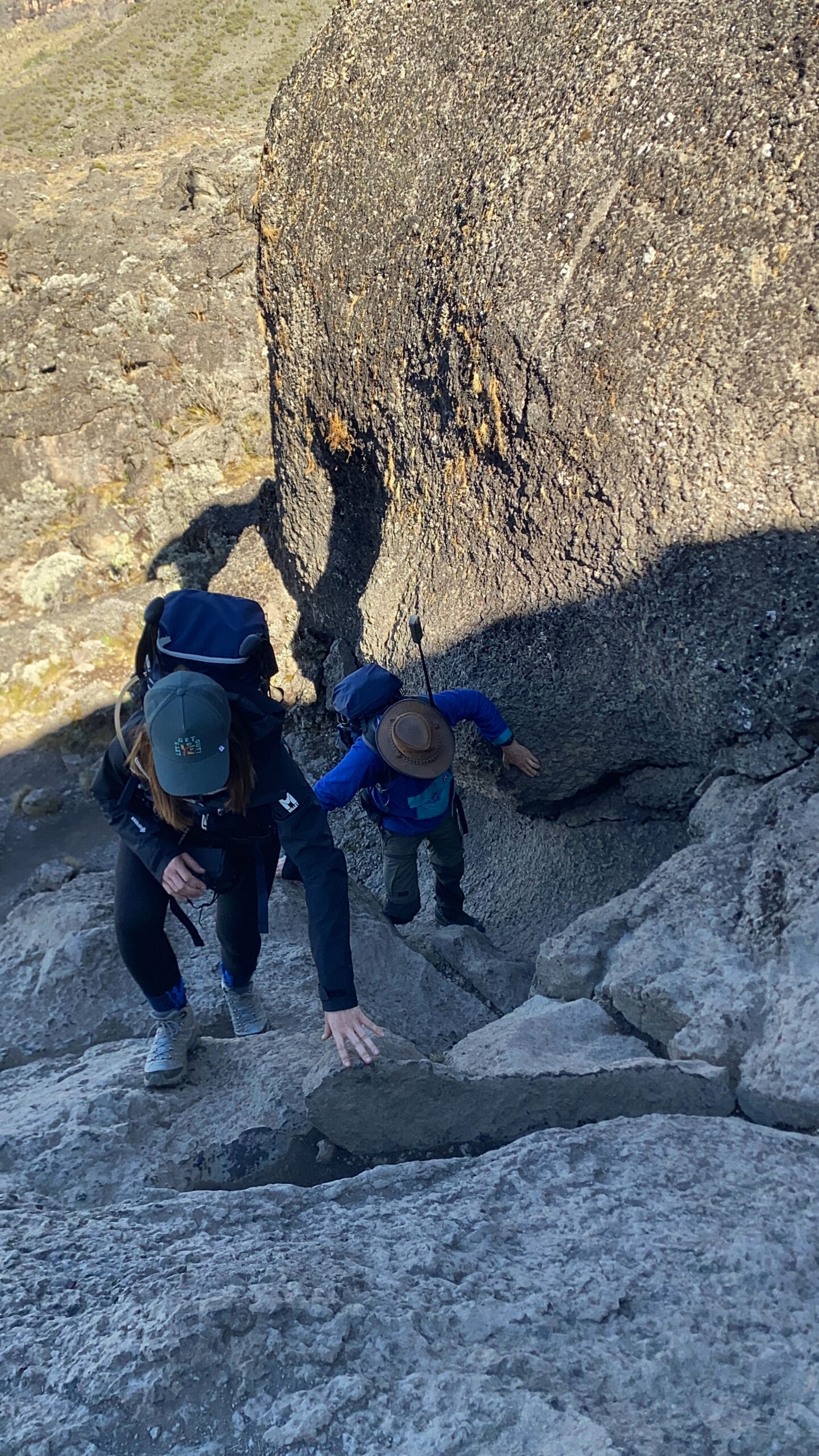
At minimum, your policy needs $100,000 in medical evacuation coverage with helicopter explicitly included, altitude coverage to at least 5,895m, Tanzania as a covered territory, and $50,000 in emergency medical treatment. Anything below these thresholds leaves a real financial gap.
| Coverage Type | Minimum Required | Recommended | Why It Matters |
|---|---|---|---|
| Medical Evacuation (Helicopter) | $100,000 | $250,000+ | Air evacuation $5,000–$15,000; international repatriation $10,000–$30,000 |
| Emergency Medical Treatment | $50,000 | $100,000+ | Moshi/Arusha hospital $500–$2,000/night; ICU escalates quickly |
| Trip Cancellation | Full pre-paid cost | Trip + flights | Typical package $2,800–$6,500; deposits non-refundable |
| Trip Interruption | Remaining unused value | Full package + rebooking | Early descent = unused lodge, food, crew costs forfeited |
| Altitude Limit | 5,895m | 6,000m+ | Most common claim rejection reason if not explicit |
| Activity Classification | Hiking / trekking | “High-altitude trekking — Kilimanjaro included” | Avoids exclusion during summit night |
| Geographic Coverage | Tanzania included | East Africa / worldwide | Some budget insurers exclude Sub-Saharan Africa |
Source: Kilimania operational data 2019–2025; market research of major adventure travel insurers, June 2026.
Recommended Additional Coverage
- Gear and equipment cover — sleeping bag, poles, boots, shell jacket typically $800–$2,500. See our Kilimanjaro Packing List, trekking poles guide, and boots guide.
- Search and rescue coverage — covers ground rescue beyond what is bundled into park fees; separate from helicopter evacuation.
Diamox Use and Your Insurance Claim: What Most Climbers Don’t Know
Short answer: Acetazolamide (Diamox) is widely prescribed for prevention or treatment of altitude sickness. Some insurers treat its use as evidence of a pre-existing altitude sensitivity, which can become grounds for denying an altitude-related claim. Disclose your Diamox use to your insurer before you buy the policy, and get written confirmation.
Some insurers interpret Diamox use in three ways, each of which has been used to reduce or deny claims:
- Evidence of a pre-existing altitude sensitivity
- A declared medical condition requiring prescription medication
- Proof that you were aware of elevated personal risk before departure
What to do: Disclose Diamox use before purchasing. Ask directly whether it affects coverage and get the answer in writing. If the answer is unfavorable, switch providers rather than omitting the disclosure.
“Always disclose prescription medications and confirm in writing that your planned use will not affect coverage. A verbal assurance during a phone call protects nobody.” — Kilimania pre-departure briefing protocol
📥 Free Download: Kilimanjaro Altitude Symptom & AMS Checklist
Used by Senior Guide Sabinus Msimba and the Kilimania team throughout every expedition. Covers AMS warning signs, HACE and HAPE emergency symptoms, and a daily health monitoring form (SpO₂, pulse, hydration).
Prepared by Sabinus Msimba, Senior Mountain Guide, Kilimania Adventure, Moshi, Tanzania. Educational purposes only — not a substitute for professional medical advice.
Pre-Existing Conditions: The Most Common Reason Altitude Claims Are Denied
A pre-existing condition is any condition for which you received treatment, took medication, or received medical advice in the period before your policy purchase date — typically the preceding 12 or 24 months. This matters on Kilimanjaro because altitude illness affects the cardiovascular and respiratory systems. If a relevant condition exists, an insurer can argue the altitude event was a foreseeable complication, not an independent acute illness.
The interpretation is applied most often when a climber has a history of:
- Hypertension or cardiac arrhythmia
- Respiratory conditions such as asthma or COPD
- Previous altitude illness on any trip
- Anaemia or blood oxygen disorders
What to do: Disclose every relevant condition. Request a pre-existing condition waiver in writing. If excluded, find a specialist adventure insurer offering full pre-existing condition cover rather than leaving the gap open.
See Climbing Kilimanjaro With Medical Conditions for the clinical side. Climbers over 50 are statistically more likely to have a declarable condition — see Climbing Kilimanjaro Over 50.
Country-Specific Insurance Guidance
Insurance availability and provider options differ significantly by country of residence. A UK resident cannot purchase a US-market policy. Use the tabs below for guidance relevant to where you live.
UK Residents
Providers to check: World Nomads (Explorer Plan), Campbell Irvine, Dogtag, Battleface, Snowcard.
FCDO guidance: The UK Foreign, Commonwealth & Development Office advises all travellers to Tanzania to carry comprehensive travel and medical insurance. The FCDO does not provide financial assistance for medical evacuations.
NHS and GHIC: The UK Global Health Insurance Card (GHIC) is not valid in Tanzania. Do not rely on it.
Typical premium: £120–£280 for a 14-day trip including high-altitude cover.
USA Residents
Providers to check: IMG Global (Patriot Travel Medical), Seven Corners, Travel Guard (Gold/Platinum), Allianz Global Assistance (OneTrip Prime or higher), Tin Leg (Adventure Plan).
State Department guidance: The US Department of State recommends comprehensive travel insurance for Tanzania and notes that medical facilities outside Dar es Salaam and Arusha are limited.
Medicare: US Medicare does not cover medical costs outside the United States. Do not assume your employer plan travels with you.
Typical premium: $180–$400 for a 14-day trip including high-altitude cover.
Australian Residents
Providers to check: World Nomads (Australian version), Cover-More, 1Cover, Travel Insurance Direct.
Smartraveller guidance: The Australian Government’s Smartraveller site warns that evacuation and medical costs in Tanzania are high and advises comprehensive insurance.
Medicare: Australian Medicare does not cover overseas medical expenses. The RHCA does not apply in Tanzania.
Typical premium: AUD 200–450 for a 14-day trip including high-altitude cover.
EU Residents
Providers to check: ERV, Allianz Travel, HanseMerkur, AXA Travel, World Nomads (EU version). Policy terms vary by EU member state — always purchase in your country of residence.
EHIC: The European Health Insurance Card is not valid in Tanzania. It only covers EU state healthcare within EU/EEA countries.
Consumer protections: EU residents benefit from stronger insurance consumer protection regulations. If a claim is denied, the EU Alternative Dispute Resolution (ADR) framework provides a structured appeals mechanism.
Typical premium: €130–€320 for a 14-day trip including high-altitude cover.
Where to Look for Coverage
The providers below are companies Kilimania clients have used and reported successful claims from. This is not an endorsement — verify all terms directly with the provider before purchasing, particularly the altitude limit, evacuation cap, and Tanzania territory clause.
| Provider | Kilimanjaro Coverage Reality | Critical Verification Before Purchase |
|---|---|---|
| World Nomads | Explorer plans may include high-altitude trekking depending on tier and country of purchase | Confirm written altitude limit (5,000m vs 6,000m); confirm Tanzania is covered |
| Allianz Global Assistance | Premium plans with adventure sports add-ons may cover Kilimanjaro routes | Check “mountaineering above 4,500–6,000m” inclusion; confirm helicopter evacuation limit |
| IMG Global | Patriot Travel Medical often includes trekking; altitude terms vary by plan tier | Request written confirmation for ascent to 5,895m in Tanzania specifically |
| Travel Guard | Higher-tier plans with adventure sports riders can include East Africa trekking | Verify Tanzania is not excluded; confirm evacuation cap in writing |
| Seven Corners | Expedition-level coverage often includes high-altitude trekking | Confirm helicopter evacuation wording above 5,000m in Tanzania specifically |
The Real Cost of Being Uninsured or Under-Insured
Short answer: An uninsured Kilimanjaro altitude emergency typically generates $14,000–$35,000 in combined helicopter, hospital, and repatriation costs. A pre-departure cancellation can mean losing your entire $3,000–$6,000 investment with no recovery path.
Scenario 1 — High Altitude Cerebral Oedema at 5,400m
| Cost Item | Real Cost Range (USD) | What This Covers |
|---|---|---|
| Helicopter evacuation | $8,000–$15,000 | Rapid extraction from high camps to Kilimanjaro helipads |
| KINAPA rescue coordination | $500–$1,500 | Ranger deployment, route access, emergency communications |
| Hospital admission — KCMC, 2–4 nights | $1,500–$5,000 | Oxygen therapy, IV fluids, monitoring |
| Diagnostics | $500–$2,000 | X-ray, CT scan, blood panels, ECG |
| Medical escort flight home | $3,000–$12,000 | Stretcher evacuation with medical escort from JRO |
| Total — No Insurance | $14,000–$35,500+ | Combined evacuation + treatment + repatriation |
With appropriate insurance, the out-of-pocket cost is typically the policy excess — $100–$500. Sabinus Msimba has personally coordinated helicopter evacuations from altitude on Kilimanjaro. The helicopter call is made by the guide based on medical need. The bill arrives afterwards, regardless of whether the climber was prepared for it.
Scenario 2 — Trip Cancellation Before Departure
| Cost Item | Typical Range (USD) | Exposure Without Cover |
|---|---|---|
| Kilimanjaro climb deposit | $1,000–$2,000 | Usually non-refundable once permits are secured |
| International flights to JRO | $1,200–$2,000 | High loss risk within 30–60 days of departure |
| Moshi pre-climb accommodation | $200–$600 | Often prepaid; partially non-refundable in peak season |
| Personal gear already purchased | $600–$1,500 | Typically not covered by basic travel policies |
| Total at Risk | $3,000–$6,100 | Full pre-trip financial exposure |
Critical detail: Trip cancellation coverage only applies to events that occur after you purchase the policy. Buy insurance the same day you pay your deposit — not the week before you fly.
Understand the full altitude risk context: How Hard Is Kilimanjaro?
How to File a Claim After Evacuation: Step-by-Step
Knowing your policy exists is one thing. Knowing how to use it during a high-stress medical event on a mountain in Tanzania is another.
- Call your insurer’s 24-hour emergency assistance line immediately. This number appears on your policy schedule. Some insurers require pre-authorisation for helicopter use — calling first protects against denial on procedural grounds.
- Inform your guide and operator. Your Kilimania guide coordinates rescue logistics. Provide your insurer’s emergency number and policy reference number to your guide so they can communicate directly with the assistance team.
- Document everything from the moment symptoms begin. Ask your guide to note the time, elevation, symptoms, and oxygen saturation readings. Kilimania guides carry pulse oximeters and log readings throughout every expedition.
- Retain every receipt and document at hospital. Request itemised bills. Keep copies of every prescription, treatment record, and discharge summary. Photograph paper documents in case they are lost.
- Complete the claim form as soon as medically able. Most insurers require submission within 30–90 days of the incident. Attach all documentation: medical records, receipts, the guide’s incident report, and any communications from KINAPA rescue coordination.
- If denied, request the specific policy clause cited. Ask for the denial in writing with the exact clause reference. UK residents can escalate to the Financial Ombudsman Service; EU residents can use the ADR framework; US residents can escalate to their state insurance commissioner.
Before You Leave Moshi: Insurance Preparation Checklist
- Save insurer’s 24-hour emergency number in your phone and on paper
- Write your policy number and insurer name on a separate card in your pack
- Share this information with your guide at the pre-climb briefing
- Download a digital copy of your policy schedule for offline access
- Email a copy of your policy to a trusted contact at home
When to Buy and How Much It Costs
Short answer: Buy the same day you pay your Kilimanjaro deposit. For a 7–14-day climb, expect to pay $150–$400, depending on age, country of residence, pre-existing conditions, and coverage amount.
| Risk Variable | Lower Cost Profile | Higher Cost Profile | Real-World Impact |
|---|---|---|---|
| Age | Under 40 | Over 60 | Premiums 2×–3× higher for over-60s |
| Country of residence | UK, EU | USA, Australia | US policies often 20–40% more than UK equivalents |
| Pre-existing conditions | None declared | Cardiac, respiratory, chronic | 15%–40% premium increase or waiver required |
| Coverage limit | $50,000–$100,000 | $250,000+ | Adds roughly $30–$80 to premium |
| Trip value insured | Climb package only | Package + flights + gear | Adds $20–$50; protects $3,000–$8,000+ in trip costs |
Climbers over 50 should budget toward the higher end. See Climbing Kilimanjaro Over 50 for the broader planning context.
Single-Trip vs. Annual Multi-Trip Policies
A single-trip policy covers one journey and suits most climbers combining Kilimanjaro with a safari or beach extension — like Zanzibar. An annual multi-trip policy covers every trip within 12 months and is more cost-effective for two or more adventure trips per year.
Critical check for annual policies: Confirm the adventure sports and altitude rider applies to every trip, not just the first. Some annual policies only add high-altitude cover per trip on specific request.
How Climbing Season Affects Your Cancellation Coverage
Kilimanjaro has two main dry windows — June–October and January–March — with the long rains (April–May) and short rains (November) in between. Trip cancellation coverage matters most during shoulder and wet periods, when weather-related disruption to flights and pre-climb logistics is more common. Check Kilimanjaro Weather by Month for current conditions.
Weather does not close the mountain itself — TANAPA keeps Kilimanjaro National Park open year-round. If your guide makes a safety decision to descend early, most policies treat an early descent as a medical or safety event rather than a weather event.
No season changes the core requirement. Altitude coverage to 5,895m, $100,000 minimum helicopter evacuation coverage, and Tanzania as a covered territory apply in every month of the year.
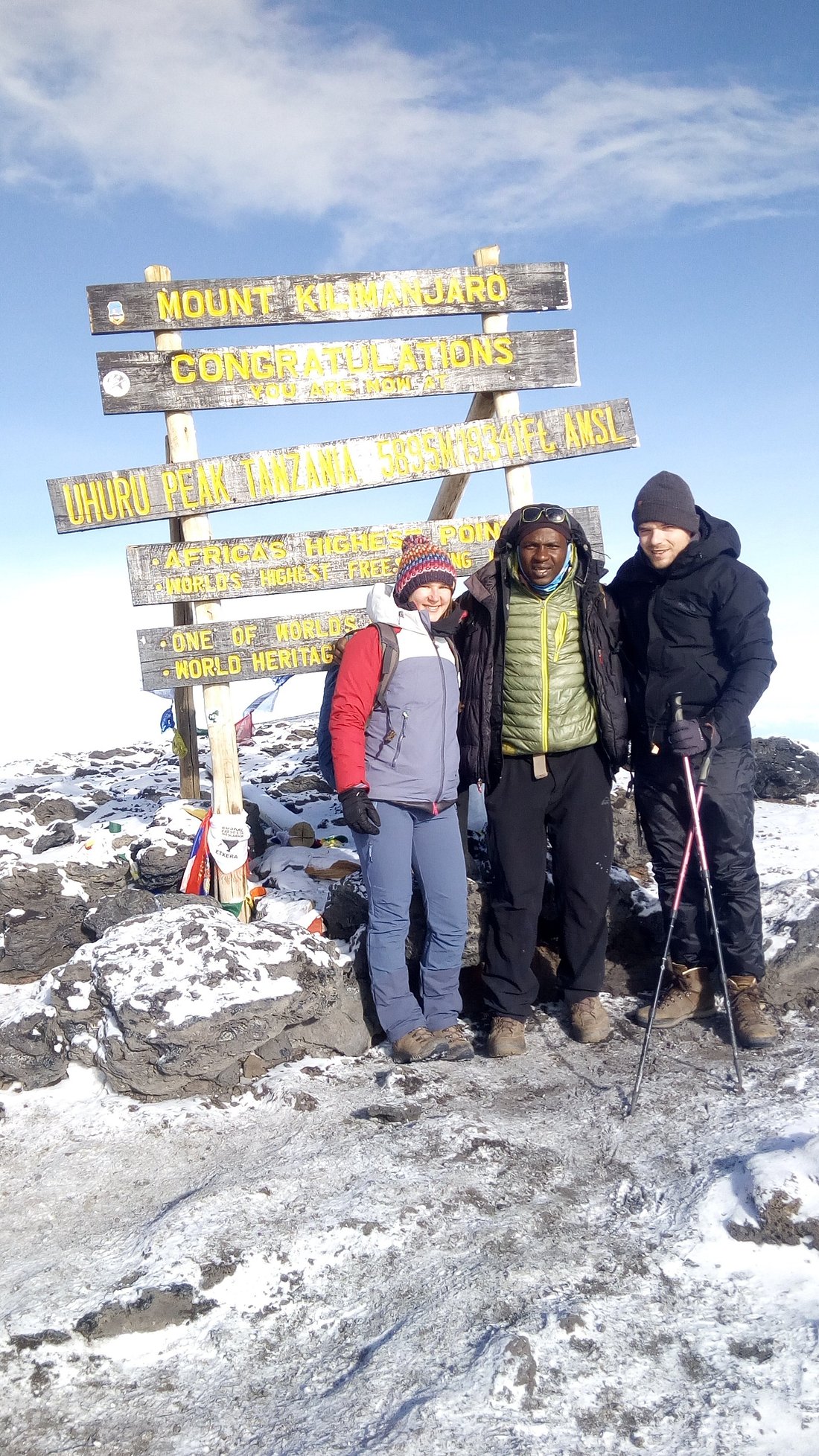
What TANAPA Covers — and What It Doesn’t
Short answer: TANAPA park fees include a rescue coordination component that gets you from the mountain to a ranger post or trailhead by ground or stretcher. TANAPA does not pay for helicopter evacuation, hospital treatment, or medical repatriation. That gap is exactly what personal travel insurance exists to close.
Confusing the two is one of the most common and costly misunderstandings climbers carry onto the mountain. TANAPA’s rescue coordination is zone-based. It does not extend to helicopter dispatch, hospital admission at KCMC, or a medical escort flight home.
Verify TANAPA’s current fee structure at tanzaniaparks.go.tz, and KINAPA’s specific regulations at kilimanjaranationalpark.go.tz. Porter welfare standards are maintained by KPAP — see our tipping guide for context.
📥 Free Download: Kilimanjaro 12-Week Training Calendar
The same week-by-week plan used by Kilimania guides, built from patterns observed across 1,247+ guided climbs.
Prepared by Sabinus Msimba, Senior Kilimanjaro Guide and Co-founder, Kilimania Adventure.
What Kilimania Requires From All Clients
We require every Kilimania client to hold valid travel insurance that includes helicopter evacuation coverage and altitude coverage to at least 5,895m before departure from the trailhead gate. We ask to see evidence of this at your pre-climb briefing in Moshi.
We enforce this requirement because we have seen what happens when a guide at 5,400m has to factor a client’s financial situation into a medical decision. We will not put a guide in that position, and we will not put a client in a position where “can I afford the helicopter?” is a question during a medical emergency.
What we accept as evidence:
- Your policy schedule showing coverage dates, altitude limit, evacuation amount, and covered territory
- Your insurer’s 24-hour emergency assistance number
- A digital copy on your phone (plus a paper backup for battery-limited summit nights)
What we cannot accept:
- Credit card travel insurance without confirmed high-altitude trekking coverage in writing
- Standard travel insurance with no adventure sports or high-altitude rider
- Any policy with an altitude ceiling below 5,895m
If you arrive without appropriate coverage, you will not start the climb, and we will not issue a refund for operational costs already committed on your behalf. This applies across every route: Lemosho, Machame, Marangu, and Rongai.
📲 Send Us Your Policy Summary
As we say here in Moshi, karibu — you are welcome to ask any question before you book, not after. Send us your policy summary before you fly, and we will tell you honestly whether it meets the requirement, free of charge.
WhatsApp: +255 756 449 990
FAQ: Kilimanjaro Travel Insurance
Usually not. Credit card insurance typically covers standard trip cancellation and baggage delay, but rarely high-altitude medical evacuation. Check the actual policy document — not the card’s marketing page — for an altitude exclusion clause. Most credit card policies cap coverage well below 4,000m and do not include helicopter evacuation as a covered benefit.
$5,000–$15,000 for the helicopter flight alone, based on Kilimania’s operational records and market research as of June 2026. Add hospital treatment in Moshi ($500–$2,000 per night at KCMC) and a possible medical escort flight home ($10,000–$30,000), and the realistic total for a serious case reaches $14,000–$35,000. These figures do not include post-repatriation medical costs in your home country.
It is a trekking peak — no ropes, crampons, or technical climbing on any standard route. The correct insurance classification is high-altitude trekking. However, some insurers classify any activity above 5,000m as mountaineering by altitude alone. Confirm in writing with your insurer that a non-technical ascent to 5,895m is covered as trekking, not excluded as mountaineering.
The same day you pay your deposit. Trip cancellation coverage only applies to events occurring after the policy’s purchase date. An illness or injury that occurs before you buy is classified as pre-existing and excluded from cancellation claims. Do not wait until the week before you fly.
Yes. A rescue plan coordinates logistics — calling for help, guiding a safe descent. It does not pay for the helicopter, the hospital, or the flight home. Those costs fall entirely to the climber without personal insurance. A rescue plan and travel insurance serve different functions; you need both.
Often 2–3 times the under-40 rate for equivalent coverage. Budget $300–$600 or more for a 14-day trip. Disclose all conditions in full — omitting them creates grounds for claim denial that will cost far more than the premium saving. See Climbing Kilimanjaro Over 50.
You can, but it is risky. Any altitude-related incident in the first 24–48 hours of coverage may be treated as pre-existing and excluded. Many insurers also impose a waiting period of up to 72 hours before medical benefits activate. Buy before you travel, and give yourself a policy start date that includes travel days.
Possibly, depending on your insurer’s policy wording. Some insurers treat the use of acetazolamide (Diamox) as evidence of a pre-existing altitude sensitivity, which can be used to deny altitude-related claims. Ask your insurer directly before purchasing: “Does my planned use of Diamox for AMS prophylaxis affect my coverage or claim eligibility?” Get the answer in writing.
The route does not change the insurance requirement. Every standard route — Marangu, Machame, Lemosho, Rongai — ends with a summit night passing through Barafu Camp (4,673m), Stella Point (5,685m), and Uhuru Peak (5,895m). The core requirements apply equally to all routes.
No. Kilimania is a trekking operator, not an insurance broker, and we do not earn commissions on insurance sales. We tell clients exactly what coverage we require and will review your policy summary for free. The purchase decision and the policy itself are entirely yours.
The Bottom Line
The cheapest insurance policy is not always the least expensive choice. A policy that fails when you need it most can cost tens of thousands of dollars. Read the actual wording — not the summary brochure — confirm the altitude limit in writing, and buy on the day you pay your deposit.
Two hours spent reading your policy document before your climb is worth more than any other two hours in your preparation. The insurance costs $150–$400. The coverage gap, if something goes wrong without it, costs $14,000–$35,000. Browse our Kilimanjaro Routes and start planning with that number clearly in mind.
📥 Free Download: Kilimanjaro Route Comparison Cheat Sheet
Comparing all major routes on difficulty, scenery, crowd levels, and summit success rates. Updated for the 2026 climbing season.
Prepared by Sabinus Msimba, Co-founder, Kilimania Adventure. Updated 2026.
We Walk With You.
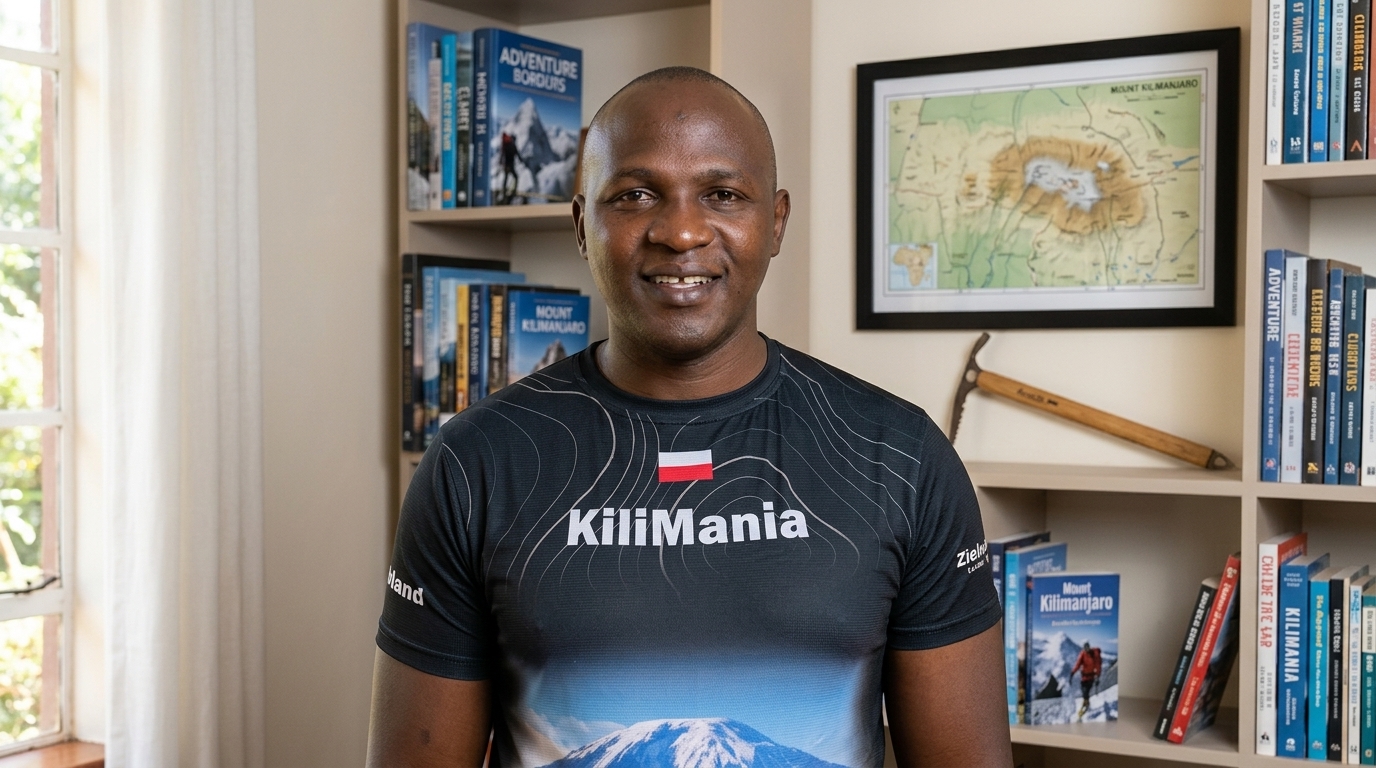
Sabinus Msimba
Senior Kilimanjaro Guide & Co-founder, Kilimania Adventure. 22 years guiding on Mount Kilimanjaro. 300+ summits. KINAPA-licensed. Has personally coordinated multiple high-altitude medical evacuations on Kilimanjaro. Expert in altitude medicine, KINAPA rescue protocols, and high-altitude trekking safety.
Last reviewed: June 2026. Review schedule: Updated each November following insurance market rate changes and any TANAPA or KINAPA fee revisions. Reviewed by Sabinus Msimba, Senior Kilimanjaro Guide and Co-founder, Kilimania Adventure. 22 years guiding, 300+ summits, KINAPA-licensed.
Read Next
- Kilimanjaro Cost 2026: Complete Breakdown — No Hidden Fees
- How Hard Is Kilimanjaro? Success Rates & Altitude Reality
- Climbing Kilimanjaro Guide 2026: Costs, Routes, Altitude & Summit Success
- Kilimanjaro Tipping Guide 2026: Exact Amounts
- Kilimanjaro Packing List 2026
- Kilimanjaro Weather By Month 2026
- Climbing Kilimanjaro With Medical Conditions
- Climbing Kilimanjaro Over 50
Leave a review: Google | TripAdvisor