Transparency note: This article is written by Kilimania Adventure, a licensed Kilimanjaro operator. Links to climbing packages and contact options appear in the article. Health information is for general context only — consult your physician before any high-altitude expedition.
Can I Get a Kilimanjaro Summit Certificate?
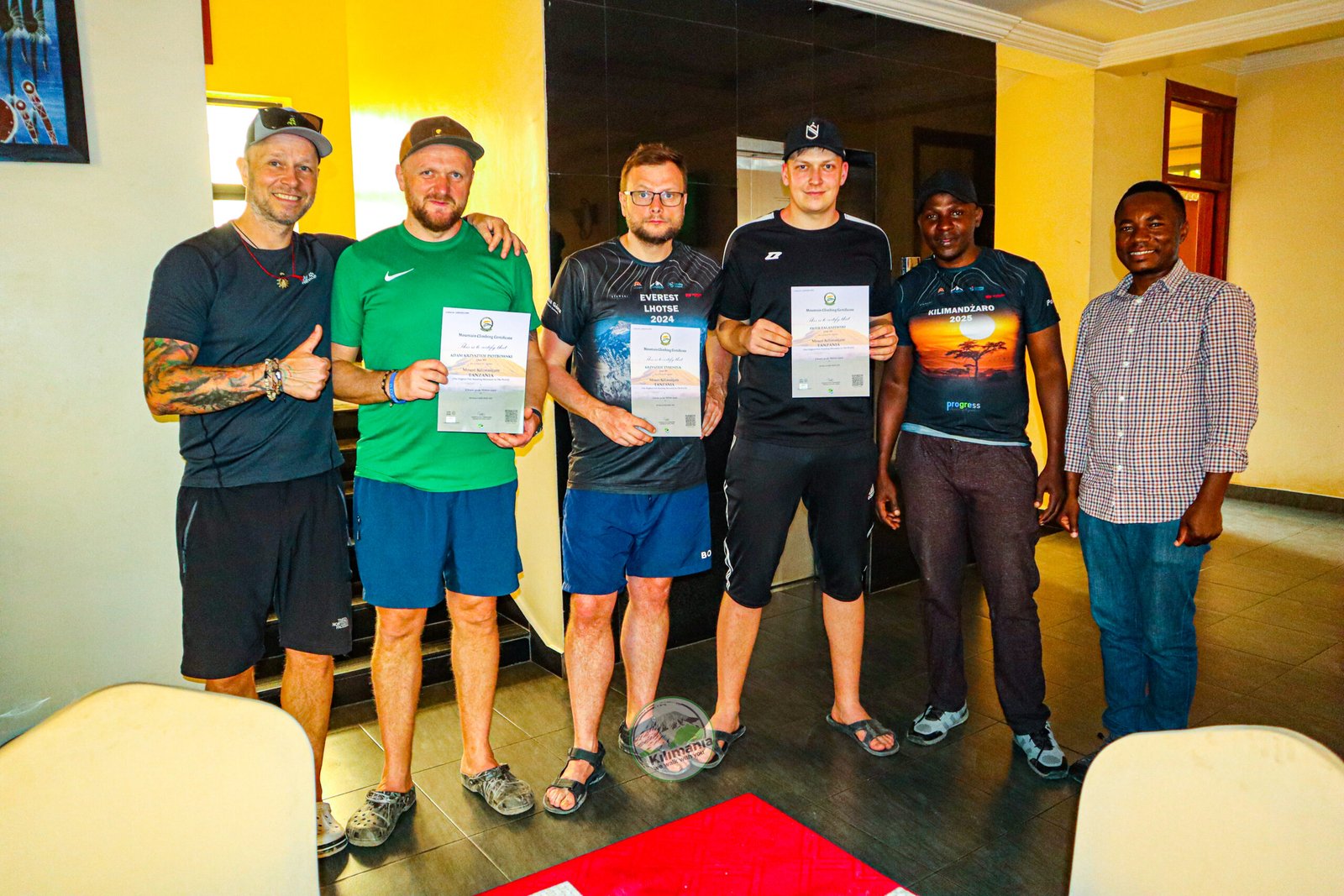
Kilimania Adventure climbers display their summit certificates after reaching Uhuru Peak at 5,895m, together with guides Donald and Sabinus Msimba. Photo: Kilimania Adventure.
Yes. Climbers who reach a recognised summit point on Kilimanjaro may receive a summit certificate. On Kilimania-operated climbs, Uhuru Peak (5,895m) — the true summit of Kilimanjaro — earns a gold certificate. Reaching Stella Point (approximately 5,756m) on the crater rim typically earns a green certificate. Both are collected at the exit gate on descent day at no additional charge. Certificate procedures are managed by TANAPA (Tanzania National Parks Authority) park staff. Confirm current procedures with your operator before your climb, as park operations can vary.
What Is a Kilimanjaro Summit Certificate?
The Kilimanjaro summit certificate is an official document recording that a climber reached a recognised summit point on Africa’s highest mountain. On Kilimania-operated climbs, it is collected at the exit gate at the end of your descent day and is presented by TANAPA park staff based on your guide’s record of your highest point reached.
The certificate is not a participation document. It records a specific altitude and a specific achievement. For most climbers, it becomes one of the more meaningful pieces of paper they bring home — proof of something genuinely difficult that they did under their own strength at altitude.
For the full context of what reaching the summit involves, see our Kilimanjaro climbing guide, which covers everything from route selection to summit night preparation.
The Three Summit Points — and What Each Means for Your Certificate
Kilimanjaro has three recognised high-altitude points that matter for the certificate process. Understanding the difference helps climbers know exactly what they are aiming for — and what their certificate will reflect.
Uhuru Peak — 5,895m
Uhuru Peak is the true summit of Kilimanjaro and the highest point on the African continent. Every route on the mountain, if continued to the absolute top, ends here. The wooden sign at Uhuru Peak reads “5895 METRES AMSL” and marks one of the most photographed spots in East African mountaineering.
On Kilimania climbs, reaching Uhuru Peak earns the gold certificate. It is the full summit achievement, and the certificate reflects that specifically.
Stella Point — approximately 5,756m
Stella Point sits on the southern crater rim. On routes including Machame, Lemosho, Shira, and Umbwe, climbers reach the crater rim at Stella Point after the steep scree and rock section of the summit approach from Barafu Camp.
From Stella Point, Uhuru Peak is approximately 139m higher in elevation — a further section of crater rim walking that takes most climbers between 45 minutes and 90 minutes at altitude. This is not a technically demanding stretch, but the thin air at this elevation makes every step feel significantly harder than the numbers suggest on paper.
On Kilimania climbs, reaching Stella Point earns the green certificate. It is a genuine high-altitude achievement. The crater rim at 5,756m is reached by only a fraction of the people who attempt it each year.
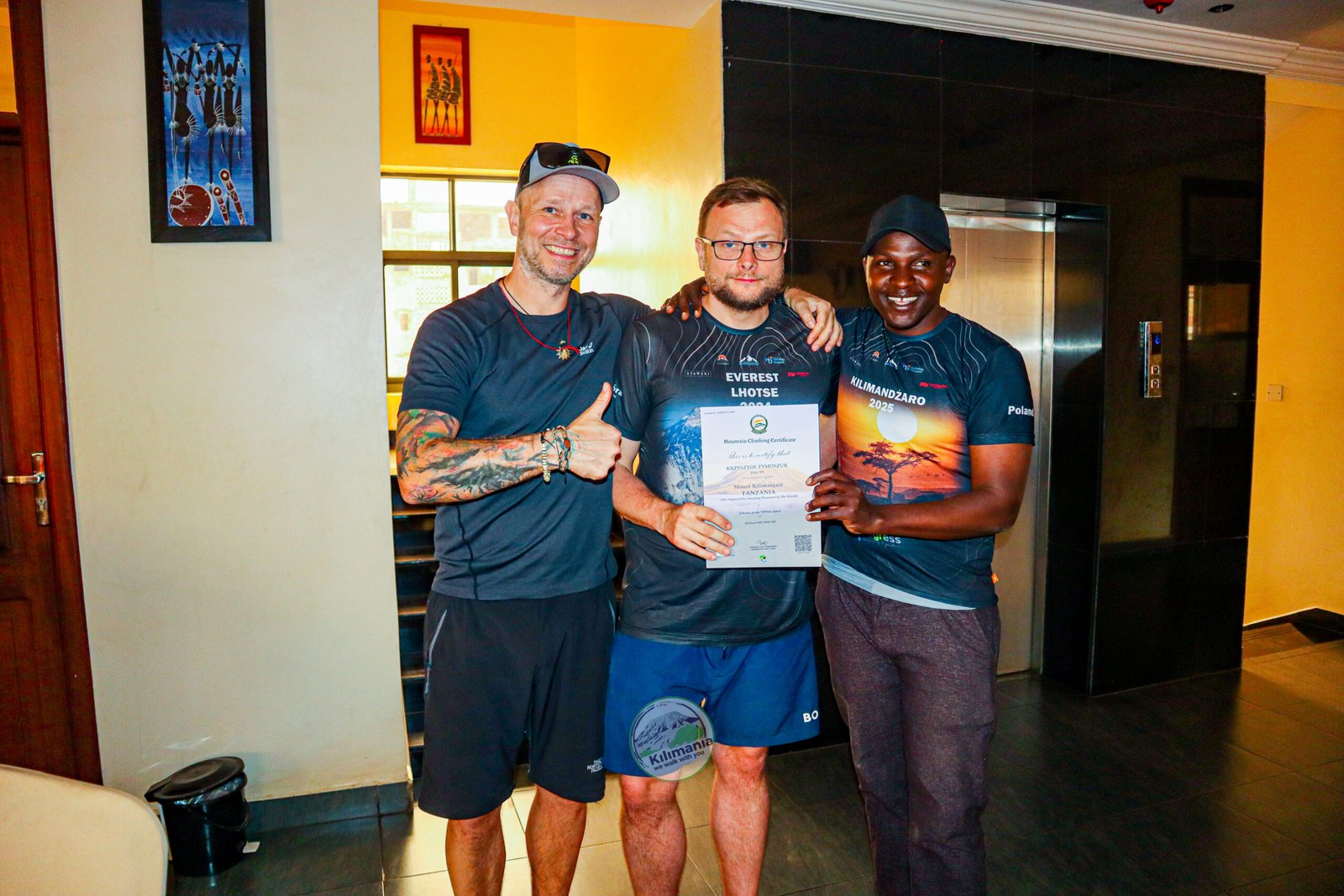
Left to right: tour leader Szymon, client Krzysztof holding his gold Uhuru Peak certificate, and guide Sabinus Msimba. Photo: Kilimania Adventure.
Gilman’s Point — approximately 5,685m
Gilman’s Point is on the eastern crater rim and is reached by climbers on the Marangu and Rongai routes during their summit approach. These routes do not pass Stella Point on the way up — instead they reach the rim at Gilman’s Point first, before continuing around the crater rim toward Uhuru Peak.
On the Marangu and Rongai routes, a climber reaching the crater rim will reach Gilman’s Point before Stella Point. Continuing around the rim past Stella Point and on to Uhuru Peak is the full summit. Climbers who turn back at Gilman’s Point are at a recognised high elevation, though it is lower than Stella Point. Certificate procedures at this point should be confirmed with your operator, as TANAPA procedures can vary.
Route note: The approach to the crater rim differs by route. Machame, Lemosho, Shira, and Umbwe approach via Stella Point. Marangu and Rongai approach via Gilman’s Point. On the Northern Circuit, the final summit push typically reaches the rim toward Stella Point. Always confirm your summit approach with your guide before summit night.
Gold vs Green: The Two Kilimanjaro Certificates Side by Side
On Kilimania-operated climbs, TANAPA issues two different certificates depending on the summit point reached. The following comparison is based on our guides’ direct experience at the exit gates over many years of operation.
| Feature | Gold Certificate | Green Certificate |
|---|---|---|
| Summit Point | Uhuru Peak — 5,895m | Stella Point — approx. 5,756m |
| What It Represents | True summit of Kilimanjaro, highest point in Africa | Crater rim reached — a significant high-altitude achievement |
| Issued by | TANAPA park staff at exit gate | TANAPA park staff at exit gate |
| Collected at | Exit gate on descent day | Exit gate on descent day |
| Cost | No additional charge on Kilimania climbs | No additional charge on Kilimania climbs |
| Route recorded | Typically yes, on Kilimania climbs | Typically yes, on Kilimania climbs |
| Name on certificate | As per passport — must match booking name | As per passport — must match booking name |
| Replacement available? | Not routinely — photograph immediately | Not routinely — photograph immediately |
Certificate colours and exact procedures are based on Kilimania’s direct field experience. TANAPA procedures can change, so confirm current requirements with your operator before your climb.
“At the gate, I have seen every kind of moment — climbers who did not expect to make the summit, standing there holding a gold certificate in disbelief. And climbers who turned back at Stella Point holding a green certificate, knowing they made the right call for their safety. Both certificates represent something real. Neither one is a consolation.”
— Sabinus Msimba, Senior Mountain Guide, Kilimania Adventure. KINAPA-licensed guide since 2003.
Thinking about which route gives you the best chance of reaching Uhuru Peak? Our guide team can help you choose an itinerary with enough acclimatisation time and the right pacing for your fitness level.
View All Kilimanjaro Climb Options💬 WhatsApp: +255 756 449 990
How the Certificate Collection Process Works
On Kilimania-operated climbs, the certificate is collected at the exit gate on the day you complete your descent — the same day as your summit attempt. Here is how the process typically works based on our guides’ experience at the gate.
- Your guide records your highest point. During the summit night, your lead guide tracks and notes the highest altitude you reach. This record is used to confirm your certificate eligibility at the gate.
- Descend to high camp for rest. After reaching your highest point, you descend to Barafu Camp — or Crater Camp on the Northern Circuit — to rest, eat, and gather your gear before the final long descent.
- Final descent to the exit gate. The descent from Barafu to the exit gate takes most climbers between four and six hours through the moorland and forest zones. On most routes, this is Mweka Gate. On the Marangu route, climbers return to Marangu Gate.
- Certificate collection at the gate. TANAPA park staff at the gate confirm your summit point with your guide and issue your certificate accordingly. On Kilimania climbs, our guides manage this process and ensure your certificate correctly records your achievement.
- Photograph the certificate immediately. Before it goes anywhere near a bag or pocket — photograph both sides of the certificate with your phone and email the image to yourself. Replacements are not routinely available from TANAPA.
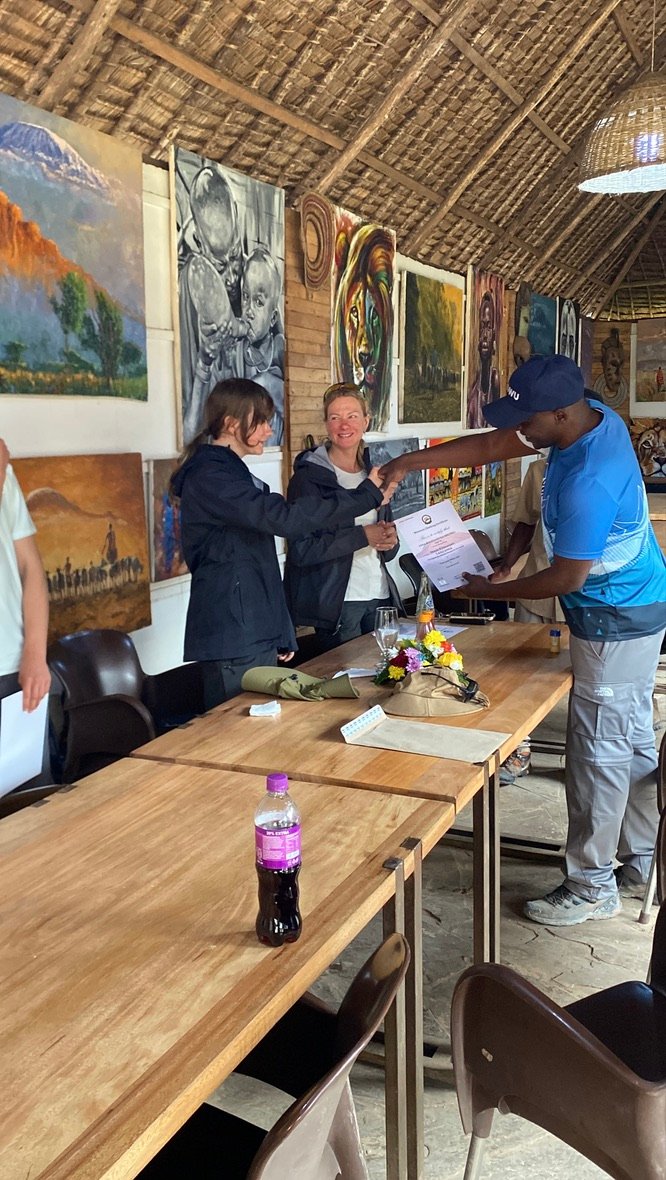
Kilimania Adventure guide Sabinus Msimba presents a gold Uhuru Peak certificate after a successful ascent. Photo: Kilimania Adventure.
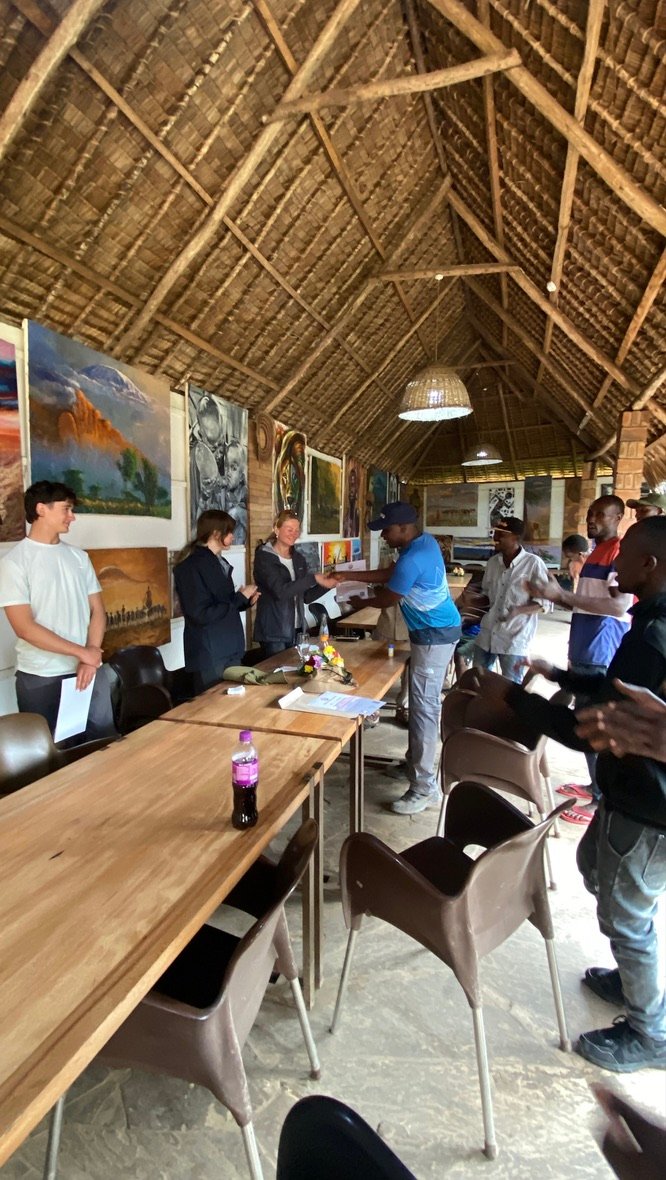
Kilimania Adventure climbers celebrate their Kilimanjaro summit certificates with guide Sabinus Msimba in Moshi, Tanzania. Photo: Kilimania Adventure.
Protect your certificate on the descent: The paper is functional, not archive quality. The descent from Barafu to Mweka Gate passes through humid forest zones where a certificate in an open pack pocket will absorb moisture. Your guide can carry it in a dry bag from the gate. If you plan to frame it, shops in Moshi town offer framing at a modest cost — worth doing before you travel home.
Want to understand what the summit night actually involves — the timing, the conditions, and the decisions your guide makes — before you commit to a climb?
Read: The Kilimanjaro Summit Night, Hour by HourWhat Information Appears on the Certificate
The certificate is a formal record, not a souvenir. On Kilimania climbs, the certificates we have seen issued typically include:
- Your full name — as it appears on your passport. This is why your booking name must match your travel documents exactly. Raise any discrepancy with Kilimania before your climb starts, not at the gate.
- The date — the date of your summit attempt. If your summit happened after midnight on summit night, this will typically be recorded as the date of arrival at your summit point.
- The altitude reached — either 5,895m for Uhuru Peak or the recorded elevation for your highest point.
- The route used — drawn from your operator’s permit documentation submitted to TANAPA before the climb begins.
- Official stamp and signature — applied by the TANAPA gate officer on descent day.
Name accuracy matters: Make sure your booking name matches your passport exactly. Certificate fields are drawn from your operator’s permit paperwork. Contact Kilimania before your climb if there is any question about name format. Corrections at the gate are difficult and are not guaranteed.
What If You Turn Back Below Stella Point?
This is worth understanding clearly before your summit night, not after.
Climbers who turn back below the crater rim — below Stella Point at approximately 5,756m — do not receive a summit certificate. There is no partial certificate, no document for reaching 5,000m or 5,200m, and no altitude-tier recognition below the defined summit points. If your highest point is Barafu Camp (approximately 4,673m) or anywhere below the crater rim, you leave the mountain without a TANAPA certificate.
This is not a judgment. Altitude affects people regardless of fitness or preparation. The conditions on summit night — sub-zero temperatures, thin air, eight or more hours of climbing in the dark — create a level of physical demand that is genuinely difficult to replicate in training. Some climbers reach 5,000m, 5,200m, or 5,400m before their body signals that continuing is not safe that day. Turning back in that situation is the correct decision.
What it means practically is this: if the certificate matters to you as an outcome, the most important decisions you can make happen before summit night — choosing a route with sufficient acclimatisation days, arriving well-rested, hydrating consistently throughout the climb, and pacing conservatively on the lower slopes. None of these guarantee success at altitude. But they substantially improve the conditions for it.
For a full explanation of success rates, route comparisons, and what happens when climbers do not reach their summit goal, read: What Happens If You Don’t Summit Kilimanjaro?
The Decision at Stella Point
For climbers approaching via Machame, Lemosho, Shira, or Umbwe, Stella Point is the moment where the character of the summit push changes. You have completed the steepest, most technically demanding section of the climb — the ascent from Barafu through the switchbacks in the dark. You are on the crater rim. The horizon begins to lighten. Uhuru Peak is 139m of additional elevation away along the crater rim path.
That 139m of elevation is not technically difficult terrain. But at over 5,700m with several hours of night climbing behind you, the thin air makes every step noticeably harder than the elevation numbers suggest. For most climbers in good condition who have reached Stella Point without significant distress, continuing to Uhuru Peak is achievable with another 45–90 minutes of steady, careful effort.
On Kilimania climbs, your guide assesses your condition at Stella Point. This assessment is based on observable symptoms — your movement, your breathing, your responsiveness, your colour — alongside a direct conversation about how you are feeling. The guide’s job at this point is not to push you to the summit. It is to make an honest, experience-based call about whether continuing is safe for you on that specific morning, given everything they have observed over the previous hours of climbing.
In our experience guiding on Kilimanjaro, the climbers who turn back at Stella Point divide roughly into two groups: those whose body has physically reached its limit for that day and who make the right call, and those who feel they could continue but are uncertain. Your guide can help you distinguish between those two situations. That judgement is part of what experienced guiding on a high-altitude mountain actually means.
If you reach Stella Point, you have already achieved something significant. A green certificate from that elevation is a genuine record of a real high-altitude accomplishment. It is not a consolation prize. It reflects exactly where you climbed.
From the Kilimania team: “We have guided climbers who reached Stella Point after seven hours of climbing in -12°C conditions and genuinely could not safely continue. They made the right call. We have also guided climbers who thought they could not continue and, after a short rest and honest conversation, went on to Uhuru Peak. The guide’s role at Stella Point is to give you an accurate picture of your situation — not to encourage, not to discourage, but to be honest.” — Sabinus Msimba, Senior Guide
How to Protect Your Kilimanjaro Summit Certificate
The certificate is a piece of paper collected after an exhausting descent, at a gate in a forest zone, before a vehicle journey back to Moshi. With a small amount of planning, it arrives home intact.
Photograph it immediately at the gate
The single most important thing you can do: photograph your certificate the moment it is placed in your hand, before anything else happens. Both sides. Then email that photograph to yourself before you leave the gate area, so it is backed up off your device. TANAPA does not routinely issue replacement certificates. A photograph is the practical backup that most climbers rely on if the original is damaged.
Bring something to protect it for transport
A rigid cardboard postal tube — the kind used for posters or rolled documents — fits in checked luggage and costs almost nothing before you travel. Alternatively, a flat A4 plastic sleeve inside your checked bag works well. Ask the Kilimania team at your pre-climb briefing in Moshi what other climbers on recent trips have used. Your guide can also carry the certificate from the gate to the vehicle in a dry bag if needed.
Framing options in Moshi
Several shops in Moshi town centre offer certificate framing. If you want the certificate framed before you fly home, this is the practical place to do it. Ask the Kilimania team to point you toward a reliable option on your return day. Framing quality and price vary, but the cost is modest and it removes the transport risk entirely.
Consider framing before you pack
A framed certificate travels as carry-on or checked luggage far more safely than a rolled or folded sheet of paper. Many climbers who frame in Moshi simply pack the framed certificate as checked luggage with their climbing gear. It arrives home already displayed.
For packing advice on the climb itself, see our Kilimanjaro packing list.
Which Route Leads to Which Exit Gate
The certificate is collected at the gate where your route exits the national park. On most routes, this is Mweka Gate. On the Marangu route, climbers return to Marangu Gate. This matters practically because your transfer vehicle from Kilimania will be waiting at the correct gate — but it is worth knowing in advance so the process is clear on descent day.
| Route | Exit Gate | Drive to Moshi (approx.) |
|---|---|---|
| Machame Route | Mweka Gate | 45 minutes |
| Lemosho Route | Mweka Gate | 45 minutes |
| Shira Route | Mweka Gate | 45 minutes |
| Umbwe Route | Mweka Gate | 45 minutes |
| Rongai Route | Mweka Gate | 45 minutes |
| Northern Circuit | Mweka Gate | 45 minutes |
| Marangu Route | Marangu Gate | 60 minutes |
Frequently Asked Questions
The Kilimanjaro summit certificate is an official document issued by TANAPA (Tanzania National Parks Authority) to climbers who reach a recognised summit point on Kilimanjaro. On Kilimania-operated climbs, climbers who reach Uhuru Peak (5,895m) receive a gold certificate, and those who reach Stella Point (approximately 5,756m) receive a green certificate. Both are collected at the exit gate on descent day and are issued at no additional charge. Certificate procedures are managed by TANAPA park staff and can vary, so confirm the current process with your operator before your climb.
On Kilimania climbs, the gold certificate is awarded to climbers who reach Uhuru Peak — the true summit of Kilimanjaro at 5,895m and the highest point in Africa. The green certificate is awarded to those who reach Stella Point on the crater rim at approximately 5,756m. Both are genuine high-altitude achievements. The gold certificate reflects the full summit; the green certificate reflects reaching the crater rim after the hardest section of the mountain. Uhuru Peak is 139m higher in elevation than Stella Point, and reaching it requires an additional 45–90 minutes of crater rim walking at altitude after an already demanding summit push.
No. A summit certificate is issued only to climbers who reach a recognised summit point — typically Stella Point (approximately 5,756m) or Uhuru Peak (5,895m). Climbers who turn back below the crater rim do not receive a certificate, regardless of how high they climbed. There is no partial certificate for reaching 5,000m or 5,400m. If the certificate matters to you, the most important preparation decisions happen before summit night — route selection, acclimatisation schedule, pacing, and hydration.
On Kilimania-operated climbs, the summit certificate is collected at no additional charge at the exit gate. Your operator’s park fees, paid before the climb, cover your permit. The certificate itself is issued by TANAPA park staff as part of the gate process. Confirm current procedures with your operator, as TANAPA processes can vary.
Replacement certificates are not routinely available from TANAPA. If yours is lost or damaged after collection, replacement is not guaranteed. The most practical approach: photograph both sides of the certificate the moment it is handed to you at the gate, and email the photo to yourself immediately so it is backed up off your device. Framing the certificate in Moshi before you travel home also removes the transport risk entirely.
On Kilimania climbs, the certificate typically includes your name as per your passport, the date, the altitude reached, and the route used. It includes an official stamp from park staff. The route information comes from your operator’s permit documentation submitted to TANAPA before the climb. Always confirm exact certificate fields with your operator, as format details can vary.
Want to understand which routes have the strongest summit success rates before you commit to an itinerary?
Kilimanjaro Success Rates by RouteFinal Advice Before Your Summit Night
The Kilimanjaro summit certificate records something real — a specific altitude, a specific date, and a specific route. It is not a participation award and it is not a marketing document. It is a formal record issued by TANAPA park staff of what you actually achieved on one of the world’s most recognised high-altitude treks.
Gold means Uhuru Peak at 5,895m — the true summit of Kilimanjaro. Green means Stella Point at approximately 5,756m on the crater rim. Both are collected at the exit gate on descent day, at no additional charge, based on your guide’s record of your highest point. Neither is issued without a genuine physical achievement behind it.
The practical things to sort before you go: confirm your booking name matches your passport exactly, bring a rigid tube or flat folder for transport, and photograph the certificate the moment it is handed to you at the gate. Everything else is handled by your guide and the TANAPA gate team.
For a complete picture of what the summit push involves — the conditions, the timing, and how your guide supports you through it — read the hour-by-hour summit night guide. For questions about route selection and itinerary, contact Sabinus Msimba directly. For the full overview of everything a Kilimanjaro climb involves, see the Kilimanjaro climbing guide.
Planning your Kilimanjaro climb? Explore route options or speak directly with the Kilimania team in Moshi for advice on choosing an itinerary that gives you the best possible preparation for the summit.
View All Kilimanjaro Climb Options✉️ info@kilimania.co.tz
💬 WhatsApp: +255 756 449 990
Related Kilimanjaro Guides
📥 Free Download: Kilimanjaro Altitude Symptom & Monitoring Checklist
Altitude-related illness is the leading reason climbers turn back before reaching the summit — and their certificate. This checklist is used by the Kilimania Adventure guide team to monitor climbers throughout every expedition.
- Normal acclimatisation symptoms above 3,000m
- Acute Mountain Sickness (AMS) warning signs
- Serious altitude illness symptoms requiring immediate descent
- Daily health self-assessment form (hydration, rest, energy)
- Guide monitoring reference for summit night
Prepared by: Sabinus Msimba, Senior Mountain Guide, Kilimania Adventure, Moshi, Tanzania. This checklist is for general educational purposes only and does not replace professional medical advice. Consult your physician before any high-altitude expedition.