Kilimanjaro Hydration: How Much Water Should You Drink Each Day?
Quick Answer
How much water on Kilimanjaro should you drink? 3–4 litres per day, minimum — that is the physiological requirement, not a guideline. At altitude above 3,000m, accelerated breathing and cold dry air cause far more fluid loss than you feel. Most climbers underdrink by 30–40% and blame the resulting headaches on altitude sickness when dehydration is often the real cause. Here is how to manage hydration correctly across all 8 days.
How Much Water on Kilimanjaro Should You Actually Drink?
The short answer is 3–4 litres a day, every day, from the gate to the summit and back. That number holds regardless of route — Lemosho, Machame, Rongai, or Northern Circuit — because it reflects what altitude does to your body, not the specific trail. Climbers who track this consciously, rather than drinking only when thirsty, arrive at each camp in noticeably better shape than those who don’t.
In This Kilimanjaro Hydration Guide
- How Much Water on Kilimanjaro?
- Why Kilimanjaro Hydration Needs Change at Altitude
- The Guide’s Hydration Schedule
- The Urine Colour Field Test
- Dehydration vs Altitude Sickness
- What to Drink — and Avoid
- Kilimanjaro Hydration by Day (8-Day Table)
- Water Safety on the Mountain
- What Climbers Say
- Frequently Asked Questions
- Practical Summary
Planning a Kilimanjaro Climb?
Our guides manage hydration, acclimatisation, and summit decisions for you — from Moshi to Uhuru Peak and back safely.
See 2026 Routes & PricesTATO-registered · KPAP compliant · Moshi, Tanzania
Why Kilimanjaro Hydration Needs Change at Altitude
At sea level, a moderately active adult loses roughly 2–2.5 litres of fluid per day through breathing, sweat, and urination. On Kilimanjaro above 3,000m, that figure climbs substantially.
Most of the increase is invisible. Here is what happens physiologically the moment you start ascending:
- Breathing rate increases. Your body detects lower partial pressure of oxygen and compensates by breathing faster and deeper. Each exhaled breath carries water vapour. At 4,800m — Kibo Camp — you may be exhaling 30–50% more air per minute than at sea level.
- Cold, dry air accelerates moisture loss. At Barafu Camp (4,673m) in July, ambient humidity can drop below 20%. Every breath you draw in pulls warmth and moisture from your respiratory tract. Every breath out takes it with it.
- Altitude diuresis. As acclimatisation begins, your kidneys excrete more fluid in response to hormonal changes. This is a normal and healthy response — but it accelerates dehydration if intake does not keep pace.
- Appetite suppression reduces incidental fluid intake. At altitude, many climbers lose their appetite and eat less. Solid food contains water. When food intake drops, so does a hidden fluid source most people never think about.
The result: climbers are chronically underhydrated on Kilimanjaro not because they are careless, but because the fluid loss is largely silent. There is no dramatic sweat. There is no intense heat. And yet the body is losing fluid at a rate that demands structured Kilimanjaro hydration habits from Day 1.
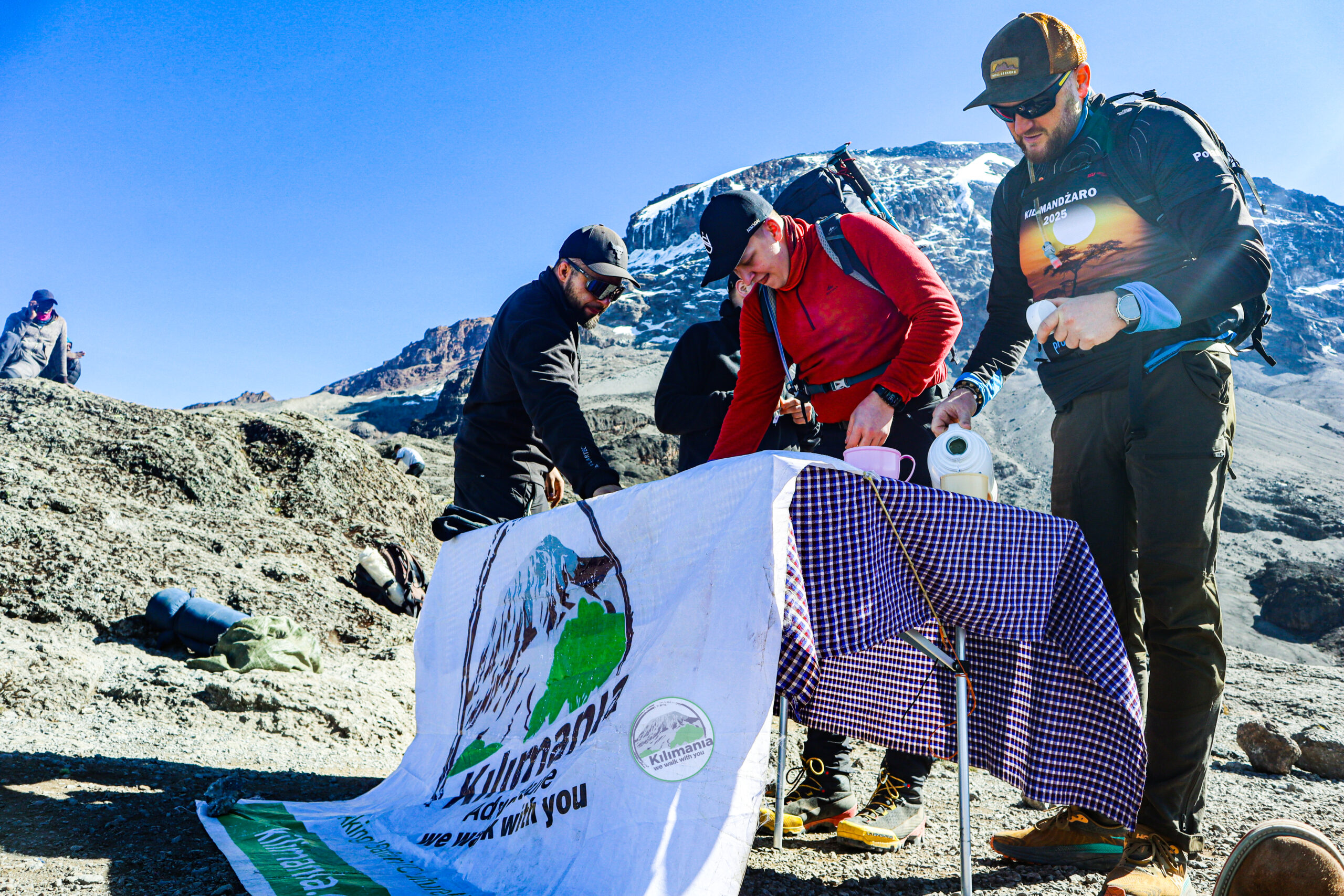
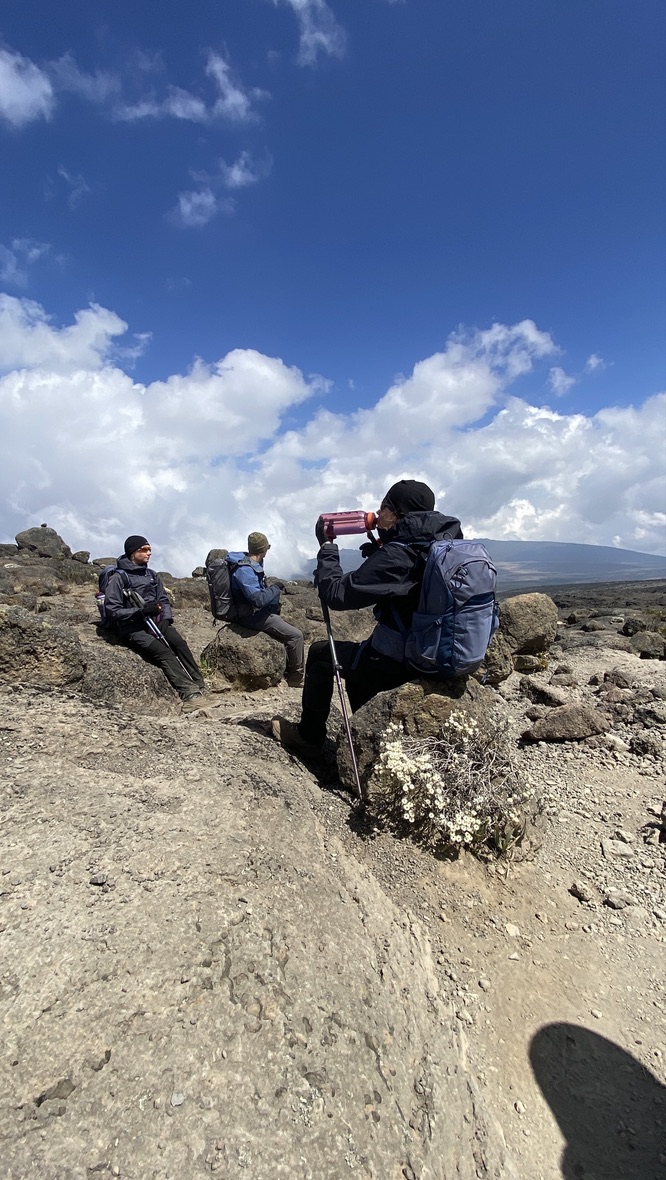
Climbers pause on the trail to drink from their bottles during a high-altitude stage. This kind of scheduled break — rather than drinking only when thirsty — is exactly how Kilimania guides keep the group on track for the 500ml-per-hour hiking target described below.
The Hydration Schedule Guides Use
Good hydration on Kilimanjaro is not constant sipping — it is structured drinking at specific points in the day. The schedule below is what Kilimania guides use to keep climbers adequately hydrated across each 24-hour period on the mountain.
Many climbers make the mistake of reducing fluid intake on summit night because they do not want to stop to urinate in -12°C to -18°C temperatures between Barafu and Stella Point. This is a significant error. Dehydration at 5,500–5,895m impairs cognitive function and physical performance precisely when you need both most. Use a pee bottle if needed. Keep drinking.
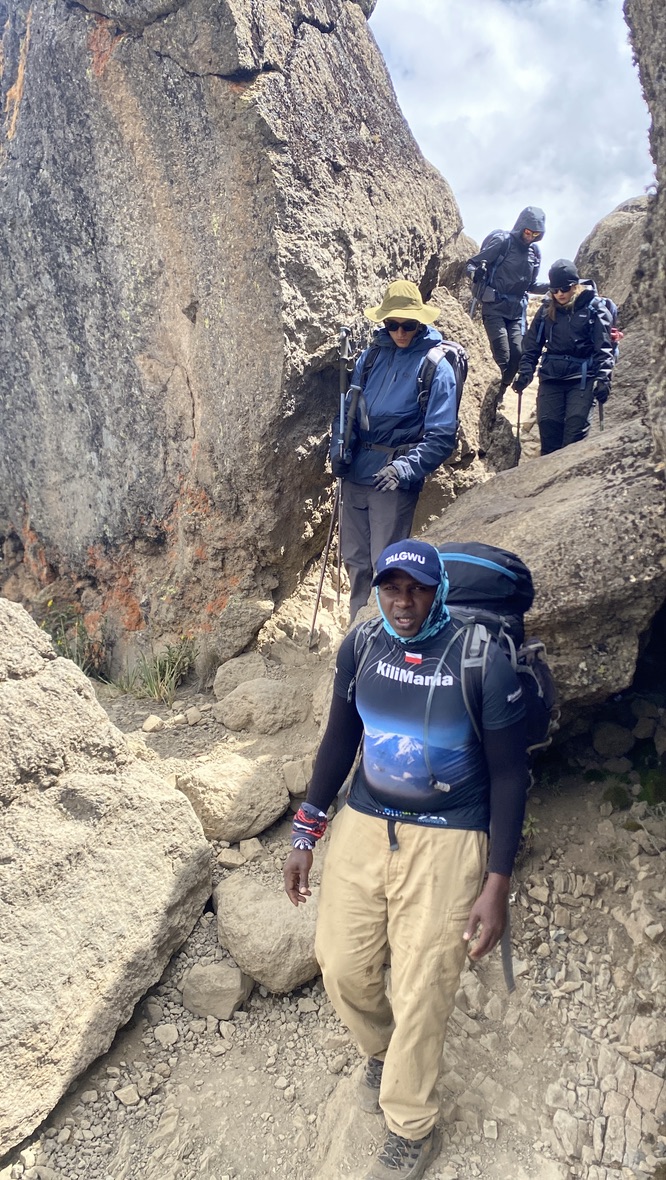
The Shira-to-Lava-Tower stage climbs to roughly 4,600m before dropping back to Barranco Camp — the steepest single-day altitude spike on the route. Sabinus paces the group and checks hydration deliberately on this stage, since it is where the gap between feeling fine and being quietly dehydrated tends to widen fastest.
The Only Field Test That Matters: Urine Colour
On Kilimanjaro, urine colour is the most reliable real-time hydration indicator available. It requires no equipment, no testing kit, and no guesswork. Guides check this with their climbers daily — particularly on Days 4, 5, and summit day, when altitude and exertion combine to accelerate fluid loss.
Aim to urinate at least 4–5 times per day during the ascent. If you are urinating fewer than 3 times in a full day, you are behind on intake regardless of how thirsty (or not) you feel. Altitude suppresses thirst. Do not use thirst as your guide on Kilimanjaro.
Want a Guide Who Monitors This Daily?
Kilimania guides track climber hydration and SpO₂ at every camp. Altitude sickness and dehydration are managed before they become emergencies — not after.
Plan Your Kilimanjaro ClimbWhatsApp: +255 756 449 990 · info@kilimania.co.tz
Dehydration vs Altitude Sickness: How Guides Tell the Difference
This is one of the most practically important pieces of information on this page. Dehydration and acute mountain sickness (AMS) share four key symptoms: headache, fatigue, nausea, and reduced cognitive function.
On the mountain, conflating the two leads to bad decisions in both directions — either undertreating AMS or descending unnecessarily for what was actually a fixable hydration deficit.
The protocol Kilimania guides use:
- Identify the symptom. Headache, fatigue, nausea, or reduced clarity — note which and when it started.
- Rehydrate immediately. Give the climber 500–750ml of water or electrolyte drink. Sit them down. Rest for 30 minutes.
- Reassess at 30 minutes. If symptoms have improved significantly — headache down from 7/10 to 3/10, energy returning, nausea reduced — dehydration was the primary driver. Continue monitoring and increase fluid intake for the remainder of the day.
- If symptoms persist or worsen after adequate rehydration, begin a formal AMS assessment: Lake Louise Score, SpO₂ reading, pulse rate, and symptom escalation check. If AMS is confirmed, apply the AMS management protocol. See our full altitude sickness guide for the complete assessment process.
I have seen climbers at Karanga Camp (4,035m) with splitting headaches convinced they have altitude sickness. We rehydrate them with 750ml of warm electrolyte drink over 25 minutes. In many cases they feel significantly better within half an hour — dehydration was the cause. We still monitor them carefully for the rest of the climb, but they did not need to descend. The 30-minute rehydration test has saved many summit attempts.
— Sabinus Msimba, Senior Mountain Guide, Kilimania Adventure
What to Drink and What to Avoid
Not all fluids are equal at altitude. Here is a straightforward breakdown of what works and what does not on Kilimanjaro.
| Drink | Counts Toward Daily Total? | Notes |
|---|---|---|
| Water (treated) | ✅ Yes — primary source | All water must be treated. Kilimania provides treated water at every camp. Never drink untreated stream water. |
| Electrolyte drinks | ✅ Yes — strongly recommended | Replace sodium and potassium lost through sweat. Use for 1–2 bottles per day, not as full replacement for water. |
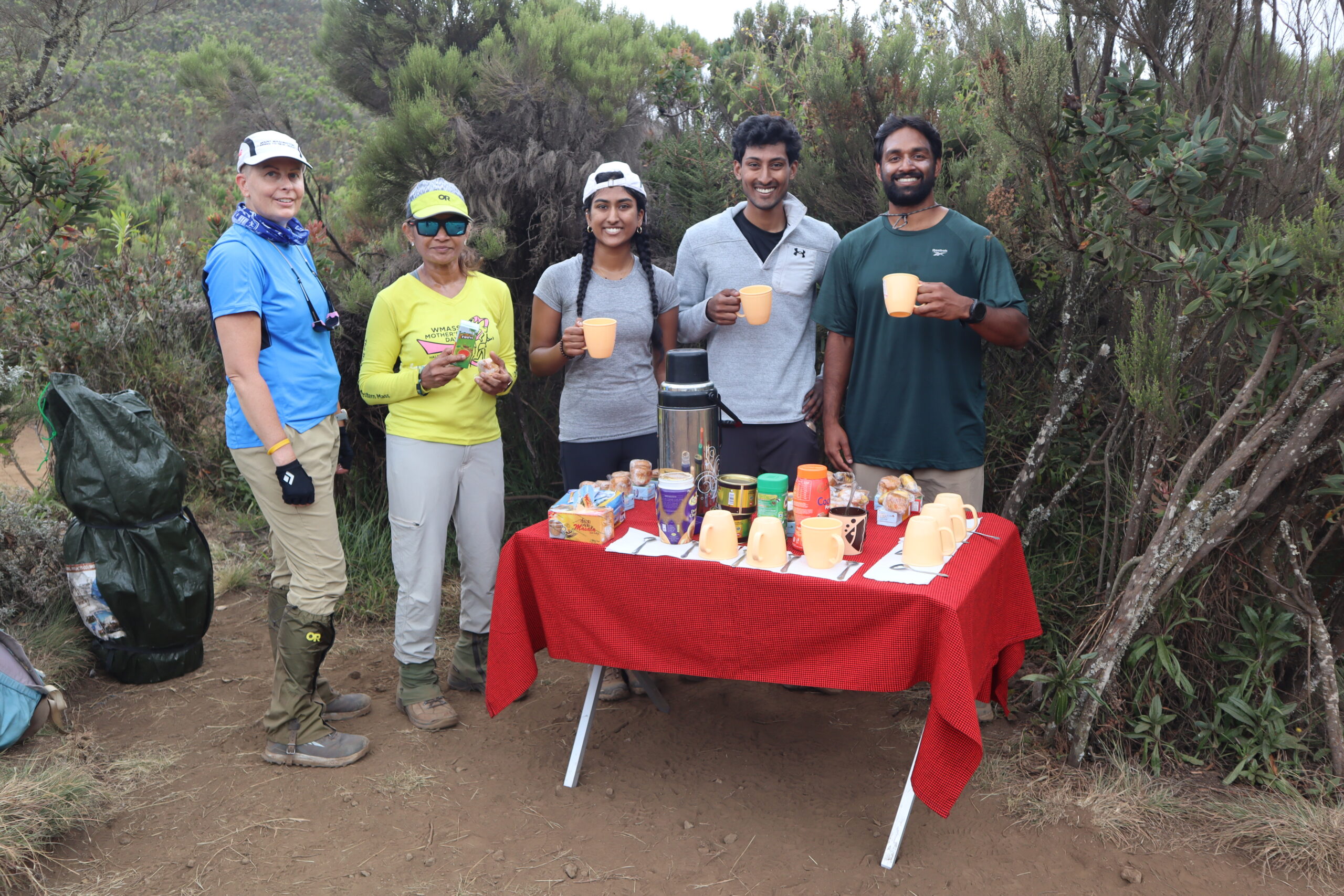
| Tea / coffee | ✅ Yes — counts in full | Mild caffeine diuresis is significantly offset by fluid volume. Both count. Provided at every camp meal. |
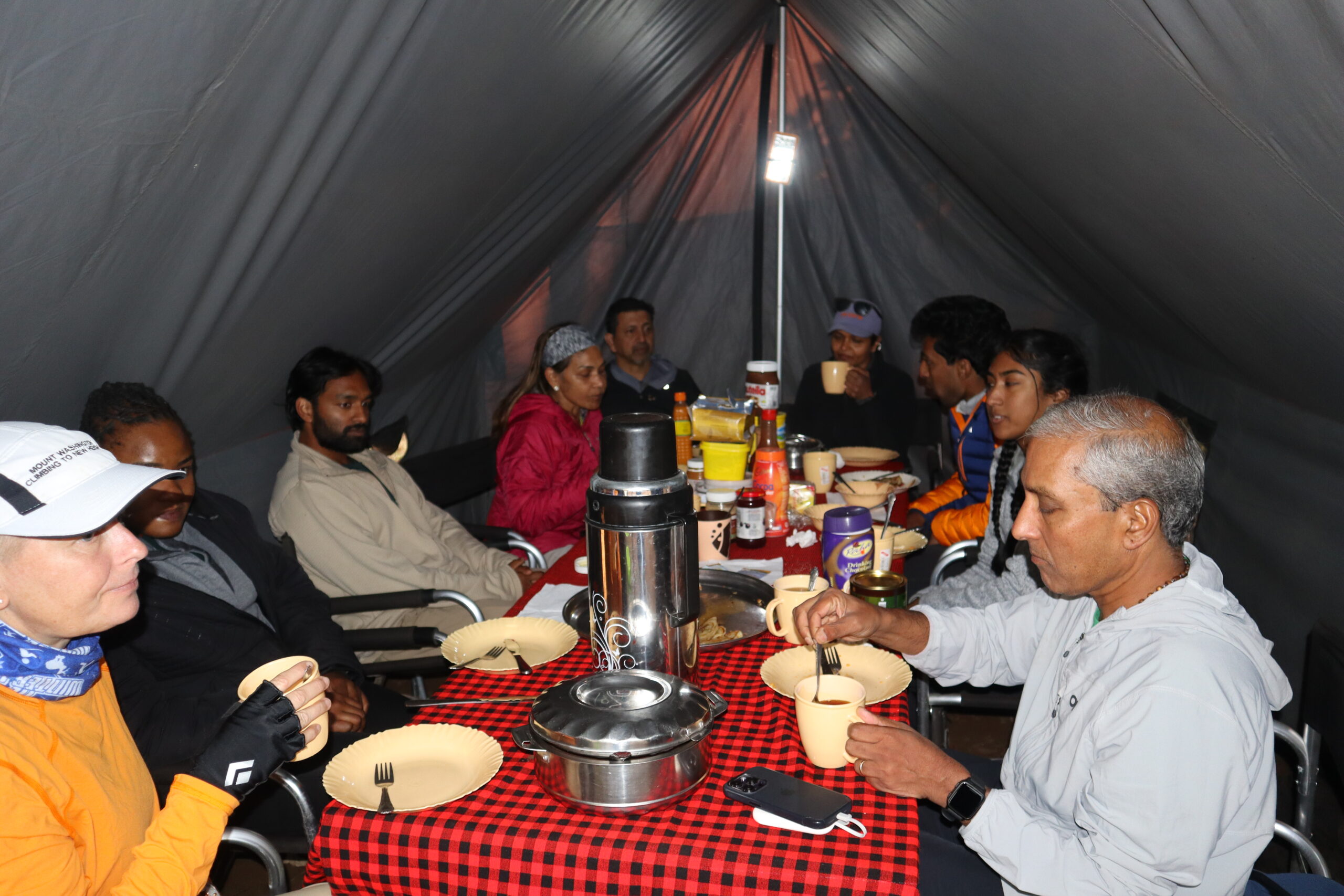
| Hot chocolate | ✅ Yes | Good for morale and calories as well as fluid. Particularly useful at high camp when appetite is suppressed. |
| Garlic soup | ✅ Yes — fluid + electrolytes | Kilimanjaro tradition. Contains sodium. Helps with fluid and has some anecdotal acclimatisation benefit. |
| Alcohol | ❌ No — actively harmful | Vasodilating and dehydrating at altitude. One beer at 4,600m has a disproportionate physiological impact. Avoid entirely above 3,000m. |
| Energy drinks | ⚠️ Use with caution | High caffeine plus altitude can elevate heart rate excessively. If you use them at sea level, limit to one per day at altitude. |
Kilimanjaro Hydration by Day: The 8-Day Breakdown
The 3–4 litre daily target applies from Day 1. Many climbers assume the lower camps are easy and drop their guard. This is a mistake — the acclimatisation window of Days 2 and 3 is precisely when dehydration causes the most disruption to the adaptation process.
| Day | Camp | Altitude | Hydration Priority |
|---|---|---|---|
| Day 1 | Machame / Lemosho Gate → First Camp | 1,800–3,100m | Establish the habit. 3L minimum. Forest humidity helps but doesn’t replace active drinking. |
| Day 2 | First Camp → Shira One/Two | 3,100–3,800m | First notable altitude effects. Respiratory rate increases. 3.5L target. Monitor urine colour from today. |
| Day 3 | Shira → Lava Tower → Barranco | Peak: 4,600m → Sleep: 3,976m | High-low acclimatisation day. Drink 4L. The Lava Tower altitude spike demands aggressive hydration. Do not rely on thirst. |
| Day 4 | Barranco → Karanga | 3,976–4,035m | Shorter hiking day. 3L minimum. The Barranco Wall is physically demanding — drink before and after. |
| Day 5 | Karanga → Barafu | 4,035–4,673m | Rest day at Barafu before summit. 4L. Pre-load for summit night. Dinner should include soup. Sleep early. |
| Day 6 | Barafu → Uhuru (5,895m) → Mweka | 4,673–5,895–3,100m | Summit day. Carry minimum 2L in insulated bottles (water freezes above 5,000m at night). Drink 500ml every 2 hours even if not thirsty. On descent, drink to rehydrate aggressively. |
| Days 7–8 | Mweka → Gate | 3,100–1,640m | Descent. Altitude dehydration stress reduces but physical exertion continues. 3L. Many climbers relax hydration too soon on descent. |
Above 5,000m at 1–3am, ambient temperatures on Kilimanjaro’s summit route regularly drop to -12°C to -20°C. Standard water bottles and hydration bladder hoses freeze within 30–45 minutes of inactivity. Carry your water bottles inside your jacket next to your body. Use wide-mouth insulated bottles rather than hydration bladder systems on summit night. Hydration bladder hose tubes freeze solid and become useless.
Water Safety: What Happens to Your Water on the Mountain
Water on Kilimanjaro comes from streams, snowmelt, and camp water points. It looks clean. It is not reliably safe to drink untreated. Giardia, cryptosporidium, and bacterial contamination have been documented in Kilimanjaro water sources at multiple elevations.
Kilimania’s process for all client water:
- Water is collected from the highest available clean source at each camp.
- It is passed through a ceramic or squeeze filter to remove particulates and most pathogens.
- Purification tablets are added as a secondary treatment.
- Hot drinks use boiled water — boiling at altitude is effective above 70°C, which is reached even at 5,000m.
If you carry your own personal filter (such as a Sawyer Squeeze), you can treat stream water directly for your personal bottles. If you rely on chemical tablets alone without filtration, allow 30 minutes contact time for iodine tablets or 4 hours for chlorine tablets at cold water temperatures.
For more on what you eat and drink at each camp, see our complete Kilimanjaro food and meals guide.
📥 Free Download: Kilimanjaro Altitude Symptom & AMS Checklist
Altitude illness is a leading reason climbers turn around on Kilimanjaro. This practical checklist is used by Senior Guide Sabinus Msimba and the Kilimania Adventure team to monitor climbers throughout every expedition.
- Normal acclimatisation symptoms above 3,000m
- Acute Mountain Sickness (AMS) warning signs
- HACE and HAPE emergency symptoms
- Daily health monitoring form (SpO₂, pulse, hydration)
- Guide reporting and self-assessment checklist
Prepared by: Sabinus Msimba, Senior Mountain Guide, Kilimania Adventure, Moshi, Tanzania.
This checklist is for educational purposes only and does not replace professional medical advice.
What Climbers Say
Rather than pull quotes out of context, we’d rather you read the reviews directly, in climbers’ own words, on the platforms where they were posted.
Verified reviews from climbers and safari guests who travelled with Kilimania Adventure.
Read on TripAdvisor →Climber feedback on our Google Business Profile, updated as new trips finish.
Read on Google →Frequently Asked Questions
Drink 3–4 litres of water per day on Kilimanjaro, minimum. At altitude above 3,000m, accelerated breathing and cold dry air increase fluid loss significantly beyond what you feel. Most climbers underdrink by 30–40% and attribute the resulting headaches to altitude when dehydration is often the primary cause. Use the 500ml-per-hour hiking schedule as your framework.
Yes. Headache, fatigue, nausea, and reduced cognitive function are shared symptoms of both dehydration and acute mountain sickness. On Kilimanjaro, guides are trained to rehydrate first and wait 30 minutes before assessing for AMS. Significant improvement after rehydration points to dehydration as the primary cause rather than altitude illness. If symptoms persist or worsen after rehydration, a full AMS assessment follows.
Yes. Tea, coffee, and hot chocolate all count toward your daily fluid intake on Kilimanjaro. The mild diuretic effect of caffeine is significantly offset by the fluid volume consumed. The only drink to avoid entirely is alcohol, which is both dehydrating and vasodilating — a dangerous combination at altitude above 3,000m.
Urine colour is the most reliable field indicator. Pale straw yellow means adequately hydrated. Dark yellow means drink immediately. Clear means slightly over-hydrated, which is harmless. Most climbers should aim to urinate at least 4–5 times per day during the ascent. If you are urinating fewer than 3 times per day, you are behind on intake regardless of thirst level. Altitude suppresses thirst — do not use it as your guide.
Water sourced from streams and camp water points on Kilimanjaro must be treated before drinking. Kilimania guides filter and treat all water for clients at every camp. Climbers should not drink untreated water directly from any source on the mountain. If you carry a personal filter, use it. Hot drinks use boiled water, which is safe even at high altitude.
Have a specific question about hydration or altitude on your route?
💬 Ask on WhatsApp — Sabinus replies directlyRelated Kilimanjaro Guides
The Practical Summary
Hydration on Kilimanjaro is not complex, but it demands consistency. The 3–4 litre daily minimum is non-negotiable above 3,000m. The 500ml-per-hour hiking schedule gives you a framework that does not rely on thirst — which altitude suppresses. Pale urine tells you when you are on track. Dark urine tells you to stop and drink immediately, before you start attributing the headache to altitude.
Dehydration and AMS overlap. Rehydrate first, wait 30 minutes, then assess. Getting that sequence right saves summit attempts and prevents unnecessary descents. It is one of the most important things a guide does over 8 days on the mountain.
If you want an 8-day ascent with experienced guides managing your hydration, acclimatisation, and summit-day decision-making, that is exactly what Kilimania does, from Moshi, every week of the climbing season.
Ready to Climb with a Team That Gets This Right?
Kilimania guides monitor climber hydration and SpO₂ at every camp. We have guided climbers to Uhuru Peak for over 22 years from our base in Moshi, Tanzania.
Contact the TeamOr plan your full climb: 2026 Routes & Prices →
Disclosure: Kilimania Adventure is a TATO-registered Kilimanjaro operator based in Moshi, Tanzania. Hydration and altitude protocols described here reflect our guides’ field practice and are for general educational purposes; they do not replace individual medical advice. Contact information and CTAs on this page link to our own booking channels.