
Materuni Waterfalls and Chagga Coffee: The Complete Guide
How these figures are sourced: distances and driving times are Kilimania operational estimates for trips departing Moshi. Trail walking times and seasonal observations are based on our guides’ field experience. Altitude and waterfall-height figures are approximate and can vary by measurement point. Prices are Kilimania’s current rates and should be confirmed before booking.
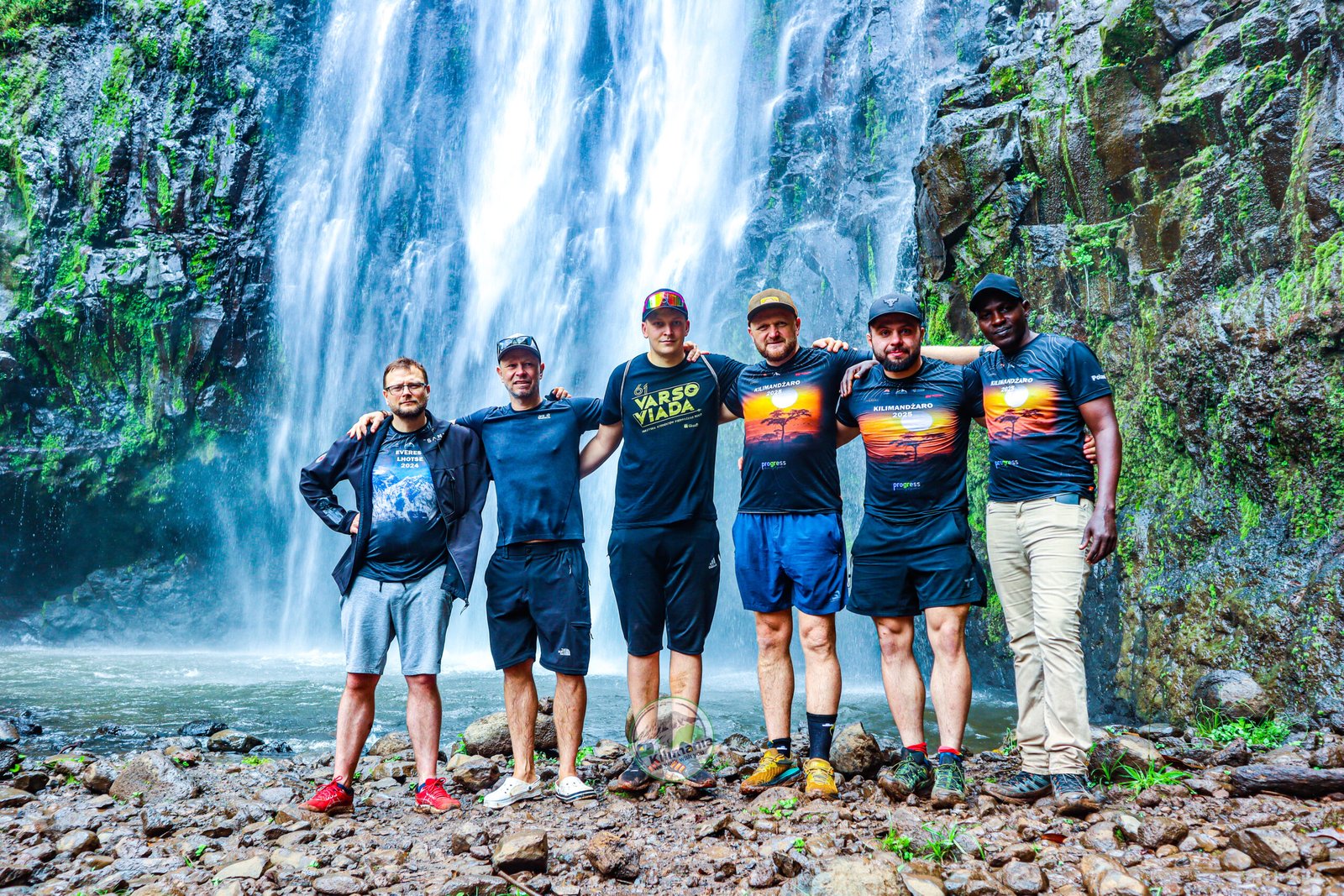



Materuni Waterfalls is a half-day or full-day trip from Moshi combining a guided waterfall hike with a hands-on Chagga coffee demonstration in the village. The waterfall stands approximately 70–80 m tall at around 2,400–2,500 m altitude, reached along a village-guided trail roughly 15 km, and a 30–45 minute drive, from Moshi.
Quick Answer
Materuni Waterfalls is an approximately 70–80 m waterfall near Materuni Village, Kilimanjaro Region, reached by a 45–60 minute guided walk. The trip is usually paired with a hands-on Chagga coffee demonstration — picking, pulping, roasting, grinding, and tasting — in the same village. A mandatory local guide accompanies every group, and lunch is included. Prices start from $85 per person for a group of five.
What’s Included
- Private transport from your Moshi accommodation
- Mandatory village guide for the trail
- Chagga coffee demonstration (picking, pulping, roasting, grinding, tasting)
- Local Chagga lunch
- Village guide and community fees
Materuni Waterfalls — Key Facts
- Village altitude: approximately 1,500–1,540 m
- Difficulty: Moderate
- Guide: Mandatory village guide
- Swimming: Possible — cold; guide assessment on the day
- Children: Suitable with supervision
- Mobility: Not suitable for limited mobility
- Wildlife: Birds, occasional colobus and blue monkeys
- Coffee experience: Picking, pulping, roasting, grinding, tasting
- Lunch: Included
- Drive from Arusha: 2–2.5 hours
- Best season: Year-round — drier Jun–Oct; strongest flow Mar–May
Table of Contents
- What Is the Materuni Day Trip?
- The Trail to Materuni Waterfalls
- The Chagga Coffee Experience — Step by Step
- Can You Swim at Materuni Waterfalls?
- Who This Trip Is For
- Who Should Choose Something Else
- Materuni Before or After Kilimanjaro
- Sabinus’s Note From the Trail
- Quick Comparison
- Pricing
- Frequently Asked Questions
- Related Day Trips
What Is the Materuni Day Trip?
Materuni Waterfalls is a half-day or full-day excursion from Moshi that combines a guided hike through montane forest to one of the more accessible large waterfalls on Kilimanjaro’s lower slopes, followed by a hands-on Chagga coffee demonstration in the village below. The waterfall stands approximately 70–80 m tall at around 2,400–2,500 m altitude — high enough that you feel the cool air well before you see the cascade.
Materuni Village is the starting point, sitting at approximately 1,500–1,540 m on Kilimanjaro’s southern slopes, approximately 15 km from Moshi by road. From the village, a mandatory local guide takes you up the trail. On return, the coffee demonstration happens with local hosts and coffee farmers in the village itself — typically 45–60 minutes of picking, processing, and tasting. A local Chagga lunch is included in the Kilimania price.
This is not a technically demanding hike, and it is not a dedicated swimming trip. What it is: a well-structured combination of nature and culture that works particularly well as a first day in Tanzania, a rest day, or a warm-up before Kilimanjaro climbing. The Tanzania day trips hub has a full comparison of Moshi-based options if you are choosing between several.
The Trail to Materuni Waterfalls
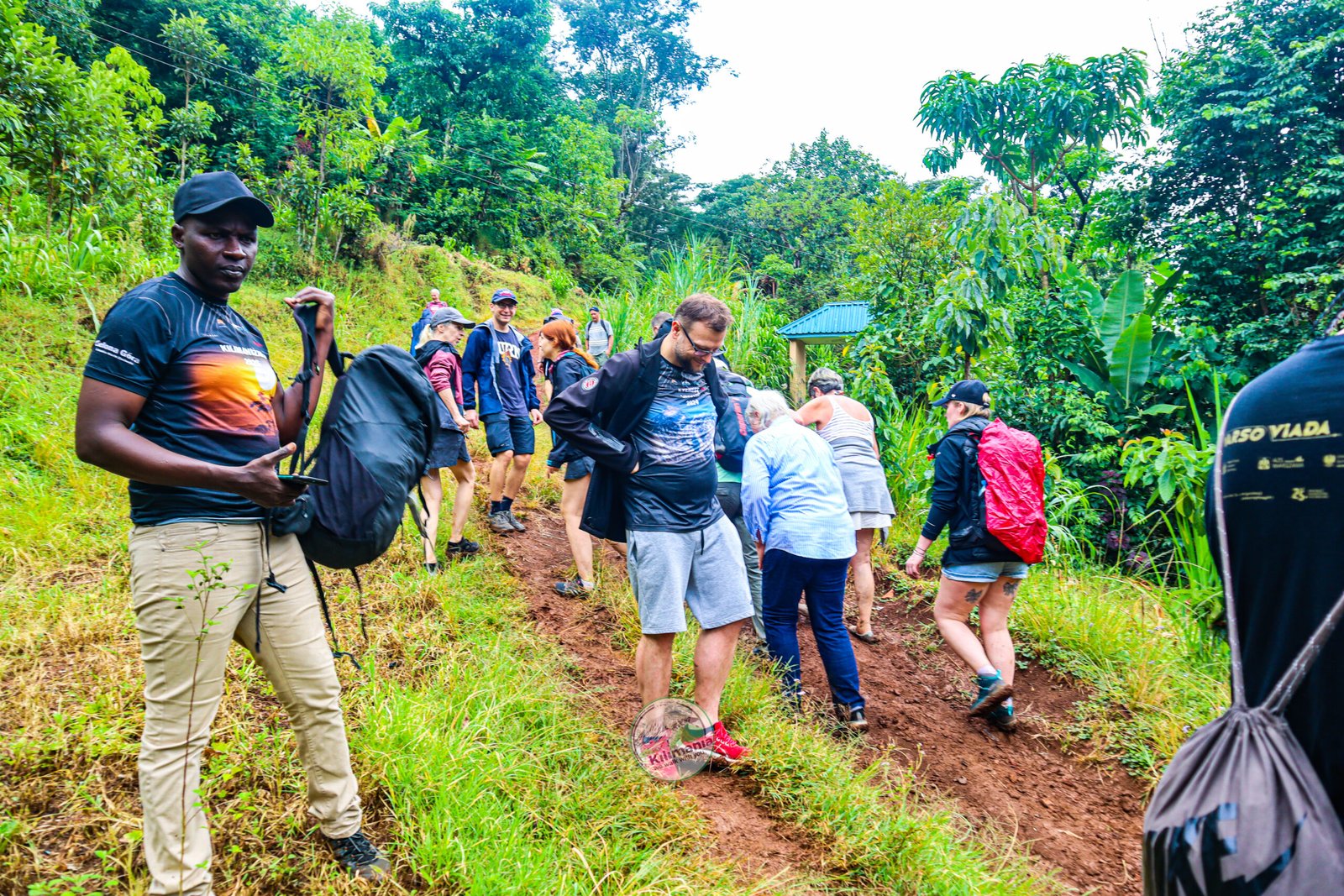
What the path looks like
The trail starts at the village entrance, immediately entering a belt of banana and coffee cultivation before the vegetation thickens into full montane forest. The path is narrow — mostly single file — with a packed earth surface interrupted by exposed tree roots and occasional embedded stones. There are two or three short sections where the gradient steepens noticeably, but nothing that requires hands or scrambling. The forest canopy stays dense for most of the route, which keeps the trail cool even in warmer months.
At roughly the halfway point, you cross a small stream. In the dry season this is a straightforward step across; after heavy rain it can run fast enough that your guide will choose the crossing point carefully. Beyond the stream, the path narrows and steepens for the final approach to the falls — you hear the waterfall before you see it. The falls drop approximately 70–80 m into a pool at the base; the mist radius is significant, and the rocks around the pool edge are permanently damp. Wildlife on the trail includes montane forest birds and occasional colobus or blue monkey groups. Recommended footwear is a closed shoe with grip — sandals are common among first-time visitors and consistently the wrong call on the final descent.
How conditions change by season
Materuni runs year-round. The trail characteristics shift meaningfully across the calendar. The summary for Materuni:
Dry
Dry
Dry
Dry
Dry
Trans.
Wet
Mild
Mild
Peak
Peak
Peak
| Season | Months | Trail Surface | Waterfall Volume | Swimming Pool |
|---|---|---|---|---|
| Dry season | Jun–Oct | Firm, dusty, roots exposed but stable | Moderate — clearly visible, lower flow | Accessible; guide still assesses |
| Short rains | Nov–Dec | Muddy patches, slippery on roots | Increasing | Rockier approach; swimming less likely |
| Dry interlude | Jan–Feb | Variable — often good | Moderate to good | Often accessible |
| Long rains (peak) | Mar–May | Muddy throughout; waterproof footwear essential | Strongest of the year | Pool turbulent; swimming typically not advised |
How long it actually takes
The trail one way takes most groups 45–60 minutes. Faster walkers in good footwear on a dry-season trail can reach the falls in around 40 minutes. Groups with children, or those visiting after rain, should plan for 60–70 minutes each way. The round trip to the falls and back typically runs 2–2.5 hours including time at the base pool. The trail includes a noticeable but non-technical climb; a precise elevation-gain figure is being confirmed with GPS measurement on an upcoming trip and will be added once available.
Book a Private Materuni Day Trip
From $85 per person for a group of five. Your group, your pace, your guide — lunch included.
See Materuni itinerary and prices →The Chagga Coffee Experience — Step by Step
The Chagga people have cultivated coffee on Kilimanjaro’s slopes for generations. At Materuni, the coffee demonstration happens with local coffee farmers and hosts at a working farm, using the tools and methods they actually use. Timing below is approximate and varies by group engagement and what is ripe that day.
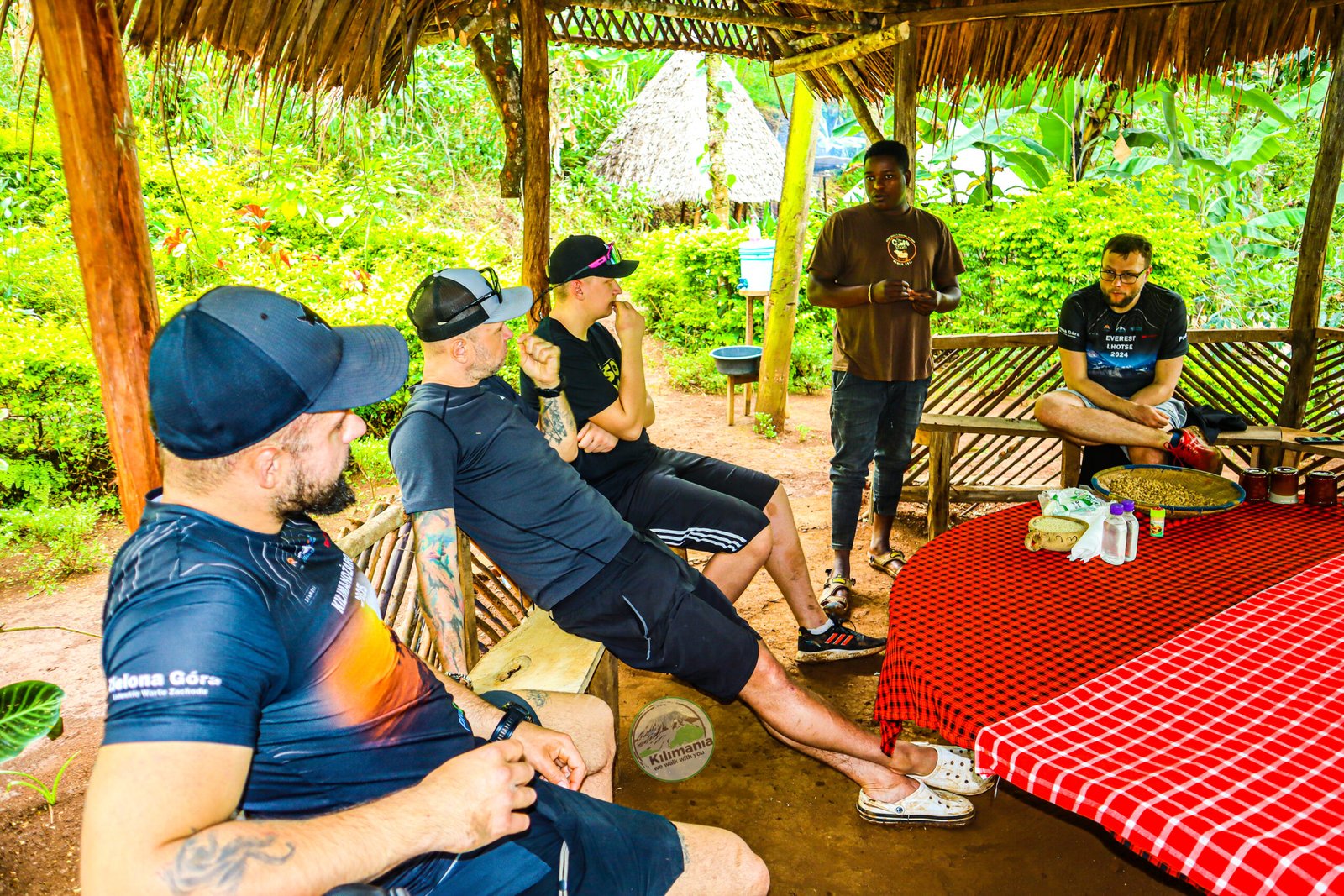
At the coffee farm
The demonstration starts at the coffee plot, in the shade of larger trees — the traditional Chagga intercropping system used on this farm, where banana plants, food crops, and shade trees grow alongside the coffee bushes. Your guide introduces the hosts and provides context on Chagga history and how coffee fits into the household economy — around ten minutes. The layered planting reduces the need for external inputs.
Picking and pulping
- 1Picking ripe cherries (5–10 minutes)
Hosts show you how to identify ripe coffee cherries — deep red, slightly yielding, easy to pull from the branch. Availability of ripe fruit to pick depends on the season and what the farm is harvesting that week; ask your guide what to expect on your travel date.
- 2Pulping by hand (10 minutes)
A simple hand-pulper strips the outer skin and most of the mucilage in one pass. You take turns operating it. The resulting beans are wet, slightly sticky, and pale green-grey.
- 3Dry roasting over an open fire (15–20 minutes)
Dried green beans from a previous batch are placed in a shallow pan over a wood fire and stirred continuously with a long-handled paddle. The beans crack, darken, and release oils as they roast — sweet, smoky, unmistakably coffee, but rawer than the packaged version.
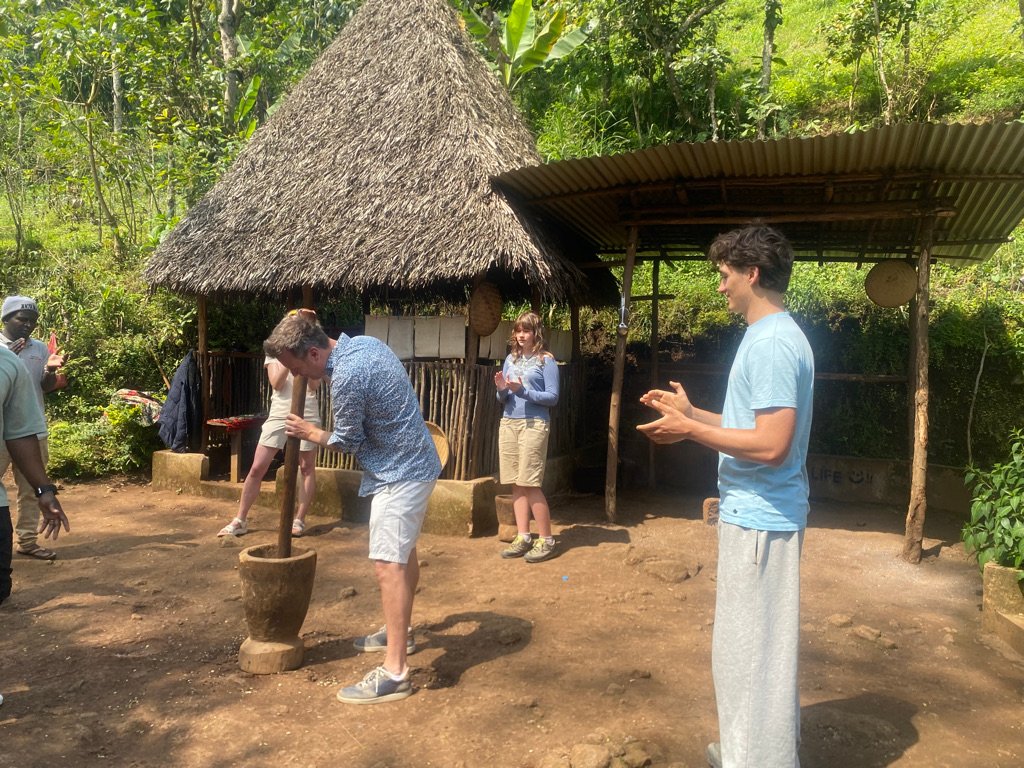
- 4Grinding with a wooden pestle and mortar (5 minutes)
Once cooled, the roasted beans go into a large wooden mortar. You take turns grinding with a heavy pestle — more effort than it sounds. Traditional grinding produces a coarser grind than a burr grinder.
The tasting
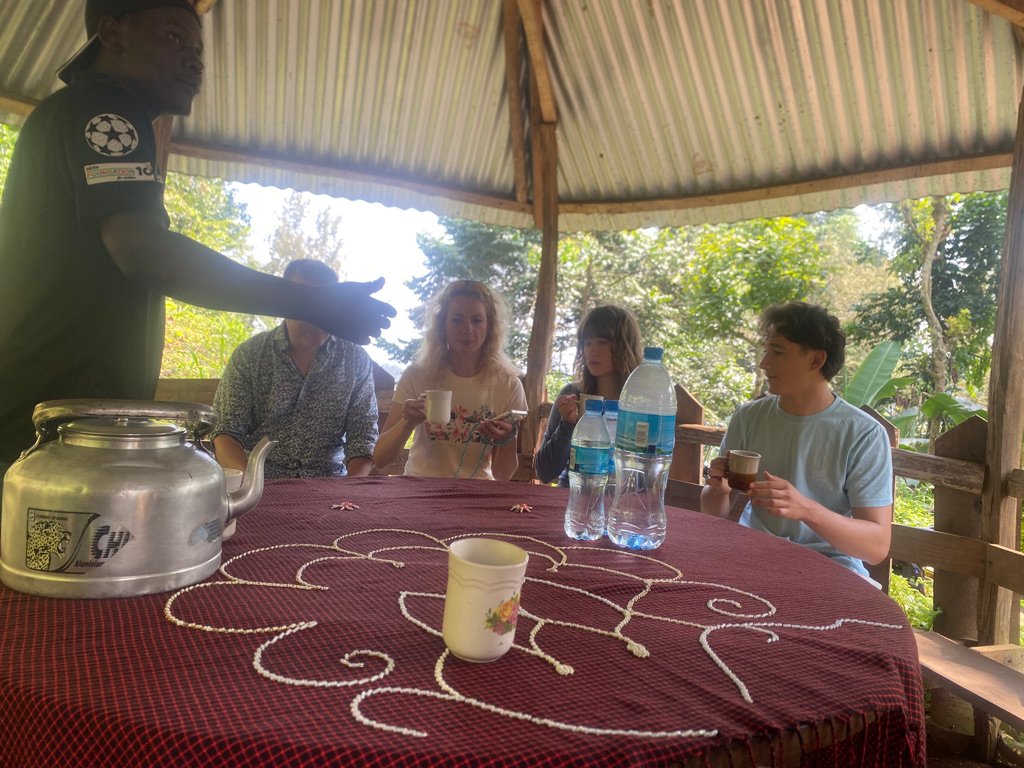
The ground coffee is brewed and served in small cups, sitting together with guests and hosts. It is strong, slightly coarse, and tastes noticeably different from commercially processed Kilimanjaro coffee: more earthy, with a brightness from the altitude-grown Arabica that persists through the rustic processing. The tasting and conversation together run approximately 20–30 minutes.
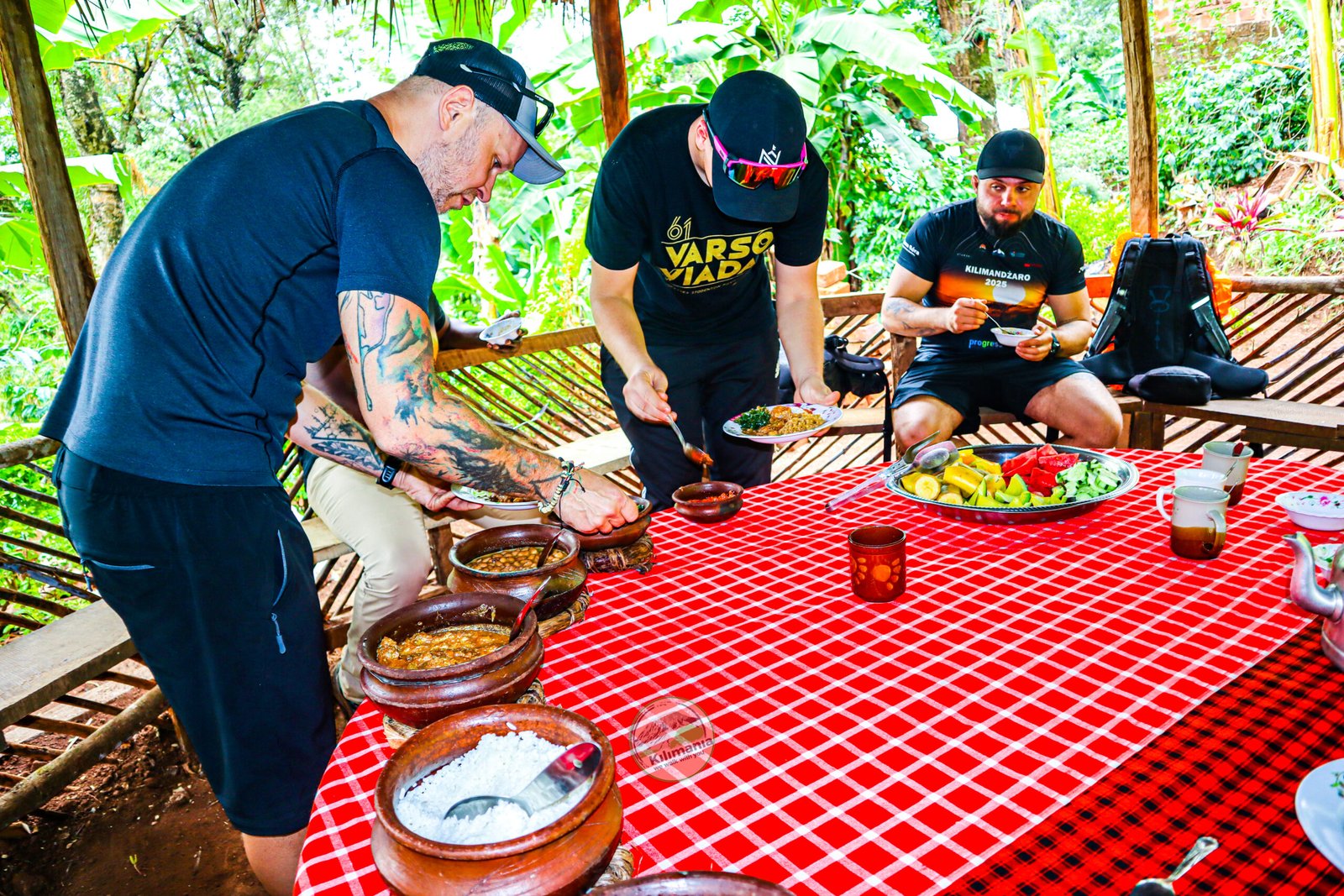
Lunch is included in the Kilimania price for the Materuni day trip. Village guide and community fees are also included. For the full breakdown, see the Materuni day trip prices and itinerary page.
Can You Swim at Materuni Waterfalls?
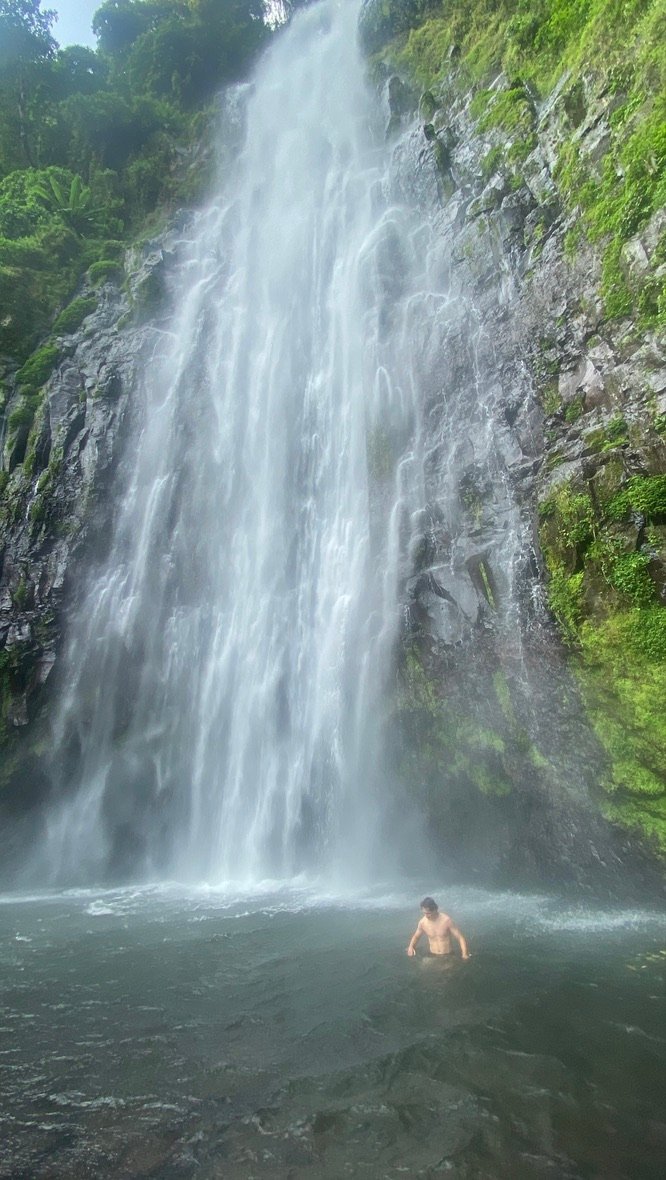
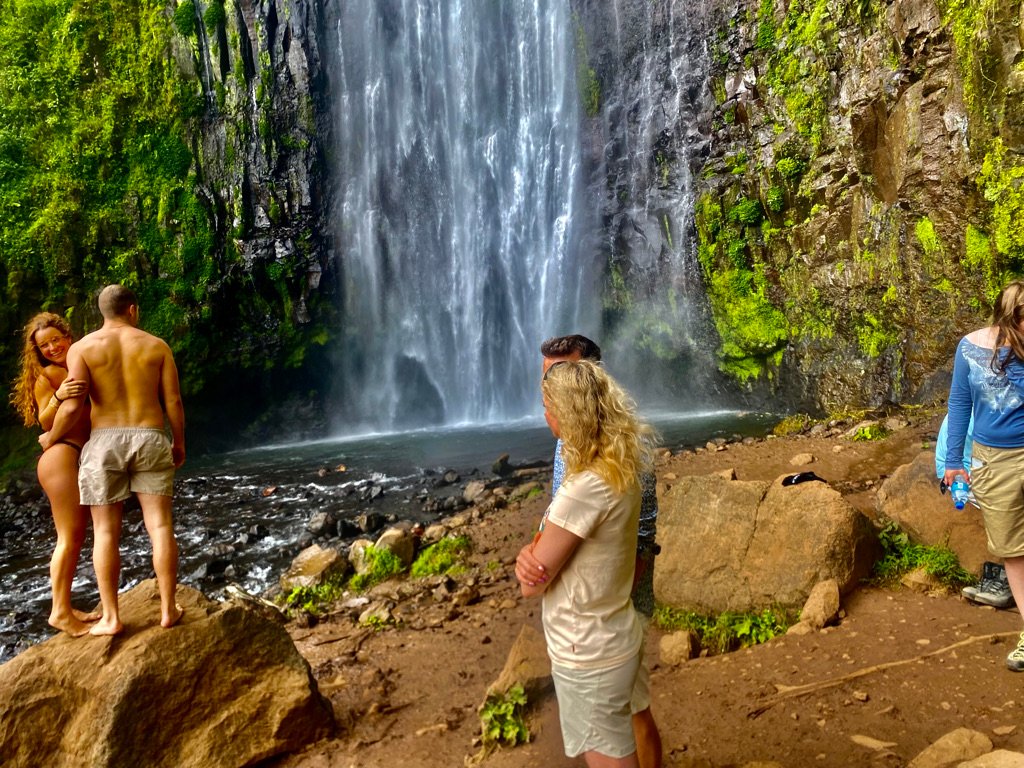
Swimming is possible in the pool below the falls, but Materuni is not a swimming destination. The pool at the base of the falls is cold — the water comes directly off Kilimanjaro at altitude. In the dry season the pool is accessible and calm enough that some guests wade in or take a quick dip. In the wet season the waterfall volume increases, the pool becomes turbulent, and the rocks around the edge are slippery. Your guide assesses conditions on arrival and makes the call on how closely you can approach the pool — follow the instruction given on the day.
If swimming is your priority for a Moshi day trip, Chemka Hot Springs is the correct choice — warm, clear water in a stable natural pool. Materuni is for looking at, listening to, and occasionally getting briefly wet in.
Who This Trip Is Best For
✓ Good fit for this trip
- Visitors wanting a genuine cultural experience in a short window
- Coffee drinkers who want to see where their cup comes from
- Families with children old enough to manage a moderate trail (supervision required on wet sections)
- Kilimanjaro climbers using this as light activity before or after their climb
- Travellers with one day in Moshi who want nature and culture together
✗ Probably not the right trip if…
- Your main goal is swimming — Chemka Hot Springs is the swim-focused option
- You have limited mobility — the trail is uneven with no accessible alternative
- You want a longer wilderness hike — the Marangu day trip covers more ground
Who Should Choose Something Else
The Materuni waterfall trail is rated moderate, but that word covers a range of realities. The path surface is uneven, includes exposed roots and a stream crossing, and becomes noticeably slippery after rain. Anyone with ankle instability, significant knee problems, or limited mobility should not attempt this trail — there is no vehicle access to the falls. For a broader selection of Moshi day trips matched to different interests, the Tanzania day trips hub is the place to start.
Materuni Before or After Kilimanjaro
🏔 Before your Kilimanjaro climb
Materuni is a moderate walking activity that can be a practical way to stay active before a Kilimanjaro climb. The trail reaches approximately 2,400 m, so it does give some altitude exposure — but it should not be treated as a substitute for acclimatisation on the mountain. Discuss your acclimatisation plan directly with your Kilimania guide.
🎉 After your Kilimanjaro climb
After several days on Kilimanjaro, the Materuni trail is physically undemanding by comparison. The moderate gradient and forest shade suit recovering legs, and the coffee experience gives the end of your Tanzania visit a calm, grounded quality.
Sabinus’s Note From the Trail
The question I am asked most often before people book Materuni is whether they will be disappointed. My honest answer is that disappointment usually comes from expecting the wrong thing. People who arrive expecting a dramatic swim like Chemka sometimes feel underwhelmed. People who arrive expecting a gentle hike through good forest, a genuinely large waterfall, and a coffee experience run by a real family rather than a tourist setup — they come back having had a day they did not expect.
The stream crossing at the halfway point is the part that changes most between seasons. In drier months it is a simple step across a few stones. After heavy rain in March or April, the water can rise to knee height, and that is when we reroute the group or wait a few minutes for the flow to settle. The coffee demonstration is the part visitors underestimate most: people expect to watch, then end up grinding beans by hand for ten minutes and understanding, properly, why a cup of coffee from this village tastes different from what they buy at home. The trail rarely follows the same script twice, and that is what makes it a farm visit rather than a performance.
— Sabinus Msimba, Senior Guide, Kilimania Adventure. KINAPA-licensed. 22 years guiding on Kilimanjaro and the surrounding region.
Quick Comparison
High-level comparison only. For a full breakdown of which trip suits your plans, see the dedicated product pages linked below.
| Feature | Materuni Waterfalls | Chemka Hot Springs |
|---|---|---|
| Primary activity | Hiking + cultural (coffee) | Swimming and relaxation |
| Water temperature | Cold (mountain runoff) | Warm (approx. 27°C) |
| Swimming suitability | Conditional — guide assesses | Yes — dedicated swimming spot |
| Drive time from Moshi | 30–45 minutes | Confirm with Kilimania |
Pricing
Materuni Day Trip — Kilimania Adventure Prices
Prices are stated per person and apply to private groups; groups are not combined with other bookings. For the full breakdown, see the Materuni day trip prices and itinerary page.
Frequently Asked Questions
How long is the Materuni waterfall hike?
45–60 minutes one way at a steady pace. Most groups complete the round trip, including time at the falls, in 2–2.5 hours. Groups with children or those visiting after rain should allow 60–70 minutes each way.
Can you swim at Materuni waterfall?
Swimming is possible in the pool below the falls, but the water is cold and the rocks are slippery after rain. Your guide assesses conditions on arrival and makes the final call. Materuni is not a dedicated swimming destination — Chemka Hot Springs is the swim-focused day trip from Moshi.
Is Materuni suitable for children?
Yes, with close supervision. The trail has uneven and sometimes wet sections, so children comfortable walking about an hour on natural terrain will manage well.
What does the coffee experience include?
Picking ripe coffee cherries, pulping by hand, dry-roasting over an open fire, grinding with a wooden pestle and mortar, and tasting the finished coffee with local hosts. The full sequence typically takes 1–1.5 hours.
How far is Materuni from Moshi?
Approximately 15 km from Moshi town centre by road. The drive takes 30–45 minutes. From Arusha, allow 2–2.5 hours.
Is lunch included in the Materuni day trip?
Yes. A local Chagga lunch is included in the Kilimania price for the Materuni day trip.
Is Materuni suitable before climbing Kilimanjaro?
Yes, as light activity. The trail reaches approximately 2,400 m, which gives some altitude exposure, but it is not a substitute for acclimatisation on the mountain itself.
What should I bring to Materuni?
Closed shoes with grip (not sandals), at least 1.5 litres of water, a light rain layer, sun protection, and a change of shoes if you plan to attempt swimming.
Request a Quote — Materuni Waterfalls Day Trip
Fill in the form below and Kilimania will respond within 12 hours (EAT, 7 days a week).
Quote Request Received
Thank you — Sabinus and the Kilimania team will reply to your enquiry within 12 hours. Check your inbox (and spam folder) for a message from info@kilimania.co.tz.
Materuni in Pictures
A few more moments from the trail, the pool, and the coffee demonstration.
Related Day Trips from Moshi
Materuni Waterfalls combines an approximately 70–80 m waterfall walk with a hands-on Chagga coffee demonstration and an included local lunch, roughly 30–45 minutes from Moshi. It works well as light activity before or after a Kilimanjaro climb. Full pricing, availability, and current trip details are on the Materuni day trip prices and itinerary page. We Walk With You.
