Kilimanjaro Park Fees 2026: What You’ll Actually Pay TANAPA, By Route
KINAPA-licensed since 2003 · 22+ years guiding · 300+ Uhuru Peak summits · Data verified before every departure · Last reviewed: 16 July 2026
Disclosure: This article is written by Kilimania Adventure, a TATO-registered Kilimanjaro operator based in Moshi, Tanzania, with a direct commercial interest in climb bookings. All prices reflect real 2026 figures cross-checked against official TANAPA schedules. Compare our quotes with at least two other TATO-registered operators before booking.
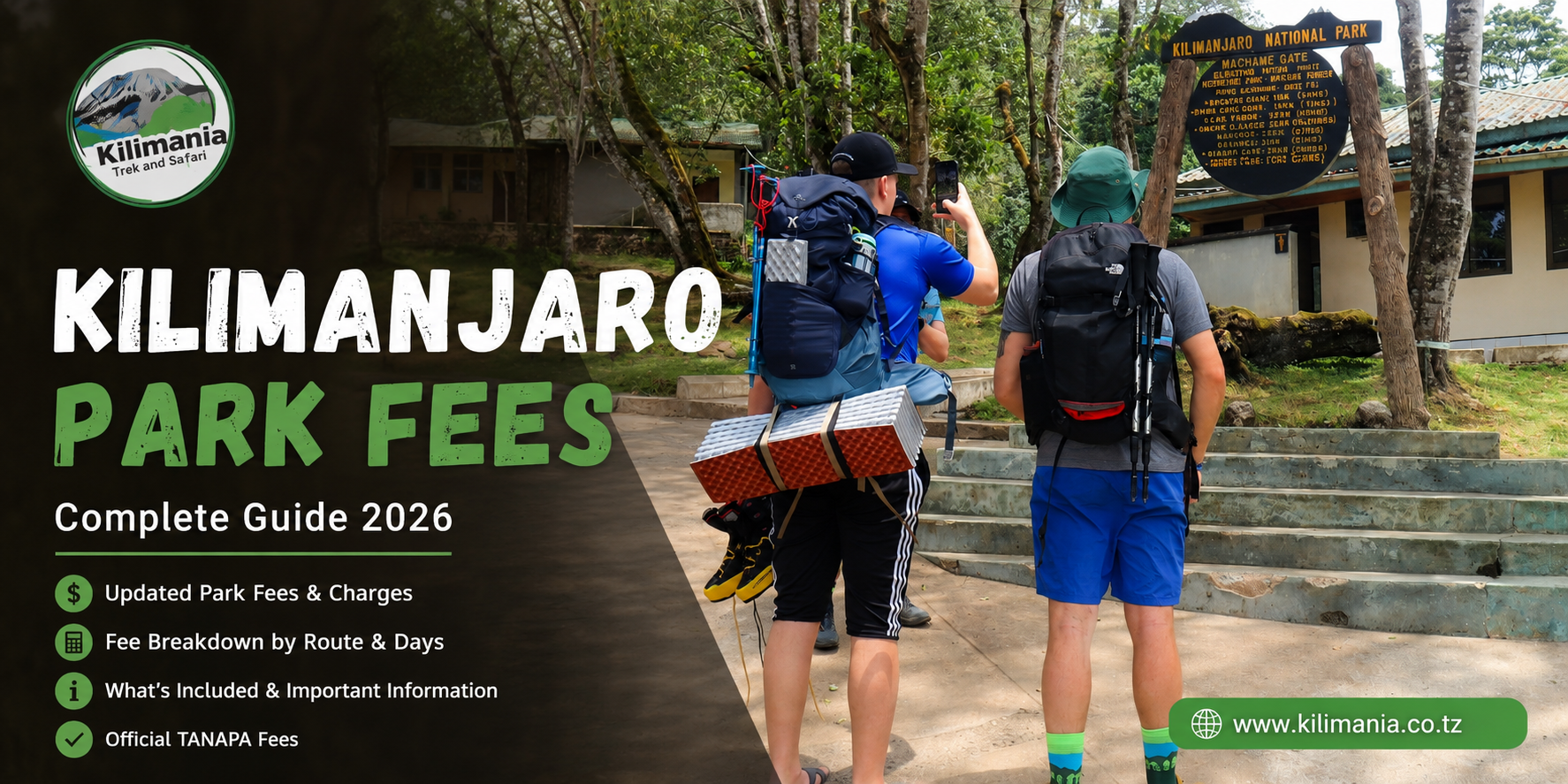
Quick Answer: How Much Are Kilimanjaro Park Fees in 2026?
Kilimanjaro park fees range from approximately $720 for a 5-day Marangu Route climb to $1,381 for a 10-day Northern Circuit climb — including mandatory 18% VAT. These are fixed, non-negotiable government charges paid to TANAPA by your licensed operator through the GePG electronic payment system.
Every climber on every route pays the same standardized rates: a $70/day conservation fee, a $50/night camping fee (or $60/night for Marangu huts), a $20 rescue levy, possible forest fees, and 18% VAT on top. No operator can negotiate, reduce, or waive these fees — and no legitimate operator will try.
Bottom Line — Before You Read Further
Park fees are the same for every operator on every route — there are no discounts, no deals, and no flexibility. A suspiciously cheap climb quote usually means someone on the crew is being underpaid to absorb the fixed TANAPA costs, not that your operator found a better rate. Always request an itemized invoice that separates park fees from the operator margin.
Understanding Kilimanjaro’s Mandatory Government Fees
Mount Kilimanjaro park fees are the single largest fixed cost of any climb — yet many travelers do not realize that more than one-third of their expedition price goes directly to Tanzania National Parks (TANAPA).
International climbers pay mandatory conservation, camping or hut, rescue, and VAT charges that can exceed $1,300 per person on longer routes. Understanding these official fees is essential for comparing operators accurately, identifying misleading quotes, and building a realistic budget for your Kilimanjaro adventure.
Climbing Kilimanjaro is one of the few major mountaineering experiences where the “permit” is actually five separate government fees, billed by day, by night, and by trip. If you see an operator advertising a Kilimanjaro climb for $1,350 all-in, you are almost certainly looking at a package that cuts corners on porter wages to absorb the $700–$1,400 in mandatory TANAPA charges that every climber pays regardless of operator.
This page is updated within 24 hours of any official TANAPA rate change and cross-checked against the GePG payment system before every Kilimania Adventure client departure.
Want a full cost breakdown including park fees for your specific route and dates?
Message our team for a transparent, itemized quote with zero hidden fees — park fees listed separately from operator costs.
TATO-registered · Response within 12 hours · 7 days a week, Moshi (EAT, UTC+3)
Current TANAPA Fee Schedule — All Kilimanjaro Routes 2026
The Tanzania National Parks Authority (TANAPA), through Kilimanjaro National Park (KINAPA), charges five mandatory fee categories. Every climber pays these fees regardless of route choice or operator. Below are the official 2026 non-resident rates for international climbers.
| Fee Category | Official Rate | Applies To | Routes Affected | Billing Method | Key Notes |
|---|---|---|---|---|---|
| Park Entry / Conservation Fee | $70 per person per day | Adults aged 16+ | All routes | Charged daily | The core fee — mandatory for every climber, every day inside the park boundary. |
| Child Entry Fee | $20 per child per day | Children aged 5–15 | All routes | Charged daily | Children under 5 enter free. Parental supervision required at all times. |
| Camping Fee | $50 per person per night | Camping route climbers | Machame, Lemosho, Shira, Umbwe, Rongai, Northern Circuit | Charged per night | Covers designated campsites including latrines, water points, and tent platforms. |
| Hut Accommodation Fee | $60 per person per night | Marangu Route climbers | Marangu Route only | Charged per night | Higher than the camping fee — reflects bunk maintenance, solar lighting, and roof infrastructure. |
| Crater Camp Fee | $100 per person per night | Climbers sleeping at Crater Camp | Any route using Crater Camp | Charged per night | Used on premium summit itineraries only. Rarely included in standard packages. |
| Rescue Levy | $20 per person | All climbers | All routes | One-time payment | Mandatory emergency ground rescue fund. Does NOT cover helicopter evacuation — purchase travel insurance. |
| Forest Conservation Fee | $20 per person | Climbers on specific routes | Lemosho and Rongai only | One-time payment | Applied when passing through forest reserve zones outside the main park gate boundary. |
| Crew Gate Fee | 5,000 TZS per crew member | All guides, porters, cooks | All routes | Paid by operator | Allows crew legal access through the gate. Must never be billed to climbers separately. |
| VAT (Value Added Tax) | 18% | Most park fees | All routes | Added to official fees | Always verify whether quoted prices include VAT — this alone adds $110–$210 to total park costs depending on route and duration. |
Rates sourced from Tanzania National Parks Authority (TANAPA) and Kilimanjaro National Park (KINAPA). All fees are paid electronically through the Government Electronic Payment Gateway (GePG). Verified by Kilimania Adventure before every client departure.
What Each Fee Category Actually Covers
Understanding what your fees fund helps explain why they are non-negotiable — and why increases are generally justified.
Park Entry Fee ($70/day)
Grants access to Kilimanjaro National Park for each 24-hour period. Funds ranger patrols, trail marking, signage, boardwalks across moorland bogs, stone steps on the Barranco Wall, and emergency shelters at high camps.
Camping Fee ($50/night)
Covers use of designated campsites on all camping routes — pit latrines, tent platforms, water collection points, and signage. TANAPA maintenance crews service these sites on rotating schedules.
Hut Fee ($60/night, Marangu)
The Marangu Route is the only route using permanent sleeping huts. The higher fee reflects bunk maintenance, solar lighting, and roof repairs on Mandara, Horombo, and Kibo huts. You sleep in a shared dormitory, not a private cabin.
Rescue Levy ($20)
Funds TANAPA’s ground rescue coordination, stretcher teams, oxygen supplies, radio communication, and ranger emergency response. TANAPA teams respond to an estimated 150–200 incidents per year. This levy does not cover helicopter evacuation — that requires separate travel insurance.
Forest Fee ($20, Lemosho & Rongai)
Charged on routes passing through forest reserve zones outside the main park gate. Funds conservation management of the lower montane forest belt, including reforestation and wildlife monitoring programmes.
Crew Gate Fees (5,000 TZS/person)
Allow your guides, cooks, and porters legal access through the park gate. Your operator pays this on each crew member’s behalf. It should never appear as a separate line item on your invoice — if it does, something is wrong.
“When clients ask why Kilimanjaro is expensive, I tell them to look at the gate receipt. Nearly half of what they pay on a 7-day climb goes directly to the Tanzanian government for conservation, rescue, and trail maintenance. That is not operator profit — that is infrastructure investment in a UNESCO World Heritage Site.”
— Sabinus Msimba, Senior Guide & Co-founder, Kilimania AdventureTotal Kilimanjaro Park Fees by Route and Duration
Park fees increase with trip length because every additional day adds another daily conservation fee plus another camping or hut charge. The table below shows estimated TANAPA and KINAPA charges for one non-resident adult on each major route.
| Route | Duration | Accommodation | Daily Park Fees | One-Time Fees | Total Before VAT | Total incl. 18% VAT |
|---|---|---|---|---|---|---|
| Marangu | 5 Days | Mountain huts ($60/night) | $590 | Rescue: $20 | $610 | $720 |
| Marangu | 6 Days | Mountain huts ($60/night) | $720 | Rescue: $20 | $740 | $873 |
| Machame | 6 Days | Camping ($50/night) | $670 | Rescue: $20 | $690 | $814 |
| Machame | 7 Days | Camping ($50/night) | $790 | Rescue: $20 | $810 | $956 |
| Lemosho | 7 Days | Camping ($50/night) | $790 | Rescue + Forest: $40 | $830 | $979 |
| Lemosho | 8 Days | Camping ($50/night) | $910 | Rescue + Forest: $40 | $950 | $1,121 |
| Rongai | 6 Days | Camping ($50/night) | $670 | Rescue + Forest: $40 | $710 | $838 |
| Rongai | 7 Days | Camping ($50/night) | $790 | Rescue + Forest: $40 | $830 | $979 |
| Northern Circuit | 9 Days | Camping ($50/night) | $1,030 | Rescue: $20 | $1,050 | $1,239 |
| Northern Circuit | 10 Days | Camping ($50/night) | $1,150 | Rescue: $20 | $1,170 | $1,381 |
The cheapest Kilimanjaro park fees apply to the 5-day Marangu Route at approximately $720 including VAT. The highest mandatory TANAPA charges are on the 10-day Northern Circuit at roughly $1,381 including VAT. Longer itineraries generally deliver higher summit success rates — but they do increase total park costs proportionally.
Why Kilimanjaro Park Fees Rise With Day Count — And Why That’s the Right Trade
TANAPA charges conservation fees per day and camping fees per night, so longer itineraries cost more in fixed government charges. But longer itineraries also acclimatize you better — and the data on this is unambiguous.
From Kilimania Adventure’s internal climb database — 1,247 guided ascents tracked between 2019 and 2026 — the pattern is consistent across every route:
“Clients who ask us to cut a day to save on park fees almost always regret it at 5,600 metres. The fee difference between a 7-day and 8-day Lemosho is a small fraction of the total trip cost. The summit success rate difference is 30 to 40 percentage points. That is not a close calculation.”
— Sabinus Msimba, Senior Guide & Co-founder, Kilimania AdventurePaying an extra ~$142 in park fees for an 8-day Lemosho instead of 7 is not a luxury upgrade — it is the cheapest insurance against turning back at Stella Point. The extra conservation day purchases a proper acclimatization rotation that the shorter itinerary cannot provide.
For climbs planned 12 or more months ahead: build in a 5–10% buffer on park fees. TANAPA reviews rates roughly every 18–24 months, with increases typically announced in May or November. A 2027 or 2028 climb budgeted at exactly today’s 2026 figures risks running short at the gate.
Free Download: Kilimanjaro 12-Week Training Calendar
Download the same week-by-week training plan used by Kilimania Adventure guides — built from patterns observed across 1,247+ guided climbs. Choosing a longer itinerary means nothing if you arrive unprepared.
- 12-week hiking and endurance progression plan
- Pack weight progression for trail realism
- Back-to-back weekend training schedule
- Peak fitness and taper strategy for your departure date
- Route recommendations based on current fitness level
How Kilimanjaro Park Fees Are Paid — What Happens at the Gate
You will never carry cash to the mountain gate. The payment and registration process is tightly regulated and handled entirely by your operator through Tanzania’s electronic government payment system.
Step 1 — Gate Arrival (06:00–08:00)
Your operator’s office staff arrive at the relevant gate — Machame Gate, Londorossi Gate (Lemosho), Marangu Gate, or Nale Moru Gate (Rongai) — with your group’s documentation: passports, booking confirmation, and crew registration cards.
Step 2 — GePG Electronic Payment
TANAPA modernized its payment system in 2021. All fees are now paid through the Government Electronic Payment Gateway (GePG) via mobile money transfer or card. Fees are quoted in USD but settled in Tanzanian shillings at the prevailing GePG exchange rate on the day of payment. Cash is no longer accepted at any gate — this change was made specifically to eliminate fee leakage.
Step 3 — Official Receipt Issuance
After payment clears, TANAPA issues an official receipt showing your name and passport number, route and duration, itemized fee breakdown, crew count and fees, total amount paid, and a GePG control number. Ask your operator for a copy of this receipt. Legitimate operators provide it without hesitation.
Step 4 — Crew Registration
Every guide, cook, and porter must present valid ID and their KPAP or TATO registration card at the gate. TANAPA logs each crew member individually — the mechanism that keeps unregistered, untrained porters off the mountain and protects crew welfare.
An operator who resists providing the official GePG receipt may have registered fewer days than you paid for — effectively pocketing the difference between the longer duration you booked and the shorter, cheaper one they registered with TANAPA. This is fraud, and it leaves you without legal cover for rescue services on unregistered days. Always insist on the receipt.
What Happens If Fees Change Between Booking and Departure
TANAPA typically announces fee changes 3–6 months ahead. If you booked at the old rate but your climb falls after the increase, you pay the new rate at the gate. Ethical operators absorb small increases under 5% or invoice the documented difference in writing. Ask any operator before booking: “If TANAPA raises fees between now and my departure date, how exactly do you handle the difference?” A clear, written answer is a positive sign.
Why Park Fees Keep Increasing and What They Fund
TANAPA has raised Kilimanjaro park fees repeatedly over the past two decades. The conservation fee sat at roughly $35/day in the late 2000s; it now stands at $70/day plus 18% VAT. The trajectory has been consistently upward — and for specific, documentable reasons.
The conservation fee has effectively doubled over roughly 15–18 years, and TANAPA’s review cadence has settled into a predictable 18–24 month cycle. If that pattern holds, climbers booking 2027 or 2028 departures today should treat the current $70/day figure as a floor, not a ceiling — and lock in written confirmation from their operator on how any mid-cycle increase would be handled before final payment.
Trail Infrastructure
Boardwalks across the moorland bogs on Lemosho and Northern Circuit, stone steps on Machame’s Barranco Wall, wooden signage at every junction, and emergency weather shelters at Barafu and high camps. Infrastructure that sees 35,000+ climbers per year requires constant maintenance budgets.
Rescue Operations
Stretcher teams, oxygen cylinder supplies, radio communication networks, and coordination with helicopter services for evacuations above 4,500m. TANAPA’s rescue teams respond to an estimated 150–200 incidents per year on Kilimanjaro. The $20 levy funds this system collectively.
Ranger Salaries & Training
Kilimanjaro National Park employs roughly 180 full-time rangers who patrol trails, enforce camping regulations, provide first response, and carry out environmental monitoring. Many hold wilderness medical certifications funded through KINAPA training programmes.
Conservation & Research
Reforestation in the lower montane zone, wildlife monitoring, and glacier-retreat measurement in partnership with UNESCO. Kilimanjaro’s glaciers have retreated by approximately 85% since 1912 — scientific measurement funded through conservation fees helps quantify this and inform policy.
Waste Management
Portable toilet tent systems at major campsites, human waste pack-out protocols, litter collection teams, and water-source hygiene monitoring near popular sites — relatively recent additions that have materially improved conditions at Barafu, Karanga, and Shira camps.
Self-Funded Operations
TANAPA’s Kilimanjaro operations are almost entirely self-funded through visitor fees, with minimal central government subsidy. If fees don’t keep pace with costs, trail maintenance and rescue capacity are what suffer first — directly affecting climber safety.
Free Download: Kilimanjaro Route Comparison Cheat Sheet 2026
Still deciding which route is right for you — and which route’s park fees represent the best value for your budget and fitness level? Download our free printable cheat sheet prepared by Senior Guide Sabinus Msimba.
- Compare all 7 major Kilimanjaro routes side-by-side
- Difficulty rating, scenery score, and crowd levels
- Park fee range per route and duration
- Expert route recommendations for first-time climbers
- Updated for the 2026 climbing season
People Also Ask About Kilimanjaro Park Fees
How much does a Kilimanjaro permit cost in 2026?
Kilimanjaro park fees range from approximately $720 (5-day Marangu) to $1,381 (10-day Northern Circuit) per person, including the mandatory 18% VAT on all TANAPA charges.
Why are Kilimanjaro park fees so expensive?
Park fees fund conservation, ranger salaries, rescue operations, trail maintenance, waste management, and research on Kilimanjaro National Park. The park is largely self-funded through visitor levies with minimal government subsidy.
Are Kilimanjaro park fees refundable?
No. TANAPA park fees are non-refundable once paid at the gate, even if a climber descends early due to altitude sickness, injury, or personal reasons. No operator can recover unused days from TANAPA.
Is the rescue levy enough to cover helicopter evacuation?
No. The $20 rescue levy covers TANAPA’s ground rescue coordination only. Helicopter evacuation from altitude requires comprehensive travel insurance with high-altitude and air-evacuation coverage — this is non-optional for every Kilimanjaro climber.
Need help choosing the right route and duration for your fitness level and budget?
We’ll recommend the option with the strongest summit probability for your specific situation — not the most expensive one. Honest advice, 7 days a week.
KINAPA-licensed since 2003 · 94% summit success rate · TripAdvisor 5.0 / 32 reviews
FAQ: Kilimanjaro Park Fees 2026
The questions our team and guides answer most often about TANAPA park fees, GePG payments, and what happens at the gate.
Are TANAPA park fees included in operator packages?
Yes, in every legitimate package. A quoted price of $2,200 for a 7-day Lemosho climb already includes the roughly $979 in TANAPA fees. If an operator lists park fees as a separate, to-be-advised charge, treat that as a serious red flag — they should know their own costs before quoting.
When comparing operators, always request an itemized invoice that separates TANAPA fees from the operator’s service margin. Both figures should be clearly stated.
Can I pay TANAPA fees directly without using an operator?
No. TANAPA requires every Kilimanjaro climber to be accompanied by a guide employed by a registered Tanzanian tour operator. Independent, unguided climbing is not permitted anywhere on Kilimanjaro National Park trails, and TANAPA will not accept fee payment directly from individual tourists. The requirement exists for safety, wildlife protection, and conservation enforcement reasons.
What happens if I leave the park early — do I get a refund?
No. Park fees are non-refundable once paid at the gate. If you descend on day 4 of a registered 7-day climb due to altitude sickness, TANAPA does not prorate or refund the unused days — and your operator cannot recover that money on your behalf either. This is one of several reasons why travel insurance that covers trip curtailment and early descent is strongly recommended in addition to basic medical and evacuation cover.
Are park fees different for group climbs versus private climbs?
No. TANAPA fees are charged per person, per day, and per night, regardless of group size. A solo climber on a 7-day Lemosho pays exactly the same $979 in TANAPA fees as each member of a twelve-person group on the identical itinerary. Group size affects your operator’s service costs and sometimes allows for price negotiation on those components — but never on government fees, which are standardized and fixed for everyone.
Have TANAPA fees changed recently, and will they change again?
Yes. The current 2026 rate is $70 per day conservation fee plus 18% VAT for adults — up from earlier figures. TANAPA reviews rates roughly every 18 to 24 months. This page is updated within 24 hours of any official announcement from TANAPA or KINAPA. For climbs planned 12 or more months in advance, budget a 5 to 10 percent contingency buffer on park fee estimates to account for the next likely review cycle.
Is the $20 rescue levy mandatory even for experienced climbers?
Yes. The $20 rescue levy applies to every climber on every route, regardless of fitness, experience, or mountaineering background. It functions as collective insurance — your fee helps fund rescue capacity for everyone on the mountain that week, and their fees fund it for you. No exemptions exist, and the levy cannot be waived or refunded.
Importantly, this levy covers TANAPA’s ground rescue response only — stretcher teams, oxygen, and ranger coordination. Helicopter evacuation from altitude is not included. Ensure your travel insurance explicitly covers high-altitude trekking above 5,000m and helicopter medical evacuation before your departure date.
What is GePG and why does it matter for park fee payments?
GePG stands for Government Electronic Payment Gateway — Tanzania’s official digital payment infrastructure through which all national park fees are now processed. Since 2021, cash has not been accepted at any Kilimanjaro gate. All payments go through GePG via mobile money or card, generating an official receipt with a unique control number.
This matters because it creates a verifiable, auditable payment trail. If your operator paid the correct fees for the correct duration, the GePG receipt proves it. If they registered a shorter trip than you paid for, the receipt will show the discrepancy. Always ask for your copy.
Do children pay reduced park fees on Kilimanjaro?
Yes. Children aged 5 to 15 pay $20 per day versus $70 for adults aged 16 and over. Children under 5 years old enter free. However, KINAPA has specific guidelines on minimum ages for summit attempts, and individual routes have physical demands that may not be appropriate for young children regardless of fee structure. Consult your operator and a medical professional before planning a climb with children.
Free Download: Kilimanjaro Altitude Symptom & AMS Checklist
Altitude illness is the leading reason climbers turn back — not fitness. This practical checklist is used by Senior Guide Sabinus Msimba and the Kilimania Adventure team to monitor every climber throughout every expedition.
- Normal acclimatization symptoms above 3,000m (what to expect)
- Acute Mountain Sickness (AMS) warning signs requiring action
- HACE and HAPE emergency symptoms requiring immediate descent
- Daily health monitoring form with SpO₂, pulse, and hydration fields
- Guide reporting protocol and self-assessment checklist
Park Fees Are Non-Negotiable — Your Operator’s Response to Them Is Not
Every legitimate operator pays the same TANAPA fees for the same route and duration. There is no discount, no special rate, and no flexibility. The real difference between a $1,500 quote and a $2,400 quote for the same itinerary is what happens around those fixed government charges.
The difference lies in guide experience, porter wages and treatment, food quality, equipment condition, safety protocol depth, and the experience each company actually delivers. A price that appears impossibly low almost always means someone on the crew is being underpaid to make the total look competitive after absorbing the mandatory TANAPA fees — not that the operator found a better government rate.
Verify Before Booking
Check TANAPA registration status, confirm KPAP porter-welfare compliance, and request an itemized invoice that separates park fees from the operator margin. Legitimate operators answer these requests immediately.
Request the Gate Receipt
After your climb, request a copy of the official GePG gate receipt showing your name, route, duration, and total fees paid. This confirms your operator registered the correct duration and paid the full amount to TANAPA.
Red Flag Checklist
Park fees listed as “to be advised.” Prices that seem to leave nothing for crew wages after TANAPA charges. Resistance to providing itemized invoices. Vague answers to KPAP compliance questions.
Kilimania Adventure has a direct commercial interest in you booking with us — we are transparent about this. The advice above applies to us too: ask us for an itemized invoice, ask us to confirm KPAP compliance, and ask us what happens if TANAPA fees change before your departure. We answer all of these questions in writing, without hesitation. So should every operator you compare.
Get the Guide-Verified Packing Checklist
Understanding park fees is one thing — arriving at the gate with the right gear is another. The exact list our guides check before every departure, including sleeping bag ratings, Moshi rental prices, and the KPAP porter weight limit, all in one printable PDF.
- Complete clothing and layering list organized by altitude zone
- Sleeping bag temperature rating guide (minimum -15°C comfort rating)
- What to rent in Moshi vs bring from home
- KPAP porter load limit (20kg maximum total, 15kg client duffel)
- Summit night kit breakdown — items our guides check at the gate
Kilimanjaro Park Fees at a Glance — 2026 Summary
- Adult conservation fee: $70 per day plus 18% VAT
- Child conservation fee (5–15): $20 per day plus VAT (under 5: free)
- Camping fee: $50 per night plus VAT (all routes except Marangu)
- Marangu hut fee: $60 per night plus VAT (Marangu Route only)
- Rescue levy: $20 per person, one-time — does not cover helicopter evacuation
- Forest conservation fee: $20 per person (Lemosho and Rongai routes only)
- Crew gate fee: 5,000 TZS per crew member — paid by operator, not climber
- VAT: 18% added to most TANAPA fees on all routes
- Payment method: Government Electronic Payment Gateway (GePG) only — no cash accepted
- Independent climbing permitted: No — a licensed operator and registered guide are mandatory
- Typical total range: $720 (5-day Marangu) to $1,381 (10-day Northern Circuit) per climber
- Refund policy: No refunds once paid — even for early descent
- Rate review frequency: Approximately every 18–24 months — buffer 5–10% for climbs 12+ months ahead
Conclusion — Park Fees Are Fixed; How You’re Treated Is Not
Kilimanjaro park fees are the same for every climber on every route, charged by TANAPA, paid electronically through GePG, and immune to operator negotiation or discount. In 2026, they range from $720 for a 5-day Marangu climb to $1,381 for a 10-day Northern Circuit expedition, including the mandatory 18% VAT that many operators quote without.
These fees fund conservation, ranger operations, rescue infrastructure, trail maintenance, waste management, and scientific research on one of Africa’s most significant UNESCO World Heritage Sites. They are not excessive — they are the cost of maintaining a mountain that 35,000+ people attempt to climb each year, and keeping it in a condition that makes those attempts worth taking.
What park fees do not fund is your safety at altitude, your guide’s experience level, your porter’s wage, the quality of your food, or the warmth of your sleeping bag. Those are determined by your operator — and they are where the real difference between a $1,500 and a $2,500 all-in quote actually lives.
Request an itemized invoice. Ask for the gate receipt. Confirm KPAP compliance. Compare at least two TATO-registered operators. Then climb with confidence.
Ready to climb with full transparency on every dollar?
We’ll send a detailed quote showing exactly where every dollar goes — TANAPA fees separated from operator costs, crew wages, and services. No hidden line items.
TATO-registered · KINAPA-licensed since 2003 · KPAP porter welfare certified · Response within 12 hours, 7 days a week
Verified Credentials & Trust Signals
Verify independently: TANAPA · KINAPA · GePG · KPAP · TATO · UNESCO World Heritage
Related Kilimanjaro Guides