
 Kilimania Adventure
Lemosho vs Northern Circuit 2026 – Which Kilimanjaro Route Is Better?
For the majority of international climbers, the 8-day Lemosho Route is the right choice: it delivers a 90% summit success rate, excellent acclimatisation, and fits a standard two-week vacation. If you need the highest possible success rate, genuinely quiet camps, or you’re over 60 with AMS history, the 9-day Northern Circuit is the superior route. Both routes share the same western approach on Kilimanjaro — the decision comes down to your available days, budget, and health profile.
Quick Answer
For most international climbers with a standard two-week vacation, Lemosho 8-day is the correct choice — roughly nine in ten climbers reach the summit, acclimatisation is excellent, and cost is lower. For climbers with 9+ available days, AMS history, or a non-negotiable need for solitude, the Northern Circuit 9-day is superior — around 96 out of 100 climbers summit. Neither is a mistake.
At a Glance Comparison
| Feature | Lemosho Route (8 Days) | Northern Circuit (9 Days) |
|---|---|---|
| Summit Success Rate | 90% | 96% |
| Duration | 8 Days | 9 Days |
| Distance | 70 km | 90 km |
| Crowds | Moderate–High | Very Low |
| Acclimatisation | Excellent | Superior |
| Barranco Wall | Yes | No |
| Cost | Lower | +$300–$400 |
| Best For | Most first-time climbers | Maximum success, solitude, AMS-prone climbers |
Key Stats
The honest bottom line — and this is the part most folks miss —
Both routes are premium options that vastly outperform shorter alternatives. The Northern Circuit costs a premium of roughly $300–$400 more per person for a measurably better acclimatisation profile and near-zero crowds. For most physically active climbers on a standard two-week schedule, Lemosho 8-day delivers everything they need. For climbers over 60, climbers with AMS history, or photographers who need empty campsites at sunrise — the Northern Circuit premium pays for itself.
Data sources: Kilimania Adventure guided-climb records (2019–2025); TANAPA fee schedules, verified June 2026; KINAPA route regulations.
⚠️ Park fees verified against published government rates at tanzaniaparks.go.tz. Figures reflect June 2026 TANAPA tariffs.
Last reviewed: July 29, 2026
Which Route Is Better?
For most climbers: Lemosho 8-day. For climbers with 15+ total travel days, a history of altitude sickness, or crowd-free camping as a hard requirement: Northern Circuit 9-day. The 6% success rate difference between the two routes is real and measurable — but for a healthy, fit climber under 60 on a standard vacation schedule, Lemosho’s acclimatisation profile is sufficient.
Which Route Matches Your Situation?
| If this sounds like you… | Choose |
|---|---|
| First Kilimanjaro climb | Lemosho |
| Two-week vacation | Lemosho |
| Budget-conscious | Lemosho |
| Age 60+ | Northern Circuit |
| Previous altitude sickness | Northern Circuit |
| Photographer | Northern Circuit |
| Want quiet camps | Northern Circuit |
| Want Barranco Wall | Lemosho |
For climbers who want the highest possible summit success rate and genuinely quiet trails: choose the Northern Circuit. From Day 4 onward, you will share camps with two or three other groups rather than forty or fifty. The 9-day itinerary keeps your body in the optimal acclimatisation zone for an extra 48 hours. For climbers over 50 or those who have experienced altitude sickness previously, that 48 hours is not a luxury — it is a physiological necessity.
For climbers who need to complete their trek within a standard two-week international vacation, choose the Lemosho route. The 8-day itinerary fits a 14-day total travel window (flights, arrival, briefing, climb, recovery) without compression. The Lava Tower acclimatisation day on Day 4 — climbing to 4,600m then sleeping at 3,900m — delivers a proven “climb high, sleep low” stimulus that gives fit, healthy climbers a 90% summit success rate.
“The Northern Circuit’s extra day makes a distinct physiological difference for climbers over 50 or those with any history of altitude sickness. But the Lemosho 8-day provides everything a reasonably fit trekker needs to reach Uhuru Peak. I recommend Lemosho for 80% of our climbers. For the other 20%, Northern Circuit is the correct choice.” — Sabinus Salvatory Msimba, Senior Guide, 22 years on Kilimanjaro
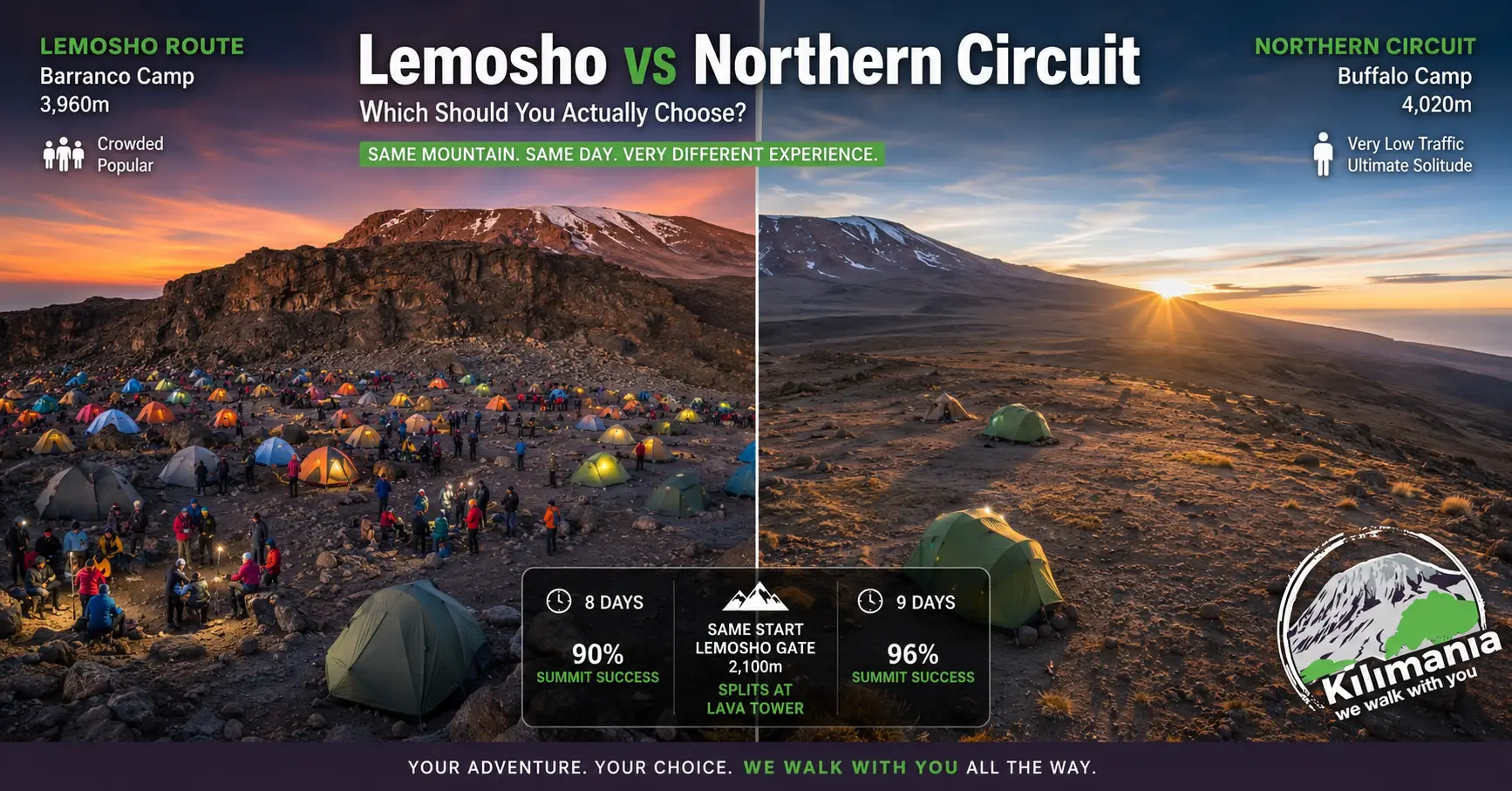
Lemosho’s one honest weakness: from Barranco Camp on Day 4, it merges with the high-traffic Machame trail. If crowd-free camping is a non-negotiable requirement, Lemosho cannot deliver that from Day 4 onward. For a full overview of all routes on the mountain, see our Kilimanjaro Routes 2026 guide.
Side-by-Side Data Comparison
The two variables that matter most are duration and crowd level. Everything else — scenery, terrain, gear requirements — is secondary. A 9-day itinerary outperforms an 8-day itinerary because it gives your body 24 additional hours to adapt above 4,000m. Crowd level determines whether your nights on the northern slopes feel like wilderness camping or a festival.
| Feature | Lemosho Route (8-Day) | Northern Circuit (9-Day) |
|---|---|---|
| Total Distance | 70 km / 43 miles | 90 km / 56 miles |
| Duration Options | 7 or 8 days | 9 days |
| Starting Elevation | 2,100m — Lemosho Gate | 2,100m — Lemosho Gate |
| Summit Night Camp | Barafu Camp (4,680m) | School Hut (4,750m) |
| Summit Vertical Gain | 1,215m via Stella Point | 1,145m via Gilman’s Point |
| Summit Success Rate | 90% (8-day itinerary) | 96% (9-day itinerary) |
| Camp Crowd Level | High — 40–50 groups at Barranco Camp | Very Low — 2–3 groups at Moir Hut |
| Scenic Variety | High — Southern Ice Field views | Highest — Full 360° traverse |
| Barranco Wall | Yes — Day 4 scramble | No — bypassed entirely |
| Cost vs Lemosho | Baseline premium route | Approximately +$300–$400 per person |
| Acclimatisation Quality | Excellent | Superior |
| Best For | Most international climbers | Solitude seekers, 60+, AMS-prone climbers |
Both routes begin on Kilimanjaro’s remote western approach and deliver excellent summit success rates. Lemosho offers the best balance of scenery, acclimatisation, and value for most climbers, while the Northern Circuit provides the highest success rate, the fewest crowds, and the greatest safety margin for altitude adaptation.
Duration: The Single Most Critical Factor
Time on the mountain is the single most critical factor for summit success — a finding our climb database confirms across 1,247+ guided ascents. A 9-day itinerary outperforms an 8-day itinerary because it gives your body 24 additional hours to adapt above 4,000m. For the full data breakdown, see our Kilimanjaro success rate by route analysis.
Crowd Level: The Permanent Split at Lava Tower
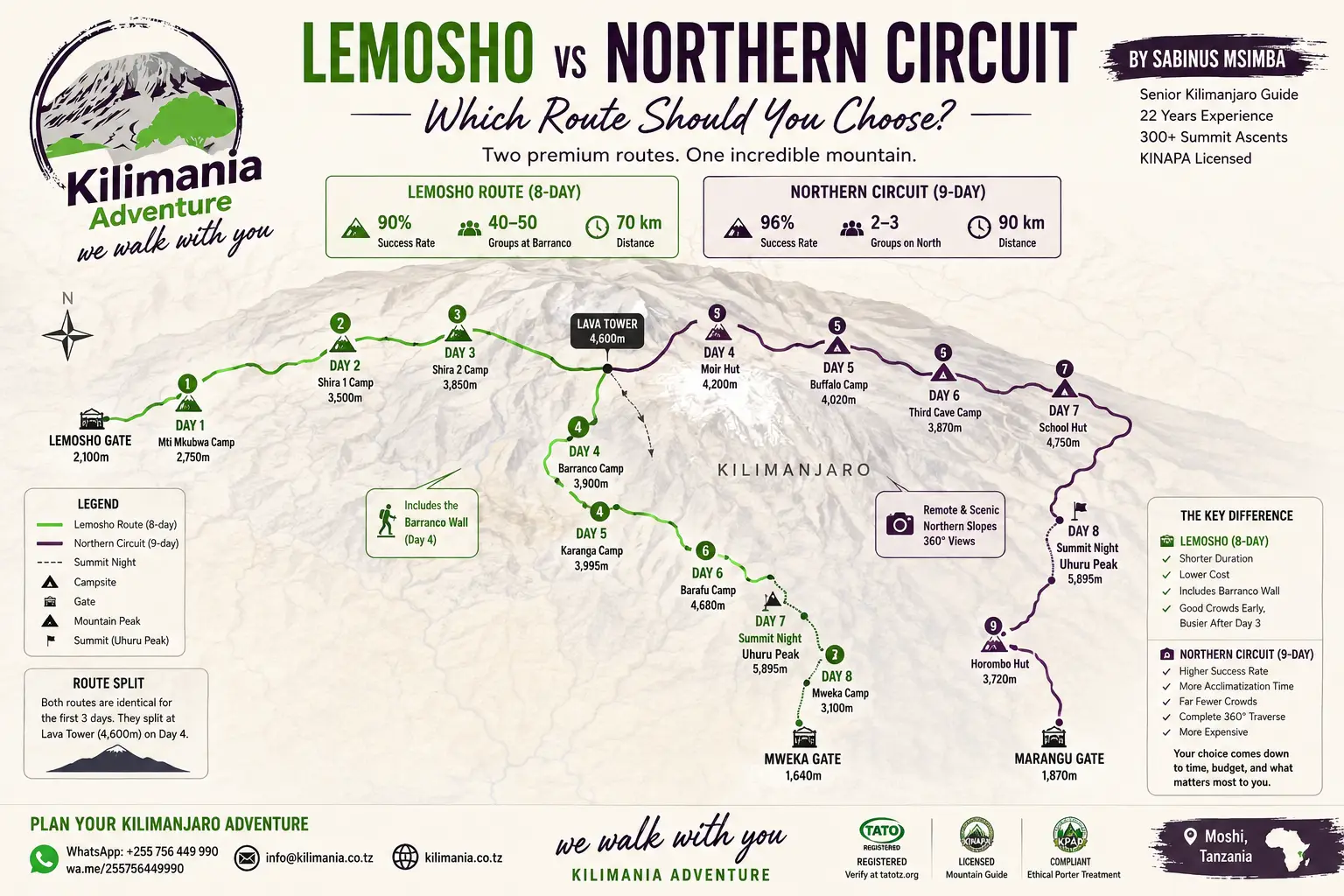
From Day 1 to Day 3, both routes share an identical trail. At Lava Tower on Day 4, the routes split permanently. Lemosho drops south into Barranco Valley, joining the high-traffic Machame trail. Northern Circuit branches north into the remote alpine desert. That night, Lemosho climbers share Barranco Camp with 40–50 other groups. Northern Circuit climbers share Moir Hut with two or three.
On the Barranco Wall
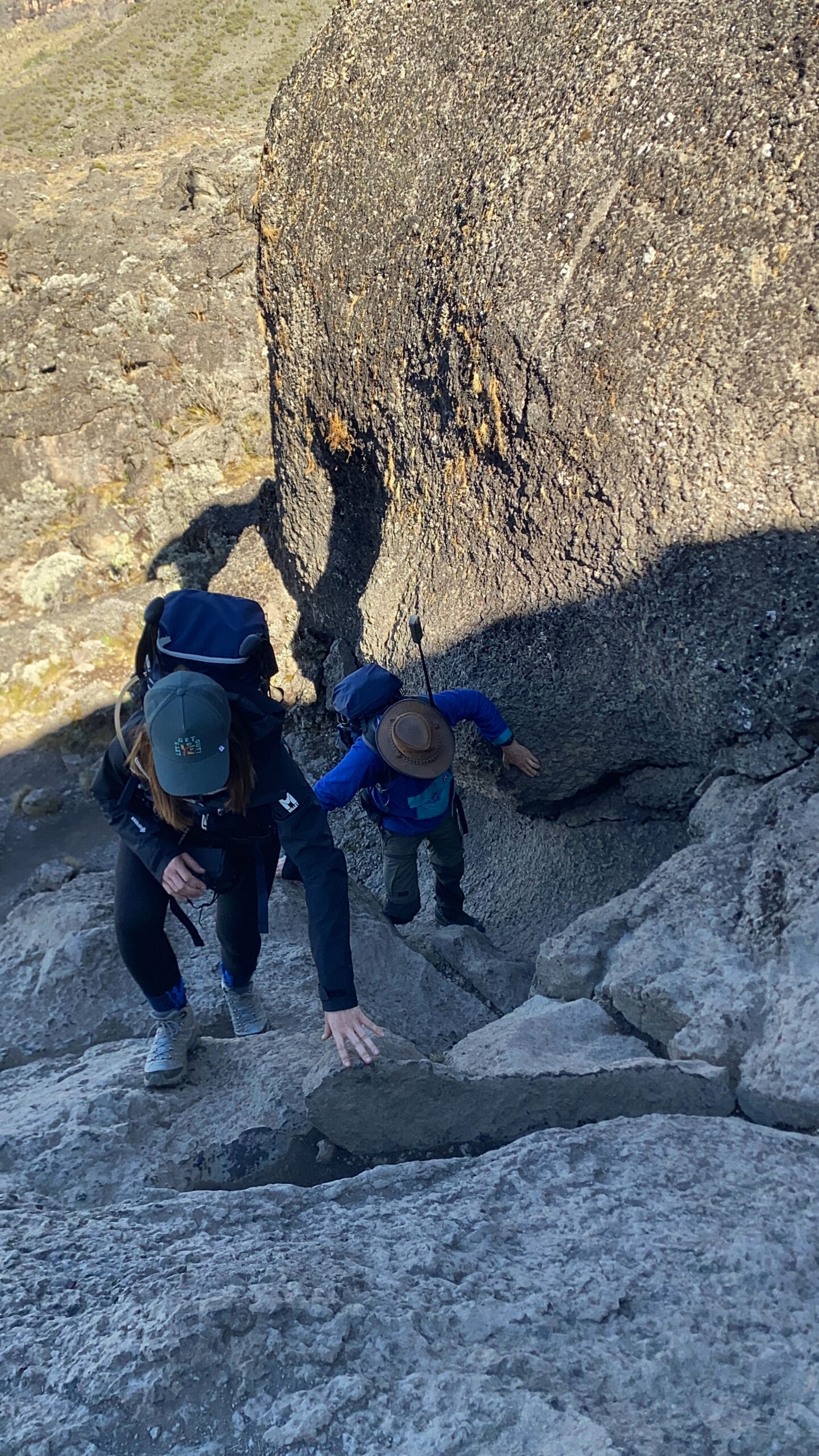
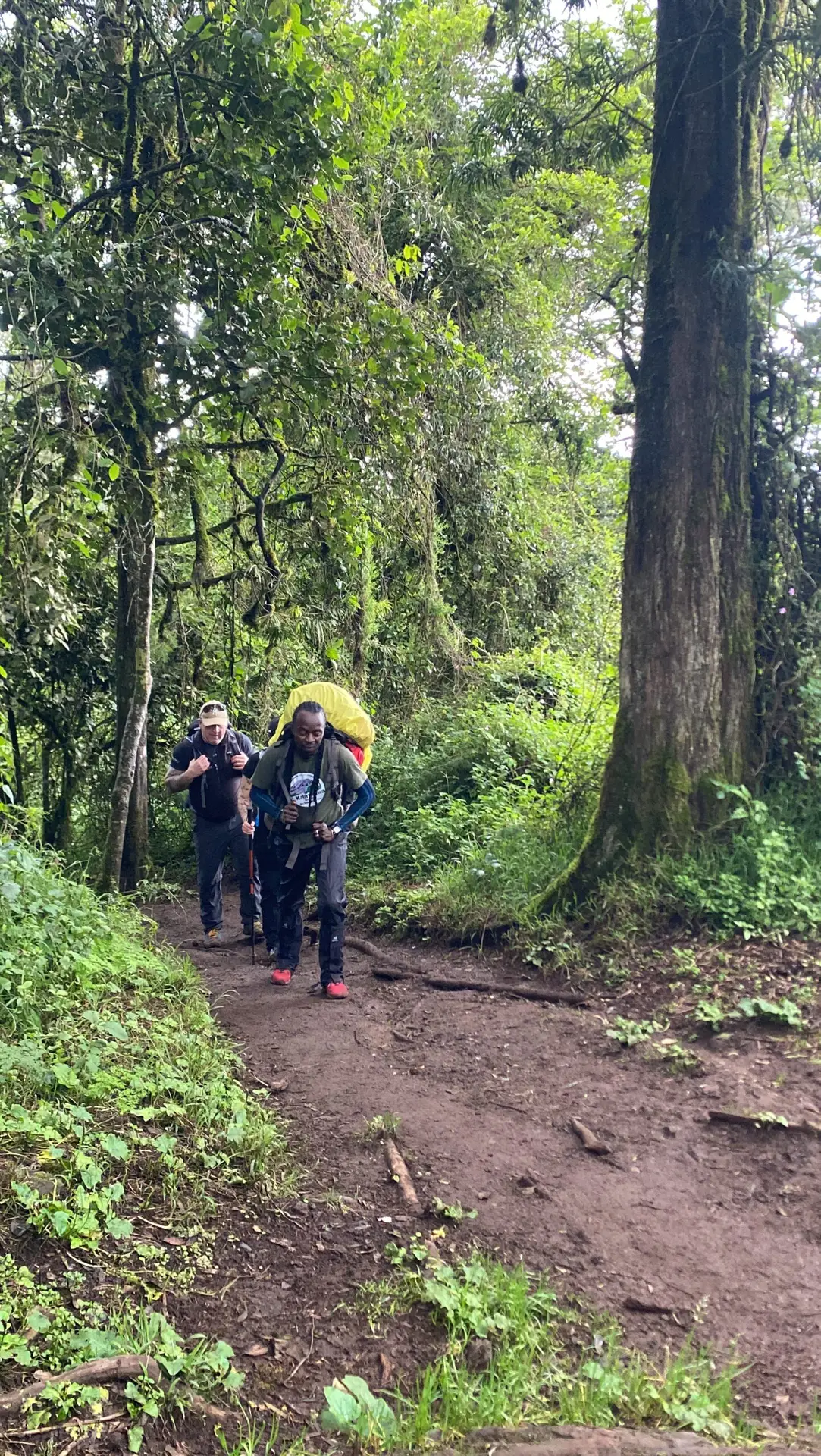
The 8-day Lemosho route includes a 250m non-technical rock scramble on Day 4 — the famous Barranco Wall. It requires using hands and feet but no ropes or technical climbing experience. Northern Circuit bypasses the wall entirely. If the Barranco Wall is on your list, choose Lemosho.
Why Success Rates Vary Between Operators
You’ll see different success rates quoted across different Kilimanjaro operators. Here’s why:
- Sample size: A 1,247-climb database produces different figures than a 47-climb database.
- Definition of “summit”: Some operators count Stella Point (5,739m) as a summit; we count only Uhuru Peak (5,895m).
- Climber selection: Some operators accept any client; we conduct pre-climb fitness assessments and medical screening.
Our 90% (Lemosho) and 96% (Northern Circuit) figures come from 1,247+ guided ascents between 2019 and 2025. They are not marketing claims — they are our operational data.
The Acclimatisation Comparison
Both routes share an identical trail for three days before splitting at Lava Tower (4,600m) on Day 4. Lemosho then descends south and reaches Barafu (4,680m) after 7 days. The Northern Circuit traverses the remote northern slopes and reaches School Hut (4,750m) after 8 days. That extra day — spent between 3,800m and 4,200m — is where the 6% success rate difference is produced.
Route Timeline
| Day | Lemosho Route | Northern Circuit |
|---|---|---|
| Day 1 | Lemosho Gate → Mti Mkubwa | Same |
| Day 2 | Shira 1 | Same |
| Day 3 | Shira 2 | Same |
| Day 4 | Lava Tower → Barranco | Lava Tower → Moir Hut |
| Day 5 | Karanga | Buffalo Camp |
| Day 6 | Barafu | Third Cave |
| Day 7 | Summit | School Hut |
| Day 8 | Descend | Summit |
| Day 9 | — | Descend |
The Golden Zone (3,800m–4,200m)
The Northern Circuit keeps climbers between 3,800m and 4,200m for an extra 48 hours — Days 5 and 6 at Buffalo Camp (4,020m) and Third Cave (3,870m). This altitude band is physiologically optimal: high enough to trigger adaptation responses, low enough to avoid sustained dangerous hypoxic stress.
Red Blood Cell Production
Sustained exposure above 3,800m stimulates erythropoietin production, which signals bone marrow to produce additional red blood cells. More red blood cells mean more oxygen delivered to muscles and the brain during the summit push. It’s also why our guides say pole pole — slowly, slowly — because the pace and the extra day work together above 4,000m. This approach is consistent with clinical altitude-illness prevention guidance published by the Wilderness Medical Society, which recommends gradual ascent profiles above 3,000m to reduce AMS incidence.
AMS Risk Reduction
The Northern Circuit’s slower daily elevation gains — averaging 350m per day versus Lemosho’s 500–700m on non-acclimatisation days — mean lower cumulative hypoxic stress. For a detailed breakdown of AMS symptoms and risk factors, see our Altitude Sickness Guide.
Honest Statement for Most Climbers
For healthy, fit climbers under 50 with no AMS history, the Lemosho Day 4 climb to Lava Tower (4,600m) provides a sufficient acute adaptation stimulus. The Northern Circuit’s extra nights above 4,000m deliver measurable additional benefit primarily for climbers over 50 or those with documented AMS susceptibility. Seriously.
⚠️ Warning: 8-Day Northern Circuit Variations
Some operators offer an 8-day Northern Circuit. Do not book it. Compressing the Northern Circuit into 8 days removes the critical acclimatisation camps at Buffalo Camp and Third Cave. An 8-day Northern Circuit delivers the same crowds as Lemosho, at a higher cost, with worse acclimatisation than the 9-day version. If you have exactly 8 days, the Lemosho 8-day is the correct choice.
For climbers with specific age or health concerns, see our guides on Climbing Kilimanjaro Over 50 and Climbing Kilimanjaro With Medical Conditions.
Cost Comparison
The Northern Circuit costs a premium of roughly $300–$400 more per person than the Lemosho 8-day. This is not operator markup. It is driven by one additional TANAPA day at a fixed government rate, plus extra crew wages, food, and remote camp logistics.
The $141.60 extra TANAPA fee per person is non-negotiable — every operator must pay it, regardless of group size. This covers the additional conservation fee ($82.60) and camping fee ($59.00) for the extra night. See our Kilimanjaro Park Fees breakdown for the full schedule.
The remaining $160–$260 difference covers an additional day of wages for your guide, assistant guides, chef, and porter team — typically 22–26 crew members per group under KPAP ethical standards — plus extra food rations that must be physically carried up the mountain. For tipping guidance, see our Kilimanjaro Tipping Guide.
Why the Northern Circuit Costs More
| Cost Item | Additional Cost |
|---|---|
| Extra TANAPA Park Fees | $141.60 |
| Guide & Assistant Guide Wages | Extra Day |
| Porter Wages | Extra Day |
| Food & Logistics | Extra Day |
| Total Premium | Approximately $300–$400 |
Actual 2026 Trip Cost by Group Size (Per Person)
| Group Size | Lemosho 8-Day | Northern Circuit 9-Day |
|---|---|---|
| Solo climber | $2,650 | $3,020 |
| Group of 2 | $2,350 | $2,700 |
| Group of 4+ | $2,150 | $2,480 |
Prices shown are indicative 2026 per-person rates and include TANAPA park fees, licensed guides, KPAP-compliant crew wages, camping equipment, meals on the mountain, and airport transfers. Final quotes vary by season, group size, and optional add-ons (Crater Camp, private toilet tent, extra acclimatisation night). Request an itemised quote for exact current pricing — see our Kilimanjaro Cost 2026 guide for full inclusion/exclusion lists.
📥 Free Download: Kilimanjaro Altitude Symptom & AMS Checklist
Altitude illness is the leading reason climbers turn around on Mount Kilimanjaro. This practical checklist is used by our senior guides on every expedition.
- ✓ Normal acclimatisation symptoms above 3,000m
- ✓ Acute Mountain Sickness (AMS) warning signs
- ✓ HACE and HAPE emergency symptoms
- ✓ Daily health monitoring form (SpO₂, pulse, hydration)
- ✓ Guide reporting and self-assessment checklist
We’ll email you the PDF instantly and send occasional Kilimanjaro planning tips. Unsubscribe anytime.
Prepared by Sabinus Msimba, Senior Mountain Guide, Kilimania Adventure, Moshi, Tanzania.
For educational purposes only. Does not replace professional medical advice.
Who Chooses Which Route — Decision Matrix
Nine climber profiles with direct recommendations. Find your profile. If your situation sits between two rows, message us with the details and we’ll give you a direct answer.
| Climber Profile | Recommended Route | Why |
|---|---|---|
| First-time climber | Lemosho | Excellent balance of acclimatisation and cost |
| Experienced trekker | Either | Depends on goals and available days |
| Age 60+ | Northern Circuit | More gradual ascent profile |
| Previous AMS | Northern Circuit | Better acclimatisation, lower daily gain |
| Limited budget | Lemosho | Lower overall cost |
| Limited vacation | Lemosho | Fits a standard two-week trip |
| Photographer | Northern Circuit | Quiet camps and unique northern landscapes |
| Wants Barranco Wall | Lemosho | Includes the famous scramble |
| Wants solitude | Northern Circuit | Minimal crowds after Day 4 |
Get a Direct Route Recommendation
Tell us your available days, age, and previous hiking experience. We’ll give you a direct answer — not a brochure.
WhatsApp +255 756 449 990 Email info@kilimania.co.tzAs we say here in Moshi — karibu — you’re welcome to ask any question before you book, not after.
For broader context on how altitude, duration, and route interact, see our Kilimanjaro Routes 2026 pillar.
Guide Perspective: Which Route Do We Recommend Most Often?
After more than two decades guiding on Kilimanjaro, our senior guides — Sabinus Msimba, Kanti Kessy, and Saimon Bashemera — usually recommend the 8-day Lemosho Route for first-time climbers with standard fitness and limited vacation time. The Lava Tower day on Day 4 is a well-designed “climb high, sleep low” stimulus and the cost is meaningfully lower than the Northern Circuit.
Our team advises climbers aged over 60, guests with previous altitude sickness, photographers, and travelers seeking maximum solitude to choose the 9-day Northern Circuit. The superior acclimatisation profile and quieter camps aren’t marketing language — they’re observable differences our guides see every season. When a climber tells us they’ve turned around on a previous high-altitude attempt, our recommendation shifts immediately to the Northern Circuit, regardless of budget.
📥 Free Download: Kilimanjaro Route Comparison Cheat Sheet
Still deciding? Download our free printable cheat sheet prepared by Senior Mountain Guide Sabinus Msimba.
- ✓ Compare all 7 Kilimanjaro routes
- ✓ Difficulty, scenery, and crowd levels
- ✓ Expert recommendations for first-time climbers
- ✓ Updated for 2026 climbing season
We’ll email you the PDF instantly and send occasional Kilimanjaro planning tips. Unsubscribe anytime.
FAQ: Lemosho vs Northern Circuit
Can I add a Crater Camp overnight on either route?
Crater Camp can be added to selected Lemosho itineraries with the appropriate permits and logistics. On the Northern Circuit, Crater Camp is not logistically feasible due to the descent route via Horombo. For climbers specifically seeking a crater overnight, Lemosho is the only viable option between these two routes. A Crater Camp overnight adds approximately $500–$800 to your climb cost and requires special KINAPA permits.
Is the Northern Circuit worth the extra money?
For climbers with previous altitude sickness, climbers aged 60+, photographers seeking quieter camps, or anyone prioritizing the highest possible summit success rate, the Northern Circuit’s additional cost is usually justified.
For most healthy climbers with limited vacation time, the Lemosho 8-day delivers an excellent balance of success rate, scenery, acclimatisation quality, and cost efficiency. See our Kilimanjaro Cost 2026 guide for full price breakdowns.
Do Lemosho and Northern Circuit share the same starting point?
Yes. Both routes begin at Lemosho Gate (2,100m) on the western side of Kilimanjaro. They share identical trails and campsites for the first three days — Mti Mkubwa (2,750m), Shira 1 (3,500m), and Shira 2 (3,850m). The routes split permanently at Lava Tower (4,600m) on Day 4.
Which route is colder?
The Northern Circuit is colder and drier. The northern face is exposed to wind patterns from the Kenyan plains with less moisture buffer than the southern slopes. Wind chill at Buffalo Camp (4,020m) in July reaches -18°C to -22°C. Barranco Camp on the same night averages -8°C to -12°C. Both routes require a four-season sleeping bag rated to -20°C minimum. See our Kilimanjaro Weather guide for full detail.
Which route has the harder summit night?
Lemosho’s summit night is marginally harder by vertical distance. Lemosho climbers start from Barafu Camp (4,680m) and climb 1,215m to Uhuru Peak via Stella Point. Northern Circuit climbers start from School Hut (4,750m) and climb 1,145m via Gilman’s Point. Most climbers report that the Northern Circuit summit night feels endless rather than steep — the horizontal trail from School Hut to Gilman’s Point is significantly longer.
Can I do the Northern Circuit in 8 days?
Compressing the Northern Circuit into 8 days removes the critical acclimatisation camps at Buffalo Camp and Third Cave. If you have 8 days, the Lemosho 8-day is the correct choice.
Which route does Kilimania recommend?
Lemosho 8-day for approximately 80% of our climbers — it balances success rate, cost, acclimatisation quality, and time efficiency better than any other route for most international trekkers. Northern Circuit 9-day for climbers who have extra time, budget, a history of altitude sickness, are aged 60+, or for whom genuine solitude is a non-negotiable requirement.
Is there mobile network coverage on the northern slopes?
Coverage on the northern face is significantly more limited than the southern circuit. An intermittent signal appears at Shira 2 Camp and School Hut. Buffalo Camp and Third Cave sit in cellular dead zones. Plan for complete offline periods on Days 5 and 6 of the Northern Circuit.
What is the hardest part of the Northern Circuit?
The summit night from School Hut (4,750m) to Uhuru Peak (5,895m) is widely considered the hardest section. While the vertical gain (1,145m) is slightly less than Lemosho’s 1,215m, the horizontal trail is longer. The exposed northern face also means colder wind chills (-18°C to -22°C).
Do you need oxygen on the Northern Circuit?
No. Supplemental oxygen is not required on the Northern Circuit — or any standard Kilimanjaro route. The mountain is a trekking peak, not a mountaineering peak. Our guides carry emergency oxygen for medical use only (AMS/HACE/HAPE treatment). Most climbers acclimatise successfully using the route’s 9-day profile.
Why Trust Kilimania Adventure for This Information
- Base: Moshi, Kilimanjaro Region, Tanzania — physical office, not an online-only booking desk.
- TATO registration: Registered member of the Tanzania Association of Tour Operators — verify at tatotz.org.
- Climb database: 1,247+ guided ascents between 2019 and 2025 — success rates are from our own climb records, not industry averages.
- Guide experience: Sabinus Msimba has guided 300+ successful summit climbs over 22 years on both routes.
- KINAPA-licensed: All guides hold current Tanzania National Park Authority mountain guide licenses — verify at kilimanjaranationalpark.go.tz.
- KPAP compliance: Registered Kilimanjaro Porters Assistance Project operator — porter wages, maximum loads, and welfare standards are independently verified.
- Transparency: We recommend Lemosho for 80% of our climbers because it is the correct route for most profiles — not because it is more profitable.
Safety and Health Information in This Article
Altitude illness is a real medical risk above 2,500m. If you have any pre-existing cardiac, respiratory, or blood pressure conditions, consult your physician before booking a Kilimanjaro climb and disclose those conditions in full to your guide at the trailhead briefing. AMS symptoms — persistent headache, nausea, fatigue disproportionate to exertion — require immediate disclosure to your guide. Descent is always the correct response to confirmed AMS. See our Climbing Kilimanjaro With Medical Conditions guide.
Financial Accuracy in This Article
All prices stated are June 2026 figures from our own operational costs and verified TANAPA fee schedules. TANAPA fees are published government rates, updated annually each November. Verify current fees at tanzaniaparks.go.tz before booking.
Conclusion
The decision between Lemosho and Northern Circuit comes down to your calendar and your budget — not your preference for scenery, because both routes are visually extraordinary. The Northern Circuit’s near-perfect summit record and near-empty northern slope camps are the two outcomes you’re buying with the extra $300–$400 and extra day. If those outcomes match your profile — particularly if you are over 60, have AMS history, or need photography-grade solitude — book our Northern Circuit 9-day climb. If you have 14 total travel days and a standard fitness baseline, book our Lemosho 8-day climb.
For most international arrivals — first-timers, couples, families, physically active travellers on a two-week schedule — Lemosho is the correct choice and shouldn’t require much deliberation. For the 20% of climbers who genuinely need the extra day: don’t compromise on the Northern Circuit’s 9-day format. The physiological benefit is real and measurable, and it’s what you’re paying for.
Plan Your Kilimanjaro Climb — Get a Fast, Itemised Quote
WhatsApp +255 756 449 990 Email info@kilimania.co.tzTell us:
- Travel dates and available days
- Number of climbers
- Age range and previous hiking experience
- Route preference or ask for our recommendation
We return a full itemised quote within 12 hours — park fees by day, crew costs, complete inclusion and exclusion list. No costs discovered at the gate.
We Walk With You.
Verify our TATO registration: tatotz.org · Official KINAPA fees: kilimanjaranationalpark.go.tz · Tanzania e-visa: immigration.go.tz
⚠️ Health & Medical Disclaimer
This article discusses altitude acclimatisation and acute mountain sickness (AMS) for informational purposes only. It does not constitute medical advice. Altitude illness is a real medical risk above 2,500m and can be life-threatening if ignored. If you have any pre-existing cardiac, respiratory, neurological, or blood pressure conditions, consult a qualified physician before booking any high-altitude trek. Our guides carry pulse oximeters and conduct daily SpO2 assessments, but they are not medical professionals. Descent is always the correct response to confirmed AMS. See our Climbing Kilimanjaro With Medical Conditions guide.
Disclosure
This article is written by Kilimania Adventure, a TATO-registered safari and Kilimanjaro climbing operator based in Moshi, Tanzania (tatotz.org). We have a direct commercial interest in Tanzania safari and Kilimanjaro bookings. All prices reflect real 2026 costs from our own operations. We encourage you to compare our quotes with at least two other TATO-registered operators before booking. Success rate data is from our own guided climb records (2019–2025) and is not independently audited.
For International Travellers
- Currency: All prices are in USD. Approximate conversions: $1,900 ≈ £1,490 | €1,770 | AU$2,850.
- Flights to Kilimanjaro International Airport (JRO): New York / Los Angeles: $800–$1,400 return | London: £550–£900 return | Sydney: AU$1,400–AU$2,200 return.
- Tanzania e-visa: $50 most nationalities | $100 US citizens. Apply at immigration.go.tz at least 7 days before departure. Use Chrome or Firefox.
- Pre-climb accommodation in Moshi: $35–$80 per night. Book one night before and one night after your climb.
- Response times: We operate on East Africa Time (EAT, UTC+3). All quote requests receive a reply within 12 hours, 7 days per week.