Machame vs Lemosho: Which Kilimanjaro Route Wins in 2026?
By Sabinus Msimba, Senior Mountain Guide & Co-founder, Kilimania Adventure — 22+ years guiding, 300+ Uhuru Peak summits, KINAPA-licensed since 2003.
Last reviewed: July 2026.
Data sources cited in this article: Kilimania Adventure guided-climb records (2019–2025, n=1,247), TANAPA official fee schedule (June 2026), KPAP porter-wage standards, the CDC Yellow Book, and Wilderness Medical Society altitude illness guidelines.
For most first-time climbers, Lemosho 8-day is the better choice. It allows more acclimatization time before the demanding Lava Tower crossing and shows a higher summit rate in our own operational records — 89% versus 79% on Machame 7-day (Kilimania guided-climb log, 2019–2025, n=1,247, counting clients who departed for summit night). Machame 7-day remains a reasonable option if you have prior altitude experience and cost is a real constraint.
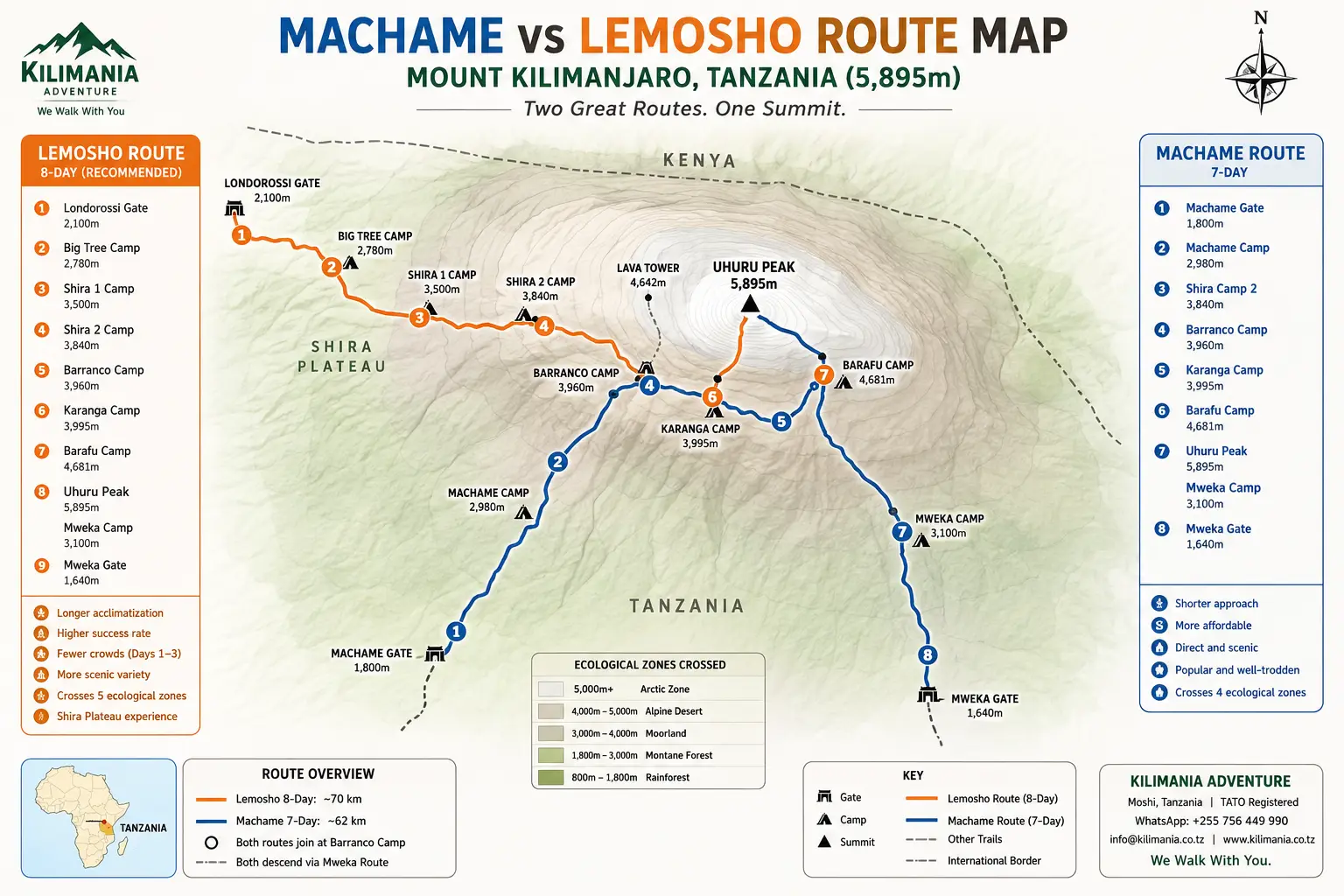
Quick Answer
First-time altitude climbers: Choose Lemosho 8-day.
Experienced trekkers with prior trekking above 4,000 m: Machame 7-day is acceptable.
Budget under $2,200: Machame 7-day saves roughly $350.
Climbers over 50, or anyone with a history of altitude sensitivity: consider Lemosho 8-day — the longer schedule gives your body more time to adapt.
Quoted Machame 6-day: we generally advise against it.
📲 WhatsApp Sabinus: +255 756 449 990 — describe your fitness, budget, and dates. We reply with a direct route recommendation within 12 hours.
How We Calculate Our Summit Success Data
Our dataset includes 1,247 Kilimania-guided clients who began a summit attempt between January 2019 and December 2025, across all routes we operate. Figures exclude clients who ended a trek for non-medical, non-altitude reasons (missed flights, personal emergencies) before reaching summit night. A “success” means reaching Uhuru Peak, 5,895 m. Route-specific figures below are drawn from the subset of that dataset that booked each named itinerary. We have not submitted this dataset for independent academic audit — treat it as operator-logged field data, not peer-reviewed research.
Key Stats (Kilimania records, 2019–2025, n=1,247)
- Lemosho 8-day summit success: 89%
- Machame 7-day summit success: 79%
- Lemosho 7-day summit success: 83%
- Headache reported at Barranco Camp, Machame climbers: 38% (self-reported during our guides’ daily health checks, not a clinical diagnosis)
- Typical cost difference, Lemosho 8-day vs Machame 7-day: ~$350
Machame vs Lemosho — Side-by-Side Comparison
| Feature | Lemosho 8-Day | Machame 7-Day |
|---|---|---|
| Summit success rate (Kilimania log, 2019–2025) | 89% | 79% |
| Duration | 8 days | 7 days |
| Starting gate | Londorossi Gate (2,100 m) | Machame Gate (1,640 m) |
| Approximate distance | 70 km | 62 km |
| Nights above 3,000 m before Lava Tower | 2 nights | 1 night |
| Typical cost, 2026 (per person, group climb) | $2,450–$2,800 | $2,100–$2,450 |
| Crowds, Days 1–3 | Low — western corridor | Moderate to high — most popular route |
| Best suited for | First-timers, age 50+, prior altitude sensitivity | Budget-focused, prior 4,000 m+ experience |
Both routes converge at Barranco Camp and share identical terrain from there — the Barranco Wall, Karanga Camp, Barafu Camp, Stella Point, and Uhuru Peak, descending together via Mweka. The entire meaningful difference is in the approach and the acclimatization schedule before that point.
The Acclimatization Difference — What Actually Happens
Short answer: Lemosho 8-day gives your body two nights above 3,000 m — including one at 3,500 m — before the 4,642 m demand of Lava Tower. Machame 7-day asks for that same climb after only one night above 3,000 m. That single extra night is the most likely explanation for the gap between the two routes’ logged success rates.
Machame 7-Day — Sleep Altitude by Night
| Night | Camp | Sleep Altitude |
|---|---|---|
| 1 | Machame Camp | 2,980 m |
| 2 | Shira Camp 2 | 3,840 m |
| 3 | Barranco Camp | 3,960 m |
| 4 | Karanga Camp | 4,035 m |
| 5 | Barafu Camp | 4,680 m |
| 6 | Mweka Camp | 3,100 m |
Lemosho 8-Day — Sleep Altitude by Night
| Night | Camp | Sleep Altitude |
|---|---|---|
| 1 | Mti Mkubwa | 2,750 m |
| 2 | Shira Camp 1 | 3,500 m |
| 3 | Shira Camp 2 | 3,840 m |
| 4 | Barranco Camp | 3,960 m |
| 5 | Karanga Camp | 4,035 m |
| 6 | Barafu Camp | 4,680 m |
| 7 | Mweka Camp | 3,100 m |
Written by guides, not physicians. Discuss any altitude, cardiovascular, or respiratory concern with a doctor before your climb. The CDC Yellow Book and the Wilderness Medical Society‘s altitude illness prevention guidelines both note that 24–48 hours at intermediate altitude (3,000–3,800 m) before ascending above 4,000 m is associated with lower rates of acute mountain sickness. Lemosho builds this window in structurally; Machame compresses it by one night.
Senior Guide Sabinus Msimba: “On Machame, I watch the Lava Tower day carefully. Some clients are not ready — they’ve only had one real altitude night. On Lemosho, the Lava Tower day is usually manageable. Clients arrive with one more night of adaptation in their bodies.”
Cost Comparison — Is the Extra $350 Worth It?
Short answer: For most climbers, yes. The $350 difference reflects one additional night of TANAPA conservation and camping fees (see the TANAPA official fee schedule, June 2026), one extra day of crew wages under KPAP fair-pay standards, one more day of food and fuel, and a longer transfer to Londorossi Gate (75 km from Moshi) versus Machame Gate (45 km).
Bottom Line
If you attempt Machame 7-day and don’t summit — roughly a 21% probability in our data — a second attempt means paying full climb costs again, plus duplicate flights and lost vacation days. That total typically exceeds $5,000. The $350 saving disappears entirely. We say this plainly even though it costs us nothing to let a client choose the cheaper route: the premium is worth paying unless you have documented evidence your body handles altitude efficiently.
Who Should Choose Which Route
Short answer: First-time high-altitude climbers, anyone 50 or older, and anyone with a history of altitude sensitivity should lean toward Lemosho 8-day. Climbers with verified experience above 4,000 m and a firm budget ceiling can reasonably choose Machame 7-day.
Choose Lemosho 8-day if:
- This is your first high-altitude trek
- You want the highest logged summit success rate
- You are over 50
- You prefer fewer crowds and more scenery
- Your budget can absorb roughly $350 more
Choose Machame 7-day if:
- You have prior trekking experience above 4,000 m
- Budget is a major factor
- You accept the trade-off between cost and acclimatization time
- You understand the lower logged success rate
Compare Your Kilimanjaro Options
- Lemosho 8 Days
- Machame 7 Days
- Northern Circuit (9 Days)
Tell Sabinus your fitness level, budget, and travel dates on WhatsApp, and get a direct route recommendation within 12 hours.
International Traveler Notes
Short answer: Both routes start and end near Moshi, roughly 45–60 minutes from Kilimanjaro International Airport (JRO). Prices above are quoted in USD; most operators, including Kilimania, accept USD cash or card with a processing fee. A single-entry Tanzania visa currently runs $50–$100 depending on nationality — verify current requirements at your nearest Tanzanian embassy before booking, as fees change without notice.
⚠️ A Note on Cheap Quotes
A Lemosho 8-day quote significantly below $1,600 cannot realistically cover TANAPA park fees, KPAP-compliant crew wages, food, and gear for eight days on the mountain. If you see a price that low, ask the operator directly how they cover fixed park and crew costs — a vague answer is a red flag.
Facts at a Glance
- Lemosho 8-day summit success: 89% (Kilimania records, 2019–2025, n=1,247)
- Machame 7-day summit success: 79% (same dataset)
- Lemosho 7-day summit success: 83% (same dataset)
- Both routes merge at Barranco Camp, 3,960 m
- Cost difference: approximately $350, per Kilimania 2026 rates
- TANAPA fees set and updated by the Tanzania National Parks Authority — verify at tanzaniaparks.go.tz
- Porter wage standards set by KPAP — verify at kiliporters.org
- Machame Gate: 45 km from Moshi. Londorossi Gate: 75 km from Moshi
Why Trust Kilimania Adventure for This Information
- Base: Moshi, Kilimanjaro Region, Tanzania — physical office
- TATO registration — verify at tatotz.org
- Climb database: 1,247 guided ascents (2019–2025) across all major routes
- Sabinus Msimba: 22+ years guiding, 300+ KINAPA-licensed summit climbs — full credentials on his author page
- We publish our failure rates and real cost breakdowns because climbers who see the data summit more often
- Verified reviews: TripAdvisor | Google Reviews
Download the Free Kilimanjaro Hidden Costs Checklist
Whether you choose Lemosho or Machame, the quoted tour price is rarely the full cost. Our free checklist — built by Sabinus Msimba from 22+ years of guiding — covers gear, flights, visas, tipping, and the expenses most operators don’t mention upfront.
- Complete Kilimanjaro budget planner
- Gear buying vs. rental comparison
- Crew tipping guide aligned with KPAP standards
- Printable pre-departure checklist
FAQ: Machame vs Lemosho
Lemosho 8-day. Its acclimatization profile gives your body two nights above 3,000 m before Lava Tower at 4,642 m. Machame 7-day can work for first-timers with verified cardiovascular fitness and documented altitude experience above 4,000 m — without that, Lemosho’s extra night is your primary safety margin.
Machame is more physiologically demanding due to its compressed acclimatization schedule, not its terrain. Day 2 pushes from 2,980 m to 3,840 m with only one prior altitude night. From Barranco Camp onward, both routes share identical terrain.
Yes. Kilimania’s Lemosho 7-day shows an 83% summit success rate in our 2019–2025 records — still better than Machame 7-day’s 79%. Choose the 8-day version when your budget allows; the extra Shira 2 night adds the full physiological benefit.
Both merge at Barranco Camp (3,960 m) — Day 3 on Machame, Day 4 on Lemosho — then share the Barranco Wall, Karanga Camp, Barafu Camp, Stella Point, and Uhuru Peak, descending together via Mweka.
Choosing the Machame 6-day to save a small amount over the 7-day version. That compressed day removes the Karanga Camp recovery stage and increases altitude sickness risk. The second most common mistake is choosing by which route “sounds harder” rather than matching physiology.
Approximately $350 more, reflecting one extra night of TANAPA fees, KPAP-standard crew wages, food, fuel, and the longer transfer to Londorossi Gate.
Conclusion
Choose Lemosho 8-day if you’re a first-time high-altitude trekker, 50 or older, or have a history of altitude sensitivity, and your budget covers the extra ~$350 — it carries the highest logged success rate in our 1,247-climb dataset (2019–2025). Choose Machame 7-day only with documented experience above 4,000 m. For a full route breakdown, see our Kilimanjaro Routes 2026 guide, our Lemosho Route guide, or our Machame Route guide.
Tell us your dates, group size, and budget — we’ll send an itemized quote within 12 hours, park fees listed by day, no costs discovered at the gate.
Related Reading
- Kilimanjaro Routes 2026: Best Route & Success Rates
- Lemosho Route Kilimanjaro 2026 — Full Guide
- Machame Route Kilimanjaro 2026 — Honest 7-Day Guide
- Kilimanjaro Success Rate By Route: Data From 1,247 Climbs
- Climbing Kilimanjaro Guide 2026: Costs, Routes & Summit Success
- Hidden Costs of Climbing Kilimanjaro
- What Kilimanjaro Summit Night Is Really Like
Disclosure: This article is written by Kilimania Adventure, a TATO-registered operator based in Moshi, Tanzania, with a direct commercial interest in Kilimanjaro bookings. All prices reflect real 2026 costs from our own operations. We encourage you to compare our quotes with at least two other TATO-registered operators before booking. Park fees and conservation charges are set by TANAPA and can change without notice — verify current fees at tanzaniaparks.go.tz.