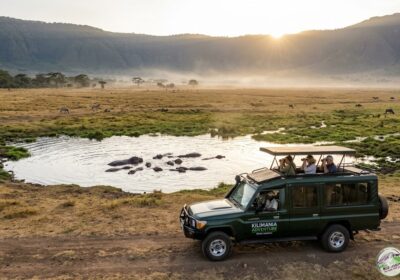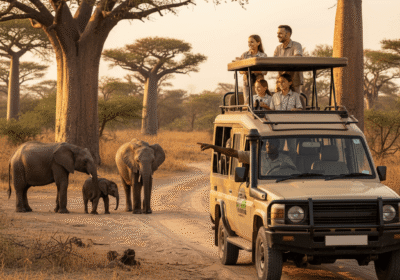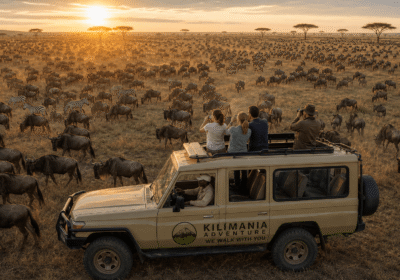
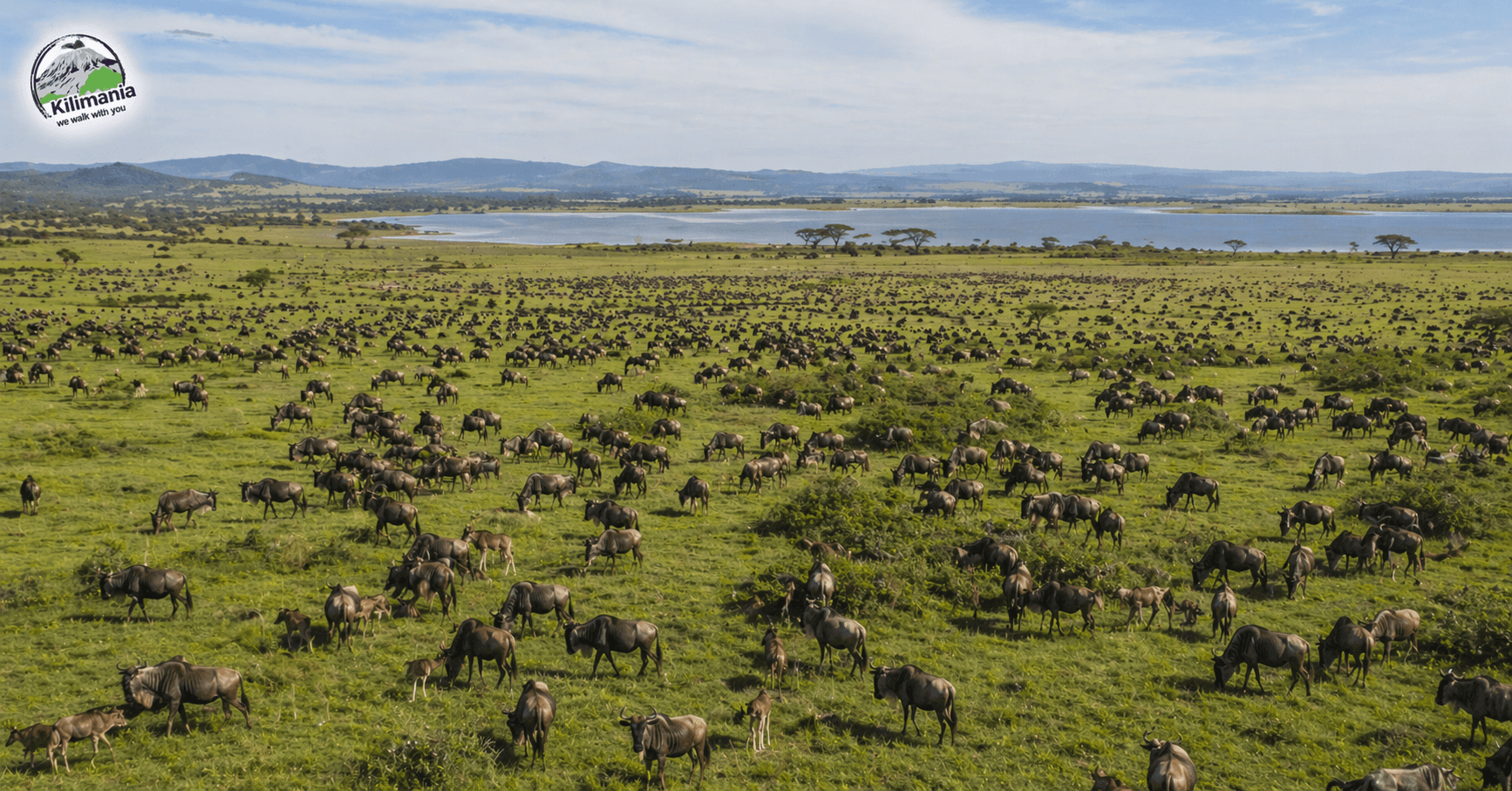
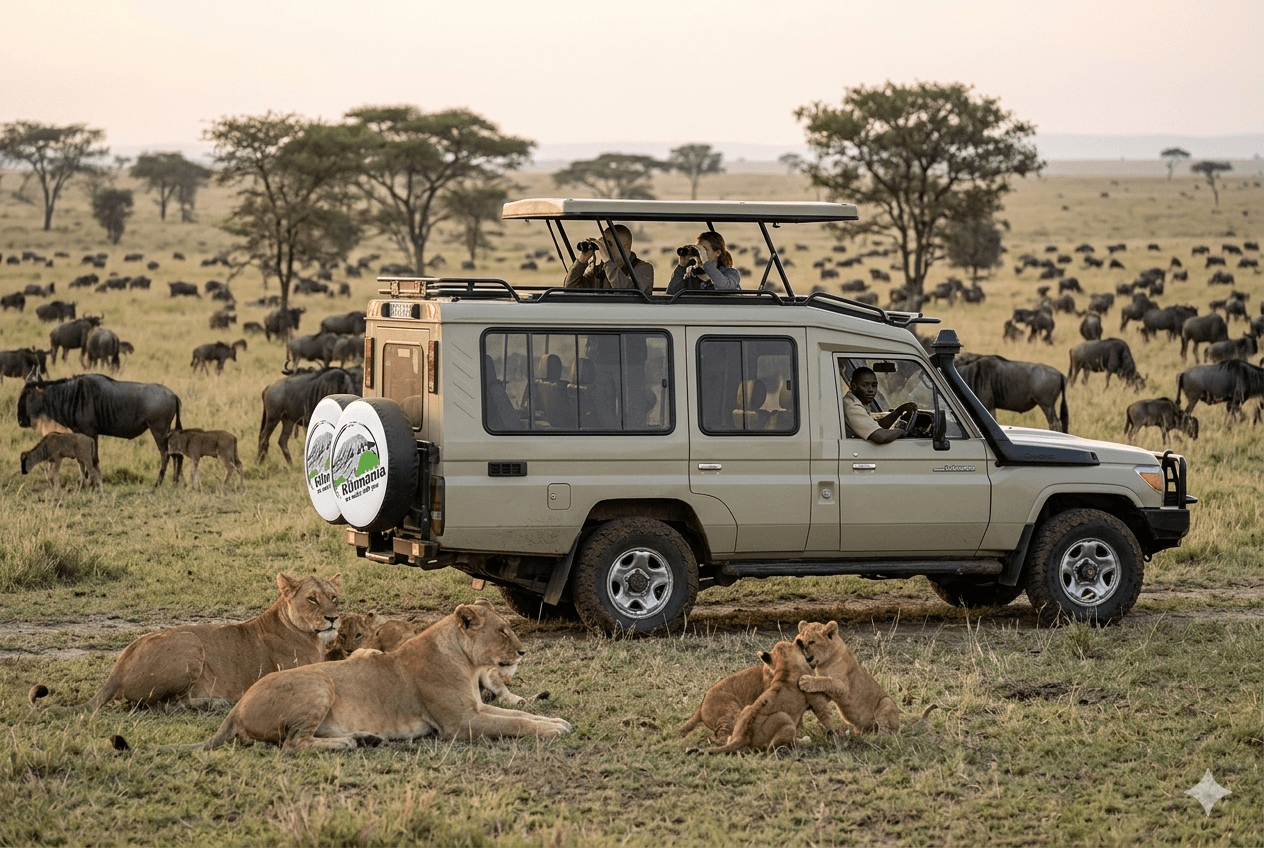
The Ndutu calving season 2026 is one of the most intense wildlife events in Africa. During peak weeks, thousands of wildebeest calves are born each day across the short-grass plains of southern Serengeti, drawing lions, cheetahs, hyenas, and other predators into the same concentrated hunting ground.
The question is not whether to go. It is when to arrive—and where to base yourself—so you are inside the action, not driving toward it.
Plan your trip with our Tanzania safari packages: https://kilimania.co.tz/tanzania-safaris/
Key Facts — Ndutu Calving Season 2026
| Topic | Details |
|---|---|
| Season window | Late December 2025 – March 2026 |
| Peak calving | Mid-January – Mid-February 2026 |
| Daily births | 6,000–8,000 calves |
| Total calves | ~500,000 across season |
| Location | Ndutu (Ngorongoro Conservation Area), Southern Serengeti |
| Off-road driving | Allowed in designated NCAA areas |
| Booking deadline | July–August for February travel |
| Camp cost | $350–$1,400+ per person/night |
| Drive time from Moshi | 6–7 hours |
| Flight time | ~50 minutes from Arusha |
Last reviewed: April 2026. Park fees and camp rates confirmed with operators before publication.
The Ndutu calving season 2026 begins building in late December 2025 as herds move south onto the short-grass plains. The peak calving window — when daily births are commonly estimated in the thousands and predator activity is at its most intense — runs from mid-January to mid-February 2026. This concentrated 4-week window is when cheetah hunts, lion ambushes, and hyena clan activity are most frequent. Book February mobile camps 6–9 months in advance. Early March remains productive but less intense. After late March, the herds begin moving northwest, and the camps relocate.
Safari map of Northern Tanzania highlighting the Ndutu calving season migration
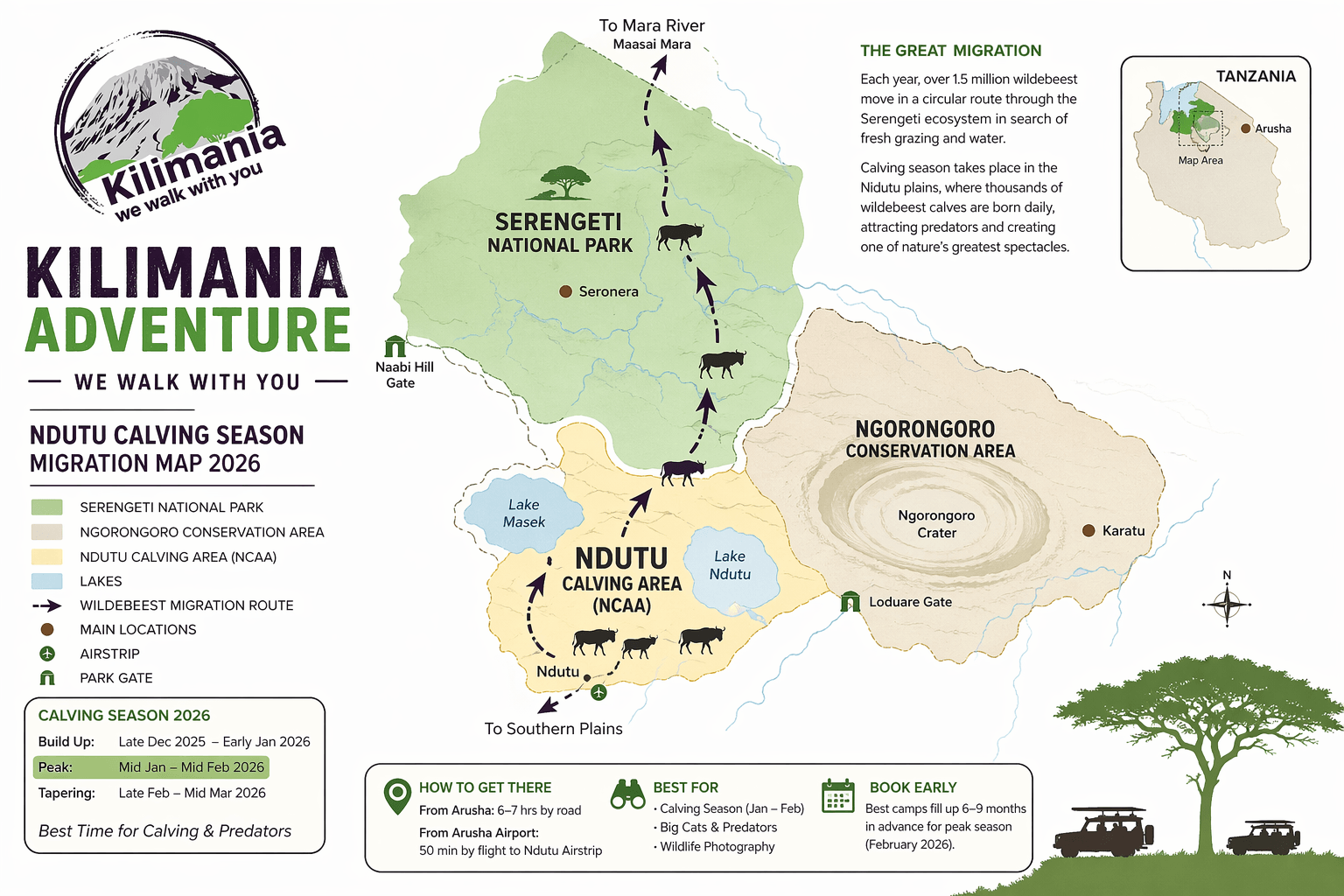
Table of Contents
Introduction
This guide covers the 2026 Ndutu calving season in specific practical terms: when the peak window opens and closes, where the highest predator activity concentrates, how to choose and book the right camp, what photography conditions and gear to prepare, and the planning mistakes that send travelers to the wrong location at the wrong time.
It is written for international wildlife travelers, photography-focused safari visitors, and first-time Tanzania safari planners from Europe, North America, and Australia who want honest, specific information rather than a generic migration summary.
Kilimania Adventure operates from Moshi, at the foot of Kilimanjaro. Our guides track southern plains conditions weekly from November through March. When rainfall patterns shift the herd concentration zone between Ndutu Lake, Lake Masek, and the Hidden Valley, we know within days — and that knowledge shapes every departure we recommend. This guide is based on real field tracking experience in the Ndutu area across multiple calving seasons.
Explore our 4-Day Big Cats Safari in Tanzania — our most popular calving season itinerary, routed specifically through the NCAA Ndutu zones that permit off-road access.
When Does the Ndutu Calving Season Start in 2026?
The calving season does not have a single start date. It follows rainfall.
When the short rains arrive in the southern Serengeti ecosystem in November and December, fresh alkaline grass grows on the volcanic plains around Lake Ndutu and Lake Masek. This grass is rich in nutrients associated with milk production and calf development. These short-grass plains are widely understood to be one of the main ecological reasons pregnant wildebeest concentrate here each year. The herds do not arrive on a specific date. They arrive because the grass is ready.
Late December 2025: First large columns reach the Ndutu plains and southern Serengeti. Scattered births begin. Predator numbers are building but not yet at peak. Fewer tourists than in January or February — a genuine advantage for travelers who can accept slightly lower birth density.
Early to mid-January 2026: Herd density increases. Birth rate rises sharply. Lions patrol herd edges. Cheetahs begin positioning on termite mounds and open ground. This is already a strong calving safari window.
Mid-January to mid-February 2026 (peak): The main calving event. Over the course of this concentrated 3–4 week period, hundreds of thousands of calves are born — an evolutionary strategy that helps overwhelm predators with sheer numbers, ensuring many calves survive despite the hunting pressure. Daily births are commonly estimated in the thousands. Major predator species across the ecosystem are highly active. This is the window this safari is built around.
Late February to mid-March 2026: Birth rate tapers. Calves from early February are now mobile and faster — predator success rates often become less obvious to observers. Hyenas and jackals remain highly active as scavengers. Herd density is still high but beginning to spread. This is a productive shoulder window, often with lower camp rates and fewer vehicles than peak February.
Late March to April 2026: Herds begin moving northwest toward the Western Corridor and Grumeti. Most mobile camps relocate or close by April. Travelers wanting calving season should be out of Ndutu by late March.
Where the Calving Takes Place — Named Hotspots
The calving zone spans the border between the southern Serengeti National Park and the Ngorongoro Conservation Area. The specific sub-zones that consistently produce some of the strongest predator activity are:
Ndutu Marsh: A permanent water feature that draws wildebeest year-round and concentrates resident lion prides and leopards in the adjacent woodland edges. Mornings here produce consistent predator encounters because both prey and predators return to water at first light.
The Hidden Valley: A low-lying depression that holds standing water longer than the surrounding plains after rain. Massive wildebeest herds gather here when other water sources dry. Hyena clans patrol the margins, and lions use the shallow edges for ambush. This sub-zone is one of the best locations for witnessing coordinated lion group hunting during calving season.
Lake Masek and Lake Ndutu shores: The alkaline lakeshores attract herds for mineral intake. Flamingos, pelicans, and wading birds gather when water levels suit. Large elephant groups use the shoreline, creating a layered wildlife scene that rewards slow, patient observation.
Gol Kopjes (eastern approach): Rocky granite outcrops east of the main Ndutu plains where leopards rest at crepuscular hours and cheetahs use elevated positions to scan for prey. Drive time from Ndutu camps is 45–60 minutes — worth the addition on a full-day game drive.
These sub-zones are associated with the wider Ndutu calving area, where off-road access may be possible in designated NCAA-managed sections under current rules. A Kilimania guide can follow developing wildlife movement off the main track where regulations allow, and conditions support it. Once a drive crosses into Serengeti National Park territory, standard park driving restrictions apply.
Guide Insight — Kilimania Adventure, southern Serengeti tracking team
In early March, wildebeest calves cluster between Lake Ndutu and the Hidden Valley after overnight rain. Predators patrol the marsh edges at first light. We position near the acacia line before sunrise — usually by 6:15 AM — and read track freshness and wind direction before committing to a route. If the herds shift west before 9:00 AM, we cut behind Shamba la Maharage to avoid churned main tracks and reach the western edge of the marsh while other vehicles are still on the primary game road. This kind of positioning is only possible with a private vehicle and an operator who has been in these specific zones for years, not just seasons.
Want to experience these predator hotspots with a private guide?
Explore our 4-Day Big Cats Safari designed specifically for the Ndutu calving season:
https://kilimania.co.tz/4-day-big-cats-safari-in-tanzania/
Ndutu vs Serengeti for Calving Season
| Feature | Ndutu (NCAA) | Central Serengeti |
|---|---|---|
| Calving activity | Very high | Low |
| Off-road driving | Allowed | Not allowed |
| Grass visibility | Short grass | Taller grass |
| Drive time to herds | 0–30 minutes | 2–3 hours |
| Predator density | Very high | Moderate |
Travelers comparing these two zones during January–March need to understand that this is not a preference question. It is a tactical question.
The most common and costly planning error is booking Central Serengeti accommodation for a January–March trip and expecting calving season action. The herds are in the south during this period. A traveler based in Seronera during February is driving 2–3 hours each way to reach Ndutu — losing 5–6 hours of wildlife time daily. The right base camp during calving season is inside or immediately adjacent to the NCAA Ndutu zone.
For a complete comparison of both ecosystems across all seasons, read our Ndutu vs Serengeti Safari guide.
Predators During Ndutu Calving Season
The concentration of pregnant and nursing wildebeest on a relatively compact short-grass plain draws major predator species into the same general zone. For many safari travelers and photographers, this creates one of the most concentrated predator spectacles in Africa’s seasonal wildlife calendar.
Lions: Large lion prides are often present in the Ndutu area during calving season, especially around marshes and herd movement corridors. Dawn is the most active period. Kilimania guides stage near known lion territories before 6:30 AM to catch first-light movements. The Ndutu Marsh and Hidden Valley are among the most reliable lion zones during peak calving.
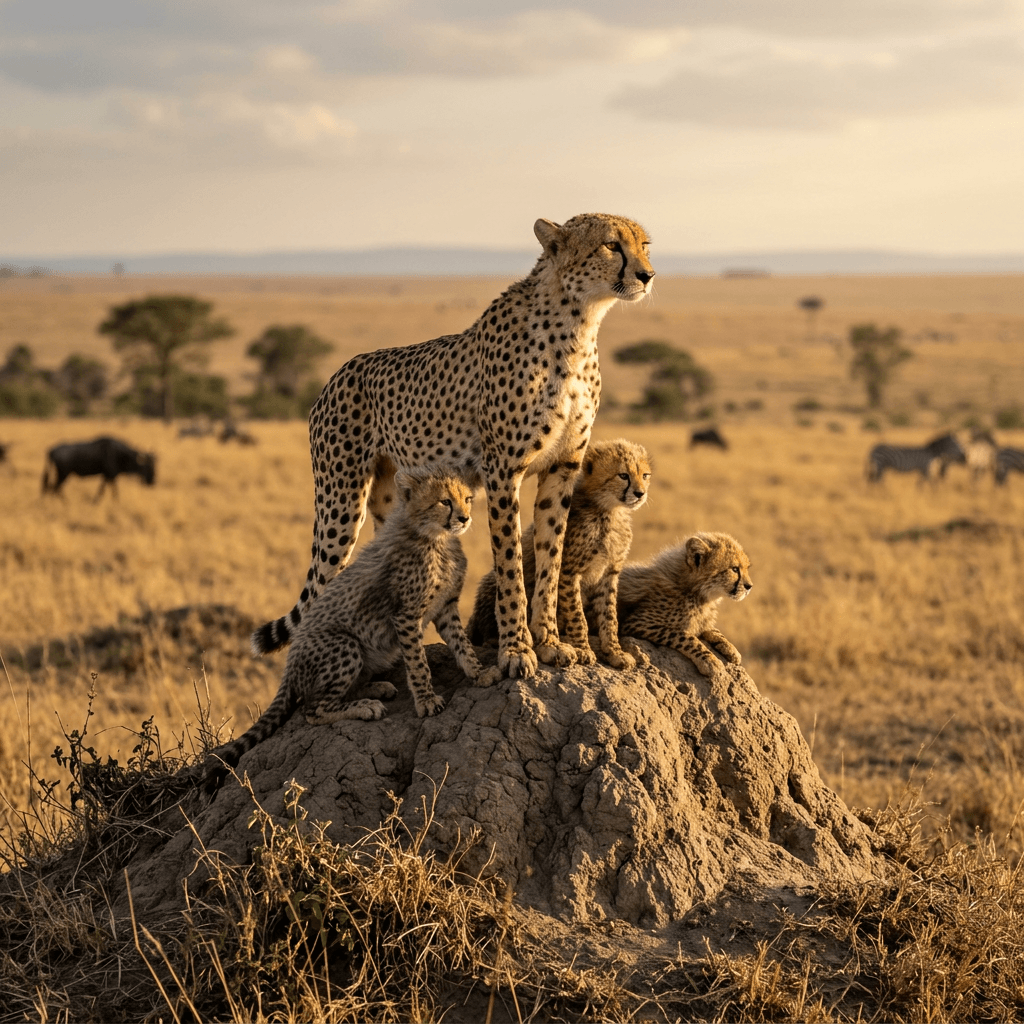
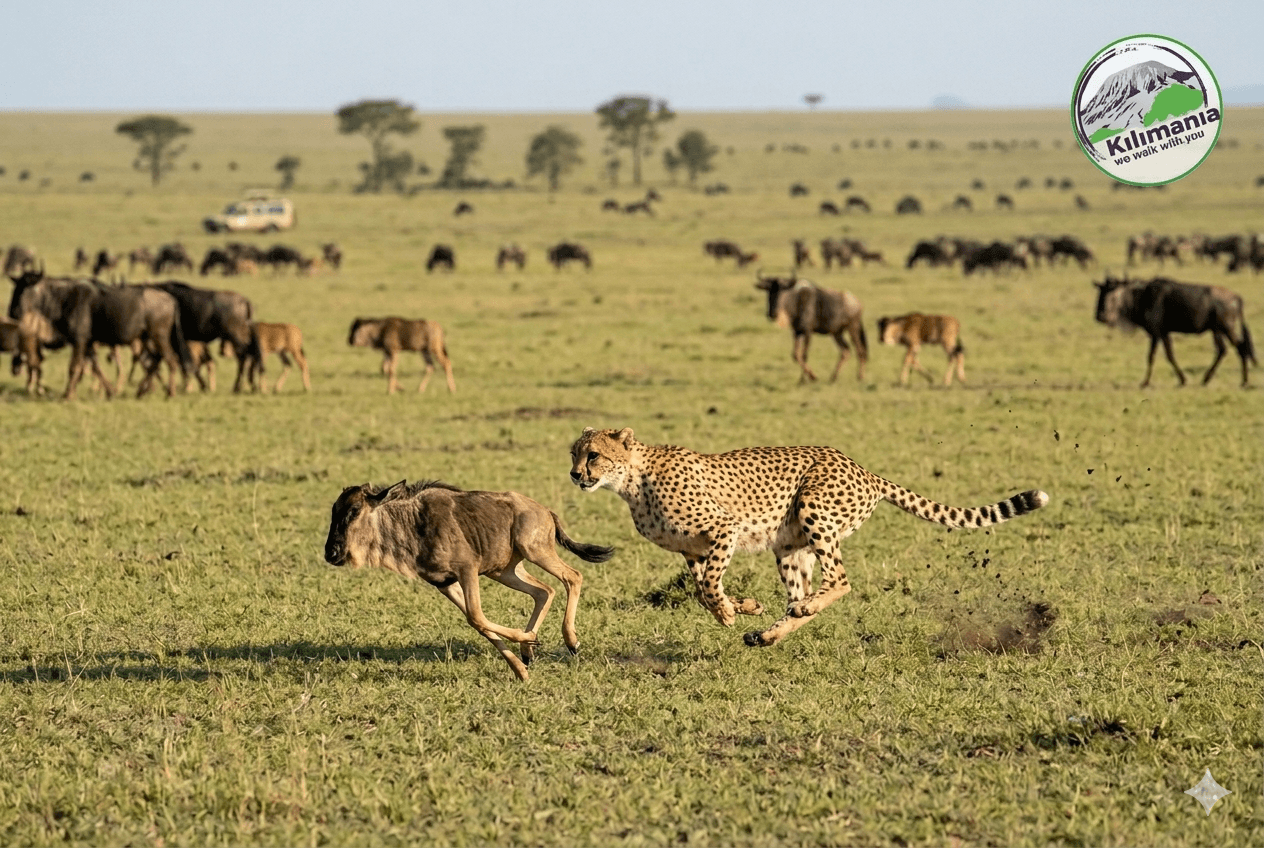
Cheetahs: The Ndutu short-grass terrain is widely regarded as one of the finest locations to witness a complete cheetah pursuit. Open visibility provides the runway cheetahs rely on for high-speed chases. Cheetahs often hunt between 8:30 AM and 10:00 AM when light has improved but temperatures are still manageable. Where regulations allow, off-road access can help guides keep visual contact with a hunt in progress in NCAA-managed areas.
Spotted hyenas: Active around the clock, with clan activity peaking at twilight and dawn. Hyenas both hunt independently and track lion kills. During calving season, highly vulnerable newborns increase hyena opportunities significantly. Large hyena clans are regularly seen in the Ndutu area during this period.
Leopards: Less predictable than the other three but present in the acacia thickets around the Ndutu Marsh and the woodland edge near Gol Kopjes. Crepuscular — most active between 5:30–7:00 AM and 5:30–7:00 PM.
Jackals, servals, and bat-eared foxes: The open calving plains also support a rich supporting cast of smaller predators. Black-backed jackals shadow wildebeest herds constantly during calving, picking off the weakest calves. Servals use the grass edge to hunt rodents and hares disturbed by moving herds.
Ndutu Migration Calendar 2026
| Period | Herd Status | Calving Activity | Predators |
|---|---|---|---|
| Dec 2025 | Arriving | Low | Increasing |
| Jan 2026 | Settled | High | High |
| Feb 2026 | Peak | Very high | Extreme |
| Mar 2026 | Moving | Declining | Moderate |
Crowd avoidance note: The second and third weeks of February are usually the busiest period. A single lion sighting or kill can attract a heavy cluster of vehicles during peak weeks. Travelers who can shift to late January or the first week of March will often find similar calving activity with fewer vehicles around a given sighting.
Photography Guide — Ndutu Calving Season
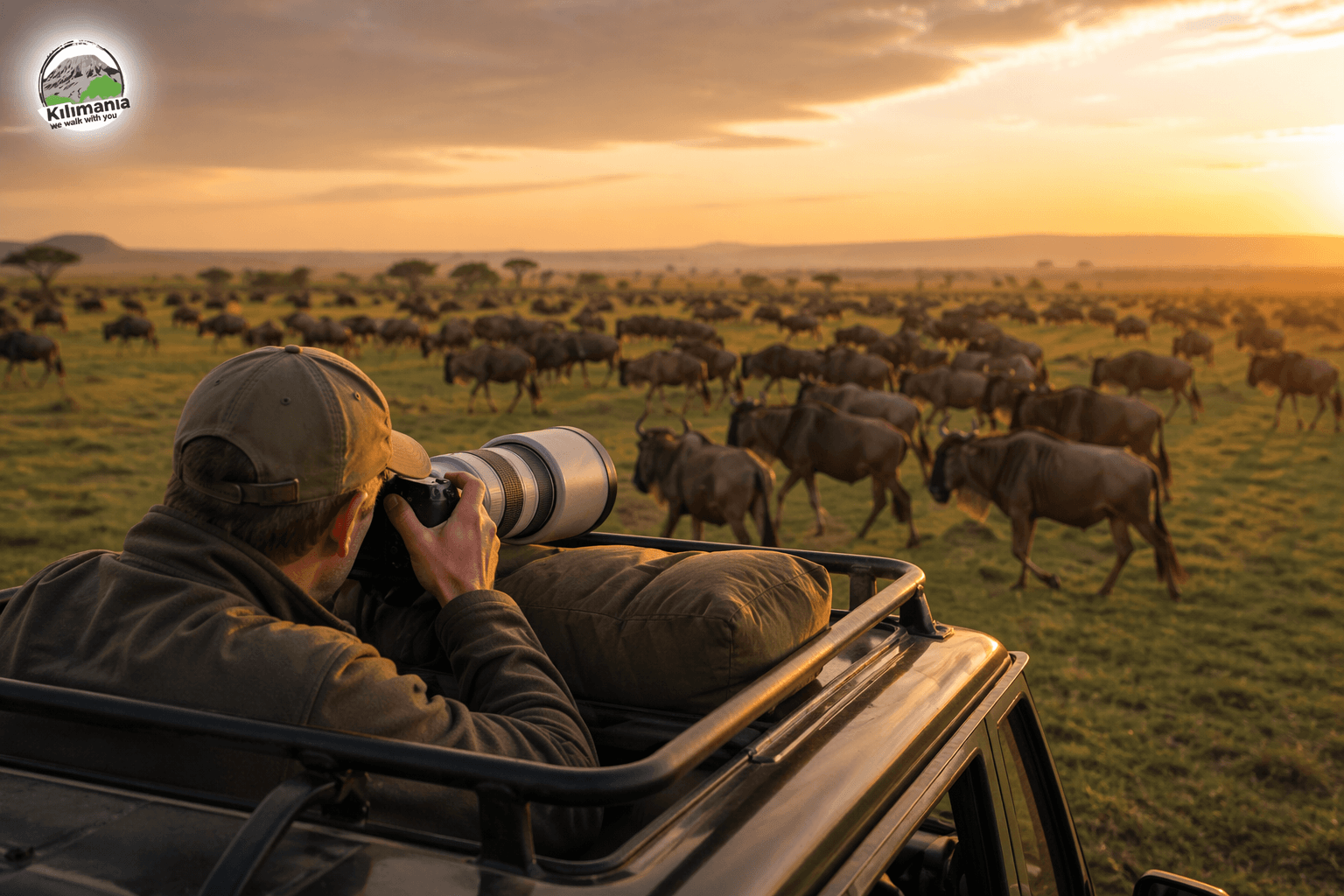
Ndutu during calving season is one of the most demanding and rewarding wildlife photography environments in Africa. The short grass, flat terrain, and selective off-road access in some NCAA-managed areas create conditions difficult to replicate in most dry-season parks.
Camera and lens setup:
| Equipment | Recommended spec | Reason |
|---|---|---|
| Primary telephoto | 400–600mm | Ethical distance from hunts while filling the frame |
| Secondary lens | 70–200mm | Environmental shots — herds, landscape, herd movement |
| Shutter speed for action | 1/1600s minimum, 1/2500s preferred | Freezes fast pursuit and reduces vehicle vibration blur |
| Shutter speed for calves | 1/500–1/800s | Calves stand still briefly; slower speed improves low-light exposure |
| Aperture | f/5.6–f/8 | Keeps predator and foreground calf sharp simultaneously |
| ISO | Auto 400–3200 | Dawn and dusk light on open plains requires high ISO flexibility |
| Drive mode | Continuous high | Burst mode essential for fast-moving action |
| Stabilisation | Beanbag on roof hatch | More stable than tripod in a moving vehicle; allows rapid direction change |
| Rain protection | Dry bag or rain sleeve | Afternoon showers arrive without warning in January–February |
| Dust protection | Lens cloth and sealed bag | Even in wet season, volcanic dust rises on dry stretches |
| ND filter | ND4 or ND8 | Balances bright sky exposure against darker wildebeest and calf foreground |
Light windows:
- 6:00–8:00 AM: Soft golden light on green grass, low angle, highest predator activity. The most productive two hours of any calving season day.
- 8:30–10:00 AM: Cheetahs are often active. Lighter harsher, but action frequency can still be high.
- 10:00 AM–4:00 PM: Midday heat reduces predator movement. Herd photography, landscape, and bird observation.
- 4:30–7:00 PM: Second activity window. Golden hour light returns. Leopards and hyenas become more active.
The most common photography mistake on a calving safari is chasing kills and ignoring the quieter moments. A newborn calf’s first steps — wobbly, disoriented, vulnerable — photographed against a line of moving wildebeest tells the calving story more completely than a single action frame. Build both into your shooting strategy.
Camp Selection and Booking Reality for 2026
Most Ndutu camps during calving season are seasonal mobile structures — canvas tent camps that position inside the calving zone from December to March, then pack up and move north with the herds. This mobility is the key advantage: a well-placed mobile camp can put you much closer to the main calving and predator areas before sunrise.
Camp cost tiers (per person per night, all-inclusive):
| Tier | Rate range | What to expect |
|---|---|---|
| Value mobile | $350–$550 | Comfortable canvas tents, shared facilities, meals included, basic guiding |
| Mid-range mobile | $600–$850 | En-suite tents, hot showers, higher-quality guiding, smaller groups |
| Luxury mobile | $900–$1,400+ | Premium canvas, private guides, exclusive location, top-quality food |
| Permanent lodge (Karatu/rim) | $200–$500 | More comfort, but 2–3 hour daily transfers to Ndutu — less wildlife time |
The booking deadline reality:
For February 2026 departures, the best-positioned mobile camps often began filling between July and August 2025 — around 6–8 months in advance. January and early March usually have more availability, but well-located camps still benefit from 4–6 months’ notice.
Travelers who wait until November or December 2025 for February 2026 camp availability may find:
- Only second-tier or less ideally positioned camps are available
- Higher rates due to reduced supply
- Fewer options to match the camp location to the herd position
The booking strategy: Contact your operator by May–June 2025 for February 2026. Provide flexible departure dates within a 2-week window if possible — this allows camp matching to actual herd position, not a fixed itinerary.
Practical Route Planning from Moshi to Ndutu
| Route option | Nights | Suited to | Key notes |
|---|---|---|---|
| Moshi + Ndutu only | 3–4 | Calving focus, photography | Best for travelers who want to maximise time in the Ndutu calving zone with minimal itinerary distraction |
| Moshi + Ndutu + Ngorongoro Crater | 4–5 | Predators + crater wildlife | Strong extension for travelers who want rhino and crater-floor wildlife after Ndutu |
| Moshi + fly-in Ndutu route | 3–5 | Limited time, budget flexible | Reduces long road transfer time and gets you into the calving area faster |
Drive and flight times from Moshi:
- Moshi to Ndutu by road: approximately 6–7 hours, depending on traffic, road conditions, and Ngorongoro gate formalities
- Moshi to Arusha Airport: approximately 1.5–2 hours by road
- Arusha Airport to Ndutu Airstrip by bush flight: approximately 50 minutes
- Kilimanjaro International Airport to Ndutu by road: approximately 6–7 hours
For travelers based in Moshi, a Ndutu-only safari is often the most efficient calving-season plane. It removes unnecessary park transitions and keeps the trip focused on the short-grass plains where the migration herds and predator activity are concentrated. This is especially valuable for photographers, repeat safari visitors, and anyone traveling with a short wildlife window.
A 3- or 4-night Moshi + Ndutu only itinerary gives you the best chance of reaching the core calving areas early, staying close to herd movement, and spending full game-drive hours inside the zone that matters most. Instead of dividing time across too many parks, this route keeps the safari built around one objective: being in Ndutu at the right moment.
For guests arriving through Kilimanjaro International Airport and overnighting in Moshi, this is also the cleanest operational start. Our team can arrange an early road departure from Moshi or a transfer to Arusha Airport for a scheduled bush flight into Ndutu, depending on budget, luggage profile, and time available.
For predator-focused travelers who want a short, high-value migration safari, our 4-Day Big Cats Safari can be adapted around a Moshi departure. Travelers who prefer to reduce road hours can also request a fly-in Ndutu version through our Tanzania Safaris planning team.
Common Planning Mistakes
Based in Central Serengeti for a calving season trip. The most expensive mistake on this list. During January–March, the wildebeest are in the south. Seronera-based travelers drive 2–3 hours each way to reach Ndutu — losing 5–6 hours of potential game viewing time daily, adding vehicle fuel costs, and arriving at the calving zone when other vehicles have already been there for hours.
Assuming calving season runs all three months at equal intensity. It does not. The peak is a 4-week window from mid-January to mid-February. Early December or late March visits offer calving activity but at significantly lower intensity. Plan around the peak window if the calving experience is your primary objective.
Waiting to book until the herds have “confirmed” their location. By the time herd concentration is obvious and reported in wildlife news, February camps are often already heavily booked. The herd movement pattern is predictable enough to book confidently 6–8 months ahead. The exact sub-zone within Ndutu can be adjusted by a flexible operator.
Crossing the NCAA/Serengeti boundary unknowingly. Some operators route game drives across the boundary between the Ndutu-area NCAA land and the Serengeti National Park. Once in SNP, standard park driving restrictions apply. Confirm with your operator that calving season game drives stay within the NCAA-managed Ndutu areas when off-road flexibility matters most. Ask this question directly before paying a deposit.
Booking a large shared vehicle. Group sizes above 6 people can affect the pace and flexibility of a game drive. When a cheetah begins a chase, a shared vehicle on a fixed schedule may leave. A private vehicle stays until the pursuit concludes. For calving season specifically, a private 4×4 can be the difference between watching a hunt from the beginning and arriving at the end.
FAQ
Q: When exactly does the Ndutu calving season peak in 2026?
The peak calving window for 2026 runs from approximately mid-January to mid-February. This is when daily births are commonly estimated in the thousands, and major predator species — lion, cheetah, hyena, leopard, and jackal — are at their most active simultaneously. February is the most reliable single month, but late January often delivers similar intensity with fewer tourist vehicles.
Q: Is Ndutu worth visiting outside of calving season?
Yes, with realistic expectations. From April onwards, most mobile camps relocate, and the herds disperse across the wider Serengeti ecosystem. Resident wildlife — elephants, giraffes, resident predators, and hundreds of bird species — remain. Predator activity and concentration are generally much lower than during the peak calving period. For travelers outside the December–March window, Central Serengeti (Seronera) or Tarangire will often produce stronger overall results. Read our Best Time to See Big Cats in Tanzania guide for the full seasonal comparison.
Q: Can I see all three big cats in four days during calving season?
Yes — a well-routed 4-day itinerary through Ngorongoro Crater and the Ndutu zone regularly produces lion, cheetah, and leopard sightings. No guide can guarantee any specific encounter in a wild, unfenced ecosystem. During peak calving, Ndutu is widely regarded as one of the strongest times and places in Tanzania for a three-big-cat safari.
Q: Do I need a 4×4 vehicle, and is off-road driving safe?
Yes to both. Ndutu’s tracks in January–March are a mix of firm volcanic soil, soft sand, and occasional wet sections near marsh edges. A standard 4×4 Land Cruiser handles all of it. Off-road driving in designated NCAA Ndutu areas is permitted under current rules and conducted by experienced guides at safe distances from wildlife. When tracks are particularly wet after overnight rain, guides assess conditions before committing to specific routes.
Q: What is the weather like during calving season?
January and February fall within the green season. Days are warm — often around 25–30°C by early afternoon. Mornings are cool before sunrise. Short afternoon storms are common in this season, though timing and intensity vary. Overall, the green-season conditions produce softer photography light, lush grass backgrounds, and cleaner air after rain — conditions many photographers prefer over the dry-season dust haze.
Q: Is Ndutu suitable for families with children?
Yes, with appropriate age expectations. Many mobile camps apply age guidelines for game drives, often starting around 8 years old, though policies vary by property. Long-day drives — 6–8 hours in a 4×4 on rough terrain — can tire younger children. The intensity of predator-prey encounters during calving, including active hunts and kills, is not suitable for every child. For families with children aged 8–14, discuss itinerary pacing with your operator before booking.
Q: How should responsible travel to Ndutu work in practice?
Responsible Ndutu safari travel means staying within designated driving areas, maintaining respectful viewing distance from wildlife, and choosing operators who employ local Tanzanian guides rather than seasonal outside teams with limited local knowledge. Camp and park payments in the area may support conservation management and community benefit structures, depending on the property and fee model. Ask your operator how their camp fees support conservation and local communities before booking.
Conclusion
The Ndutu calving season 2026 peaks in a 4-week window from mid-January to mid-February. That precision matters — arrive a month early or base yourself in the wrong ecosystem and the experience is entirely different. The combination of synchronized calving, legal route flexibility in the Ndutu area, short-grass terrain, and intense predator activity makes this a wildlife experience with no close equivalent elsewhere on the continent.
If February camps are already full when you read this, late January and early March are genuine alternatives — not consolation prizes. Both windows deliver calving action with lower vehicle density and often better photography conditions. If your dates are flexible, late January and early March offer the same calving intensity with fewer vehicles and better positioning opportunities.
Plan your calving season route with our team: 4-Day Big Cats Safari in Tanzania or browse all Ndutu-inclusive itineraries at Tanzania Safaris.
We Walk With You.
Planning Ndutu for 2026? Tell us your travel window, group size, and photography priorities. Our Moshi team will outline which camp tier fits your budget, which sub-zone to prioritise for your specific dates, and whether January, February, or March gives you the best combination of calving intensity and camp availability.
Contact us: kilimania.co.tz/contact.
For official park fees and current regulations:
TANAPA — Tanzania National Parks Authority | NCAA — Ngorongoro Conservation Area Authority