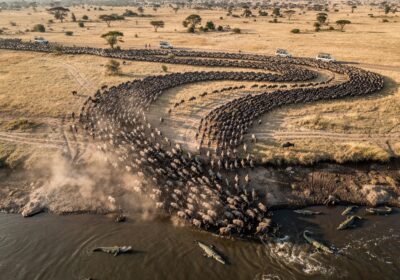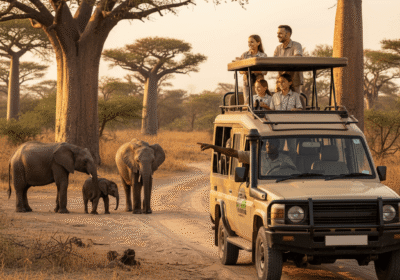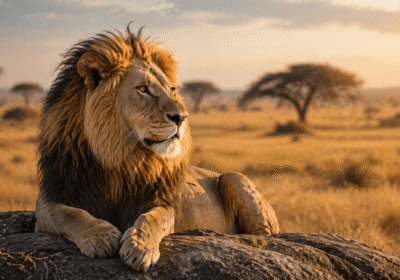
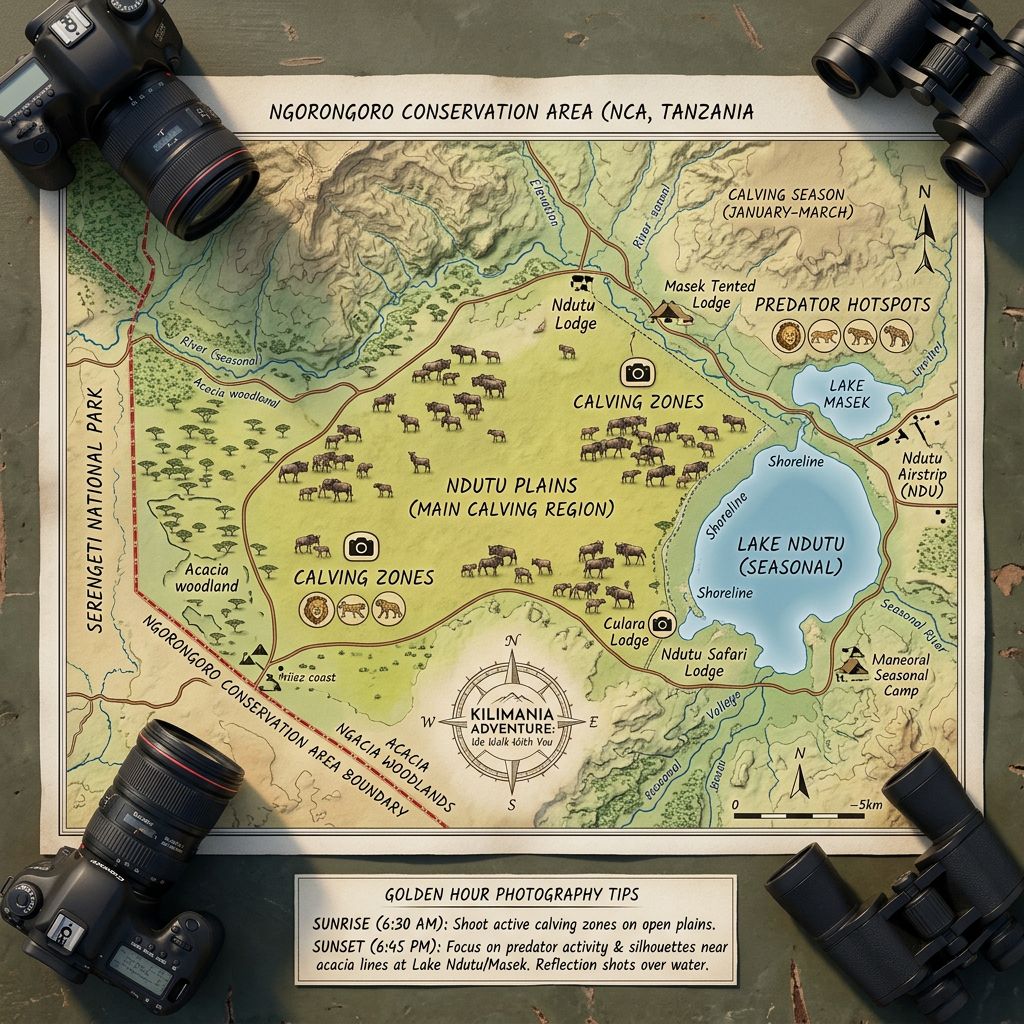
During peak calving season in Ndutu, approximately 8,000 wildebeest are born every single day — roughly one every ten seconds. A photographer who understands birth-sequence signals, predator activity windows, and ethical distance rules can document more raw wildlife behaviour in a single morning game drive than in months of regular safari travel elsewhere on the continent.
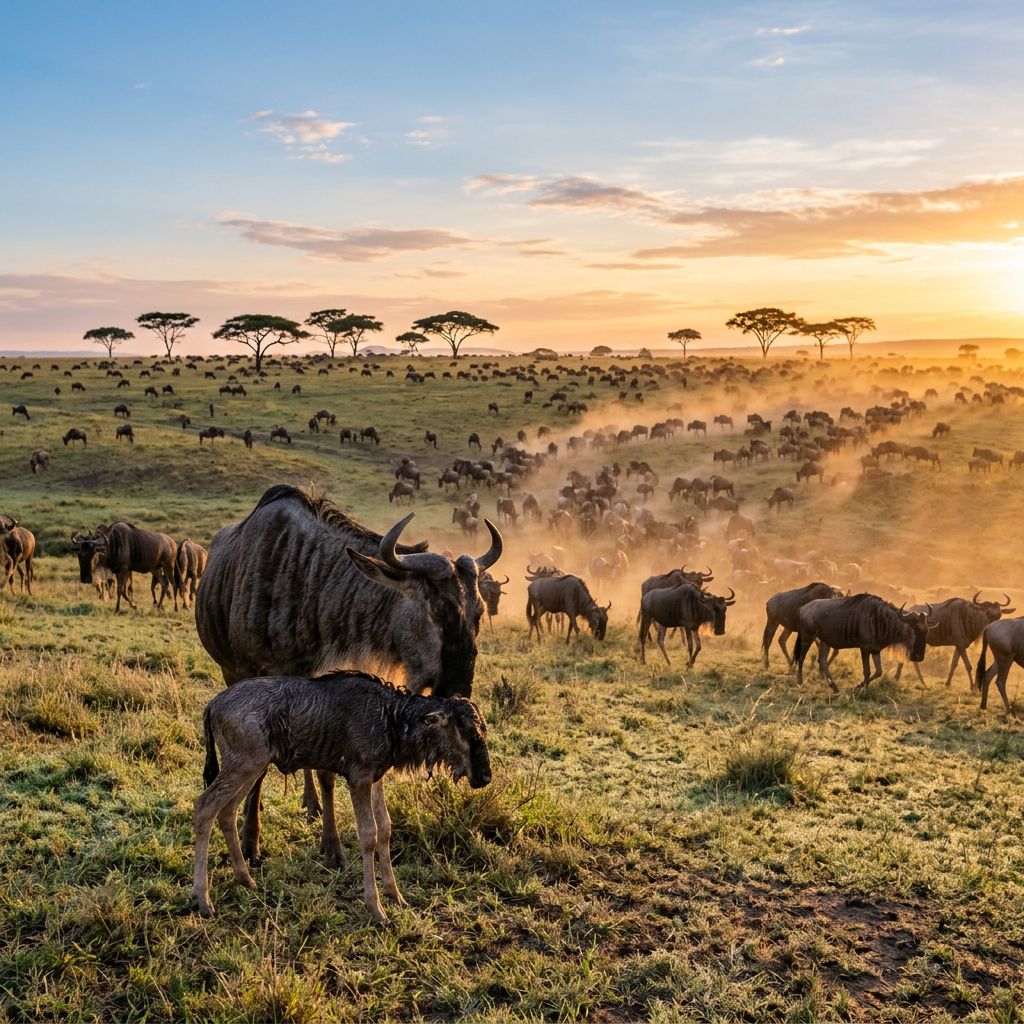
A successful Ndutu wildlife photography safari calving season requires three things working together: shutter speed of 1/1600s minimum for running wildebeest (1/2500s–1/3200s for cheetah pursuit), ethical distances of 25 metres from big cats and 20 metres from laboring females, and positioning before 6:15 AM to capture the Jan 25–Feb 10 peak window when light, births, and predator activity align simultaneously. The Jan 25–Feb 10 period is when all three overlap.
Table of Contents
Introduction
This guide covers precise camera settings tied to specific wildlife behaviours, exact golden hour timing windows for January and February in Ndutu, ethical distance guidelines with the ecological reasons behind each threshold, lens choices for the open-plains environment, and a complete gear checklist with Arusha rental prices.
It is written for wildlife photographers and serious safari travelers from Europe, North America, and Australia who want technical preparation, not generic advice. Whether you are shooting with a mid-range zoom or a professional telephoto prime, the settings and timing here apply directly to the Ndutu calving environment.
Kilimania Adventure operates photography-focused departures from Moshi and Arusha. Our guides have tracked calving season patterns across more than 15 seasons in the Ndutu zone, reading herd movements and predator territories that change week by week.
For the full calving season timing and camp booking context, read our Ndutu Calving Season 2026 guide.
Best camera settings for the Ndutu calving season
- Shutter: 1/1600–1/3200
- Aperture: f/5.6–f/8
- ISO: 400–1600
- Best time: 06:45–08:30
Camera Settings by Behaviour — The Ndutu Framework
Fixed settings do not work in Ndutu. Light changes from cool-toned pre-dawn at 6:00 AM to direct equatorial sun by 9:30 AM. Subject movement ranges from a stationary nursing calf to a cheetah at 110 km/h. The right approach is a behaviour-based decision framework, not a single preset.
Newborns and stationary herds:
- Shutter speed: 1/500–1/800s
- Aperture: f/5.6–f/8 for herd depth across multiple animals
- ISO: 400–800 in adequate light
- Focus mode: Continuous autofocus (AI Servo / AF-C), single flexible zone
Use f/4–f/5.6 when isolating a single newborn calf — this softens the background grass effectively while keeping the calf’s eye sharp. The calf’s glistening birth coat and the still-attached umbilical cord are the visual details that make these images read immediately. Expose for the highlights, not the midtones — the light-coloured Ndutu grass tricks camera meters into underexposing darker wildebeest hides. Dial in +0.3 to +0.7 exposure compensation as a starting point.
Running wildebeest and predator disturbance:
- Shutter speed: 1/1600–1/2000s minimum
- Aperture: f/5.6–f/8
- ISO: 800–1600 depending on cloud cover
- Drive mode: Continuous high-speed burst
When herds stampede during a predator disturbance, 1/1600s is the minimum safe threshold for a sharp frame. At 1/1000s, galloping wildebeest show motion blur that looks like photographer error rather than creative choice.
Cheetah pursuit — the hardest sequence in Ndutu:
- Shutter speed: 1/2500s–1/3200s
- Aperture: f/4–f/5.6
- ISO: 1600–3200 — do not hesitate to push
- Drive mode: Maximum frames per second your buffer allows
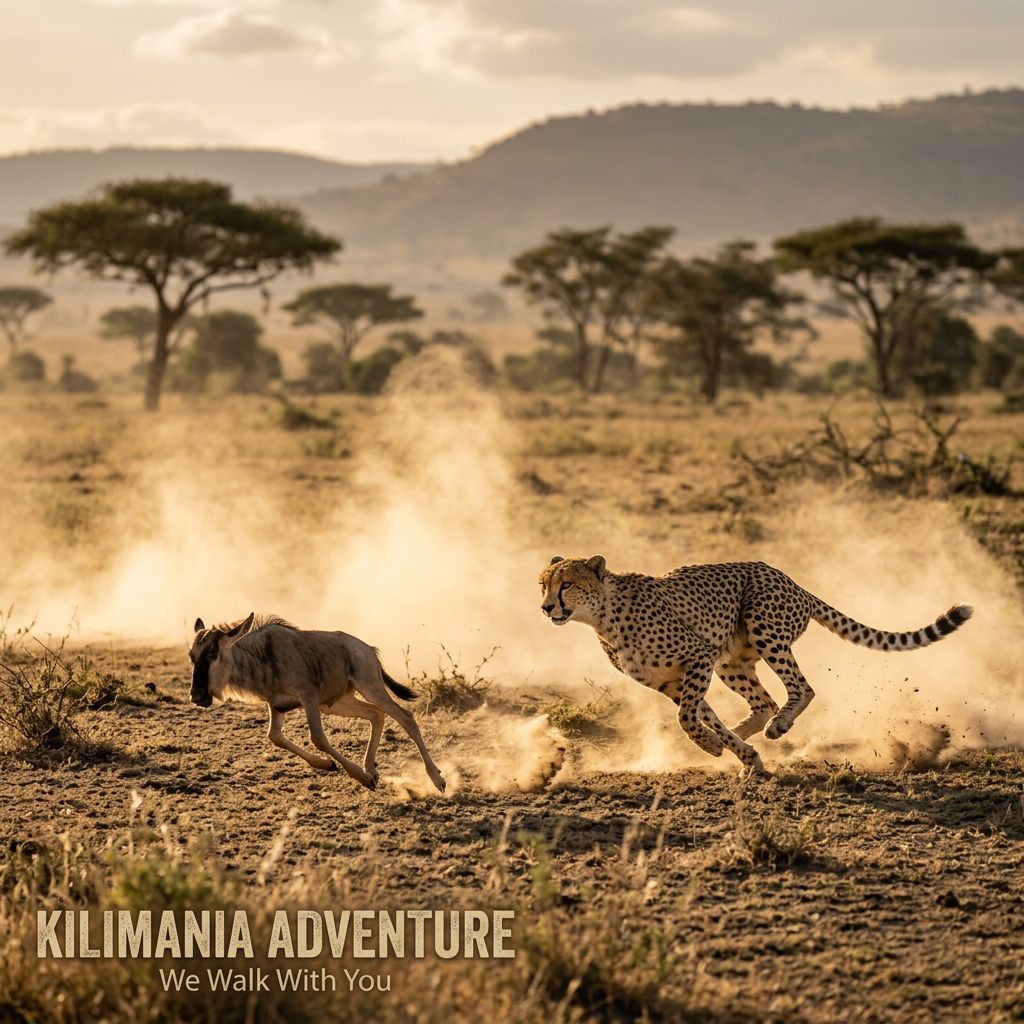
A cheetah pursuit in Ndutu typically lasts 60–90 seconds from the start of the sprint to the kill or escape. Do not attempt to recompose during the chase. Keep the entire cheetah within the frame, shoot at maximum frame rate, and crop in post. One critical technique that improves keeper rates dramatically: trap-focus on the space 10 metres ahead of the running cheetah rather than tracking the animal itself. When the cheetah moves perpendicular to your vehicle position, the subject enters your pre-set focus point rather than requiring you to track at speed.
A noisy sharp birth sequence image carries more documentary value than a clean blurred frame. Modern full-frame sensors handle ISO 3200 cleanly. Push ISO to maintain shutter speed.
Wildebeest Calving Photography — Reading Behaviour Before the Shot
Successful photography of births is almost entirely about reading behavioural signals before the delivery begins, not reacting after. A photographer who positions correctly 20 minutes before birth has time to compose, check settings, and wait. A photographer who reacts to the birth is always late, Ndutu Wildlife Photography Safari Calving Season
Birth sequence signals (15–30 minutes before delivery):
A pregnant cow separates from the main herd and begins pacing in small, irregular circles. She will lie down repeatedly and rise again within 30–60 seconds. Visible contractions are apparent from a vehicle at 50 metres — the cow’s flanks visibly pulse on a 30–60 second cycle. At this stage, position your vehicle.
Vehicle positioning for birth photography: Ndutu Wildlife Photography Safari Calving Season
Place the vehicle at a 45-degree angle to the cow at 50–70 metres distance, with the rising sun behind you (front-lighting). This angle provides a clear sightline to the birth sequence while keeping the vehicle’s engine noise and scent less disruptive than a direct approach. Do not approach closer than 40 metres while active labour is in progress — a vehicle at 30 metres or closer can cause the cow to abort the labour sequence, rejoin the herd, and attempt delivery later in less safe conditions.
The delivery window:
From amniotic sac emergence to the calf reaching the ground: 4–7 minutes. This is your critical sequence. Switch to continuous burst mode. Focus on the eye of the emerging calf.
The golden window — first 7 minutes of life: Ndutu Wildlife Photography Safari Calving Season
A newborn wildebeest stands within 3–7 minutes of birth. The coat glistens with birth fluid. The umbilical cord is still visible. The mother licks vigorously. A calf’s first three attempts to stand — wobbling, collapsing, trying again — tell the calving story more powerfully than any single frame. Shoot continuous sequences, not individual frames.
Predator arrival: Ndutu Wildlife Photography Safari Calving Season
Hyena clans patrol calving zones systematically. When wildebeest suddenly stampede in a coordinated direction — different from the scattered movement of general grazing — scan the opposite horizon. Cheetahs use the chaos of calving as hunting cover.
For predator timing and location context, read our Best Time to See Big Cats in Tanzania, Ndutu Wildlife Photography Safari Calving Season
Golden Hour and Blue Hour — Three Shooting Windows in Ndutu
Most photographers plan for two golden hour windows. Ndutu offers three. Missing the third is the most common omission among photographers on standard game drive schedules, Ndutu Wildlife Photography Safari Calving Season
Morning golden hour — the primary window:
January: Productive shooting runs from 6:15 AM to 7:15 AM. The sun rises at approximately 6:35, and the first 40 minutes of light produce warm orange tones that render wildebeest coats in rich amber. By 7:30 AM, the light becomes cleaner and more directional — shift from environmental shots to backlit dust sequences as running herds catch the side-light.
February: The productive window narrows slightly to 6:20–7:10 AM as atmospheric dust increases in the drier conditions of mid-season. This dust creates haze but also adds atmosphere to wide shots.
Position your vehicle east of your subject during this window for front-lighting. For backlit dust shots, position west of the moving herd and shoot into the light with exposure compensation set to +1.0 to +1.5.
Evening golden hour:
January: 5:30–6:15 PM delivers warm light for predator portraits. Lions on termite mounds near Lake Masek catch this light directly. The Ngorongoro Conservation Area boundary behind creates a distinctive skyline.
February: 5:45–6:30 PM. The slightly elevated humidity in late-season creates atmospheric haze that softens evening light — excellent for silhouettes but requires more aggressive exposure compensation than January evenings.
Blue hour — the overlooked window:
Between 7:00 PM and 7:15 PM, the sky above the Ngorongoro Conservation Area boundary turns deep cobalt. This saturation intensifies due to fine volcanic dust kicked up by thousands of hooves during the day—an atmospheric condition unique to the calving season on the Ndutu short-grass plains. Wildebeest herds settling for the night create distinctive horizon lines across this backdrop. The 15-minute window requires ISO 3200–6400 and a monopod braced against the vehicle roof. The resulting images convey the scale of the migration more powerfully than any midday frame—thousands of animals silhouetted against a dust-saturated cobalt sky reads as “vast wilderness” in a way that a daylight telephoto shot cannot.
Most mobile camps serve dinner at 7:00–7:30 PM. Photographers who want the blue hour window should discuss this with their guide and camp management before the first evening.
For a structured photography route focused on predator action, see
https://kilimania.co.tz/4-day-big-cats-safari-in-tanzania/
Ethical Wildlife Photography Distance Guidelines (FIXED)
25 metres from predators and 40–70 metres from calving wildebeest to avoid disturbance.
This aligns with practical field standards used by guides in Tanzania National Parks and helps maintain natural animal behavior without stress or disruption.
Species-specific distances:
| Both species are unpredictably reactive to a close vehicle approach | Minimum distance | Why it matters photographically |
|---|---|---|
| Big cats (general) | 25 metres | Relaxed predators display natural behaviour — grooming, interaction, play |
| Cheetah actively hunting | 25 metres — vehicle stationary once hunt commences | Movement toward a hunting cheetah causes it to abandon the stalk |
| Calving females in active labour | 20 metres | Closer approach causes cow to rejoin herd and delay delivery |
| Newborns in first 30 minutes | 40 metres | Mother may abandon calf if stressed by vehicle proximity |
| Lions with cubs | 30 metres | Lionesses with young display heightened defensive behaviour |
| Elephants and buffalo | 30 metres | Both species are unpredictably reactive to close vehicle approach |
| Rhino (NCA only) | 100 metres | Both species are unpredictably reactive to a close vehicle approach |
The ethical distance principle applies directly to image quality: an undisturbed animal at 30 metres in natural behaviour produces a more publishable image than a stressed animal at 15 metres turning away from the camera. Ethical distance is not a sacrifice of photographic opportunity — it is the condition that makes good wildlife photography possible.
TANAPA and NCAA regulations also prohibit flash photography for all wildlife in Tanzania’s national parks and conservation areas. On-camera flash, off-camera flash, and any artificial illumination directed at animals are prohibited. Violation results in immediate removal from the protected area. Drones are banned park-wide. Fines for drone use reach $500 USD, Ndutu Wildlife Photography Safari Calving Season
For official regulations, consult TANAPA — Tanzania National Parks Authority directly before your departure.
Guide Insight — Kilimania Adventure, Ndutu calving season team When a cow begins the circling behaviour, we position the vehicle immediately and cut the engine. We watch wind direction first — downwind positioning keeps our scent away from the cow and the predators that are watching the same animal we are. We have seen a lioness 80 metres away, flat in the grass, watching the same labouring cow. The guide who reads both the cow and the predator at the same time gets the sequence that includes the birth and the arrival. That is what 15 seasons of calving season work teaches you.
Best Lenses for Safari Photography in Tanzania — Ndutu Specific
Ndutu’s open terrain and legal off-road access change the optimal lens choice compared to standard Serengeti game drives. Proximity to calving and predator activity means you are often closer to subjects than in vehicle-road-bound parks — making mid-range zooms genuinely useful rather than merely convenient.
| Often overlooked, essential when wildebeest are within 10 metres | Focal range | Best for | Notes |
|---|---|---|---|
| 100–400mm or 150–600mm zoom | Primary Ndutu range | Calving action, predator portraits, herd movement | Most versatile single lens choice; covers 90% of Ndutu situations |
| 70–200mm f/2.8 | Close encounters, low light | Birth sequences in pre-dawn light, environmental portraits | The f/2.8 aperture handles 6:00–6:30 AM darkness better than any zoom |
| 500mm or 600mm prime | Distant predator isolation | Cheetah at maximum separation from vehicle | Heavy; professional rental in Arusha recommended over travel purchase |
| 24–70mm wide | Migration scale, landscape | Blue hour horizon shots, herds surrounding the vehicle | Often overlooked; essential when wildebeest are within 10 metres |
The dual-body strategy:
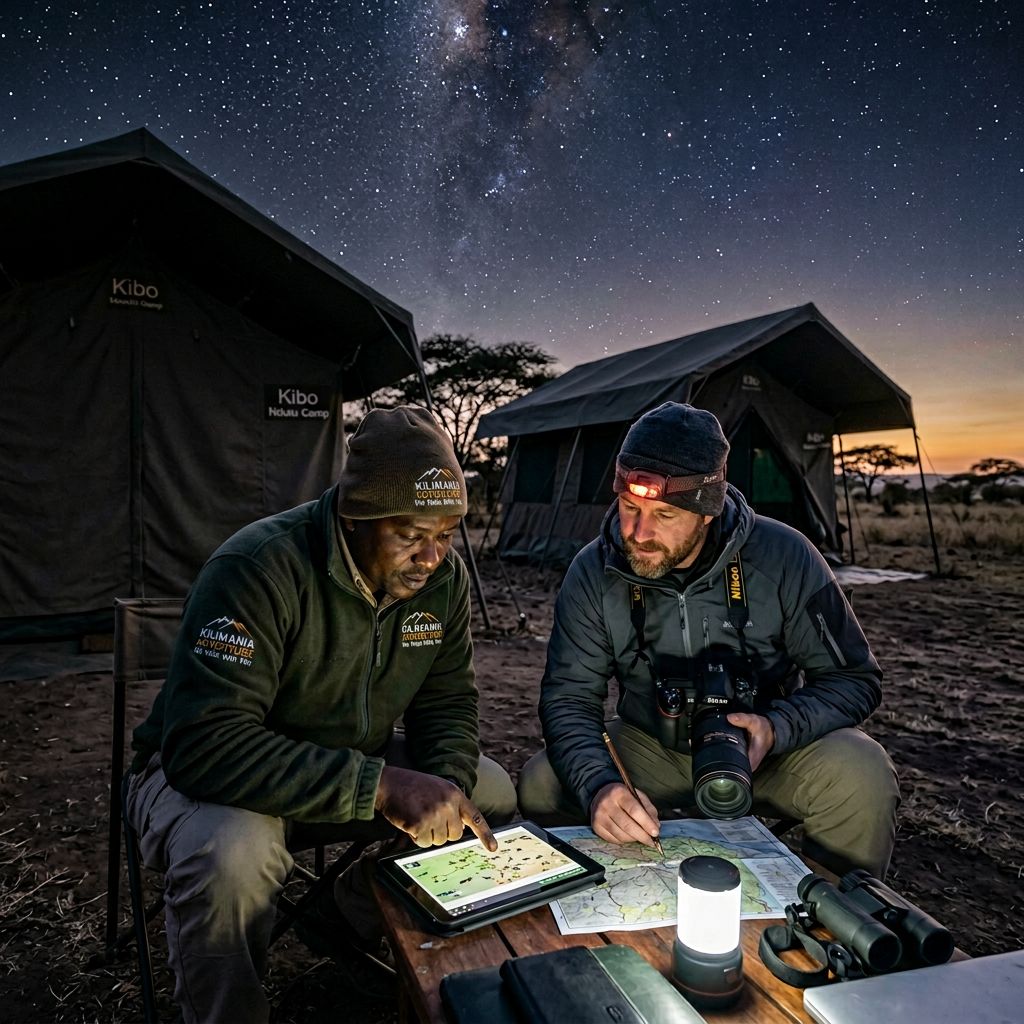
Changing lenses in Ndutu exposes sensors to fine volcanic dust that penetrates camera seals. Professional photographers in Ndutu run two bodies: one carrying the long zoom (100–400mm or 150–600mm) for distant action, and one carrying the 70–200mm or 24–70mm for close encounters and landscape-scale images. This setup eliminates field lens changes and reduces sensor contamination risk.
APS-C crop factor note: Photographers using APS-C sensor cameras (Canon Rebel series, Sony a6000 series, Nikon DX bodies) gain an effective 1.5–1.6x reach multiplier. A 100–400mm on APS-C delivers approximately 600mm equivalent reach — sufficient for most Ndutu situations without requiring a heavier prime.
Arusha equipment rental pricing:
Camera rental providers in Arusha typically stock Canon and Sony telephoto lenses during peak safari season:
- Sony 200–600mm: $45–60 USD per day
- Canon 100–500mm: $55–70 USD per day
- 70–200mm f/2.8 (Canon or Sony): $40–55 USD per day
For February travel during calving season, reserve gear 60–90 days in advance. Availability becomes tight, as the same photography groups securing mobile camps early also book rental equipment well ahead of time.
leaning more about Tanzania Safari Cost 2026: Full Price Breakdown, Hidden Fees
Photographing Cheetah Hunts — Technical Preparation
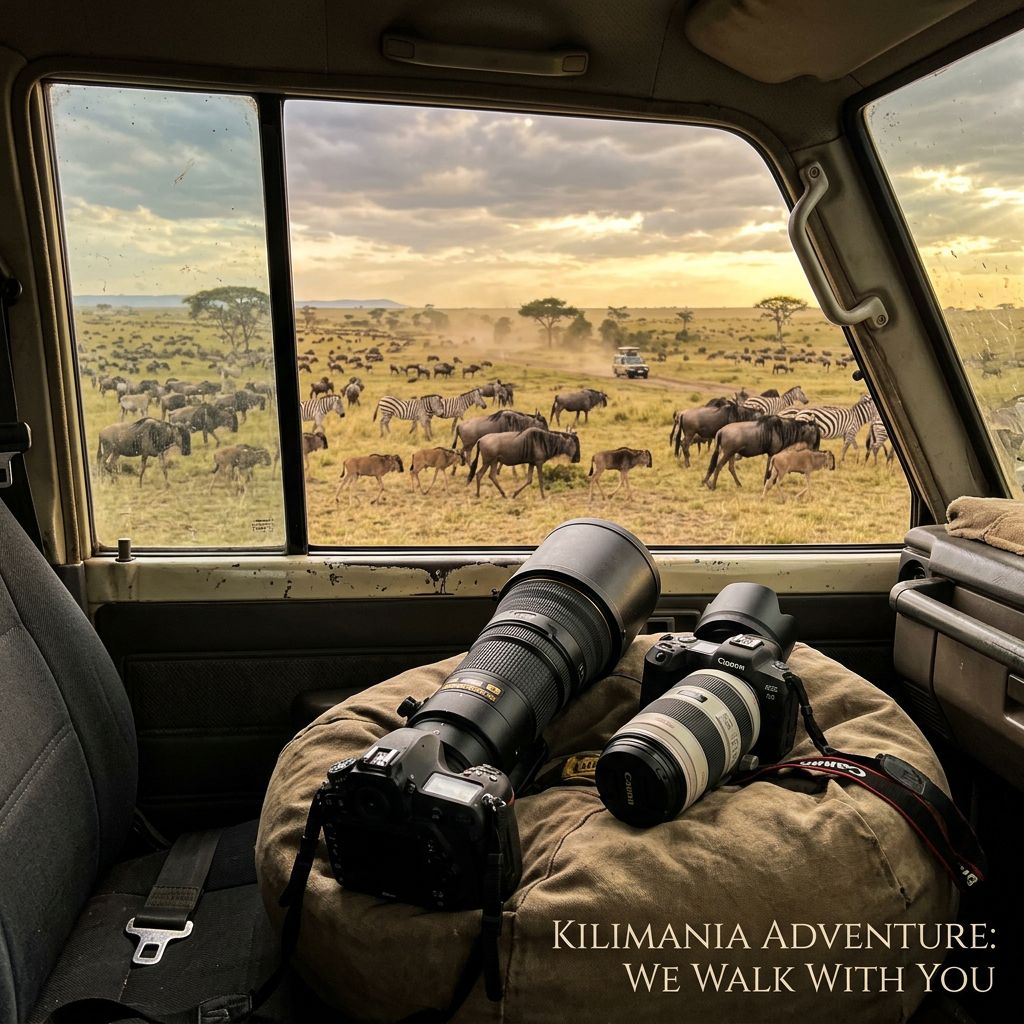
Ndutu during calving season is arguably the most consistently productive location for cheetah hunt photography in East Africa. The combination of short-grass terrain (15–30cm), abundant naive prey, and legal off-road positioning creates conditions unavailable elsewhere on the northern circuit.
Pre-hunt behaviour signals:
A cheetah preparing to hunt shows four visible signals, typically in sequence: ears locked forward with body lowered to ground level, shoulder blades visibly prominent above the spine, tail twitching rapidly at the tip, and a fixed stare at a specific prey animal 50–100 metres distant. When these indicators appear simultaneously, check your settings immediately.
Camera configuration for a pursuit:
- Shutter speed: 1/2500s minimum; 1/3200s preferred
- Enable continuous autofocus with animal eye-detection (if available on your camera)
- Switch to maximum continuous drive mode; your buffer allows
- Trap-focus technique: pre-focus on the space 10 metres ahead of the cheetah’s path, not on the animal itself — this produces higher keeper rates when the subject moves perpendicular to your position
The chase sequence lasts 60–90 seconds. Do not compose during the sprint — keep the entire cheetah and prey within the frame, shoot at maximum frame rate, and crop in post. The decisive moment of contact lasts less than half a second.
Critical regulation: TANAPA regulations prohibit vehicles from repositioning once a hunt has commenced. Your vehicle must remain stationary until the kill is complete and the cheetah has begun feeding. Violation disrupts the hunt, potentially causing the cheetah to lose the kill, and results in removal from the conservation area.
The afternoon session (16:00–18:00) produces a secondary cheetah activity window. After the midday rest, cheetahs often move to elevated termite mounds to scan for afternoon prey. Evening golden hour light catching a cheetah on a mound — profile against the orange horizon — is one of the most sought-after frames in Ndutu Wildlife Photography Safari Calving Season.
For location context on where cheetahs concentrate during calving season, our 4-Day Big Cats Safari in Tanzania describes the specific sub-zones.
Ndutu vs Central Serengeti — Photography Comparison
| Factor | Ndutu (Calving Season Jan–Mar) | Central Serengeti (Jan–Mar) |
|---|---|---|
| Wildlife density | Very high — all species converging | High — residents, but herds absent |
| Off-road access | Legal in NCAA zones | Prohibited — vehicle-road only |
| Grass height | 15–30cm — full-speed chases visible | 60–100cm — obscures action |
| Predator predictability | High — prey concentrated, predators follow | Lower — large territory, dispersed |
| Photography style | Action, close range, behaviour sequences | Scenic, landscape, migration scale |
| Drive time to calving zone | 0–30 minutes from mobile camp | Drive time to the calving zone |
Photography Workshop vs Standard Safari — The Value Calculation
A dedicated photography workshop in Ndutu runs 6–7 days with a maximum of 3–4 guests per vehicle. The guide holds professional photography credentials and understands light direction, background selection, and subject positioning — not just wildlife identification.
Cost comparison:
- Photography workshop rate: $650–900 USD per person per day
- Standard calving season safari: $350–550 USD per person per day
The workshop premium is $300–350 per person per day, approximately 15–20% additional cost over the standard safari rate.
The value calculation:
A photographer traveling to Ndutu typically invests $5,000–15,000 USD in camera equipment and $3,000–8,000 USD in flights and travel. The workshop premium across a 7-day trip adds approximately $2,100–2,450 per person. Distributed across thousands of frames with positioning optimised for light angle, vehicle window guarantee, and extended time at sightings, this premium represents a 200–300% improvement in image quality at 15–20% additional cost.
Explore our photography-focused itinerary: 4 Days Tanzania Safari with Ndutu Calving Season.
Complete Ndutu Safari Photography Gear Checklist
Camera bodies:
- Primary body with fast continuous autofocus and ISO 3200 clean performance
- Backup body — dust-related failure is the most common equipment issue on the Ndutu plains
Lenses:
- Long zoom reaching 400mm minimum (100–400mm, 150–600mm, or 200–600mm)
- Mid-range zoom 70–200mm f/2.8 for low light and close encounters
- Optional: 1.4x teleconverter (adds reach, loses one stop of light)
Memory and power:
- 64GB cards minimum, 8+ cards total — shooting RAW at 20 fps fills cards rapidly
- 4+ camera batteries — cold Ndutu pre-dawn mornings drain batteries 30% faster than ambient temperatures
- Vehicle charger (12V cigarette lighter adapter) for in-field charging between drives
- 20,000mAh power bank for camp charging when solar power is limited
- Universal Type G adapter (Tanzania runs 230V)
Dust and rain protection:
- Rain cover for each camera body — used as a dust shield even on clear days
- Circular polariser for cutting glare on Lake Ndutu salt crust
- Shower cap for lenses between sightings when not actively shooting
- Sensor cleaning kit: rocket blower and sensor swabs — clean sensor every evening, not when you notice dust spots
- Minimum 8 lens wipes per day — front elements accumulate volcanic dust constantly
- Ziploc bags for memory card changes in dusty conditions
Support and reference:
- Beanbag for vehicle roof hatch — more stable than a tripod, allows rapid direction change
- Monopod for blue hour and low-light work requiring extra stabilisation
- Headlamp with red light mode for pre-dawn camp navigation and settings checks
- Binoculars (8×42) for locating cheetahs on termite mounds before positioning the vehicle
FAQ: Ndutu Wildlife Photography Safari Calving Season
When is the exact peak window for calving photography in Ndutu in 2026?
Peak calving concentration falls between January 25 and February 10, 2026. This is when daily births reach 6,000–8,000 and predator density is at its annual maximum. The morning sweet spot within this window is 6:15–7:00 AM, when golden hour light, birth activity, and predator movement all overlap simultaneously. January and early March are productive but with lower intensity than this peak window.
Do I need a 600mm lens for Ndutu photography?
No — helpful but not essential. The 100–400mm and 150–600mm zoom ranges cover 90% of Ndutu situations. Because off-road driving is legally permitted in NCAA Ndutu zones, vehicles can approach wildlife more closely than in road-bound parks. The regulated 25-metre minimum from predators makes 400–500mm sufficient for frame-filling portraits. On an APS-C sensor camera, 100–400mm delivers approximately 600mm equivalent reach. A 600mm prime is valuable for distant predator isolation but adds significant weight to multi-day safari drives.
Can I rent camera equipment in Arusha?
Yes. Arusha has two reputable camera rental operations with Canon and Sony systems. During peak calving season, rental availability is limited — book 60–90 days in advance for February dates. Recommended strategy: bring your primary body and rent a backup body or specialty telephoto locally. Sony 200–600mm rents for approximately $45–60 USD per day; Canon 100–500mm for $55–70 USD per day.
Is flash photography permitted during calving season in Ndutu?
No. Flash photography is prohibited for all wildlife throughout Tanzania’s national parks and the Ngorongoro Conservation Area — including on-camera flash, off-camera flash, and any artificial illumination directed at animals. Violation results in immediate removal from the protected area. Shoot at higher ISO and wider aperture for low-light birth sequences rather than using flash.
Are drones permitted for calving season photography in Ndutu?
No. Drones are banned park-wide across Tanzania’s national parks and the NCAA. Fines for drone use reach $500 USD. Use ground-level telephoto lenses and vehicle roof hatch positioning for coverage of calving plains.
What focusing mode works best for a running cheetah?
Q: Use continuous autofocus (AI Servo on Canon, AF-C on Nikon and Sony) for all active subjects. For a cheetah in full pursuit, try the trap-focusing technique: pre-focus on the space 10 metres ahead of the running cheetah rather than tracking the animal itself. This raises keeper rates when the subject moves perpendicular to your vehicle. Animal eye-detection autofocus performs well on stationary subjects but can struggle with galloping wildebeest in dusty conditions — switch to standard zone AF for high-speed pursuit sequences.
What should I bring to protect gear from Ndutu dust?
Never change lenses in the field with vehicle windows open. Use a rain cover as a dust shield at all times between sightings, not only during rain. Clean your sensor every evening using a rocket blower — do not wait until you notice dust spots in images. Bring three times more lens wipes than you estimate needing. Store memory cards in sealed Ziploc bags when not in the camera.
Conclusion
The key practical insight from this guide is simple: in Ndutu during calving season, shutter speed discipline, behaviour reading, and ethical distance work together. A photographer who understands birth sequence signals positions before the delivery begins. A photographer who respects the 25-metre minimum from big cats photographs natural behaviour rather than stress responses. A photographer who is on the plains by 6:15 AM catches the overlap of golden hour light and peak predator activity that makes Ndutu’s calving season irreplaceable.
If you are deciding between a standard calving season safari and a dedicated photography workshop, consider the per-image cost. The workshop premium distributes across thousands of frames, each one better positioned for light and subject distance than a standard game drive vehicle allows.
Our 4-Day Big Cats Safari in Tanzania places photographers in the NCAA Ndutu zones where off-road access applies, with guides who understand light direction and predator behaviour — not just wildlife identification. We Walk With You.
Planning a photography-focused safari in Ndutu for 2026? Tell us your travel window, camera system, and whether you want standard calving season positioning or a dedicated workshop structure. Our Moshi team will outline the right route, camp, and guide combination — including current Arusha equipment rental availability for your dates.
Contact: kilimania.co.tz/contact
For official park regulations: TANAPA | NCAA
Written by Kilimania Adventure Editorial Team
Reviewed by a Tanzania-licensed safari guide based in Moshi, Sabinus S. Msimba
Kilimania Adventure — We Walk With You. Moshi, Tanzania | kilimania.co.tz