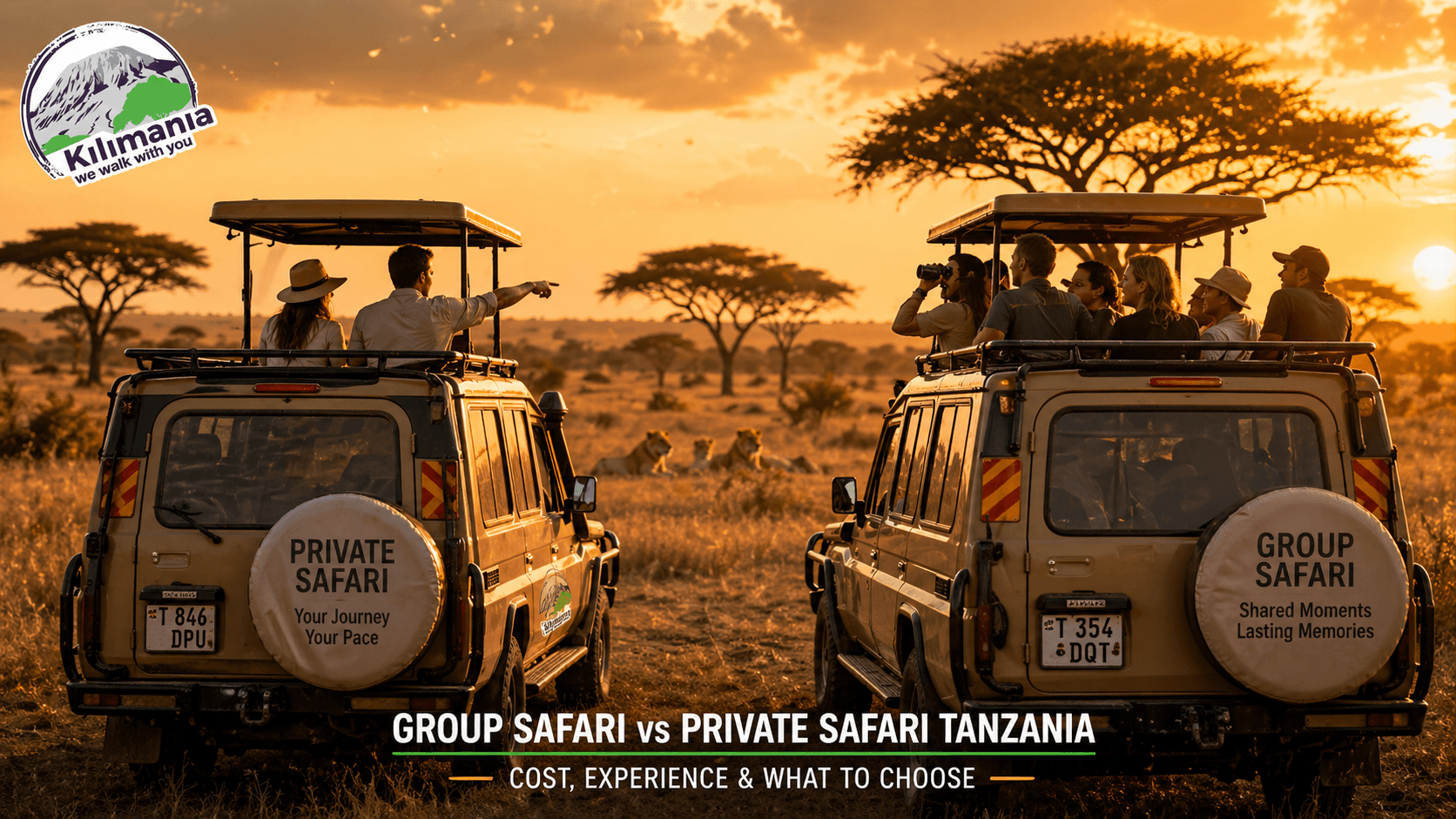
A group safari splits a $200–$300 daily vehicle cost across 4–6 strangers, saving you money but sharing every decision; a private safari puts that same vehicle entirely under your control for $125–$800 more per day — buying you time, silence, and the freedom to stay with a lion for two hours instead of twenty minutes.
Biggest Mistake Travelers Make: Group Safari vs Private Safari Tanzania
The most expensive mistake is not about money — it’s about misreading your travel personality. Solo travelers who crave solitude book group safaris and spend six days frustrated by small talk. Couples on honeymoon who worry about budget book group departures and realize by day two that sharing sunrise with strangers dims the romance. Conversely, budget-conscious solo travelers who book private safaris often feel the financial pain acutely without enjoying the flexibility they paid for. Match the option to who you actually are, not who you wish you were on safari.
When the Price Difference Disappears
For 4–6 travelers, private and group safaris cost nearly the same per person. A family of five or six friends pays approximately $42–$50 per person per day for a private vehicle versus $33–$50 per person per day for a group joining safari — a difference of roughly $9 per day, or $63 across a full week. That $63 buys complete control over departure times, sighting durations, and vehicle positioning. For groups of 6, the private option is effectively the same price as sharing with strangers. Never join a group departure if you are traveling with 4–6 people who already know each other.
Private Safari ROI: Return on Experience
The $125–$800 daily premium for a private safari buys something measurable: time at sightings. A group vehicle averages 10–20 minutes per predator sighting before consensus demands movement. A private vehicle stays 60–120 minutes. Over a 7-day safari with 8–10 major sightings, the private option delivers roughly 8–12 additional hours of observation time — the equivalent of adding 1–2 full game drives to your itinerary at no extra daily cost.
For photographers, that additional time at each sighting produces portfolio images no lens can replicate. For families, the ROI is measured in meltdowns avoided when a child can take a bathroom break without negotiating with four strangers.
A Tanzania safari costs $250–$400 per person per day in a group vehicle and $375–$1,200 per person per day in a private vehicle. The $125–$800 daily difference buys one thing: control over every minute of your game drive. Whether that control matters depends on who you are traveling with, what you want from wildlife sightings, and how you handle sharing a vehicle with strangers for 40–60 hours across the northern circuit. There is a third option most travelers miss — lodge game packages that split the difference between group pricing and private flexibility.
Group vs Private Safari Tanzania A group safari in Tanzania places you in a shared 6-seat Land Cruiser with other travelers at $250–$400 per person per day. A private safari gives you exclusive use of the vehicle and guide at $375–$1,200 per person per day.
The private vs group safari Tanzania cost gap runs 50–60% higher per person, but for photographers needing 40 minutes with a single lion, honeymooners wanting complete privacy, and families with young children needing flexible pacing, the additional expense directly improves wildlife encounter quality in Serengeti National Park and Ngorongoro Crater.
Which Is Better: a group or a private safari in Tanzania?
If you are deciding between a group safari and a private safari in Tanzania, the better option depends on your travel style, not just your budget. A group safari is best for solo travelers and budget-focused visitors who are comfortable sharing a vehicle and schedule. A private safari is better for couples, families, and photographers who need flexibility, privacy, and extended time at wildlife sightings.
For most travelers, the decision comes down to one question: Do you value saving money, or controlling your experience?
What This Looks Like in Real Pricing (November 2026):
A 6-day private safari for 2 travelers covering Tarangire, Ngorongoro, and Central Serengeti with mid-range lodges: $2,340 per person. The same route as a group joining safari (4–6 travelers): $1,580 per person. Both include all park fees, crater descent, and meals. The $760 difference buys exclusive vehicle use for 6 full days — approximately $127 per day per person.
Key Takeaway — The $760 difference for a couple equals $127 per day. That daily rate buys: unlimited time at sightings, no seat rotation, your choice of departure time, and complete privacy. For many travelers, that is the best value on the entire safari invoice.
Table of Contents
Introduction
If you are comparing a group vs private safari Tanzania experience, the difference comes down to cost, control, and how you want to experience wildlife in places like Serengeti National Park and Ngorongoro Crater.
From our base in Moshi near Arusha, we operate both group and private safaris across Tanzania’s northern circuit, including Tarangire National Park and Lake Manyara.
This guide breaks down the real 2026 costs, experience differences, and when a private safari actually costs nearly the same as joining a group.
The group vs private safari Tanzania decision affects your total budget, daily experience, and time spent at wildlife sightings. While both options visit the same parks like Serengeti and Ngorongoro, the difference in flexibility and control changes the entire safari experience. This guide is designed to help you decide between a group safari and a private safari in Tanzania by comparing real costs and experience differences.
For a full breakdown, see our Tanzania safari cost breakdown 2026 guide. For tipping details, read our “How Much to Tip on Tanzania Safari ” guide. To plan timing, see our best time to visit the Serengeti guide.
Safari Starting Points: Arusha vs Moshi vs Zanzibar
Most Tanzania safaris begin from Arusha or Moshi, the two main gateway towns to the northern circuit. Travelers flying into Kilimanjaro International Airport (JRO) typically start their safari within 1–2 hours of arrival.
- Arusha: The most common safari hub, closer to Serengeti and Ngorongoro logistics
- Moshi: Slightly quieter, often preferred by Kilimanjaro climbers, combining trekking and safari
- Zanzibar: Requires a domestic flight to Arusha before starting your safari
If you are comparing group vs private safari Tanzania options, your starting location can affect availability. Group safaris run more frequently from Arusha, while private safaris offer flexible pickup from both Arusha and Moshi, and can be customized for Zanzibar arrivals.
Choosing the right starting point ensures smoother logistics and better alignment with your safari type.
Plan Your Tanzania Safari in Minutes
Get your quote on WhatsApp
Get expert advice based on your budget, travel style, and group size.
We’ll recommend the best option — group or private — with real pricing.
Why You Can Trust This Comparison Tanzania Group Safari vs Private Safari Cost (2026 Breakdown)
This comparison is based on real safari operations, not theory. Kilimania Adventure runs weekly group departures and private safaris across Serengeti, Ngorongoro, Tarangire, and Lake Manyara throughout the year.
Our guides spend over 200 days per year in the field tracking wildlife movement, adjusting routes based on seasonal patterns, and managing both shared and private safari experiences. The cost differences, time at sightings, and vehicle dynamics described in this guide reflect actual on-the-ground conditions — not estimated averages.
This is why the pricing, timing, and experience differences outlined here match what travelers experience in real safaris across Tanzania’s northern circuit. Kilimania Adventure is a registered member of the TATO and operates under regulations set by the TANAPA. Follow all park rules, conservation policies, and licensed guiding standards.
Tanzania Safari Cost Per Person: Group vs Private
The vehicle is the entire cost difference. A safari Land Cruiser with driver-guide and fuel costs $200–$300 per day, regardless of how many passengers sit inside it. Group safaris divide this fixed expense across multiple travelers. Private safaris place the full burden on you.
Here’s what most travelers don’t realize: The vehicle cost is the same $200–$300 whether it carries 2 people or 6. The only variable is how many people split it.
Real cost breakdown per person per day (vehicle only):
| Group Size | Shared Vehicle Cost Per Person Per Day | Private Vehicle Cost Per Person Per Day |
|---|---|---|
| 2 people | $100–$150 | $100–$150 |
| 3 people | $67–$100 | $100–$150 |
| 4 people | $50–$75 | $100–$150 |
| 6 people | $33–$50 | Not applicable (group maximum) |
Full safari cost comparison (7-day northern circuit, mid-range accommodation):
| Safari Type | Cost Per Person (2 Travelers) | Cost Per Person (4 Travelers) | Cost Per Person (6 Travelers) |
|---|---|---|---|
| Group joining safari | $2,800–$3,500 | $2,400–$3,000 | $1,800–$2,500 |
| Private safari | $3,800–$4,800 | $3,200–$4,200 | $2,800–$3,800 |
A couple pays roughly $1,000–$1,300 more per person for a private 7-day safari compared to joining a group. A group of four pays $800–$1,200 more per person. A group of six sees the narrowest gap — $1,000 or less per person — because the vehicle cost already divides efficiently.
The fixed costs that apply equally to both options:
| Fixed Cost Item | Amount (USD) |
|---|---|
| Tanzania visa | $50 (most nationalities) |
| Serengeti National Park entry | $70 per day |
| Ngorongoro Conservation Area | $82 per day |
| Ngorongoro Crater descent fee | $295 per vehicle |
| Tarangire National Park | $53 per day |
| Lake Manyara National Park | $53 per day |
| Tips (guide, cook, camp staff) | $35–$40 per day ($245–$280 for 7 days) |
Park fees in Serengeti and Ngorongoro remain identical whether you sleep in a dome tent or a luxury suite and whether you share a vehicle or travel privately. This is why the group safari Tanzania price per day can reach $400 during peak season — fixed costs create a high floor that no operator can go below. The $700–$950 fixed-cost layer applies to every safari regardless of group or private status.
For the most popular budget-friendly group departures from Moshi and Arusha, see our Tanzania budget safari itinerary with published dates throughout 2026.
Group vs Private Safari Tanzania
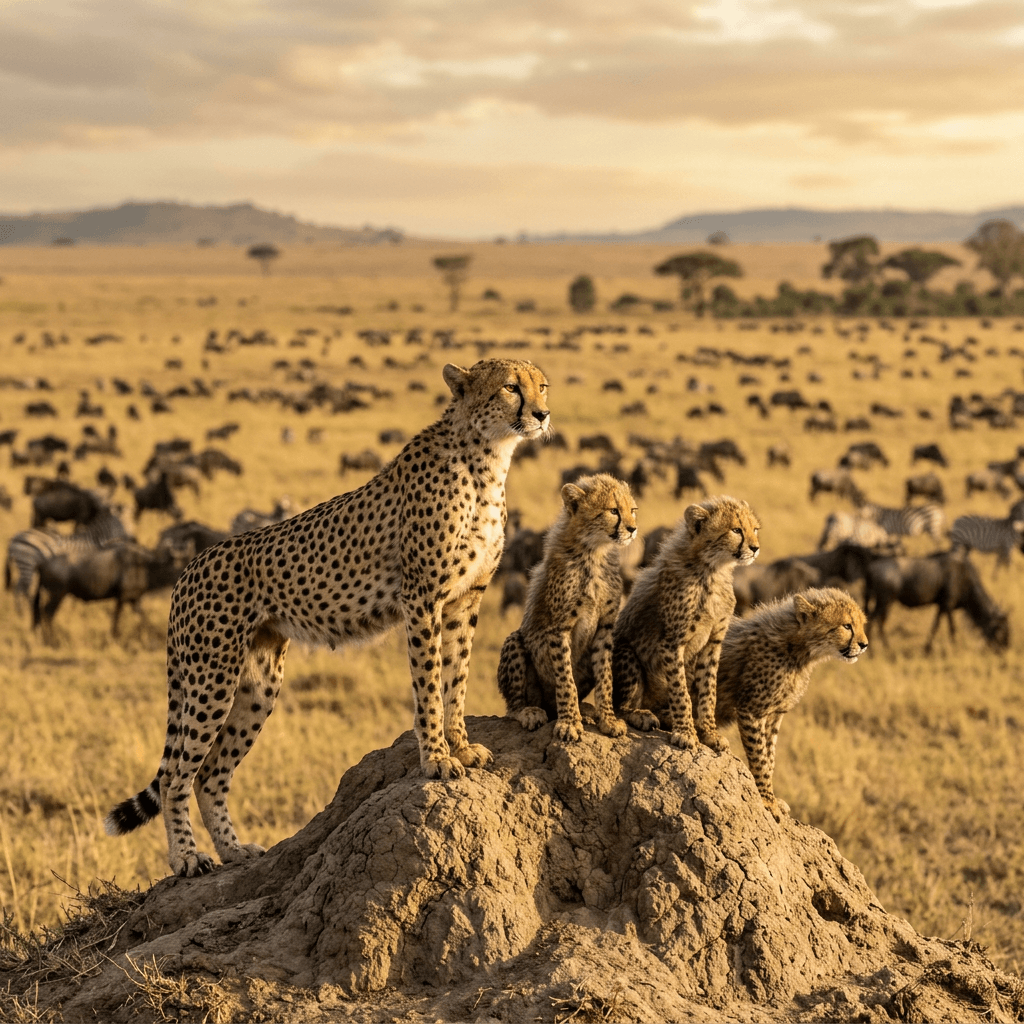
A group safari in Tanzania costs $250–$400 per person per day, while a private safari costs $375–$1,200 per person per day. The price difference comes from sharing or owning the safari vehicle. Group safaris reduce cost by splitting expenses among 4–6 travelers, while private safaris give full control over time, route, and wildlife viewing.
The 6-Person Sweet Spot: When Private Costs the Same as Group
There is a pricing scenario most travelers never discover until it is too late: at 6 passengers, a private vehicle costs nearly the same per person as joining a group departure.
The math:
| Group Size | Private Vehicle Cost Per Person Per Day | Group Joining Cost Per Person Per Day | Difference |
|---|---|---|---|
| 2 people | $125–$150 | $100–$150 | $25–$0 per day |
| 4 people | $62–$75 | $50–$75 | $12–$0 per day |
| 6 people | $42–$50 | $33–$50 | $9–$0 per day |
For 6 travelers, the per-person vehicle cost of a private safari is approximately $42–$50 per day. A group joining a safari divides the cost of the vehicle among strangers at $33–$50 per day. The difference is roughly $9 per person per day — or $63 across an entire 7-day safari.
For that $63, here is what changes:
- You control every departure time
- You decide how long to stay at every sighting
- You choose which parks to prioritize each day
- You have the guide’s undivided attention
- Zero social negotiation with strangers
- Complete privacy at every moment
This is why small groups of 4–6 friends or family traveling together should rarely join a group departure. The cost saving is negligible, but the experience difference is total. If you are a family of five or six, or a group of couples traveling together, book privately — the mathematics work in your favor.
Why Tanzania Safari Prices Vary So Much
Tanzania safari prices vary based on location, season, and logistics. Parks like Serengeti National Park are remote, requiring long drives or domestic flights, while areas like Ngorongoro Crater include additional conservation fees and a $295 crater descent fee per vehicle.
Group safaris reduce costs by sharing the vehicle, fuel, and guide across 4–6 travelers, while private safaris increase costs by offering exclusive use of the vehicle and full flexibility. Seasonal demand also affects pricing, with peak season (June–October) increasing lodge rates by 20–40%, while low season (March–May) can reduce accommodation costs by up to 50% without changing park fees.
For travelers who want this exact configuration, our 4-Day Big Cats Safari in Tanzania operates as a private tour and becomes extremely cost-effective for groups of 4–6.
Plan Your Tanzania Safari in Minutes
Get your quote on WhatsApp
Get expert advice based on your budget, travel style, and group size.
We’ll recommend the best option — group or private — with real pricing.
Experience Difference: Group vs Private Safari Tanzania
The cost difference is objective mathematics. The experience difference is personal and compounds across every hour of your safari.
Shared vehicle reality:
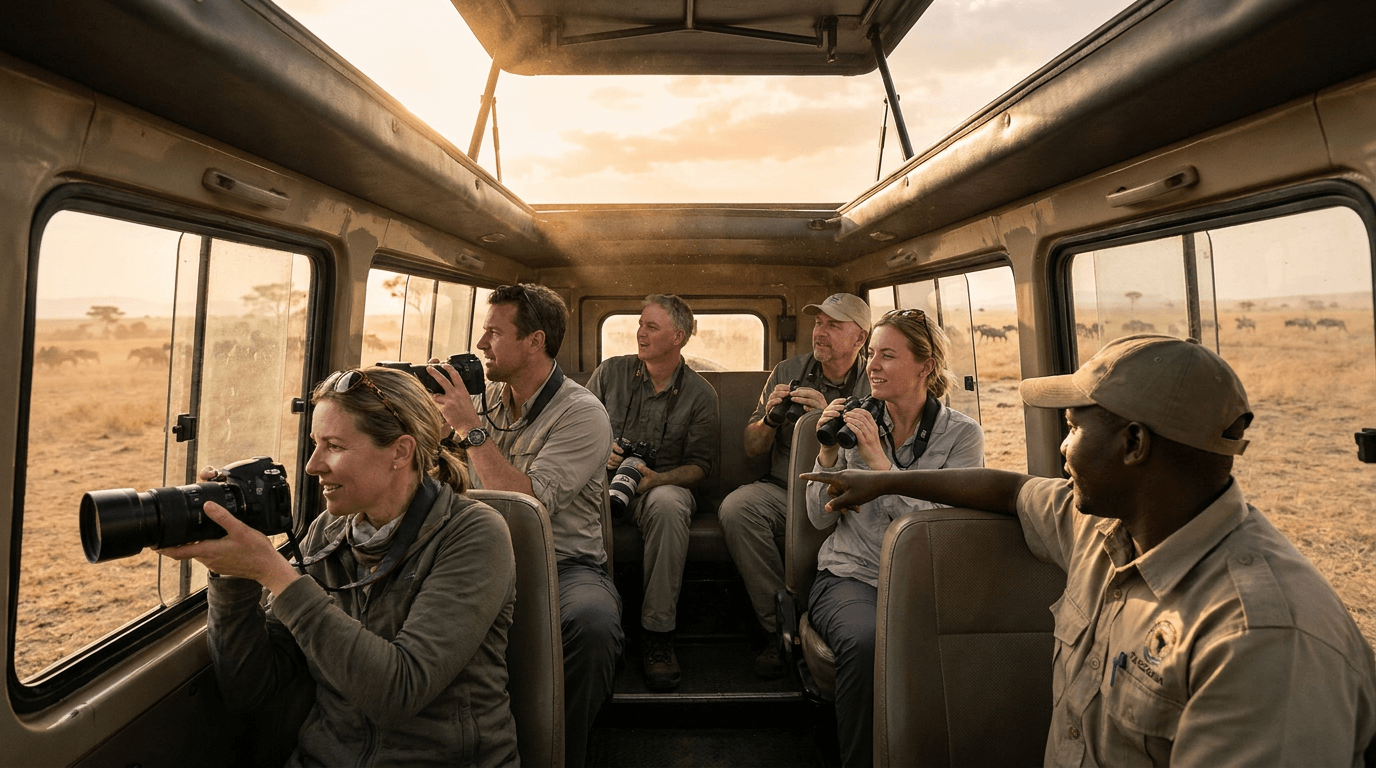
You sit with up to five other travelers, you may not know. The vehicle departs at the agreed time — usually 6:30 AM if the group consensus holds. Stops at sightings are governed by the majority interest. If three passengers want lunch at 12:30 and you are watching a cheetah reposition for a hunt, you move on. On a 7-day safari from Moshi or Arusha covering Tarangire, Lake Manyara, Ngorongoro, and Serengeti, you spend 40–60 hours inside this vehicle. The social dynamic shapes every game drive.
Private vehicle reality:
You set the departure time. If you want to leave camp at 5:45 AM to catch the first light on Simba Kopjes, your guide starts the engine. If you find a lioness stalking a warthog near Moru Kopjes and want to wait 90 minutes to see if she hunts, nobody asks to move on. The vehicle becomes your personal mobile observation platform. Your guide focuses entirely on your interests — if you mention wanting to see serval or caracal, they tailor the route to drainage lines and kopjes where those cats appear.
What changes at the sighting level:
| Aspect | Group Safari | Private Safari |
|---|---|---|
| Time at a lion sighting | 10–20 minutes (group consensus) | 30–120 minutes (your decision) |
| Departure time | Fixed (usually 6:30 AM) | Your choice (5:45 AM possible) |
| Route adjustments | Pre-set itinerary | Daily flexibility based on wildlife movement |
| Silence at sightings | Variable | Guaranteed when needed |
| Window seat access | Rotated among 6 passengers | Always available |
In Central Serengeti, this difference becomes clear quickly. A leopard sighting might last 10 minutes in a group vehicle. Private travelers often stay 45–60 minutes waiting for the cat to descend, stretch, or hunt. The same applies in Ngorongoro Crater, where a private guide can adjust routes based on radio reports of black-maned males moving between Lerai Forest and Ngoitokitok.
For travelers focused on predator behavior, pairing a private vehicle with the right season matters. Read our best time to see big cats in Tanzania guide to align your private safari with peak lion, cheetah, and leopard activity periods.
Why Photographers Almost Always Choose Private
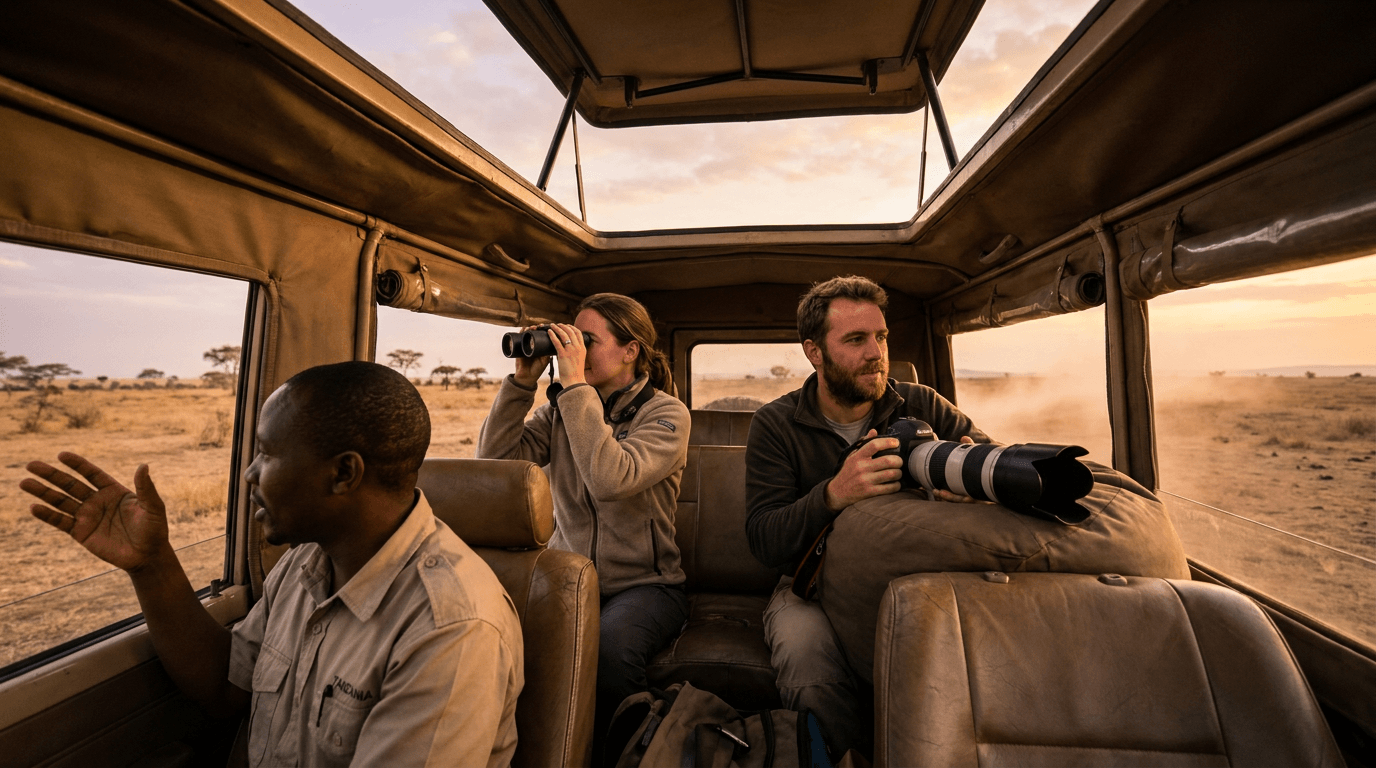
The private safari vs group tour for photography debate is settled by one practical reality. You cannot ask five strangers to wait 40 minutes while you adjust settings for a lilac-breasted roller on a twig with the perfect backlight. You cannot request total silence when a lion is vocalizing, and you are recording audio. You cannot reposition the vehicle three times to change your angle on a hunting cheetah without consensus from people who may not care about the shot.
What a private vehicle gives photographers:
Unlimited time at sightings.
Stay with a leopard for two hours waiting for it to descend from the acacia. Stay with a lion pride from sunrise until the cubs wake and nurse. The group vehicle left 90 minutes ago.
Exact vehicle positioning.
Backlit breath on a cold morning requires the vehicle to be east of the animal at dawn. Side-lit hunt sequences require specific angles relative to the sun at different times of day. Your private guide positions the vehicle exactly where you need it. No negotiation.
Silence on demand.
Predator vocalizations, alarm calls, and the sound of hooves on dry earth are part of the photographic sequence. A private vehicle guarantees the quiet you need.
No seat rotation.
Your camera stays mounted. Your beanbag stays positioned. You never surrender the window seat to a seatmate.
The Photographer’s Calculation:
A private vehicle costs approximately $125 extra per person per day compared to a group safari. If waiting 40 extra minutes at a leopard sighting produces one portfolio image you could not have captured in a group vehicle, that $125 bought something a $10,000 lens cannot: time. For photographers targeting Ndutu’s calving season predators or Serengeti’s kopje-dwelling big cats, the private vehicle is the single most impactful expenditure after renting a quality telephoto lens.
For a photography-focused safari, our Ndutu Wildlife Photography Safari operates as a private tour during the calving season when predator action peaks.
Pros and Cons of Group Safari Tanzania
5 Advantages of a Group Safari:
Lower cost per person.
Dividing vehicle, guide, and fuel costs across 4–6 travelers reduces the daily rate by 30–50% compared to a private safari for two. This is the primary reason travelers choose group departures.
Social experience.
Shared campsites and long game drives build genuine connections. Solo travelers from the USA, UK, Germany, and Australia regularly meet lifelong friends around the campfire after dinner. Many book group safaris specifically for the camaraderie.
Easier logistics for solo travelers.
Joining an existing group departure from Moshi or Arusha is simpler than arranging a private safari alone. Operators publish set departure dates covering Tarangire, Ngorongoro, and Serengeti — you book a seat and show up.
Built-in wildlife spotting.
Six pairs of eyes see more than two. On a group safari near Seronera, passengers in the back row regularly spot leopards in acacia trees and servals in drainage lines that a single couple would miss entirely.
Fixed logistics handled.
The operator sets the route, departure times, and camp bookings. For travelers who prefer not to manage detailed itinerary decisions, this removes a significant planning burden.
5 Disadvantages of a Group Safari:
No control over pacing.
You leave a sighting when the group decides, not when you are ready. If three passengers want lunch at 12:30 and you are watching a cheetah reposition for a hunt, the vehicle moves on.
Vehicle position compromise.
Six passengers means three rows. Window seats are shared. Photographers wanting a specific angle for backlit subjects may need to negotiate with seatmates who also want that position.
Mismatched interests.
Birders, big cat specialists, and general wildlife viewers share the same vehicle for 7 days. A passenger focused on raptors may want to stop for a martial eagle, while others push for the next lion sighting.
Fixed departure dates.
Group safaris run on set schedules. If your travel dates do not align with a departure, you either wait for the next one or pay for a private vehicle.
The silence deficit.
Group vehicles are social spaces. Conversation, laughter, and occasional phone calls are normal. For travelers who need quiet observation, this can diminish the experience.
For travelers who want to join a group but ensure quality, the best small group safari Tanzania, limited to 6 passengers, works because operators cap vehicle occupancy at six, giving every traveler a guaranteed window seat and enough personal space for a full day on the move. Our 3-7 Days Tanzania Budget Safari runs set-date group departures with this exact configuration.
Pros and Cons of Private Safari Tanzania
5 Advantages of a Private Safari:
Complete schedule control.
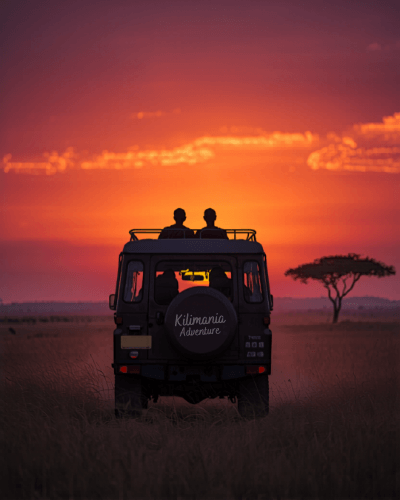
Depart at dawn or sleep in. Stay with a single lion pride for four hours. Return to camp late after a sunset sighting. Your guide works to your rhythm, not a group consensus. This is the single most valuable private safari Tanzania benefit.
Photographer’s advantage.
Position the vehicle exactly where the light works for backlit subjects. No seat rotation. No waiting for someone else’s wide-angle shot before you get your telephoto frame.
Guide attention undivided.
A private guide focuses entirely on your interests. If you mention wanting to see serval or caracal on day one, they tailor the route to habitat, drainage lines, and kopjes where those cats appear. An experienced guide who knows which pride used Moru Kopjes three days ago adds more value than any lodge upgrade.
Privacy and comfort.
Honeymooners and couples get uninterrupted time together. Families with young children can manage snack breaks, bathroom stops, and shorter game drives without affecting other travelers. The vehicle becomes your private space for the entire safari.
Route flexibility based on real-time wildlife movement.
If a coalition of cheetahs has been reported near Gol Kopjes that morning, your guide can adjust immediately. Group safaris follow pre-set routes and cannot pivot based on fresh radio reports.
3 Disadvantages of a Private Safari:
Higher cost.
A private 7-day safari costs $800–$1,300 more per person than a group safari. For a couple, that is $1,600–$2,600 extra total. This is the only meaningful disadvantage.
Fewer eyes are spotting wildlife.
Two or four eyes instead of twelve. Skilled guides compensate through years of experience reading animal behavior and habitat, but some sightings develop because a passenger in the back row spotted movement in tall grass.
No built-in social element.
Solo travelers on private safaris spend evenings alone unless they actively seek company at lodges or campsites. Some travelers prefer this. Others find the silence isolating after several days.
The Lodge Game Package: The Hidden Third Option
There is a third path between group and private that most travelers discover only after arriving in Tanzania. Some permanent tented camps and lodges in Serengeti and Ngorongoro offer game packages — shared game drives using camp-employed guides and vehicles included in your accommodation rate.
How lodge game packages work:
You book accommodation at a camp that includes game drives. Each morning, you join other lodge guests in the camp’s vehicle, guided by a resident guide who works exclusively in that immediate area. The guide knows the specific kopjes, river crossings, and pride territories within a 20–30 kilometer radius more intimately than any drive-in guide from Moshi or Arusha could.
The advantage:
A camp guide who has tracked the same lion pride near Namiri Plains for three years will know where those cats drink at dawn, which acacia they favor at midday, and when cubs were last seen. This hyper-local knowledge can produce better sightings than a private guide covering the entire Serengeti.
The trade-off:
You share the vehicle with other lodge guests. It is still a group experience, but typically with 4 guests rather than 6. The departure time is set by the camp, not negotiated among passengers. You cannot demand a 5:45 AM start if the camp runs a 6:30 AM schedule.
When lodge game packages make sense:
- You are a couple wanting better guiding than a general group tour, but unwilling to pay the full private premium
- You are staying at a specialized camp in a high-density wildlife zone where local guide knowledge creates a genuine advantage
- You are combining a lodge package (shared game drives) with one or two private days for specific photographic goals
When lodge game packages do not work:
- You are a photographer who needs vehicle positioning control
- You want departure flexibility
- You are visiting multiple parks and need a guide who stays with you throughout
For travelers wanting lodge-based experiences with camp-employed guides, our Ndutu Safari Camps 2026 guide compares mobile and permanent camps that offer game packages during the calving season.
Seasonal Strategy: When Group Beats Private on Value
The time of year you travel changes the group vs. private calculation significantly. During peak season, group safaris protect budget travelers from inflated demand. During the green season, private luxury becomes accessible at near-group prices.
| Season | Months | Group Safari Price Per Day | Private Safari Price Per Day | Strategic Recommendation |
|---|---|---|---|---|
| Peak dry season | June–October | $300–$400 | $550–$1,200 | Group protects budget from inflated private demand |
| Calving season | January–February | $280–$380 | $500–$1,000 | Book 8–10 months ahead regardless of choice |
| Shoulder (November) | November | $220–$320 | $400–$750 | 20–30% savings; private becomes more accessible |
| Shoulder (March) | March | $200–$300 | $375–$650 | 20–40% savings; best value window |
| Green season | April–May | $180–$250 | $300–$500 | Private luxury at group prices (40–50% discounts) |
The green season private safari advantage:
During April and May, many luxury lodges reduce rates by 40–50%. A couple can book a private mid-range to luxury safari for approximately $300–$500 per person per day — the same price as a peak-season group safari. Wildlife viewing remains strong for resident species; only the migration herds are typically farther south or north, depending on rainfall patterns.
The peak season group safari necessity:
From June through October, private vehicle demand surges. Rates reach their annual ceiling. A group safari at $300–$400 per day becomes the only viable option for travelers with a fixed budget under $3,000 total. The group vehicle insulates you from the demand-driven price inflation that affects private bookings.
November and March deliver 20–40% savings with no meaningful wildlife trade-off. These are the two most underrated months on the northern circuit for cost-conscious travelers weighing group safari vs private safari Tanzania options.
Hidden Costs of Group Joining Safaris
Budget safari pricing includes the vehicle, guide, accommodation, and park fees in the headline number. These additional costs apply regardless of group or private choice and often appear after the deposit is paid.
What group safari quotes sometimes exclude:
| Hidden Cost Item | Typical Amount (USD) | Notes |
|---|---|---|
| Ngorongoro Crater descent fee | $295 per vehicle | Confirm it is included. Some operators list it separately and add it to your invoice after booking. Divided by 6 passengers = $49 each; paid solo = $295. |
| Sleeping bag rental | $15–$25 | Budget camping safaris may charge this unless you bring your own. |
| Drinks beyond bottled water | $2–$5 per drink | Sodas, beer, and wine are additional at camps and lodges. Bottled water on game drives is typically included. |
| Hot air balloon safari | $595–$650 per person | Optional add-on, rarely included in base pricing. |
| Maasai village visits | $30–$50 per person | Optional cultural add-on. |
| Airport transfers | $50–$100 each way | Some operators include the Kilimanjaro Airport transfer. Confirm in writing. |
| Tips for guide and camp staff | $35–$40 per day ($245–$280 for 7 days) | Expected but rarely listed in the headline price. |
The $700–$950 fixed cost layer that applies to every safari:
Even on the most budget-friendly group camping safari, park fees, crater descent, tips, and the Tanzania visa add $700–$950 per person to a 7-day northern circuit itinerary. This fixed-cost floor is why the headline daily rate of $250 does not translate to a $1,750 total for a week — the real minimum, with all costs included, sits closer to $1,800–$2,000 per person.
For an itemized breakdown of every cost component, our How Much Is a Tanzania safari guide shows the math line by line so you can verify operator quotes before paying a deposit.
Safari Vehicle Sharing Etiquette Tanzania
After years of guiding shared safaris from our Moshi base, here are the unwritten rules that make group vehicles function smoothly across 40–60 hours of game drives.
Window seat rotation.
Switch seats at each major stop or after lunch. Front and back rows offer different perspectives. Staking a permanent claim on one side of the vehicle creates quiet resentment by day three.
Communicate sighting priorities early.
Tell your guide and fellow passengers what you most want to see on day one — big cats, birds, migration crossings, or general wildlife. The group can then decide collectively when to invest extended time in a sighting versus move on.
Limit phone calls on game drives.
Sound carries across the open vehicle. A five-minute phone conversation about work pulls every other passenger out of the environment they paid to experience.
Respect the guide’s positioning decisions.
If your guide angles the vehicle a certain way relative to the sun or another vehicle, it is usually for a reason — light direction, animal behavior, park regulations, or giving every passenger a clear view. Trust the professional.
Pack light in the vehicle cabin.
Each seat has limited space. A small daypack per person is appropriate. Large camera bags go under seats, not on laps, blocking others’ movement or visibility.
Avoid strong scents.
Perfume, cologne, and heavily scented sunscreen attract tsetse flies in Tarangire and woodland areas. Neutral, unscented products make the vehicle more comfortable for everyone.
Be punctual at departure times.
The group agrees on a morning departure time. Consistently being the last person ready means the group loses 15–20 minutes of prime wildlife activity during the golden hour when predators are most active.
How to Find a Group to Join for Safari Tanzania
Solo travelers and couples looking to join a group safari have several practical paths to finding a departure.
- Book through a Moshi-based operator with published departure dates. Local operators run regular group departures covering Serengeti, Ngorongoro, Tarangire, and Lake Manyara. Ask for the departure calendar and confirm how many travelers are already booked on your preferred dates. Our Tanzania Safaris page lists available routes.
- Request group availability 3–6 months ahead. Popular departure dates fill first. June–October and December–February groups often close 4–5 months before departure. Last-minute requests for group spots during peak season rarely succeed.
- Be flexible on the route and start date. If a specific date has no group availability, ask about alternative departure dates within a few days. A small shift — departing on a Tuesday instead of a Sunday — can mean the difference between joining a group at $300 per day and paying $550 per day for a private vehicle.
- Confirm the passenger count before paying. A “group safari” with only you and one other traveler works well and provides excellent value. Confirm the minimum and maximum group size in writing before transferring any payment. A group of 2–3 is intimate; a group of 6 is full; a group of 7–8 means someone does not have a proper window seat.
- Verify TATO registration. Confirm your operator holds a current license with the Tanzania Association of Tour Operators TATO. Unregistered operators may quote lower prices but carry a higher risk of cancellations or hidden charges.
For travelers targeting the calving season in Ndutu, joining a group departure focused on the southern Serengeti provides predator action without private safari pricing. Read our Ndutu Calving Season guide for seasonal timing.
Which Is Better: a group or Private Safari Tanzania?
The answer depends on four factors: who you are traveling with, what you want from game drives, when you are traveling, and your budget.
Choose a group safari if:
- You are a solo traveler or a couple comfortable meeting others
- Your budget is the primary consideration
- You enjoy the social aspect of shared travel
- You are visiting for general wildlife viewing, not specialized photography
- Your travel dates align with an existing group departure from Moshi or Arusha
Choose a private safari if:
- You are a photographer needing specific light, angles, and extended time at sightings
- You are on a honeymoon and value complete privacy
- You are traveling with children under 12 who need flexible pacing
- You have specific wildlife goals — a particular species, behavior, or photographic outcome
- Your travel dates are fixed and no group departure matches your schedule
- You are a group of 4–6 friends or family (the 6-person sweet spot makes private nearly the same cost as group)
Choose the lodge game package if:
- You want hyper-local guide knowledge in a specific wildlife zone
- You are willing to trade departure flexibility for intimate habitat expertise
- You are combining a camp package with one or two private days for photography
Final Decision Based on Your Travel Style: Group Safari vs Private Safari in Tanzania
| Specialized interests need to guide the flexibility that a group cannot provide | Recommended Choice | Why |
|---|---|---|
| Solo traveler, budget-focused | Group safari | Lowest cost, social atmosphere, set departures available |
| Couple on honeymoon | Private safari | Privacy, romantic pacing, no compromises with strangers |
| Family with children under 12 | Private safari | Flexible schedule, child-friendly pacing, bathroom stops on demand |
| Serious wildlife photographer | Private safari | Unlimited time at sightings, full vehicle positioning control |
| First-time safari-goer | Group safari | Lower financial commitment, learn preferences for next trip |
| Small group of 4–6 friends | Private safari (sweet spot) | At 6 people, per-person cost nearly identical to group pricing |
| Fixed travel dates, no group available | Private safari | Your only option if departure dates do not align |
| Mixed interests (birding, cats, general) | Private safari | Specialized interests need guide flexibility a group cannot provide |
| Senior travelers | Private safari | Slower pace, more frequent rest stops, no pressure from group schedule |
| Traveling April–May (green season) | Private safari | Luxury at group prices due to 40–50% accommodation discounts |
Bottom Line: Group Safari vs Private Safari Tanzania
If you are a solo traveler or a couple on a strict budget under $2,500 per person for a week, choose a group safari. The cost saving is real, the social element can be enjoyable, and you will see the same lions, elephants, and leopards as every private vehicle in the park.
If you are a photographer, a honeymoon couple, a family with young children, or a group of 4–6 friends traveling together, choose a private safari. For groups of 6, the cost difference is negligible — approximately $63 per person for a full week.
For everyone else, the $125–$800 daily premium buys something measurable: 8–12 additional hours of observation time across your safari, complete control over every decision, and the silence needed to hear a lion’s call across the Serengeti plains at dawn.
The compromise option: Book a group departure but add 1–2 private days for areas you care about most — Serengeti’s kopjes for leopards or Ndutu for calving season predators. This hybrid approach gives you budget efficiency for general game drives and private flexibility for the sightings that matter.
Plan Your Tanzania Safari in Minutes
Get your quote on WhatsApp
Get a detailed safari quote (no obligation)
We’ll break down group vs private costs for your exact trip.
Related Tanzania Safari Guides
To plan your safari more effectively, explore these detailed guides:
- Tanzania Safari Cost Breakdown 2026 (full pricing explained)
- Best Time to Visit Serengeti for Wildlife Viewing
- Serengeti vs Ngorongoro: Which Park Is Better?
These guides help you compare costs, timing, and destinations so you can choose the right safari experience based on your travel goals.
FAQ: Group Safari vs Private Safari Tanzania
Q: Is a private safari worth the cost in Tanzania?
A private safari in Tanzania is worth it if you want full control of your schedule in Serengeti, Ngorongoro, or Tarangire. It suits couples, photographers, and small groups. For 4–6 people, the cost is close to group tours, making it a strong option.
Q: How much does a private safari cost per day in Tanzania?
A private safari costs $375–$1,200 per person per day in 2026. Mid-range private safaris from Arusha or Moshi average $700–$1,100 per day for two people. Larger groups reduce the cost per person.
Q: How much is a group safari in Tanzania per day?
Group safaris cost $250–$400 per person per day. Camping safaris in Tarangire or Lake Manyara are cheaper, while lodge safaris in Serengeti cost more during peak season (June–October).
Q: Can solo travelers join a group safari in Tanzania?
Yes. Solo travelers can join group safaris from Arusha or Moshi. Most tours do not charge a vehicle supplement, but some lodges in Serengeti or Ngorongoro may add a single room fee.
Q: What is the maximum group size on a Tanzania safari vehicle?
Most safari vehicles carry 6 passengers, each with a window seat. Avoid vehicles with 7–8 people, as this reduces comfort and wildlife viewing in Serengeti National Park.
Choosing between a group vs private safari Tanzania experience depends on your budget, travel style, and expectations.
If you want to reduce costs and meet other travelers, a group safari is the best option. If you want full control, privacy, and more time at wildlife sightings in places like Serengeti National Park and Ngorongoro Crater, a private safari is worth the extra cost.
From our base in Moshi, we help travelers choose the right safari style based on real experience — not marketing.
We Walk With You.
Final Verdict in One Sentence:
| Want hyper-local guiding, but okay sharing a vehicle | Choose |
|---|---|
| Solo traveler or couple on strict budget | Group Safari |
| Photographer, honeymooner, family, or group of 4–6 | Private Safari |
| Want hyper-local guiding but okay sharing vehicle | Lodge Game Package |
Book with confidence, not confusion. Match the option to who you actually are, not who you wish you were on safari. That is the only rule that matters.