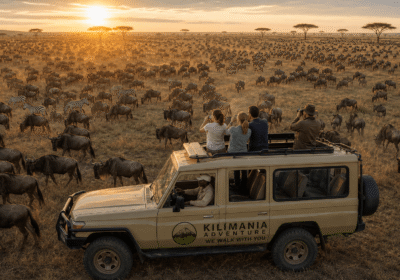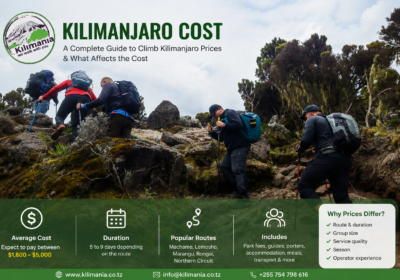
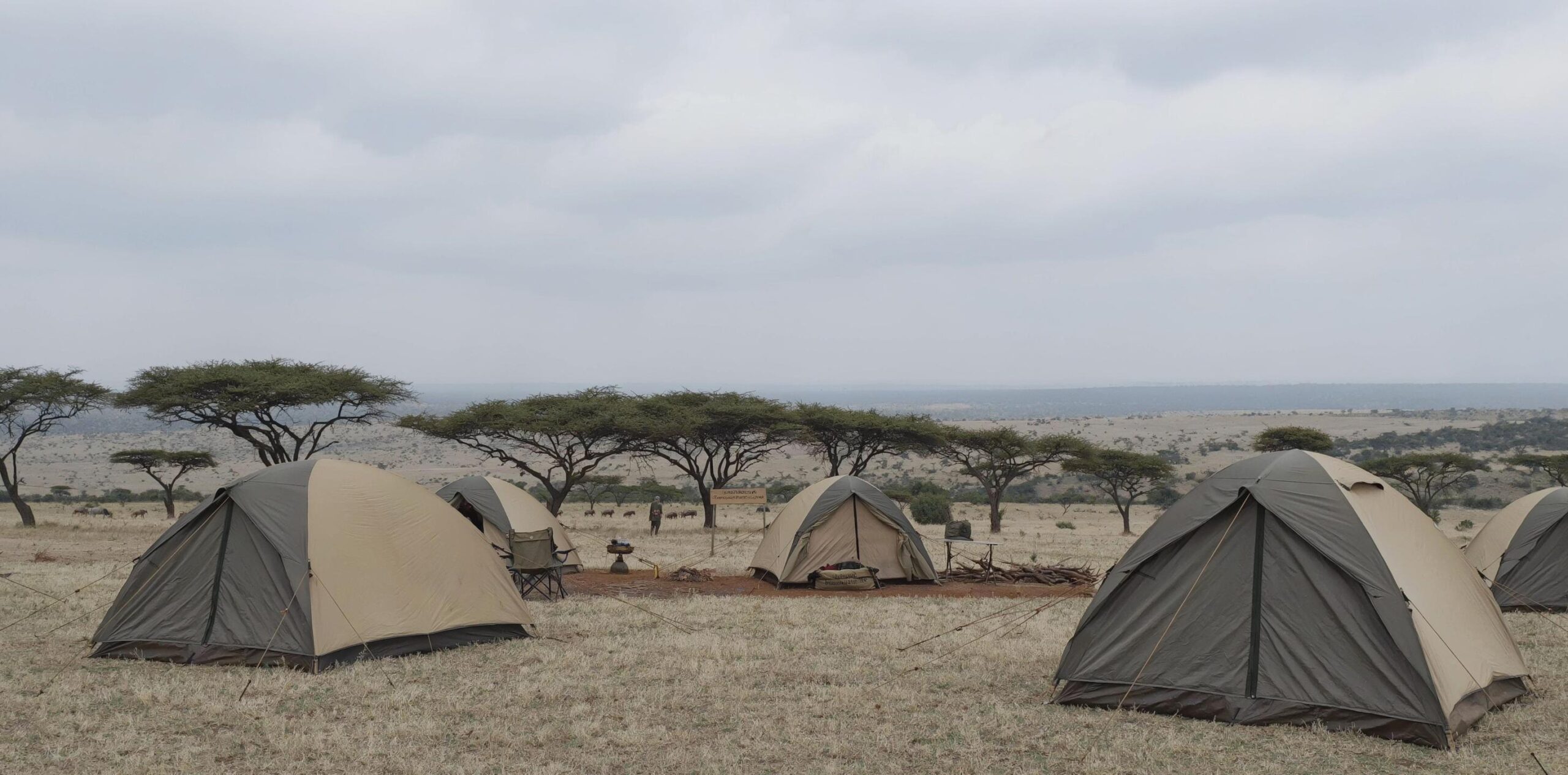
Budget camping safari in Tanzania is the most affordable way to experience Serengeti, Ngorongoro Crater, Tarangire, and Lake Manyara without paying lodge prices. Most travellers spend $200–$350 per person per day on group camping safaris, depending on season, group size, and park fees.
These safaris use shared 4×4 Land Cruisers, public campsites inside or near national parks, and professional driver-guides based in Arusha and Moshi. Wildlife viewing is identical to lodge safaris — the difference is comfort, privacy, and accommodation level.
How much does a budget camping safari cost in Tanzania?
A realistic budget safari price includes park fees, vehicle, guide, food, and camping equipment.
- Serengeti National Park: $70 per person/day
- Ngorongoro Crater entry: $70 per person + $295 vehicle fee
- Tarangire National Park: $53 per person/day
- 4×4 safari Land Cruiser: $200–$300 per day (shared group)
- Camping equipment + cook: $40–$80 per person/day
Final total price:
- 3-day safari: $900 – $1,400 per person
- 5-day safari: $1,400 – $2,300 per person
- 7-day safari: $1,800 – $3,200 per person
Anything below $200/day usually excludes park fees or uses unlicensed operators.
A budget camping safari on Tanzania’s Northern Circuit delivers Serengeti, Ngorongoro Crater, Tarangire, and Lake Manyara access at $200–$350 per person per day. Accommodation is a dome tent at TANAPA-operated public campsites. Wildlife is not fenced out. Ngorongoro rim nights drop to 8–12°C and require a 0°C-rated sleeping bag year-round. For full cost and itinerary breakdowns, see our Serengeti Big Five Safari Cost & Itinerary 2026.
Key Stats
- $200–$350 per person per day, all-inclusive budget camping
- $30–$50 — public campsite fee per person per night
- 8–12°C — Ngorongoro rim overnight low, June–August
- 2,400m — altitude of Simba A campsite
- 3 km — Nyani campsite from Seronera Valley
- 7 days — minimum recommended Northern Circuit itinerary
The Bottom Line: A legitimate 7-day Northern Circuit camping safari cannot be priced below $1,050 per person when park fees alone exceed $580. Any lower quote omits park fees, the $295 crater descent charge, or both. Request a line-item breakdown before paying any deposit.
Table of Contents
Introduction
This article explains what a Tanzania camping safari physically feels like — campsite by campsite, night by night. It covers temperatures, bathroom realities, lion sounds, and the traveller types for whom camping works and those for whom it does not. Written for solo travellers, couples, first-time campers, and budget-conscious travellers from the USA, UK, Germany, Netherlands, Australia, and Canada planning 2026 Northern Circuit departures.
From our base in Moshi, Kilimanjaro Region, Kilimania Adventure runs daily safaris to Serengeti National Park, Ngorongoro Crater, Tarangire National Park, and Lake Manyara National Park, with pickups from Kilimanjaro International Airport (JRO) and Arusha Airport (ARK).
Is Budget Camping Safari Tanzania Worth It?
Yes — for travellers who prioritise wildlife immersion over comfort. A 7-day camping itinerary covering Serengeti, Ngorongoro, and Tarangire costs $1,050–$1,750 per person versus $2,450–$3,850 for the same route in mid-range lodges. Wildlife sighting quality is identical. Sleep quality is not.
Camping delivers what lodges cannot replicate: you are inside the ecosystem at night, not beside it. At Nyani campsite near Seronera Valley, lions roar from distances that register physically. At Simba A on the Ngorongoro rim, hyenas patrol the camp perimeter while the crater fills with mist 600 meters below. At Ndutu during calving season, wildebeest move through camp at dawn.
The honest trade-off: a sleeping bag replaces a bed, a long-drop toilet replaces a flush bathroom, a power bank replaces your charging socket. Whether that saves you $700–$2,100 across 7 days depends entirely on your priorities.
Our 6-day Tanzania safari through Tarangire, Serengeti, and Ngorongoro runs as a camping itinerary and consistently delivers all Big Five sightings. Travellers looking for more comfort should see 15 Best Serengeti Lodges & Camps 2026 or Best Mid-Range Safari Lodges in Tanzania 2026.
What Types of Safari Camping Exist in Tanzania?
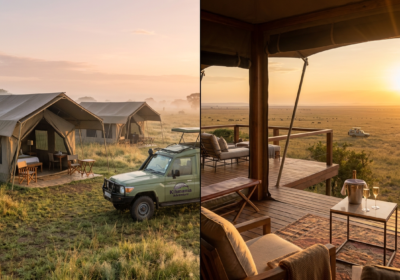
Three distinct categories — TANAPA-operated public campsites (shared, basic, unfenced), private special campsites (exclusive, bush facilities, deeper wilderness), and mobile tented camps (walk-in tents, real beds, hot showers). Budget safaris use public campsites. Each tier delivers a fundamentally different experience.
Public Campsite
Private Special Campsite
Mobile Tented Camp
TANAPA manages public campsites across Serengeti, Tarangire, and Lake Manyara. The NCAA manages Ngorongoro Conservation Area sites, including Simba A and Simba B. For migration timing, read best time to visit Serengeti for the Great Migration.
Why are Tanzania safaris expensive?
Most safari costs in Tanzania come from government conservation fees rather than company profit.
For example:
- Serengeti park fee: about $70 per adult/day
- Ngorongoro Crater vehicle fee: about $295 per vehicle
- Conservation fees and VAT apply separately
- 4×4 safari vehicles consume large amounts of fuel across long distances
This is why extremely cheap safari offers often exclude park fees or use unlicensed operators.
What Are the Serengeti and Ngorongoro Campsites Really Like?
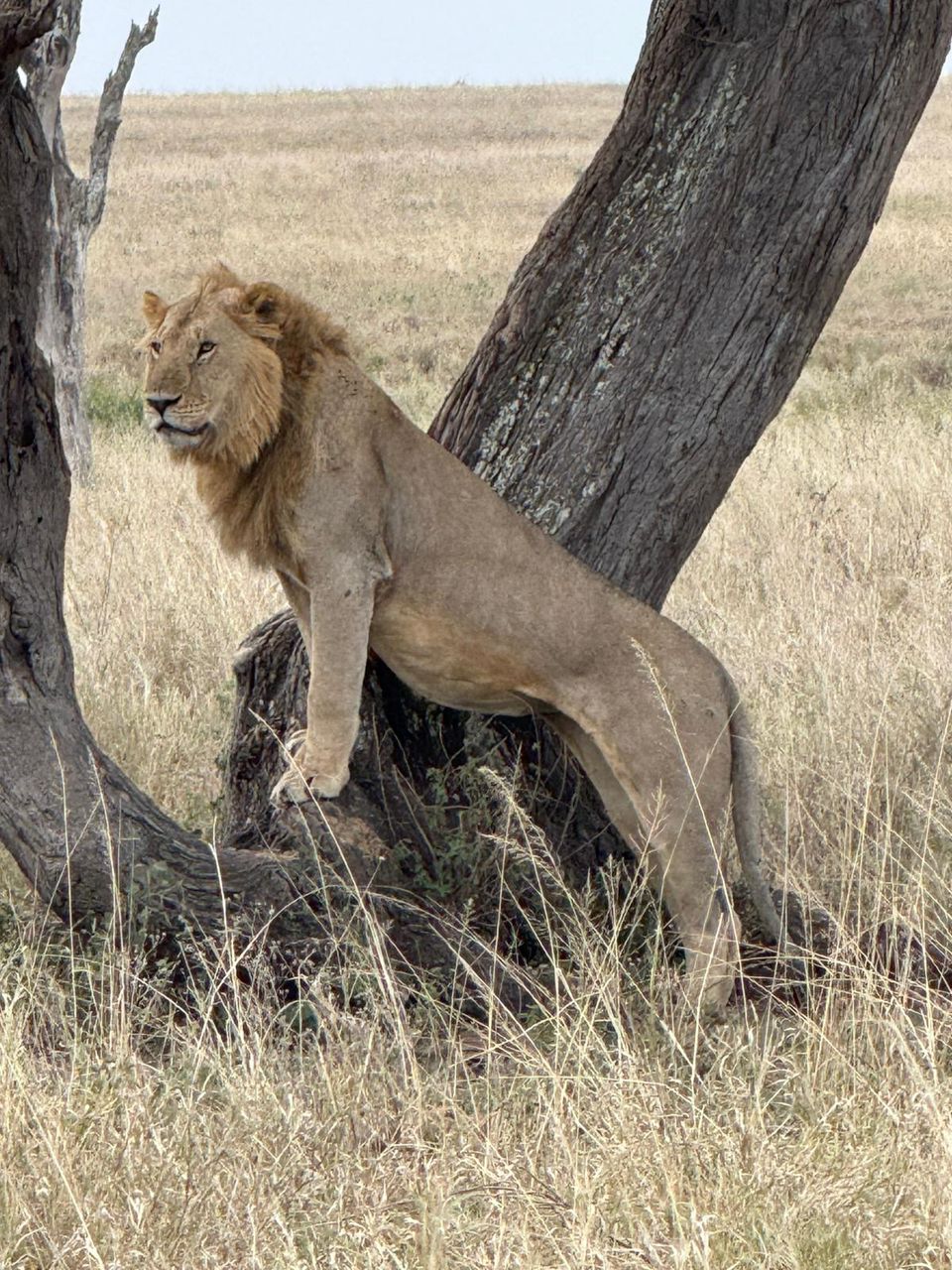
Tanzania public campsites range from basic to very basic. Nyani and Seronera have flush toilets and cold showers. Simba A and Simba B on the Ngorongoro rim have wind, serious cold, and minimal infrastructure. All are unfenced. Wildlife moves through every site after dark.
[IMAGE: Simba A campsite at Ngorongoro rim — tents, crater valley below, wind-bent acacias, June 2026 ALT: Tanzania camping safari Simba A campsite Ngorongoro rim crater view 2026 File: camping-safari-tanzania-simba-a-ngorongoro-rim-2026.webp]
Nyani Campsite — Central Serengeti
Nyani (nyani = Swahili for baboon — accurate for the daytime visitors) sits 3 km from Seronera Valley, the highest predator-density zone in Serengeti National Park.
Facilities: Flush toilets · Cold showers · No electricity · Multiple shared bays · TANAPA ranger overnight patrol
Lions roar here nightly during July–October when migration prey density peaks in Central Serengeti. By night three, most travelers stop waking to the sound. Several have told me they sleep worse at home afterwards. Best route for this campsite: Northern Circuit Big Five 7-day safari.
Simba A — Ngorongoro Crater Rim, 2,400m
Managed by NCAA. June–August nights drop to 8–12°C and occasionally 5°C before dawn. Wind is consistent and strong. A 0°C sleeping bag is the minimum — not optional, not seasonal.
Simba A: Basic flush toilets · Cold shower · NCAA security ranger Simba B: Long-drop toilets only · No shower · More remote position
Buffalo and hyenas enter both campsites after dark. Stay inside after 9 PM. Our 4-day Ngorongoro and Serengeti itinerary uses Simba A on the crater night.
Seronera — Central Serengeti
The most established public campsite in the park. Flush toilets, occasional solar-heated warm showers, ranger station nearby. Busier and noisier than Nyani. Better infrastructure, less wilderness atmosphere. Good choice for travellers who want Serengeti wildlife access with slightly better baseline facilities.
Lobo — Northern Serengeti, Kogatende Zone
Northern Serengeti’s campsite during migration season (July–October). Mara River crossing zones with wildebeest (Connochaetes taurinus) and Nile crocodiles (Crocodylus niloticus) are within 20–40 km. Facilities: long-drop toilets, cold water, shared cooking areas. Context is exceptional. Facilities are not.
Ndutu — Southern Serengeti / Ndutu Plains
Calving season base (January–March). Wildebeest calves and cheetah (Acinonyx jubatus) near camp at dawn. The highest predator-to-prey concentration of any Northern Circuit campsite during this period. See our 4-day Tarangire Ndutu, Ngorongoro itinerary.
What Do Toilets and Showers Actually Look Like?
Nyani and Seronera have flush toilets. Simba B and Lobo use long-drop toilets only. All public campsites have cold showers. At Ngorongoro rim campsites in June–July, a cold shower at 2,400m requires real commitment. Bring your own toilet paper — this is non-negotiable.
Long-Drop Toilets
A concrete stall over a deep pit. At busy campsites during peak season, smell accumulates by day three. Toilet paper runs out. Floors get muddy in the rain. Carry 2–3 rolls sealed in ziplock bags per person, plus wet wipes.
The 2 AM toilet walk — 30–80 meters from your tent to the toilet block, headlamp on red-light mode, sounds of animals somewhere just beyond the light radius — is the campsite experience most travellers underestimate before departure. It becomes normal faster than you expect.
Showers
Cold pipe water at all public campsites. Seronera occasionally has solar-heated water on sunny afternoons. At Simba A in July, cold water at high altitude is genuinely uncomfortable.
Field fix: Ask the camp cook for a heated water bucket the evening before a Ngorongoro rim night. Kanti Kessy, our senior Northern Circuit driver-guide with 17 years on the circuit, calls this the most-requested and least-planned small luxury on Northern Circuit camping safaris.
What Happens When Lions Are Outside Your Tent?
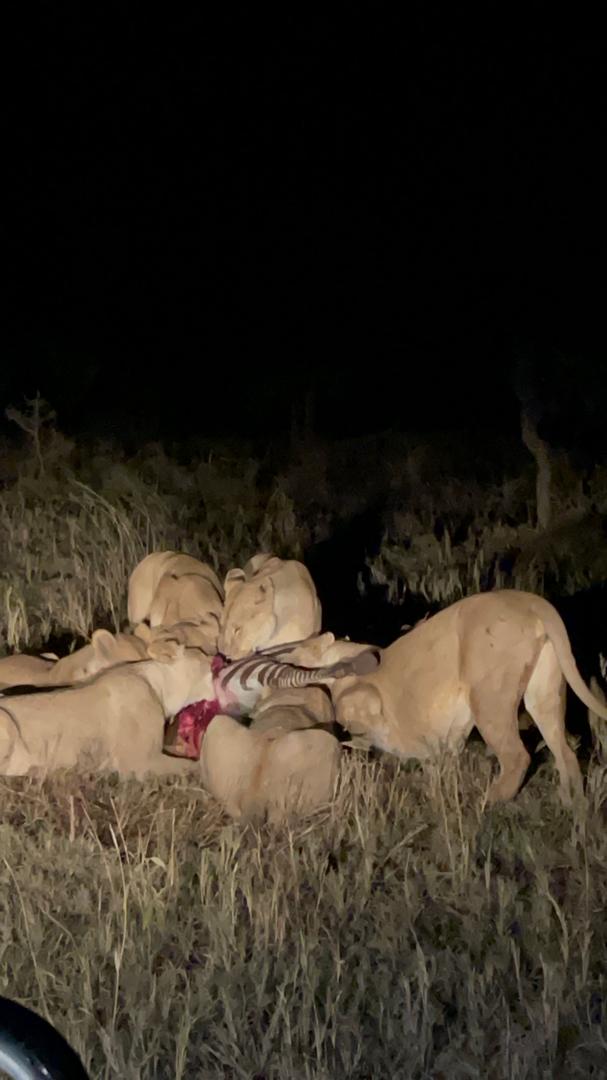
Lions (Panthera leo) are recorded near Nyani and Lobo campsites on most nights during July–October. The roar at close range is physical — a chest vibration felt before you fully wake. The correct response: stay inside, stay calm, wait. In 22 years of guiding, no Kilimania client has been injured by wildlife at a public campsite.
The roar from a dome tent at night does not sound like a nature documentary. It feels like it comes from the ground as much as the air. Most first-time campers experience an involuntary adrenaline spike, several seconds of disorientation, then a slow recalibration of breathing.
By night three at Nyani or Lobo, most travellers are calibrated to it. Several have told me they sleep worse at home on their first night back.
Campsite Safety Protocol
- Stay inside the tent — do not unzip to look outside
- No bright white torch pointing outward
- Red-light headlamp inside the tent only
- Wait for the animal to move away — this takes minutes, not hours
- Your guide sleeps in or beside the safari vehicle and monitors the camp
Wildlife investigates food smells, not humans. The single rule that covers 95% of campsite safety: all food goes inside the locked vehicle after dinner. Not inside the tent. Inside the vehicle.
What Does the Camp Crew Provide?
Budget camping crews provide dome tents, roll mats, sleeping bags, a camp cook, three meals per day, and tea and coffee. Meals are filling and consistent. Dietary variety at remote campsites is limited. Declare vegetarian, vegan, gluten-free, or halal requirements at booking — not on departure day.
What’s Included
- 2-person dome tent, roll mat, sleeping bag, small pillow
- Portable gas jiko stove and cookware
- Breakfast, packed lunch, hot camp dinner
- Tea and coffee throughout the day
- Filtered or bottled drinking water
- Guide overnight in or beside the vehicle
Food Reality
Breakfast: Eggs, toast or chapati, fruit, tea or coffee. Lunch: Sandwiches, boiled eggs, fruit, snacks — eaten on game drives or at picnic sites. Dinner: Rice or pasta with stew, soup, bread, and tea.
All food is loaded from Moshi before departure. No resupply between parks. Louis Salvatory, who manages our group departures and has run camping logistics for 12 years, calls this “the most underestimated planning constraint on any Northern Circuit camping safari.”
| Safari Type | Accommodation | Vehicle | Typical Cost |
|---|---|---|---|
| Budget Camping | Public campsites | Shared | $200–$350/day |
| Mid-Range Lodge | Permanent lodges | Shared/private | $350–$600/day |
| Luxury Safari | Luxury tented camps | Private | $700–$1500+/day |
Who Should Not Book a Camping Safari?
Budget camping is not appropriate for travellers with chronic back pain, severe light-sleep sensitivity, medical hygiene requirements, or children under 5. Honeymooners expecting privacy are consistently better served by lodge options. Being direct about this saves disappointment no wildlife sighting can compensate for.
Upgrade to a Lodge If:
Chronic back pain. Five to seven nights on a foam roll mat changes your body mechanics. This affects travellers with pre-existing conditions consistently and significantly.
Very light sleeper. Nyani campsite produces noise: lions, hyenas, wind, group vehicles, birds before 5 AM. If disrupted sleep impairs your ability to function, book a lodge.
Honeymoon. Camping is a shared space with zero privacy. See our Tanzania Honeymoon Safari & Zanzibar 2026 for lodge-based itineraries. A 5-day safari and luxury Zanzibar beach combination works well for couples wanting both wildlife and genuine comfort.
Children under 5. Toilet distances, cold nights, and wildlife proximity are genuinely difficult for very young children. See Tanzania Safari With Kids: Age Limits & Safety 2026 for age-appropriate structures.
Strict hygiene requirements. Long-drop toilets at shared campsites do not meet clinical hygiene standards.
The Mixed Strategy
2–3 camping nights in Central Serengeti combined with lodge nights in Ngorongoro or Tarangire gives wildlife immersion without committing every night to basic facilities. It is the most practical Northern Circuit structure for travelers who want both experiences without full-trip fatigue.
For destination-level decision-making, our Serengeti vs Masai Mara 2026 comparison covers predator density, vehicle limits, park fees, and value differences between the two destinations.
[IMAGE: Dome tent at Tarangire campsite, baobab tree background, dry season morning light, Kilimania Adventure setup ALT: Tanzania camping safari dome tent Tarangire National Park baobab Kilimania Adventure 2026 File: tanzania-camping-safari-dome-tent-tarangire-kilimania-2026.webp]
How Do You Spot a Fake Safari Quote?
A 7-day Northern Circuit camping safari covering Serengeti, Ngorongoro, and Tarangire cannot be delivered below $1,050 per person. Park fees alone total $580–$650 per person for those three parks. Any lower quote omits fees, the $295 crater descent charge, or both. The arithmetic is not ambiguous.
Park fees are fixed by TANAPA and NCAA. They apply to every operator identically. A quote below the published fee floor either excludes fees (demanded as cash at the gate) or represents an operator that does not intend to enter the parks.
Five Fraud Patterns
- Deposit theft — Operator takes 30–50% deposit and does not appear on departure day.
- Park fee exclusion — Quote excludes fees; cash is demanded at the park gate on arrival.
- Crater descent omission — $295 per vehicle, NCAA fee missing; demanded at the crater rim.
- Bait and switch — Quote confirmed, then “fuel surcharge” or “VAT revision” demanded in Tanzania.
- Unlicensed operation — Real vehicle, real departure, no TATO registration, no guide license.
How to Verify Before Paying
- Request TATO registration number — verify at tatotz.org
- Ask for park fees listed by park, by day, by number of travellers
- Confirm crater descent at $295 per vehicle (not per person)
- Ask for VAT treatment in writing
- Request a complete inclusion/exclusion list
- Never pay more than 30% deposit more than 90 days before departure
Essential Packing List.
Non-Negotiable
- Headlamp — red-light mode for night toilet walks
- Power bank — 20,000mAh minimum; no electricity at public campsites
- Sleeping bag to 0°C — required at Ngorongoro rim; recommended everywhere
- Toilet paper — 2–3 rolls, sealed in ziplock bags
- Wet wipes — 100+ count; most versatile hygiene item on the trip
- DEET repellent — 40–50% concentration
- Warm layers — thermal base, fleece mid-layer, windproof outer
- Dust-proof bags — for all electronics and medications
Strongly Recommended
- Earplugs (other groups and vehicles, not lions)
- Inflatable pillow
- Camp towel (microfibre)
- Flip-flops for shower blocks
- Anti-diarrheal medication and oral rehydration salts
- SPF 50+ and lip balm
Packing note: Use a soft-sided duffel bag of 15kg maximum. Hard-sided suitcases do not fit properly in Land Cruiser luggage compartments. Pack soft. Pack light.
What is included in a budget camping safari
Included
- 4×4 Land Cruiser with pop-up roof
- Professional licensed guide
- All park game drives
- Camping equipment (tents, mattresses, chairs)
- Safari cook + meals (breakfast, lunch, dinner)
- Drinking water (1.5–2L per day)
Excluded
- International flights
- Tanzania visa ($50–$100)
- Tips for guide & cook ($25–$40/day group)
- Drinks (soda, alcohol)
- Travel insurance
- Balloon safari ($550–$650 optional)
Why Trust Kilimania Adventure for This Information
- Base: Moshi, Kilimanjaro Region — physical office, not an online booking desk
- TATO registered — verify at tatotz.org
- 22 years: Sabinus Msimba, 300+ Kilimanjaro summits, 200+ Northern Circuit field days per year
- 17 years: Kanti Kessy, Northern Circuit driver-guide
- Commitment: We publish honest limitations and real fee data because travellers who understand real costs book better safaris
“Honest warning: July nights at Ngorongoro rim are freezing. Bring thermal underwear. But we saw a leopard kill at 6 AM because we were already at the gate.” — Emma v.d.B., Netherlands, March 2026 [Verified TripAdvisor]
“Priced the same 7-day safari through an Australian agent: $2,950. Emailed Kilimania directly: $2,100. The $850 we saved paid our Zanzibar flights.” — Laura and Mike, UK, November 2025 [Verified Google Reviews]
Who is the budget camping safari for?
Solo travelers
Best for social group safaris, lower per-person cost
Couples
Private upgrades recommended for comfort inside Serengeti camps
Families
Suitable for children aged 6+; private vehicle recommended
Backpackers
Lowest-cost shared departures from Arusha or Moshi
Safari Starting Points – Choose Your Gateway
Arusha – The Safari Capital
The beating heart of Tanzania’s safari industry. Here’s what locals know:
- Just 45 minutes from Tarangire National Park
- Home to experienced budget safari operators who’ve been running trips for decades
- Local tip: Stock up on snacks and batteries here – prices triple inside the parks!
- Most budget safaris depart early morning (6:30 AM) to maximise game viewing time
Moshi – Kilimanjaro’s Gateway Town
Nestled at the base of Africa’s highest peak:
- Quieter alternative to bustling Arusha
- About 80 km east of Arusha – adds 1.5 hours to park entry
- Insider advantage: Better prices on camping gear if you need last-minute supplies
- Perfect if you’re combining the Kilimanjaro trek with a safari
Kilimanjaro International Airport (JRO)
Smart move for time-pressed travelers:
- Direct pickup possible – start your safari within 2 hours of landing
- Located halfway between Arusha and Moshi (46 km to each)
- Pro tip: Morning flights mean same-day park entry; evening arrivals require Arusha overnight
Choose Budget Camping If:
- under 45
- okay with shared bathrooms
- Prioritising wildlife over comfort
- solo traveler
- backpacker
Avoid Budget Camping If:
- honeymoon
- bad back
- light sleeper
- elderly traveler
- luxury expectations
FAQ: Budget Camping Safari Tanzania
How much is a budget safari in Tanzania?
A budget camping safari costs $200–$350 per person per day, depending on season and group size.
Is camping safari safe in Tanzania?
Yes. Public campsites are protected by park rangers and guided by licensed operators.
Do I need a private safari vehicle?
No. Budget safaris use shared vehicles, but private upgrades are available for comfort.
What animals will I see?
Elephants, lions, giraffes, zebras, wildebeest, buffalo, and sometimes leopards and cheetahs.
Are park fees included?
Reputable operators include all park fees, but always confirm before booking.
Conclusion
A legitimate Tanzania camping safari starts at $150 per person per day — all park fees included, all meals provided, no costs discovered at the gate. Before paying any deposit, verify one thing: the Ngorongoro Crater descent fee of $295 per vehicle appears as a line item in the written quote. Most difficult camping experiences trace back to logistics, not wildlife — wrong sleeping bag, no warm layers, no power bank, an operator who omitted fees. Every one of these is preventable. Browse our 6-day Tanzania safari through Tarangire, Serengeti, and Ngorongoro — our most-booked 2026 camping route from Moshi — to see what an honest all-inclusive itinerary looks like.
We Walk With You.
For International Travelers
All prices in USD. Conversions: $1,800 ≈ £1,400 | €1,680 | AU$2,700.
- New York / Los Angeles → JRO: $800–$1,400 return
- London → JRO: £550–£900 return
- Sydney → JRO: AU$1,400–AU$2,200 return
Tanzania e-visa: $50 most nationalities | $100 US citizens. Apply at immigration.go.tz, minimum 7 days before travel. Use Visa/Mastercard on Chrome or Firefox. Yellow fever: required only from endemic countries — not for direct flights from USA, UK, EU, or Australia. Pre-safari accommodation in Moshi: $35–$80 per night.
Response times: Kilimania Adventure operates EAT (UTC+3) from Moshi. All quote requests answered within 12 hours, 7 days per week.
Disclosure: Written by Kilimania Adventure, a TATO-registered safari operator based in Moshi, Tanzania. All prices reflect real 2026 operational costs. We encourage you to compare quotes with at least two other TATO-registered operators before booking.
By Sabinus Msimba — Senior Safari Guide and Co-founder, Kilimania Adventure. 22 years guiding Northern Circuit safaris from Moshi. Hundreds of nights at Nyani, Simba A, Seronera, and Lobo public campsites. Last reviewed: June 2026
Data notice: Park fees and campsite charges are set by government authorities and may change without notice. Verify current rates at tanzaniaparks.go.tz before booking.