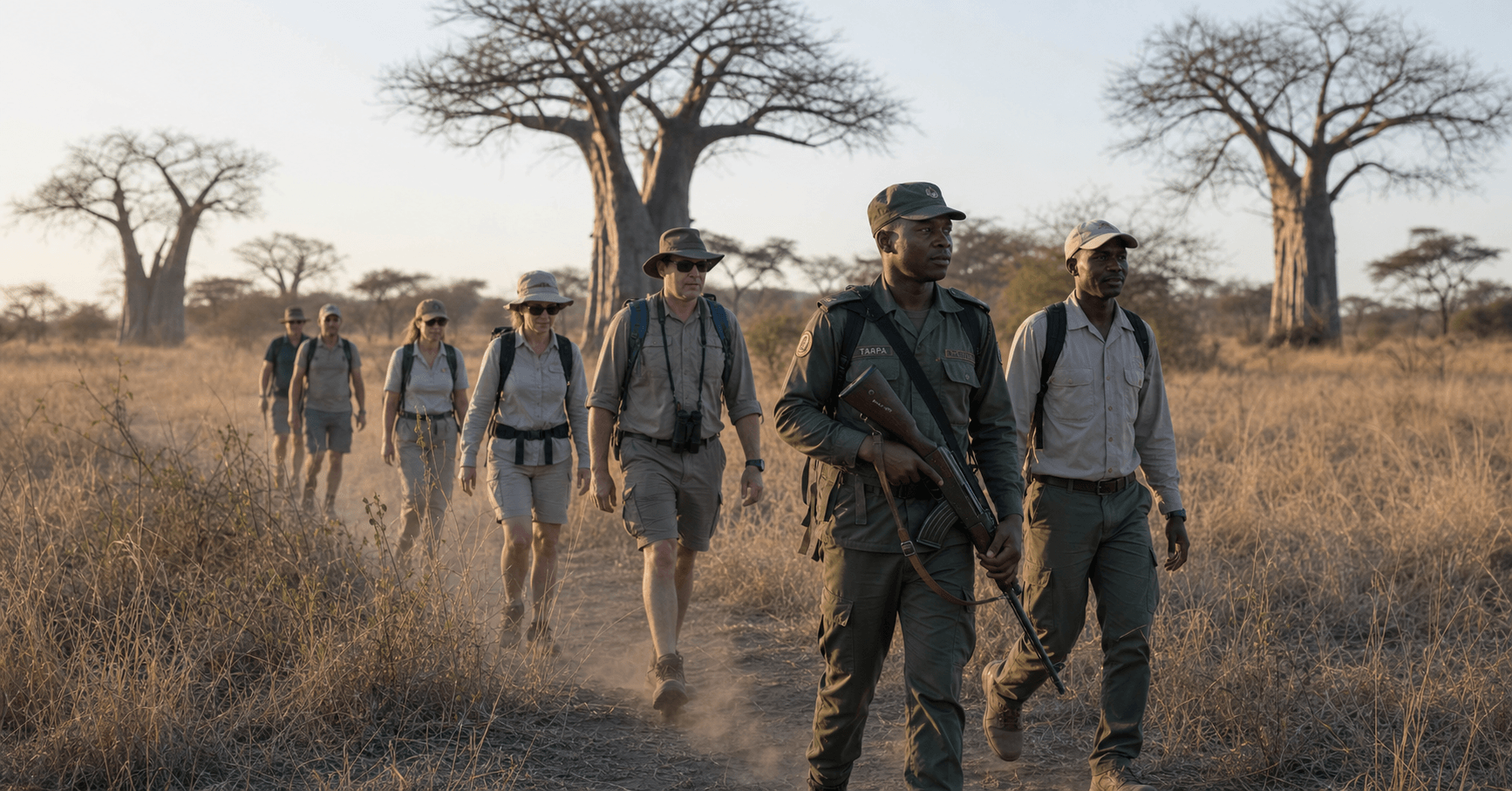
At 5:45 AM at Tarangire’s Lemiyon Gate, a Tanzania walking safari starts with a wind check, a clothing inspection, and one rule: if an animal charges, you stop. You do not run.
Four parks legally permit wilderness walking: Tarangire, Ruaha, Nyerere, and Arusha. Every walk requires a TANAPA-licensed guide and an armed ranger — $20–$30 per group, paid at the gate. The Ngorongoro Crater floor is permanently prohibited. The morning window closes at 10:00 AM.
About the Author
Data verification notice: Park fees, ranger charges, and conservation area rules are set by government authorities and subject to change. All figures reflect published May 2026 rates. Verify current fees at tanzaniaparks.go.tz before booking. Request a gate receipt during your safari to confirm your operator paid the correct published amount.
Tanzania walking safaris operate legally in Tarangire, Ruaha, Nyerere, and Arusha National Parks. TANAPA mandates a licensed guide and an armed ranger for every wilderness walk — no exceptions. Groups cover 3–8 kilometers between 6:00 AM and 10:00 AM. The ranger fee is $20–$30 per group, paid directly at the gate. Ngorongoro Crater floor walking is strictly prohibited under NCAA regulation.
Quick Answer
A Tanzania walking safari requires a TANAPA-authorized armed ranger ($20–$30 per group), a licensed guide, and a hard morning window ending by 10:00 AM. Legal parks include Tarangire, Ruaha, Nyerere, and Arusha. Ngorongoro Crater floor walking is permanently prohibited. Groups cover 3–8 km at tracking pace with a maximum of 6 guests per ranger.
Can Tourists Walk Freely in Tanzania National Parks?
No. Independent walking inside Tanzania national parks is prohibited. TANAPA regulations require all wilderness walking safaris to operate with a licensed guide and an armed ranger in approved walking zones.
Key Stats
- $20–$30 — armed ranger fee per group (paid at gate)
- 6 guests — maximum per licensed armed ranger
- 3–8 km — distance covered per walking session
- 10:00 AM — hard cutoff for all wilderness walks
- 12 years — TANAPA minimum age for wilderness zones
- 4 parks — legally permit full walking safaris in Tanzania
A walking safari adds $20–$30 in ranger fees to your standard itinerary and delivers ecological education no vehicle can replicate. Tarangire is the right entry point — manageable terrain, strong elephant presence, and direct access from Moshi via Lemiyon Gate. Any operator offering wilderness walks without a TANAPA-authorized armed ranger is operating outside Tanzanian law.
At a Glance: Walking Safari vs Game Drive
| Factor | Walking Safari | Game Drive |
|---|---|---|
| Daily distance | 3–8 km on foot | 50–100 km by vehicle |
| Wildlife contact | Tracking-based: spoor, calls, signs | Visual sightings at safe distance |
| Armed ranger | Mandatory (TANAPA regulation) | Not required |
| Extra fee | $20–$30 per group | Included in park vehicle cost |
| Species encounter rate | 8–12 species per session | 20–30 species per full day |
| Best use case | Tracking education, ecology immersion | Big Five photography, volume sightings |
| Time window | 06:00–10:00 only | Full day (dawn–dusk) |
Table of Contents
Which Parks Allow Walking Safaris in Tanzania?
Tarangire National Park — Beginner-Friendly Walking Safari
Ruaha National Park — High-Adventure Wilderness Walks
Nyerere National Park — Rufiji River Walking Routes
Arusha National Park — Closest Walking Safari to Kilimanjaro
Serengeti National Park — Strictly Restricted Walking Zones
Ngorongoro Crater — Walking Prohibited on Crater Floor
From our base in Moshi, Kilimania Adventure runs walking add-ons in Tarangire National Park with pickups from Kilimanjaro International Airport (JRO) and Arusha Airport (ARK). Multi-day Ruaha expeditions require advance ranger coordination — contact us at least 21 days before departure.
Do You Need an Armed Ranger for a Walking Safari in Tanzania?
TANAPA requires an armed ranger for every wilderness walk outside a lodge buffer zone. This is a legal condition of the walking permit — not a recommendation. The ranger fee is $20–$30 per group, paid directly at the park gate, separate from standard entry fees. Any operator who skips this step is operating outside Tanzanian law.
The ranger carries a minimum .458 Winchester Magnum or .375 Holland & Holland rifle. This is emergency wildlife defense equipment — not a hunting tool. Its only function is stopping a charging animal as a last resort when every other safety protocol has failed.
How ranger assignments work:
- Operators apply for walking permits 24 hours in advance through the park gate
- The park assigns specific rangers to specific zones each morning
- Rangers complete quarterly firearms qualification and annual emergency drills
- Travelers cannot request a personal armed escort outside the park system
The ranger does not provide wildlife commentary. Your licensed Kilimania guide handles tracking, route navigation, and species identification. The ranger monitors threats and manages safety positioning. Both roles must be present simultaneously.
Ask to see the ranger’s TANAPA identification card and your operator’s walking permit before leaving the gate. If either is absent, do not proceed.
How Safe Are Walking Safaris in Tanzania?
Every wildlife encounter is managed through three operational zones based on distance, animal species, and behavior. The guide and ranger assess continuously and move the group in real time. The system has no overrides — the guide’s hand signal stops all movement immediately.
| Zone | Distance | Ranger Position | Communication | Typical Wildlife |
|---|---|---|---|---|
| Zone 1 — Observation | 100+ meters | Low-ready monitoring position | Normal conversation allowed | Herbivores and relaxed predators |
| Zone 2 — Caution | 50–100 meters | High-alert defensive posture | Hand signals only | Elephants, buffalo, lion groups |
| Zone 3 — Emergency | Under 50 meters | Active protection response | Freeze and follow guide commands | Any animal approaching rapidly |
Species-specific distance minimums:
- African elephant (Loxodonta africana): 100 meters minimum. Herds with calves require 200-meter clearance — matriarchs detect human scent downwind and redirect the herd without warning.
- Cape buffalo (Syncerus caffer): Controlled retreat begins at 100 meters. Buffalo behavior is non-linear. Guides increase distance rather than hold position.
- African lion (Panthera leo) with cubs: 150-meter minimum. Lions without cubs are assessed individually by body posture and directional awareness.
- Lone bull elephant in musth: Treated as Zone 2 from first sighting regardless of distance. The group exits the area entirely.
If an animal charges: The group stops on the guide’s hand signal. Running triggers predator chase behavior and is prohibited under any circumstance. The ranger moves between guests and the animal. Standard emergency procedure involves controlled retreat behind the nearest solid cover — a mature baobab, large termite mound, or vehicle if accessible.
Serious incidents involving physical contact remain extremely uncommon under TANAPA-guided operations. Distance management, wind reading, and group compliance are the primary protective factors — not the rifle.
Field note — Nyerere National Park, Rufiji River west bank: Elephant herds alter course 200 meters downwind when detecting synthetic fragrance. During one morning walk along the Rufiji corridor, our guide detected a wind shift 90 seconds before the matriarch raised her trunk. He repositioned the group crosswind immediately. The herd moved into thick bush. No emergency protocol required — the system worked exactly as designed.
What Wildlife Tracking Skills Do Guides Use?
Walking pace is 2 km/hour with frequent full stops for sign analysis. A guide who walks past spoor without examining it is not doing the job. Tracking replaces speed — you cover less ground and understand the ecosystem at a level no vehicle provides.
Spoor identification: Lion tracks (Panthera leo) show no claw marks — retractable claws leave clean oval impressions 8–12 cm wide. Elephant tracks reach 35–50 cm with visible toenail impressions. Edge sharpness tells you recency: crisp edges mean passage within two hours; wind-eroded edges indicate older tracks.
Dung analysis: Warm elephant dung signals passage within 30 minutes. Cool dung with a dry surface crust suggests 2–12 hours prior. Content confirms diet — elephant dung contains undigested grass fiber; lion scat shows bone fragments and coarse hair.
Alarm call interpretation: A francolin’s ground-level alarm call indicates a predator moving within 100 meters. Oxpeckers emit sharp ascending calls when large mammals approach disturbance. When these calls shift direction, the guide stops the group immediately — the animal has moved.
Wind reading: Elephants detect human scent from 1–2 kilometers downwind. Guides wet a finger and read airflow before any approach. Wind shifts trigger immediate route recalculation. This step never gets skipped.
Field note — Ruaha National Park, Mbagi River zone: At pre-sunrise departure from fly-camp, our guide stopped the group and held a hand signal for three minutes. A lion’s low growl had shifted 40 degrees. He moved the group 60 meters west before continuing. No visual was ever made. The tracking record logged: “lion, approximately 120 meters, Mbagi south bank.” Tracked entirely by sound direction — never seen.
What Fitness Level Does a Walking Safari Require?
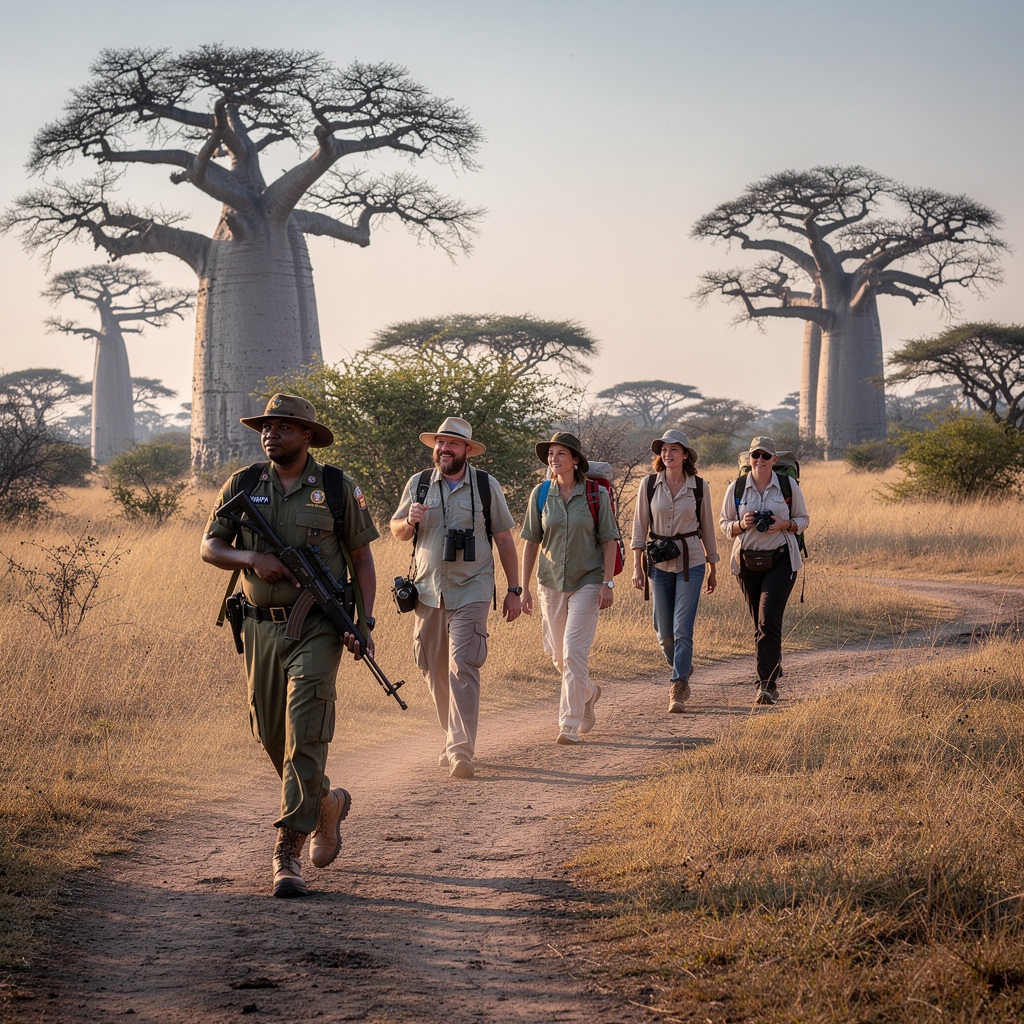
Walk 5 km on uneven terrain at 2 km/h, carrying 3 kg, in up to 32°C heat. Cardiovascular endurance matters less than ankle stability and heat tolerance. The pace is slow — the ground is not cooperative.
Tarangire terrain includes compacted savanna, loose volcanic sand, termite mound fields, and dry riverbeds with hidden subsurface voids. Ruaha adds rocky escarpments and miombo root systems. Nyerere includes knee-height reed corridors requiring high-stepping.
Who should not book a wilderness walking safari:
- Travelers with recent ankle surgery or active ligament instability
- Travelers with unmanaged asthma or cardiovascular conditions — consult your physician first
- Children under 12 — TANAPA minimum age for wilderness zones (see Tanzania safari with kids age limits)
- Travelers who cannot complete 5 km in warm conditions without stopping
Common mistakes that create real problems:
| Mistake | Why It Matters | What to Do Instead |
|---|---|---|
| Wearing shorts | Acacia thorns (3–5 cm) can pierce skin easily in dry savanna zones | Wear long trousers in neutral safari colors |
| Dark blue or black clothing | Tsetse flies in Ruaha and Nyerere strongly target dark tones | Use khaki, olive, tan, or stone colors |
| Heavy camera kit | Extra weight reduces walking efficiency and increases fatigue | Carry one body + light telephoto (max 200mm–300mm) |
| New boots | Blisters form quickly on uneven terrain (Serengeti edges, Tarangire bushland) | Break in boots for at least 3 weeks before safari |
| Hiding medical conditions | Guides must plan evacuation routes and walking pace safely | Disclose asthma, knee, or heart conditions before departure |
Field note — Tarangire River corridor, Lemiyon sector: Morning dew on dry riverbeds creates hidden sinkholes beneath compacted sand. At 7:15 AM, the first step off a hardened trail produced an ankle roll in unworn boots. Our guide rerouted to elevated ground for the return, adding 800 meters to the circuit. This is standard dry season adjustment — not an unusual event.
What Nobody Tells You About Walking Safaris
You will not see a leopard. Walks end by 10:00 AM without exceptions. Multi-day fly-camping uses long-drop sanitation. Lodge walks and walking safaris are entirely different activities — confusion between the two is the most common source of post-trip disappointment.
Leopard sightings are rare on foot. Leopards (Panthera pardus) detect approaching humans 200 meters before any visual is possible and move silently into canopy. Guides track them through claw scrapes, territorial scent marks, and kill positioning in tree forks. Evidence of leopards is common; direct sightings are not.
The 10:00 AM cutoff is absolute. By 9:30 AM in open Tarangire savanna, surface temperatures exceed 32°C. Wildlife retreats to shade. Thermal activity eliminates ambient scent tracking. TANAPA walking permits specify a hard morning window — afternoon walks are not a regulatory gray area.
Lodge walks are not walking safaris. A lodge nature walk is a 1-hour interpretive stroll within 500 meters of the property on cleared paths. It does not require an armed ranger. It does not enter active wildlife habitat. A TANAPA-regulated walking safari is a 3–4 hour trek through unrestricted corridors with mandatory ranger oversight and a formal walking permit. Most lodge websites describe both as “bush walks” — ask specifically which category applies before booking.
Fly-camp sanitation is basic. Ruaha and Nyerere wilderness camps use long-drop facilities. If sanitation standards are a deciding factor, Tarangire half-day walks from a lodge base are a more practical choice.
What to Wear and Carry on a Walking Safari
Pack light. You carry your own daypack for up to four hours in heat.
Mandatory clothing:
- ☑ Long-sleeved shirt — lightweight synthetic or cotton, neutral color (khaki, olive, stone, tan)
- ☑ Long trousers — same color palette, durable fabric
- ☑ Closed-toe hiking boots with ankle support — broken in minimum 3 weeks before travel
- ☑ Wide-brimmed hat with chin strap — wind gusts remove standard hats in open savanna
- ☑ Polarized sunglasses
Daypack contents:
- ☑ Minimum 2 liters of water per person
- ☑ SPF 50+ sunscreen — reapply every 90 minutes
- ☑ DEET 30%+ insect repellent — essential in tsetse-active Ruaha and Nyerere zones
- ☑ 8×42 or 10×42 binoculars
- ☑ Single camera body with 200mm lens maximum
- ☑ Personal first aid (blister plasters, antihistamines, personal medication)
- ☑ Lightweight fleece for 6:00 AM departure — dry season temperatures start at 16–19°C
Leave in the vehicle:
- Camouflage clothing — civilian camouflage is prohibited by Tanzanian law
- Perfume, scented lotion, or chemical-heavy sunscreen — elephants detect synthetic fragrance from approximately 1 km downwind
- Drones — prohibited in all Tanzanian national parks without broadcast permits
- Bright white, red, or yellow clothing
Tipping the armed ranger is prohibited under park policy. For guide and crew tipping norms, see the Tanzania safari tipping guide.
Why Trust Kilimania Adventure for This Information
- Base: Moshi, Kilimanjaro Region, Tanzania — physical office, not an online-only booking desk
- TATO registration: Registered member of the Tanzania Association of Tour Operators — verify at tatotz.org
- Field guide: Sabinus Msimba — 22 years guiding, 300+ Kilimanjaro summits, KINAPA-licensed
- Verify current fees at Tanzania National Parks (TANAPA) .
- Safari operations: Kanti Kessy — 17 years on the Northern Circuit, TATO-affiliated driver-guide
- Field days: 200+ days per year in Serengeti, Ngorongoro, Tarangire, and Lake Manyara
- Transparency: We publish honest limitations and real costs because travelers who understand the reality book better safaris
- Contact: +255 756 449 990, 7 days per week from Moshi
FAQ: Walking Safari Tanzania
Is a walking safari in Tanzania safe?
Yes. Walking safaris are safe when operated under TANAPA regulations with a licensed guide and armed ranger. Most incidents happen when travelers ignore guide instructions or move suddenly near wildlife.
Do walking safaris require an armed ranger?
Yes. TANAPA requires an armed ranger for all wilderness walking safaris in Tanzania outside lodge buffer zones.
Can you walk in Serengeti National Park?
Only in restricted lodge areas. Walking is prohibited in Seronera Valley and active migration corridors. Most Serengeti safaris are vehicle-based.
Can you walk inside Ngorongoro Crater?
No. Walking on the Ngorongoro Crater floor is permanently prohibited by NCAA regulations. Walking is allowed on the crater rim, Empakaai, and Olmoti.
How fit do you need to be for a walking safari?
You should comfortably walk 5–8 km on uneven terrain in warm temperatures. Tarangire and Arusha National Park walks suit moderate fitness levels.
What is the difference between a lodge walk and a walking safari?
A lodge walk stays close to camp and usually lasts 1 hour. A walking safari enters active wildlife habitat for several hours with a licensed guide and armed ranger.
What animals do you see on a walking safari?
Elephants, giraffes, zebra, antelope, buffalo, and birdlife are common. Lion tracks are regularly seen, while predator sightings are less frequent for safety reasons.
What should you wear on a walking safari?
Wear long trousers, long sleeves, and broken-in hiking boots in khaki, olive, or tan colors. Avoid black, dark blue, camouflage clothing, and strong perfume.
Are walking safaris suitable for children?
Usually for ages 12+. Younger children may struggle with heat, distance, and uneven terrain.
Which month is best for a walking safari in Tanzania?
June to October is best. Dry-season conditions improve wildlife visibility, walking safety, and cooler morning temperatures.
Plan Your Tanzania Walking Safari
Kilimania Adventure operates TANAPA-regulated walking safaris in Tarangire National Park and multi-day walking expeditions in Ruaha, with licensed guides, TANAPA-issued armed rangers, and departures from Moshi, Arusha, and Kilimanjaro International Airport (JRO). Contact our operations team for current ranger availability, seasonal walking conditions, and park access updates.
How We Verify Walking Safari Information
All operational procedures in this guide are based on active field operations, TANAPA walking permit regulations, and direct guide experience across Tarangire, Ruaha, Nyerere, and Arusha National Park.
This article is reviewed annually after TANAPA publishes updated park tariffs.
Plan Your Tanzania Walking Safari
Kilimania Adventure operates licensed walking safaris in Tarangire, Ruaha, and Northern Circuit extensions with TANAPA-authorized armed rangers.
WhatsApp: +255 756 449 990
Email: info@kilimania.co.tz
We provide itemized quotations with ranger fees, park fees, and seasonal access conditions clearly listed before booking.
Response times: Kilimania Adventure operates on East Africa Time (EAT, UTC+3) from Moshi. Messages sent after 6:00 PM EAT receive responses the following morning. All quote requests receive a reply within 12 hours, 7 days per week.
Verify our TATO registration: tatotz.org Official park fees: tanzaniaparks.go.tz NCAA crater regulations: ncaa.go.tz
For International Travelers
All prices are in USD. Current conversions: $1,000 ≈ £790 | €930 | AU$1,530.
Flights to Kilimanjaro International Airport (JRO):
- New York or Los Angeles: $800–$1,400 return
- London: £550–£900 return
- Sydney: AU$1,400–AU$2,200 return
Tanzania e-visa: $50 most nationalities | $100 US citizens — apply at immigration.go.tz at least 7 days before departure. Use Visa or Mastercard. Chrome or Firefox browser recommended.
Yellow fever certificate: required only if arriving from an endemic country. Not required for direct flights from USA, UK, EU, or Australia.
Continue Planning
- 3-day Tarangire walking and night safari — dedicated walking itinerary with day-by-day breakdown
- 7 days Tanzania safari Northern Circuit Big Five — full Northern Circuit with walking add-on options
- Budget camping safari Tanzania — campsite facilities and gear requirements for budget walkers
- Tanzania safari with kids — age limits, family fitness requirements, and child safety rules
- Zanzibar beach extension — post-safari beach options from Dar es Salaam
A walking safari adds $20–$30 in ranger fees to your itinerary and returns ecological knowledge no game drive can provide. Tarangire is the correct starting point for first-time walkers on a Northern Circuit itinerary — manageable terrain, strong elephant presence, and direct Lemiyon Gate access from Moshi. The armed ranger requirement is non-negotiable and exists for clear operational reasons. Proper footwear, neutral clothing, and honest fitness assessment determine whether the walk succeeds.
Disclosure: This article is written by Kilimania Adventure, a TATO-registered safari and Kilimanjaro operator based in Moshi, Kilimanjaro Region, Tanzania. We have a commercial interest in Tanzania safari bookings. All operational data reflects our own field experience. We encourage you to compare our quotes with at least two other TATO-registered operators before booking.
Last reviewed: May 2026 Review schedule: Updated each November following TANAPA’s annual tariff announcement. Fee changes applied within 72 hours of official publication.
We Walk With You.