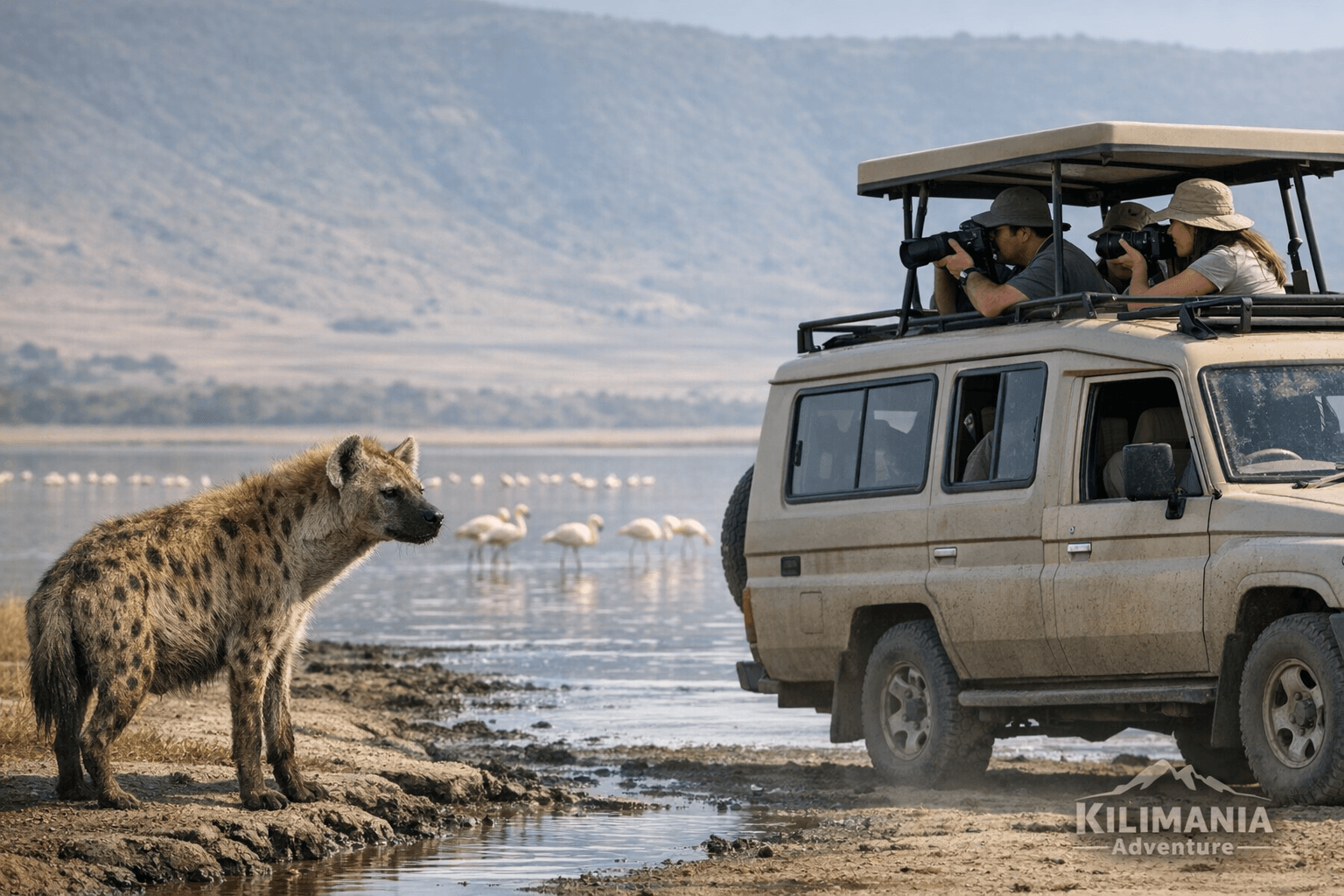
A 2-day Ngorongoro Crater safari from Moshi costs $450–$520 per person in a group of 4–6 travelers. Two travelers usually pay $650–$750 each, while solo travelers in a private vehicle pay $890–$950 because the $295 crater descent fee is charged per vehicle, not per person.
The drive from Moshi to Lodoare Gate takes 5.5–6 hours via Arusha and Karatu. A same-day return is not realistic. Minimum recommended itinerary: 2 days and 1 night.
The largest mandatory government fees in 2026 are:
- NCAA conservation fee: $70.80 per adult per day
- Ngorongoro Crater descent fee: $295 per vehicle
Any quote dramatically below these operational realities should be checked carefully before paying a deposit.
Key Stats
Budget a minimum of $450 per person in a group of 4–6. Any quote well below that number cannot cover the NCAA daily fee, descent fee, vehicle, licensed guide, and accommodation legally. If you receive a figure under $400 per person for 2 days, ask for a full line-item breakdown before paying any deposit.
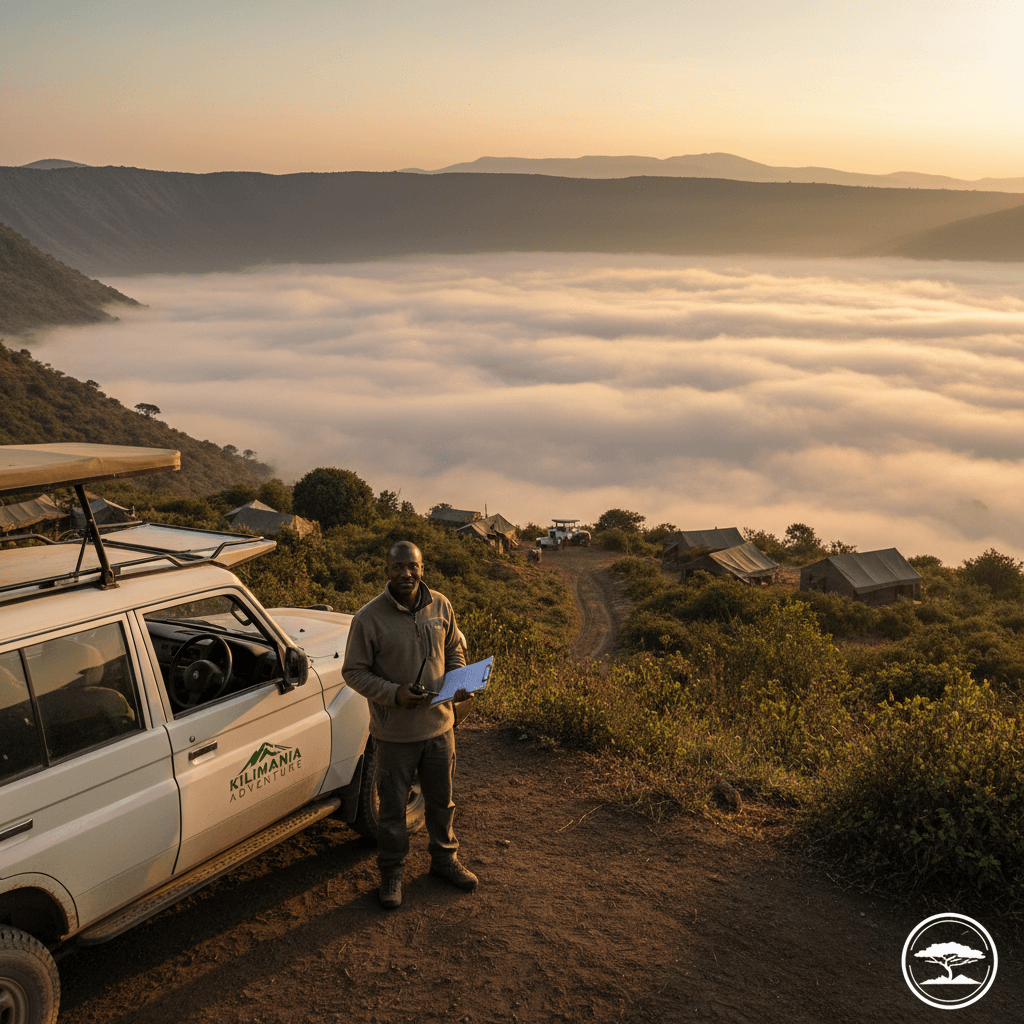
What Is a Ngorongoro Crater Safari from Moshi?
Ngorongoro Crater is the world’s largest intact volcanic caldera — 260 km² of enclosed grassland, alkaline lake, and forest managed by the NCAA (Ngorongoro Conservation Area Authority). Unlike Serengeti, where wildlife follows the Great Migration across 30,000 km², the Crater’s walls — averaging 600 meters high — keep resident lions, spotted hyenas (Crocuta crocuta), black rhinoceros (Diceros bicornis), buffalo, wildebeest, and zebra present every month of the year.
Starting this trip in Moshi makes practical sense for three traveler types. Kilimanjaro climbers who finish their summit in Moshi and want a wildlife extension before flying home. Travelers arriving at Kilimanjaro International Airport (JRO), which sits 40 km from Moshi — directly on the route toward the Conservation Area. And anyone who prefers to avoid a separate transfer to Arusha when their accommodation, climb, or onward flight is already anchored in Moshi.
The experience inside NCAA boundaries is identical whether your operator is based in Moshi or Arusha. Gate entry, conservation fees, crater descent rules, and wildlife zones do not change. What changes is the logistics getting there.
From our base in Moshi, Kilimanjaro Region, we run daily departures to Ngorongoro, Serengeti, Tarangire, and Lake Manyara, with pickups from JRO and Arusha Airport (ARK).
Ngorongoro Safari After a Kilimanjaro Climb
Many travelers begin their safari immediately after finishing Kilimanjaro because Moshi is already their recovery base before departure flights.
The most common sequence is:
- Kilimanjaro climb finishes in Moshi
- One recovery night at hotel
- Safari departure to Ngorongoro or Serengeti
- Return to JRO for international flight
This avoids unnecessary transfers to Arusha and keeps logistics simple after summit recovery.
How Much Does a Crater Trip from Moshi Cost in 2026?
The most important structural fact about Ngorongoro pricing: several major costs are fixed per vehicle, not per person. The crater descent fee is $295 whether you have one passenger or six. Vehicle hire is fixed. Only the NCAA fee ($70.80 per adult per day) and accommodation scale with passenger count — which is why group size affects the per-person total more dramatically here than at almost any other Tanzania park.
What the $295 Crater Descent Fee Costs Per Person
The crater descent fee is charged per vehicle — not per passenger. The total remains $295 regardless of how many travelers are inside the Land Cruiser.
All figures divide the fixed $295 per-vehicle fee across passengers. The total never changes — only who shares it.
Any quote under $400 per person for a 2-day itinerary cannot legally cover all required fees and services. If you see that number, ask for a line-by-line breakdown before sending any payment. See complete Serengeti Migration Month-by-Month Guide 2026.
Drive Time from Moshi to Lodoare Gate
Map tools often show 190 km and suggest a 3-hour drive. In real operations, the safari route from central Moshi through Arusha, Makuyuni, Mto wa Mbu, and Karatu to Lodoare Gate measures 240–260 km and takes 5.5–6 hours with stops. The discrepancy matters: planning around the map distance rather than the real drive time is one of the most common scheduling errors on this route.
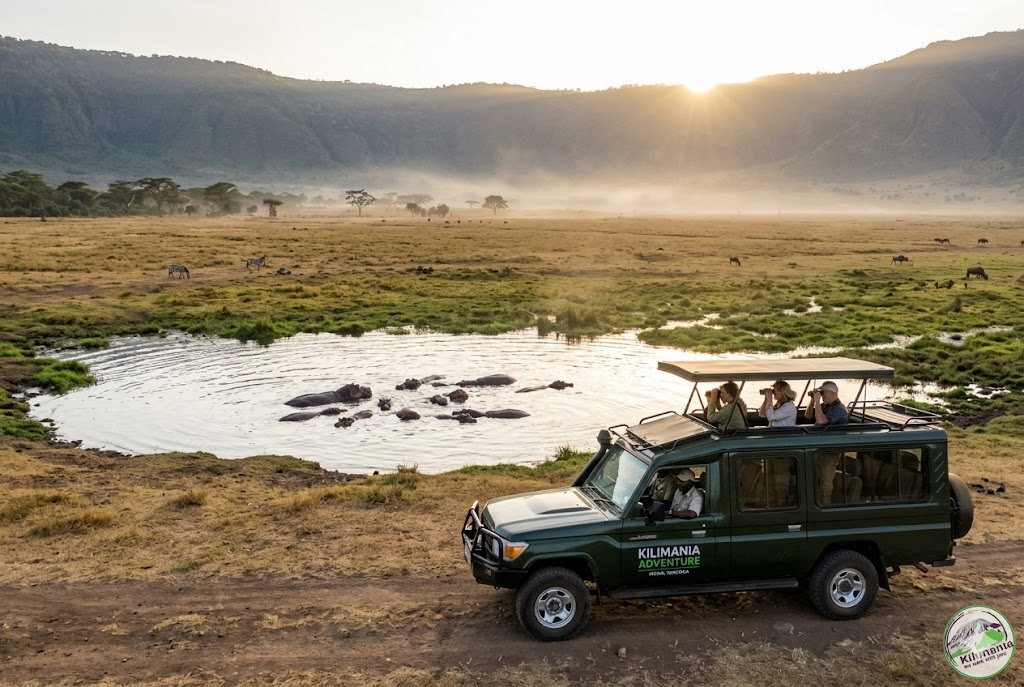
Kanti Kessy — 17 years driving the Northern Circuit — recommends leaving Moshi by 6:30–7:00 AM. That puts you at Lodoare Gate by early afternoon, clears gate queues before the midday rush, and gives you the afternoon wildlife window before settling into rim or Karatu accommodation.
The section from Karatu to the Crater rim is steep, winding, and noticeably cooler than the lowlands. If you are prone to motion sickness, request the front passenger seat before you leave Moshi. That is easier to arrange in advance than on a narrow highland road.
One scheduling note worth making plainly: do not plan a same-day international flight on the day you return from the Crater. Road delays happen. Sleep in Moshi or near JRO the night before any departure flight.
What Vehicle Is Used for Ngorongoro Safaris?
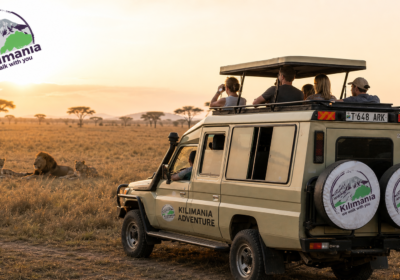
Most legitimate operators use a stretched 4×4 Toyota Land Cruiser with:
- pop-up safari roof
- charging ports
- refrigerator or cooler
- UHF/VHF wildlife radio
- reinforced suspension for crater roads
Ngorongoro descent roads are steep, dusty, and rough during some seasons. Small SUVs and standard vans are not permitted for most professional crater operations.
Can You Do Ngorongoro as a Day Trip from Moshi?
No — and the math explains why. Depart Moshi at 6:30 AM. Arrive Lodoare Gate by noon after stops. Clear formalities by 12:45 PM. Descend to the Crater floor by 1:15 PM. The mandatory gate closure is 6:00 PM, which means beginning your ascent no later than 5:30 PM. That leaves roughly 4 hours on the floor — then an immediate 5.5–6 hour return drive, arriving in Moshi after midnight.
That is a drive, not a safari.
The minimum that actually works is 2 days / 1 night. Day one is travel, arriving on the rim or in Karatu by late afternoon. Day two is the Crater — a 6:30 AM descent, five to six hours on the floor, picnic at Hippo Pool, ascent by 5:00 PM, and the return drive. Solo travelers who want both the Crater and a second park without stretching to 4 days should look at our 3-day Lake Manyara and Ngorongoro safari.
Which Itinerary Works for Your Schedule?
Two days is the minimum; three days is usually the better trip. Adding Lake Manyara National Park costs an additional $59 park entry per person per day — and significantly changes the wildlife variety, because Manyara’s woodlands hold tree-climbing lions and large elephant herds that the open Crater floor does not.
2-Day Itinerary
Kanti Kessy is direct about the 6:30 AM descent: “The first two hours on the floor are when lions are still active from the night. By 9:00 AM they are in the grass and the vehicle count has doubled. The early descent is the wildlife viewing — not a suggestion.”
3-Day Option: Add Lake Manyara
Day 1 covers Lake Manyara National Park — flamingos on the alkaline shoreline, tree-climbing lions in the fever tree forest. Day 2 is the full Ngorongoro Crater game drive. Day 3 is the return to Moshi. For travelers with a fourth day, the 4-day Tarangire, Ndutu, and Ngorongoro route adds Tarangire’s elephant concentrations — the highest density in East Africa outside Amboseli.
Private Safari vs Joining Group Safari
Private safaris give you a dedicated vehicle, flexible wildlife viewing time, and direct control over departure schedules. Joining safaris reduce costs by splitting vehicle and crater descent fees across multiple travelers.
Private Safari
Best for:
Couples, families, photographers
Main advantage:
Flexible pace and private wildlife viewing
Main limitation:
Higher overall cost
Joining Group Safari
Best for:
Solo travelers and budget travelers
Main advantage:
Lower price through shared costs
Main limitation:
Less schedule flexibility
Most photographers and honeymoon travelers choose private safaris because guides can spend longer at sightings without group pressure.
Is February Good for Ngorongoro?
February is one of the most underrated months for a crater trip from Moshi. Vehicle density on the Crater floor averages 15–20 vehicles simultaneously in February — compared with 40–60 in July and August. Accommodation runs 20–30% cheaper than peak dry season. And the resident wildebeest population — approximately 7,000 animals separate from the Serengeti Migration herds — calves in January and February, which drives unusually active lion, spotted hyena (Crocuta crocuta), and jackal behavior on the Crater floor.
The trade-off is visibility. Green-season grass is thicker, which makes cats harder to locate by eye than in dry-season open terrain. This is where guide knowledge matters far more than the season. Guides working the Crater use radio networks, behavioral tracking, and fresh sign — not just scanning for movement from the road. Isack Mlala and Louis Salvatory, both long-standing members of our team, use these methods to find predators during active windows even when vegetation is high.
Travelers focused on the Great Migration calving season should target Ndutu Plains and the southern Serengeti ecosystem between January and March.
These calving grounds sit roughly 150 km west of Ngorongoro Crater and are commonly combined in one Northern Circuit safari route.
Our 4-day Tarangire, Ndutu, and Ngorongoro safari combines calving herds, predator activity, and crater wildlife in a single itinerary.
Best time to visit Ngorongoro & Ndutu
What Wildlife Can You Realistically Expect?
The Crater’s enclosed ecosystem — walls averaging 600 meters high — keeps prey and predator populations resident year-round. There is no migration in or out. What you find depends on the guide’s knowledge of territory, behavior, and timing more than on luck.
Seen consistently: Lions, spotted hyenas, African buffalo, wildebeest, Burchell’s zebra, Grant’s and Thomson’s gazelles, hippos at permanent water sources, elephants (mainly older bulls), golden and black-backed jackals, warthogs, flamingos when lake levels allow.
Possible: Black rhinoceros (Diceros bicornis) — critically endangered, a small population persists on the Crater floor. Sightings are real but sometimes at a distance. No ethical guide promises them.
Uncommon: Leopard. The open grassland floor lacks woodland cover. Sighting rates inside the Crater are significantly lower than in Serengeti’s Seronera Valley or Tarangire’s riverine zones.
Adding elephants and baobabs? Explore our Tarangire National Park Safari Guide.
Speak With a Tanzania Safari Expert on WhatsApp
Chat directly with the Kilimania Adventure team for real safari prices and the best Serengeti itinerary for your dates and budget.
Moshi or Arusha: Which Starting Point Makes More Sense?
Start from wherever you are already sleeping. That is the honest answer.
Arusha sits about 80 km closer to Ngorongoro’s Lodoare Gate than Moshi. But Kilimanjaro International Airport (JRO) lies between the two cities.
If you land at JRO and transfer first to Arusha, you drive east before turning back west toward Ngorongoro. That usually adds 60–80 km and around one extra hour of road time.
For travelers arriving through JRO or combining safari with a Kilimanjaro climb, Moshi is often the more practical starting point. Travelers already sleeping in Arusha usually save time departing directly from Arusha.
The more useful question is not which town to use, but which operator has a TATO registration, a licensed guide, and a transparent quote. Verify any operator at tatotz.org before paying a deposit, regardless of where they are based.
What Is Included and Excluded?
A complete 2-day crater package from Moshi covers hotel or JRO pickup, a 4×4 Toyota Land Cruiser with a pop-up roof, a KINAPA-licensed driver-guide, NCAA conservation fee ($70.80 per adult per day), crater descent fee ($295 per vehicle), accommodation, and all meals. That is what “fully inclusive” means.
Not included in any legitimate package: Tanzania e-visa ($50 most nationalities, $100 US citizens — apply at immigration.go.tz), international flights, travel insurance, tips, alcoholic drinks, and personal medical costs.
On travel insurance: Tanzania has limited medical infrastructure in remote areas. A policy covering emergency evacuation is not optional on this itinerary.
Tipping: $25–$40 per vehicle per day for your driver-guide; $10–$15 per traveler per day for a camping cook. Paid in cash at the end of the safari.
How to Spot a Fraudulent Quote
Any 2-day quote below $400 per person cannot cover the NCAA daily fee, crater descent fee, vehicle, and licensed guide simultaneously. The arithmetic is not complicated — the fixed government fees alone account for $140–$215 per person before a vehicle, fuel, guide, or bed is added.
The $ 295-per-vehicle crater-descent fee is the most commonly misquoted figure in this niche. Some operators list it per person — producing a total of $1,180 for four passengers on a fee that should cost $295. Others simply leave it out of the quote and demand cash at the descent road inside the Conservation Area.
Five patterns to recognize:
- Deposit theft — operator takes 30–50% and does not appear on departure day.
- Park fee exclusion — NCAA fees absent from quote; cash demanded at Lodoare Gate.
- Crater descent omission — $295 not in writing; demanded in cash at the descent road.
- Bait and switch — price agreed, then “fuel surcharge” or “VAT revision” added on arrival in Tanzania.
- Unlicensed operation — real vehicle, real departure, but no TATO registration and no guide license.
Before paying any deposit, confirm in writing:
- NCAA conservation fee per person per day (should be $70.80)
- Crater descent fee total and per-passenger calculation (should be $295 ÷ group size)
- Exact accommodation name, not just tier
- VAT inclusive or exclusive, stated clearly
- Cancellation terms
A serious operator answers these questions immediately and in writing.
Red Flags at a Glance
“Priced the same 7-day safari through an Australian agent: $2,950. Emailed Kilimania directly: $2,100 for the same itinerary. The $850 we saved paid our Zanzibar flights.” — Laura and Mike, UK, November 2025 [Verified Google Reviews]
“Honest warning: July nights at Ngorongoro rim are freezing. Bring thermal underwear. But we saw a leopard kill at 6 AM because we were already at the gate.” — Emma v.d.B., Netherlands, March 2026 [Verified TripAdvisor]
Speak With a Tanzania Safari Expert on WhatsApp
Chat directly with the Kilimania Adventure team for real safari prices and the best Serengeti itinerary for your dates and budget.
Why Travelers Use Moshi as Their Safari Base
Moshi is not just a Kilimanjaro climbing town. It is also a practical safari departure point because:
- JRO airport sits only 40 km away
- Many climbers have already finished expeditions in Moshi
- Hotels are usually cheaper than in Arusha
- Transfers are simpler after summit recovery
For travelers combining Kilimanjaro and safari in one itinerary, Moshi often reduces unnecessary transport time and hotel changes.
FAQ: Ngorongoro Crater from Moshi
Is Ngorongoro better from Moshi or Arusha?
How much does a crater trip from Moshi cost per person in 2026?
How far is Moshi from Ngorongoro Crater?
Can you do a day trip from Moshi to the Crater?
Is the crater descent fee per person or per vehicle?
Is February a good month to visit?
Are park fees included in the package?
Can I see the Big Five in Ngorongoro?
Should I sleep in Karatu or on the rim?
Do I need malaria prevention?
How far ahead should I book?
Why Trust This Information
- Base: Moshi, Kilimanjaro Region, Tanzania — physical office, daily departures
- TATO registration: Verify at tatotz.org
- Kilimanjaro guiding: Sabinus Msimba, 300+ summits, 22 years, KINAPA-licensed
- Northern Circuit: Kanti Kessy, 17 years, 200+ field days per year across Serengeti, Ngorongoro, Tarangire, and Lake Manyara
- Transparency: We publish honest limitations, real park fee data, and the actual cost floor — because travelers who understand the real numbers book better trips
Health note: This article references malaria risk and cold temperatures at the Crater rim (8–12°C at night, year-round). Malaria prevention decisions require a qualified travel clinic consultation — not a safari operator. Pack warm layers for the rim regardless of what month you travel.
Financial accuracy: All prices reflect June 2026 Kilimania Adventure operational costs and verified NCAA and TANAPA fee schedules.
Conclusion
A Ngorongoro Crater safari from Moshi is realistic, efficient, and highly worthwhile for travelers already near Kilimanjaro International Airport or finishing a Kilimanjaro climb.
The most important numbers to understand before booking are:
- NCAA conservation fee: $70.80 per adult per day
- Crater descent fee: $295 per vehicle
Those two costs explain most safari pricing differences in Tanzania.
For most travelers, the best value comes from a 2-day or 3-day itinerary shared between 4–6 passengers. Solo travelers should strongly consider joining departures to reduce fixed vehicle costs.
If a quote seems dramatically cheaper than the real operational floor, request a full breakdown before sending money.
The Crater delivers one of the highest wildlife densities in Africa — but good planning, realistic timing, and a licensed guide matter more than simply choosing the cheapest package. See our 3-day Lake Manyara and Ngorongoro safari; for a four-day extension that adds Tarangire, the 4-day Tarangire, Ndutu, and Ngorongoro itinerary is the option most of our Moshi-based travelers choose.
We Walk With You.
Speak With a Tanzania Safari Expert on WhatsApp
Chat directly with the Kilimania Adventure team for real safari prices and the best Serengeti itinerary for your dates and budget.
Disclosure: This article is written by Kilimania Adventure, a TATO-registered safari operator based in Moshi, Tanzania. All prices reflect 2026 costs from verified operations and government fee schedules. We recommend comparing quotes with at least two other TATO-registered operators.
Written by: Sabinus Msimba, Senior Safari Guide, Kilimania Adventure
Experience: 22 years guiding Serengeti, 300+ Kilimanjaro summits, KINAPA-licensed
Last Updated: January 2026
TANAPA park fees verified January 2026. Always check tanzaniaparks.go.tz before booking.
For International Travelers
All prices in USD. Approximate conversions: $800 ≈ £635 | €740 | AU$1,240.
Flights to Kilimanjaro International Airport (JRO): New York/LA $800–$1,400 return | London £550–£900 | Sydney AU$1,400–AU$2,200.
Tanzania e-visa: $50 for most nationalities | $100 for US citizens — apply at immigration.go.tz at least 7 days before departure using Chrome or Firefox with a Visa or Mastercard.
Yellow fever: Required only if arriving from an endemic country. Not required from the USA, UK, EU, or Australia.
Pre-safari accommodation in Moshi: $35–$80 per night.
Kilimania Adventure operates on EAT (UTC+3) — 3 hours ahead of London, 8 hours ahead of New York. All enquiries receive a reply within 12 hours, 7 days per week.