
Updated: May 2026 | 20 min read
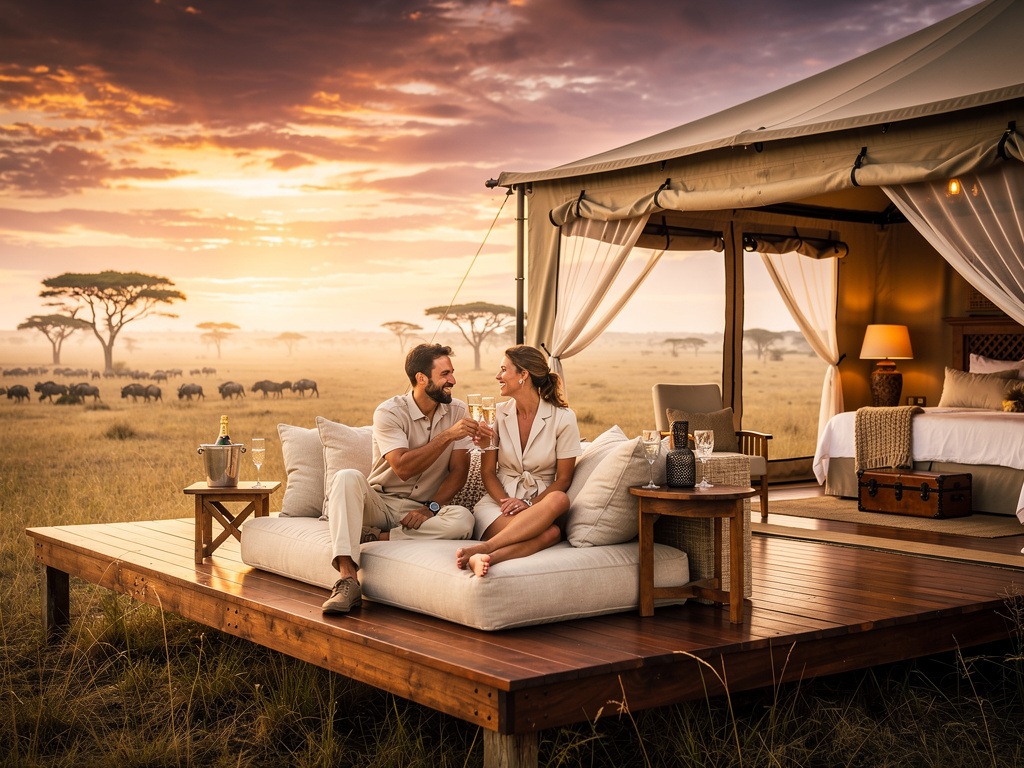
Tanzania honeymoon safari combines the Serengeti’s Great Migration, Big Five game drives in Ngorongoro Crater, and Zanzibar’s white-sand beaches in one journey. This guide answers the key planning questions couples ask about costs, safety, timing, and how to structure a seamless safari-to-beach honeymoon in 2026.
Tanzania Honeymoon Safari: Quick Answer
A Tanzania honeymoon safari and Zanzibar package combines world-class wildlife with Indian Ocean beaches in one trip. Most couples spend 6–7 nights on safari in Tarangire, Ngorongoro Crater, and Serengeti, followed by 3–5 nights in Zanzibar.
The most popular itinerary is 10 days, with a private safari, a bush flight from Serengeti to Zanzibar, and four beach nights. Expect to pay between $5,800 and $20,000+ per couple, depending on accommodation level and travel season.
The best time to visit is June to October for dry-season wildlife viewing and late December to February for calving season in southern Serengeti. September offers the strongest combination of safari conditions and Zanzibar beach weather.
This guide explains costs, itinerary options, lodge selection, bush flight logistics, the best Zanzibar beaches, and how to plan a honeymoon that matches your budget and travel style.
At a Glance
| Factor | Detail |
|---|---|
| Best For | Couples planning 6–18 months ahead |
| Sweet Spot Duration | 10 days (6 safari nights + 4 beach nights) |
| Best Months | Late June–October; late December–February |
| Key Safari Parks | Tarangire, Ngorongoro Crater, Serengeti |
| Beach Destination | Zanzibar — north coast or east coast |
| Arrival Airport | Kilimanjaro International Airport (JRO) |
| Bush Flight | Seronera or Kogatende → Zanzibar (ZNZ), 2h 15m–3h |
| Soft Bag Limit | 15kg maximum on all bush flights |
| Nearest Operator Base | Moshi, Kilimanjaro Region — 1 hour from JRO |
Tanzania Honeymoon Safari Packages Compared
| Package | Days | Price Per Couple | Best For |
|---|---|---|---|
| Budget | 7 Days | $5,800–$7,200 | First safari and Zanzibar experience |
| Mid-Range | 10 Days | $7,800–$11,000 | Most honeymoon couples |
| Luxury | 10 Days | $12,000–$20,000+ | Private safari and premium lodges |
| Ultra Luxury | 14 Days | $18,000–$28,000+ | Private villas and exclusive experiences |
Recommendation: The 10-day mid-range itinerary offers the best balance of wildlife, comfort, and value for most honeymoon couples.
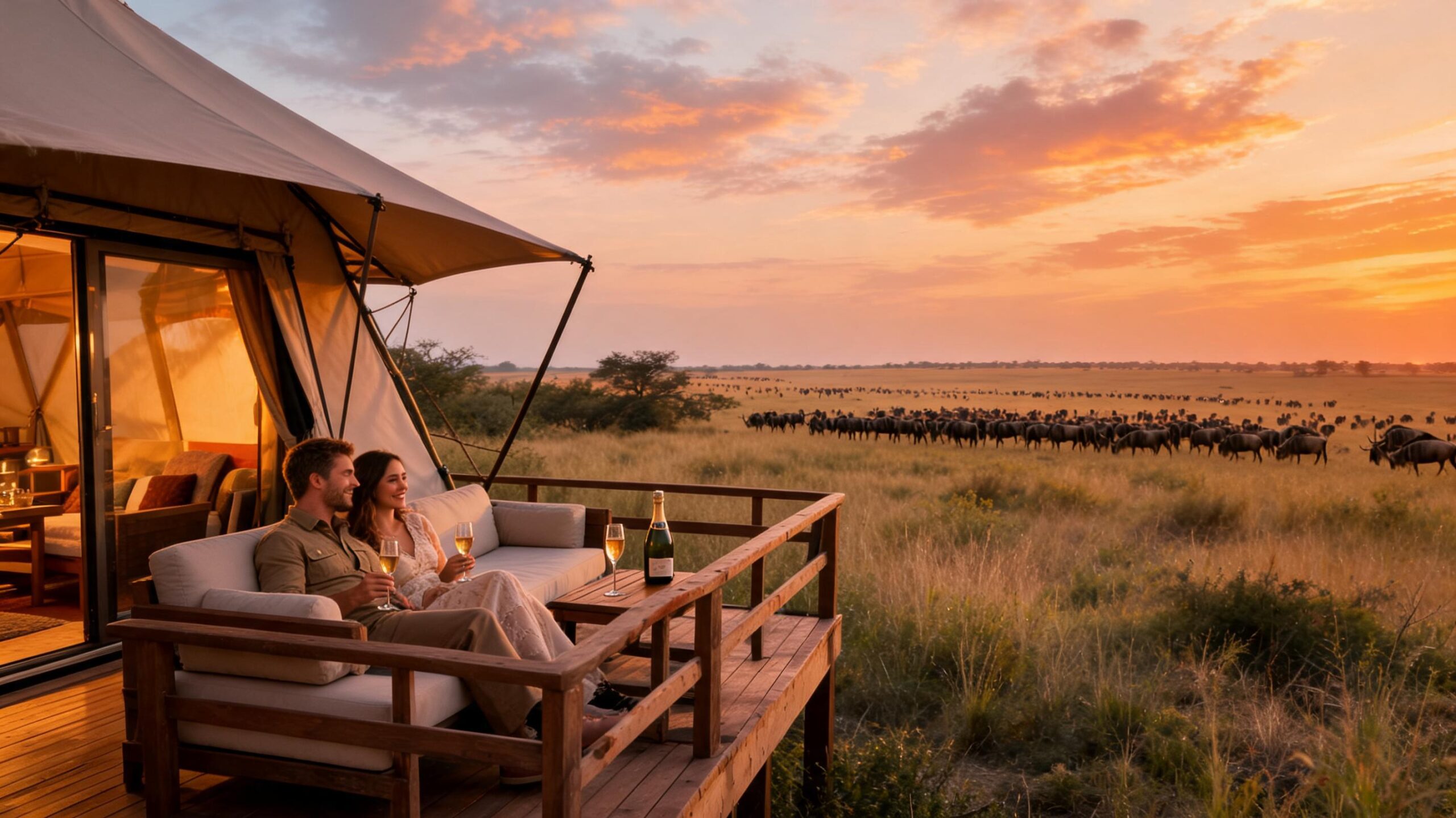
Table of Contents
Why Tanzania Works as a Honeymoon Destination
Three structural facts make Tanzania work specifically for honeymooners — not marketing claims, but operational realities our guides see on the ground every season.
1. Wildlife Density Is Documented, Not Marketed
Ngorongoro Crater holds one of the highest concentrations of large mammals on Earth within a contained 260 km² caldera. On a single crater floor day, you can realistically encounter all of the Big Five — African lion, African elephant, Cape buffalo, leopard (Panthera pardus), and black rhino. That last one matters: black rhinos are functionally gone from most of East Africa. The Ngorongoro population, around 25–30 individuals, is one of the last genuinely viewable wild populations on the continent.
In Tarangire National Park, our guides regularly encounter elephant herds of 80 or more animals near the Tarangire River and Silale Swamp during the September–October dry season. The Seronera Valley lion prides in central Serengeti have been continuously studied since 1966 — they are among the most vehicle-habituated large predators in Africa. Cheetah (Acinonyx jubatus) sightings in the open grasslands south of Seronera are consistent from June through October.
2. The Beach Transfer Is Genuinely Short
Unlike Southern African honeymoons that require repositioning flights of three to five hours, the transfer from Seronera airstrip to Zanzibar (ZNZ) takes one bush flight with a single stop — 2h 15m to 2h 45m total. You leave the Serengeti in the morning and reach a beach resort by late afternoon of the same day. That transition is one of the most satisfying single days of travel you can plan.
3. Real Privacy Tiers Exist — At a Price
At premium level — camps like Sayari Camp by Asilia Africa, One Nature Mara River, or Singita Sasakwa Lodge — honeymoon suites with private plunge pools, meaningful distance from neighboring units, and dedicated butler service are operational realities, not brochure language. The price reflects this: $1,650–$5,400 per couple per night.
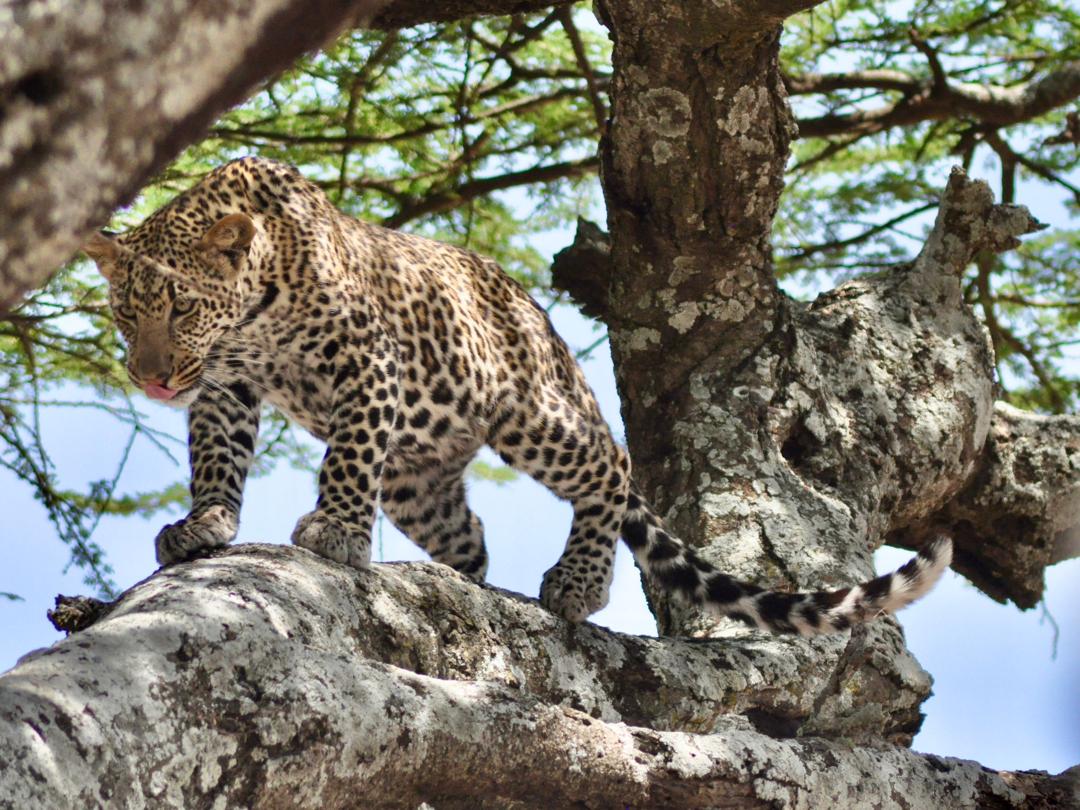
At mid-range, privacy is less, but genuine wildlife access is identical. The Serengeti does not care what tier of camp you stay in. The leopard at the sausage tree on the Seronera River is visible from any vehicle.
The honest trade-off: International flights add $1,200–$2,200 per couple. Bush flight baggage rules require real packing discipline — more on that below. Ngorongoro rim nights drop to 8–12°C even in July. Cold, dusty, early mornings. These are manageable constraints, not reasons to reconsider.
Tanzania Honeymoon Safari Cost (2026 Prices)
A Tanzania honeymoon safari typically costs $2,500 to $12,000 per couple depending on duration, luxury level, and season.
- Budget honeymoon safari (5 days): $250–$350 per person per day
- Mid-range honeymoon safari (7 days): $350–$600 per person per day
- Luxury honeymoon safari (7–10 days): $700–$1,500 per person per day
What is included:
- 4×4 safari vehicle with pop-up roof
- Professional guide and driver
- Park fees (Serengeti $70–$83/day, Ngorongoro $70/day + crater fee)
- Accommodation (lodges or tented camps)
- Meals during safari
- Airport pickup from JRO or ARK (Moshi/Arusha)
Flights to Tanzania and tips are not included.
For a line-by-line cost comparison, see our Tanzania safari cost 2026 guide.
For a detailed per-park fee breakdown and full cost structure, see our Tanzania safari cost guide.
Best Honeymoon Safari Itineraries in Tanzania
5-Day Honeymoon Safari (Budget Option)
- Tarangire National Park (elephants & baobabs)
- Ngorongoro Crater (Big Five in one day)
- Lake Manyara (lions & flamingos)
7-Day Honeymoon Safari (Most Popular)
- Tarangire National Park
- Serengeti National Park (central + migration zones)
- Ngorongoro Crater
- Optional hot air balloon Serengeti ($599 per person)
10-Day Luxury Honeymoon + Zanzibar
Fly to Zanzibar for a beach honeymoon extension
Serengeti + Ngorongoro + Tarangire
See our full safari packages page for 14-day departure dates from Moshi.
Bush Flight Logistics: Serengeti to Zanzibar
This is the section most articles skip or reduce to a single line. The bush flight is simple — once you understand how it actually works.
The Route
From Central Serengeti (Seronera airstrip, SEU):
Seronera → Arusha (ARK, refueling stop) → Zanzibar (ZNZ). Total flight time: 2h 15m–2h 45m. Departures typically 10:45 AM–1:00 PM. Zanzibar arrival: 2:15–3:30 PM.
From Northern Serengeti (Kogatende airstrip, KGT):
Kogatende → Lake Manyara stop → Zanzibar (ZNZ). Total: 2h 45m–3h 30m.
Operators: Coastal Aviation, Auric Air, Regional Air Tanzania. All operate scheduled shared bush flights.
Aircraft: Cessna 208 Caravan (12 seats), occasionally Cessna 404 Titan. Not pressurized. Maximum altitude 10,000 feet. Expect light turbulence over the Rift Valley escarpment.
Cost: $295–$520 per person, Seronera or Kogatende to Zanzibar. Book 3–6 months ahead for peak season.
The Rules Nobody Explains Clearly
Luggage: 15kg per person, strict. Soft duffel bag only — no hard-shell suitcases, no wheeled carry-ons. A small daypack counts as your personal item and is permitted in addition to the 15kg duffel. Excess luggage: $5–$8 per kg, paid in cash at the airstrip. The Seronera airstrip weighs bags on a digital scale in front of the aircraft. It is not a negotiation.
Practical solution: Before your safari, leave your main suitcase in free storage at your Moshi hotel. Travel the entire safari in two 15kg soft duffels. Collect the suitcase on your return to Moshi after Zanzibar.
Transfer day reality: Lodge checkout → vehicle to airstrip (30–60 minutes) → bag weigh and boarding → flight → Arusha stop (30–40 minutes on ground) → onward leg → Zanzibar taxi transfer (30–45 minutes). Total door-to-door: 7–9 hours. Plan for a late beach arrival on this day. Do not book a sunset dinner reservation.
No Wi-Fi at Seronera. Print your bush flight confirmation before leaving the lodge.
Best Months for Safari and Beach Weather
The two destinations have independent weather patterns that occasionally align perfectly and occasionally clash entirely.
The Full Month-by-Month Picture
| Month | Safari Quality | Zanzibar Beach | Honeymoon Verdict |
|---|---|---|---|
| January | Excellent — Ndutu calving begins, blue wildebeest (Connochaetes taurinus) births | Hot, clear, swimmable | ✅ Strong |
| February | Excellent — peak calving at Ndutu, Serengeti south | Hot, clear, swimmable | ✅ Strong (most underrated month) |
| March | Declining — long rains approaching, mud on Ndutu access roads | Rains arriving mid-month | ⚠️ Book only early March |
| April | Poor — long rains, many camps closed, roads impassable | Long rains, rough seas, not swimmable | ❌ Avoid entirely |
| May | Very poor — camps reopening late May only | Rains tapering, seas rough | ❌ Avoid |
| June | Very good — migration moving north, Grumeti River crossings | Dry, warm, swimmable | ✅ Strong |
| July | Very good — northern Serengeti filling, first Mara crossings | Dry, cool evenings, swimmable | ✅ Strong |
| August | Excellent — Mara River crossings peaking | Dry, warm, clear | ✅ Excellent |
| September | Excellent — Mara crossings continue, peak big cat activity | Dry, warm, clear | ✅ Best single month |
| October | Very good — crossings tapering, Serengeti south reactivating | Dry, warm, swimmable | ✅ Strong |
| November | Green season — short afternoon rains, quiet parks, discounts | Short afternoon showers, mostly usable | ✅ Good value, some weather risk |
| December (late) | Very good — herds moving south to Ndutu for calving | Hot, swimmable | ✅ Strong |
Why February Gets Underestimated
February is the most commonly misjudged month. Couples assume “near March” means near the rains. It does not. February is peak calving season at Ndutu — thousands of blue wildebeest calves born within a few weeks, which concentrates predators at densities that rival the Mara crossings. Zanzibar is hot and clear. It is the strongest value month in the calendar.
Why April Is Non-Negotiable
The low rates in April exist for a direct reason. Long rains hit both mainland Tanzania and Zanzibar simultaneously. Many Serengeti camps close physically. Ngorongoro and Tarangire roads deteriorate to the point where vehicles can become stuck. The price is irrelevant — the experience does not happen at the level that justifies the journey.
For the complete migration calendar and month-by-month Serengeti conditions, see our Serengeti migration month-by-month guide.
Private vs Shared Safari Vehicle
For most honeymoon couples, this is the single most important planning decision after choosing travel dates.
What the Difference Actually Means on the Ground
Shared vehicle (4–6 passengers): You depart at 6:00 AM because that is when the group agrees to depart. You leave a sighting when the group votes to move. You wait while another couple photographs something that does not interest you. You have two pop-up roof hatches shared between six people.
Private vehicle (just the two of you + guide): You depart when you choose. You stay with the leopard for 90 minutes because you want to. You eat your packed lunch at the site of the action if the action is happening. You have every roof hatch. Your Maasai guide Kanti does not need to manage six opinions — he focuses entirely on finding what you want to see.
Safari Accommodation Styles
1. Budget Safari Accommodation ($80–$180 per person per night)
- Shared campsite tents or basic lodge rooms (bandas)
- Shared bathrooms (long-drop or basic flush toilets)
- Cold or bucket showers (heated on request in some camps)
- Foam camp beds, not proper hotel mattresses
- No electricity inside tents (only common area lighting)
- Simple 2-course meals cooked at camp
- Shared safari vehicles with 5–7 guests
- Best for: young travelers, backpackers, budget explorers
2. Mid-Range Safari Lodges ($200–$450 per person per night)
- Private tent or lodge room (25–40 m²)
- En-suite bathroom (flush toilet + hot shower)
- Real bed with mattress, linen, and mosquito net
- Solar + generator electricity (usually 12–24 hours/day)
- USB charging points inside the room/tent
- Full-board meals (breakfast, lunch, dinner included)
- Safari vehicles shared with 2–4 guests (sometimes private option)
- Wi-Fi available in the main lounge (slow connection)
- Best for: couples, families, first-time safari travelers
3. Luxury Safari Lodges ($600–$2,000+ per person per night)
- Large private suites or villas (50–120 m²)
- Indoor + outdoor bathrooms, sometimes bathtubs and plunge pools
- 24-hour electricity and air-conditioning in some lodges
- King-size beds with premium bedding and turndown service
- À la carte dining and premium wine & drinks included
- Fully private safari vehicle with flexible schedule
- Night drives and walking safaris in private concessions (where allowed)
- Best for: honeymooners, luxury travelers, private high-end trips
Key Differences at a Glance
- Budget: Shared facilities, basic comfort, lowest cost
- Mid-range: Private rooms + real bathrooms + strong comfort upgrade
- Luxury: Full privacy + premium service + high-end amenities
Most Important Reality (Tanzania Safari Truth)
- The biggest upgrade is not decoration — it is privacy, hot water, and power reliability
- Mid-range already gives ~80% of the luxury safari experience at ~50% of the price
- Budget safaris save money but reduce comfort and travel flexibility significantly
A private vehicle on a 6-day safari adds roughly $1,200–$1,800 to the total. In most cases, that upgrade improves every game-drive hour of the trip more than any single lodge upgrade at an equivalent cost.
The Radio Reality
A private vehicle controls your schedule — not your solitude at sightings. The park ranger’s radio operates across all vehicles. When a cheetah with cubs is reported near the Seronera River, vehicles converge. Your private vehicle gets you there first and lets you stay longest when others leave. You will not always be alone at the sighting. For genuine wildlife solitude, request camps in low-density concessions: Loliondo Game Controlled Area, Grumeti Reserve, or the Klein’s Gate area in far northeastern Serengeti, where vehicle numbers are limited by concession terms rather than park-wide rules.
For full private safari options from Moshi, see our Tanzania safari packages.
Which Zanzibar Coast Is Right for Your Honeymoon?
Zanzibar is not one experience. The north coast and east coast are functionally different destinations.
North Coast: Nungwi and Kendwa
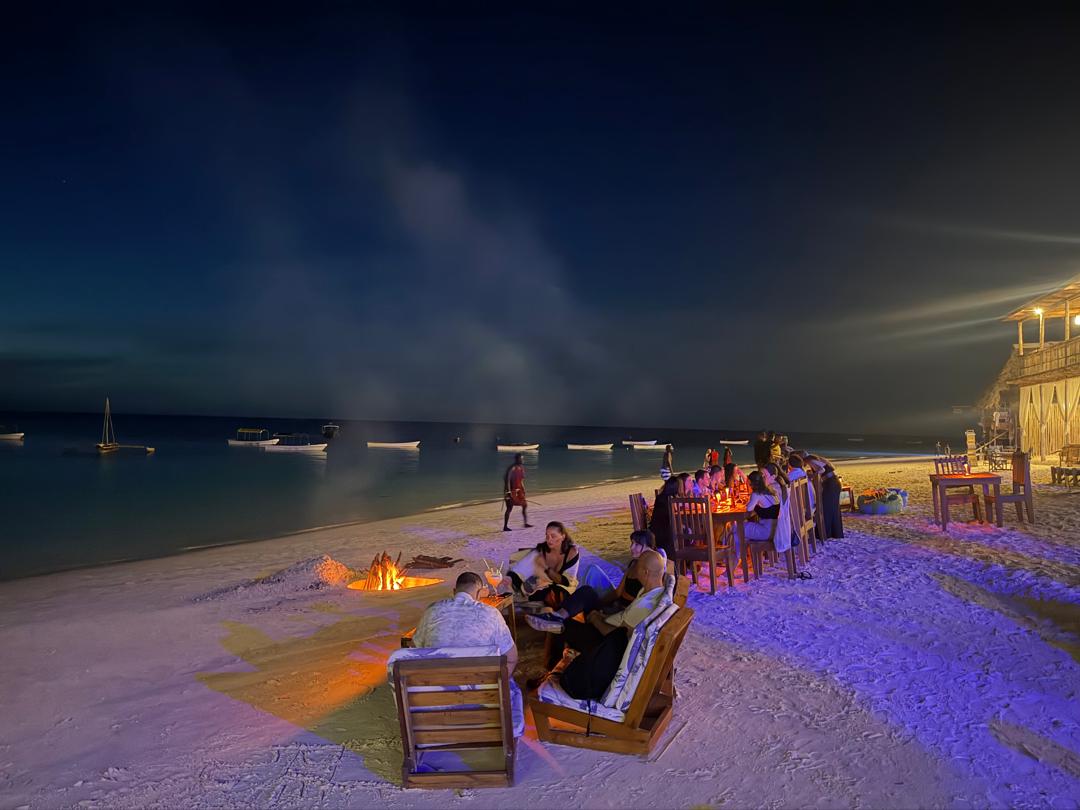
The north coast faces west and northwest. Tides are gentler. Swimming is possible at almost any tide level without crossing long stretches of exposed reef flat. Sunsets are over water — you watch the sun drop into the Indian Ocean from your beach chair. There is some nightlife at Nungwi — beach bars, live music at the larger hotels. Kendwa is quieter.
Best for: First-time honeymooners who want guaranteed sea access, sunset views, and some social atmosphere.
East Coast: Matemwe, Paje, Jambiani, Kiwengwa
The east coast faces the open Indian Ocean. The water is turquoise, and the beaches are arguably more photogenic. The resorts are more spread out. But the tidal range is significant — at low tide, the water can recede 600–800 meters, leaving exposed sand and reef flat for several hours. Swimming is not always possible from the beach.
Kiwengwa is popular with European charter groups and has some of the larger all-inclusive resorts. Matemwe is quieter and closer to the Mnemba Atoll snorkeling. Paje is known for kite surfing and attracts a younger crowd. Jambiani is the quietest of the east coast villages — simple, local, unhurried.
Best for: Couples who prioritize seclusion over guaranteed swimming, or who plan to spend time in the water specifically at high tide. Check current tide tables through the Tanzania Meteorological Authority before finalizing an east-coast booking.
Stone Town: Worth One Night
Stone Town is not a beach destination — it is a UNESCO World Heritage Site and one of the best-preserved Swahili coastal trading towns in the world. Forodhani Gardens street food at night, the old Arab Fort, the House of Wonders, the former slave market site, and the narrow winding alleys of the old quarter are all worth half a day. If your itinerary allows a Stone Town night between the airstrip arrival and your beach resort transfer, it adds genuine cultural depth. It is not a place to base your beach honeymoon.
Honeymoon-Friendly Lodges by Park
The Honest Caveat
Every camp in Tanzania’s Northern Circuit markets itself as “romantic.” The word is used so broadly it has become meaningless. Below, we separate lodges with structural honeymoon features — private plunge pools, real suite isolation, meaningful distance from neighboring units — from those that are simply comfortable and well-run.
Structural features worth verifying before booking:
- Which specific tent or unit number is the honeymoon suite
- Distance in meters to the nearest occupied unit
- Whether the private plunge pool is actually private or shared with two adjacent suites
- Whether a dedicated private deck faces the view you expect
Tarangire National Park
Oliver’s Camp (Asilia Africa)
Small (ten tents), eastern Tarangire, inside the park. Anti-poaching walking safaris included. Honeymoon tent (Tent 1 or 2) has an elevated deck facing the Tarangire plains. No plunge pool, but the isolation is real — 80+ meters between units.
Per couple per night (2026): $1,200–$1,650 | Style: Intimate, walking-focused
Sanctuary Swala
Deeper inside Tarangire, away from the main gate crowds. Eleven tents. Tent 11 is the recognized honeymoon unit — positioned at the perimeter with open bush views and no adjacent unit within 60 meters. Rose petals and champagne on arrival when requested in writing at booking.
Per couple per night (2026): $900–$1,350 | Style: Classic tented camp, honeymoon-specific unit available
Tarangire Treetops (andBeyond)
Unusual architecture — suites built into or around massive baobab trees. Feels genuinely different from standard tented camps. The treehouse suites have private viewing decks. Less suited to couples who want a pure bush-intimacy feel; better for couples who want a visual wow factor.
Per couple per night (2026): $1,100–$1,600 | Style: Architecture-led, baobab tree setting
Ngorongoro Conservation Area
Ngorongoro Crater Lodge (&Beyond)
The most photographed lodge in Tanzania. Three separate camps (North, South, Tree) on the crater rim at 2,300 meters. Dramatic Maasai-meets-colonial décor. Each suite has a private viewing window directly over the crater. The lodge is not subtle — chandeliers, rose-petal baths, butler service. Genuine honeymoon infrastructure.
Per couple per night (2026): $2,200–$4,800 | Style: High drama, genuinely private suites
Entamanu Ngorongoro (Nomad Tanzania)
Twelve tents on the western crater rim. More understated than Crater Lodge. Views from the private deck are outstanding. The tent spacing is real — this is not a row of tents with thin canvas walls between couples. Cold nights are guaranteed (pack a fleece regardless of the month).
Per couple per night (2026): $1,800–$2,800 | Style: Understated elegance, genuine seclusion
Ngorongoro Farm House (Elewana)
On the Karatu coffee farm just outside the NCA boundary. Not inside the crater access zone — transfer to the crater gate each morning. Better suited to couples who want a softer aesthetic and more resort-style comfort than the exposed rim lodges. Lower-cost tier.
Per couple per night (2026): $600–$900 | Style: Farm setting, mid-range, good base for crater days
For the full Ngorongoro experience and drive logistics, see our Ngorongoro Crater safari from Moshi guide.
Serengeti National Park
For the complete lodge ranking with real prices, migration zones, and unit-by-unit analysis, see our 15 Best Serengeti Lodges 2026 guide.
Sayari Camp (Asilia Africa) — Northern Serengeti, Kogatende
The closest permanent camp to the Mara River crossing zone. Fifteen tents. Tent 1 (Nyumba Suite) is the recognized honeymoon suite — a freestanding structure with a private plunge pool, outdoor shower, and full-length deck facing the Mara River valley. When the migration is active (July–October), wildebeest are visible from the private deck.
Per couple per night (2026): $2,200–$3,800 | Style: Luxury, migration-zone positioning, genuine suite isolation
One Nature Mara River Camp
Nine tents, northern Serengeti. Smaller than Sayari and less well-known, which means better value and fewer vehicles from the camp at sightings. Private decks on all units. Honeymoon setup (flowers, cake, champagne) reliable when requested at booking.
Per couple per night (2026): $1,800–$2,800 | Style: Intimate, boutique, migration-zone
Singita Sasakwa Lodge (Grumeti Reserve)
A private concession — not Serengeti National Park, but adjacent to the western migration corridor. The Sasakwa Hill Cottage has a private infinity pool, multiple bedrooms, a garden, and butler service. The concession has its own vehicle circuit with almost no other guests. This is what genuine wildlife privacy looks like.
Per couple per night (2026): $4,800–$8,400 (lodge suites); Sasakwa Hill Cottage from $9,000/night | Style: Ultimate luxury, private concession
Four Seasons Safari Lodge Serengeti (Central Serengeti)
Not a tented camp — a full-service hotel inside Serengeti. Pool suites have private plunge pools. A waterhole directly in front of the main building attracts elephants and buffalo after dark. Better suited to couples who want hotel-level infrastructure (spa, multiple restaurants, air conditioning) alongside their wildlife.
Per couple per night (2026): $1,400–$2,600 | Style: Hotel-grade, infrastructure-led, central Serengeti
Tanzania Safari & Zanzibar Add-Ons
Hot Air Balloon Safari (Serengeti)
- Cost: $599 per person
- Booking: 2–4 weeks ahead
- Includes: Sunrise flight + champagne bush breakfast
Private Bush Dinner
- Cost: $80–$150 per person
- Booking: 48 hours
- Includes: 3-course dinner in the wild with lanterns + staff service
Sundowner Experience
- Cost: $40–$120 per couple
- Booking: 48 hours
- Includes: Sunset drinks at a scenic viewpoint (kopje or crater rim)
In-Tent Couples Massage
- Cost: $80–$120 per couple
- Booking: 24 hours
- Includes: 60-minute massage in your tent or private deck
Zanzibar Sunset Dhow Cruise (Shared)
- Cost: $60–$110 per person
- Booking: 24 hours
- Includes: 2-hour sunset sailing on traditional dhow boat
Private Dhow Cruise (Zanzibar)
- Cost: $180–$350 per boat
- Booking: 48 hours
- Includes: Exclusive boat for couples + guide
Private Beach Dinner (Zanzibar)
- Cost: $100–$180 per person
- Booking: 48 hours
- Includes: Romantic dinner on the beach at sunset
Stone Town Spice Tour
- Cost: $40–$70 per couple
- Booking: 24 hours
- Includes: Guided spice farm + Stone Town history walk
Mnemba Atoll Snorkeling
- Cost: $80–$130 per person
- Booking: 24 hours
- Includes: Boat trip + snorkeling + sandbank lunch
The Bush Dinner Reality Check
“Private clearing” is not a legally defined term. Some lodges set the bush dinner table 50 meters from the communal mess tent, in a spot audible to other guests. Before booking, ask explicitly: Is the clearing physically separate from other guests? Which specific direction from camp? How far? If the answer is vague, it is not what you are imagining.
Legitimate private bush dinners — like those offered at Oliver’s Camp and Sayari — involve a vehicle drive of 10–20 minutes from camp to a remote location with no other guests within sight or earshot. That is the version worth booking.
The Balloon: Why It Books Out
The Serengeti balloon operates one or two baskets per day depending on demand. Each basket holds 12–16 passengers. In August and September, both baskets are full. Couples who plan to add the balloon at the last minute (at camp, the evening before) find it sold out. Book at the time you confirm your itinerary, not when you arrive.
Honeymoon Planning Timeline
12 Months Before Departure
- Lock in your travel window: late June–October or late December–February
- Choose trip length: 7, 10, or 14 days
- Request quotes from at least two TATO-registered operators (tatotz.org)
- Identify your tier: budget / mid-range / luxury
- Decide: north coast or east coast Zanzibar
9 Months Before
- Pay deposit with your chosen operator
- Confirm the specific lodge suite or tent number in writing
- Book international flights to JRO — prices increase closer to departure
- Email your honeymoon flag with specific requests: cake flavor, champagne preference, flower type, dietary requirements
- Book the hot-air balloon — this step is frequently left too late
6 Months Before
- Confirm all bush flight bookings
- Consult a travel medicine clinic — malaria prophylaxis prescription, hepatitis A and typhoid vaccination if not current
- Confirm yellow fever vaccination is at least 10 days old before the departure date
- Purchase travel insurance — ensure it includes emergency medical evacuation up to $500,000
- Purchase Flying Doctors’ Society of Africa membership (~$25 per couple) — covers emergency air evacuation from Serengeti to Nairobi
3 Months Before
- Apply for a Tanzania e-visa at immigration.go.tz — do not leave this until the final week
- Switch to two soft duffel bags for packing — practice staying under 15kg per person
- Follow up with lodges on honeymoon extras in writing
2 Weeks Before
- Re-confirm all bookings: lodges, flights, bush dinner, balloon
- Get USD cash — bring a mix of $1, $5, $20, and $100 bills (post-2009 printed notes only; older bills are refused at many exchange points)
- Check east coast tide tables if booked on Zanzibar’s east coast
- Download offline maps for Arusha, Moshi, and Stone Town
Day Before Departure
- Print all bush flight confirmations — Seronera airstrip has no Wi-Fi
- Pack soft duffels — weigh them on a home scale if available
- Ensure original yellow fever booklet is in your carry-on, not your checked luggage
What Nobody Tells You About This Trip
The Privacy Gap
“Romantic” is a décor adjective. It describes the lighting and the flower arrangement. It does not describe physical distance from other guests. A tent described as a “romantic honeymoon suite” in a camp with 20 units and 2-meter canvas walls between adjacent tents is not private. Before paying a deposit, ask: Which specific unit number is the honeymoon suite? How many meters to the nearest occupied tent? If the answer is not specific, ask again.
The Crater Rim Is Cold
Ngorongoro rim lodges sit at 2,300–2,400 meters above sea level. Night temperatures drop to 8–12°C even in July — the peak of the dry season. Couples who pack only beach clothes and a light jacket spend their entire morning uncomfortable. Pack a mid-weight fleece regardless of your travel month. The crater floor itself is warmer, but the drive down happens at dawn.
Honeymoon Perks Are Not Automatic
At premium brands — Asilia Africa, Sanctuary Retreats, andBeyond, Singita — rose petals, arrival champagne, and a celebratory cake are real, consistent, and well-executed when requested at booking with specific written instructions at least 14 days before arrival. Arriving at the lodge and mentioning at check-in that it is your honeymoon will get you a warm greeting. It will not reliably get you a private beach dinner, a decorated tent, or a specific bottle of wine. The difference is lead time and written confirmation.
Medical Evacuation Is Not Optional
Seronera in central Serengeti is 350 kilometers from the nearest facility capable of surgical intervention. Your standard travel insurance almost certainly does not cover the full cost of an emergency air evacuation to Nairobi, which can reach $15,000–$40,000. Flying Doctors’ Society of Africa membership costs approximately $25 per couple and covers emergency air evacuation. Buy it. Buy standard travel insurance in addition.
February Is Not Rainy Season
The most consistent planning misconception we hear. February is the peak of the Ndutu calving — thousands of blue wildebeest calves are born within weeks on the short-grass plains south of Seronera. Predator activity concentrates here. The weather is dry and hot. Zanzibar is at its clearest. February is the most underrated honeymoon month in the calendar, and the rates at some lodges reflect residual misconception rather than reality.
The Migration Is Not One Event
Couples book for “the migration” as if it is a performance with fixed dates. The Serengeti-Mara ecosystem supports approximately 1.5 million wildebeest moving continuously across a 900-kilometer circuit. There is no wrong month for migration if you understand which zone the herds occupy. The Mara River crossings (July–October) are the most dramatic single event, but the Ndutu calving (December–March) and the Grumeti crossings (May–June) are equally powerful, less crowded, and in some months significantly cheaper.
Tanzania Safari & Zanzibar Mistakes (2026 Guide) — What to Avoid
Most safari and Zanzibar trips fail on planning, not wildlife or hotels. These are the most common mistakes and the correct way to fix them so your itinerary works in real conditions across Serengeti, Ngorongoro, Tarangire, and Zanzibar.
1. Booking April for “cheap prices.”
April looks cheaper, but it is the peak long rains season in mainland parks and Zanzibar.
Problem: Muddy roads, reduced game drive efficiency, flight delays.
Better choice: November short rains or June–October dry season for stable safari conditions.
2. Trying to visit too many parks in 7 days
Five parks in one week reduce wildlife time and increase driving.
Problem: Exhausting schedule, low game-viewing quality.
Better itinerary: Tarangire → Ngorongoro → Serengeti (short stay) → Zanzibar.
3. Using hard-shell suitcases
Safari logistics are not designed for rigid luggage.
Problem: No space in 4×4 vehicles and small aircraft.
Better choice: Two soft duffel bags (max 15kg each). Store hard cases in Moshi or Arusha.
4. Booking “romantic lodges” without details
Marketing photos often do not match your exact room.
Problem: Wrong unit location or shared facilities.
Fix: Request exact tent/room number, view direction, and whether pool or deck is private.
5. Not pre-booking balloon safaris
Serengeti balloons sell out early in peak season.
Problem: No availability on arrival.
Fix: Book at lodge confirmation stage (minimum 2–4 weeks ahead, earlier in July–October).
6. Assuming honeymoon perks are automatic
Romantic setups are not guaranteed by default.
Problem: Missed decorations, dinners, or champagne.
Fix: Request in writing at booking and reconfirm 10–14 days before arrival.
7. Skipping evacuation insurance
Standard travel insurance is not enough for remote safari zones.
Problem: High medical evacuation cost risk.
Fix: Add Flying Doctors cover (~$25 per couple) plus full travel insurance.
8. Ignoring Zanzibar tide patterns
East coast beaches are strongly affected by tides.
Problem: Low tide exposes the reef, limiting swimming.
Fix: Choose Nungwi or Kendwa for consistent swimming year-round.
9. Overbooking arrival-day activities
Transfers from the mainland to Zanzibar are long and unpredictable.
Problem: Missed dinners or sunset plans.
Fix: Keep arrival day free (7–9 hours total travel time).
10. Leaving visa application late
Visa delays are common during peak travel months.
Problem: Processing delays or rejected timelines.
Fix: Apply 2–3 months before travel via https://immigration.go.tz/
Takeaway
- Tanzania safaris are logistics-driven, not hotel-driven
- The biggest failures come from season mismatch + poor routing
- Correct planning increases wildlife time by up to 40–60%
Operator Notes: Based on Honeymoon Trips Operated 2023–2026
Based on honeymoon itineraries operated by Kilimania Adventure from our Moshi base over three years:
- 63% of couples chose the 10-day structure over 7 or 14 days
- September accounted for 28% of all honeymoon departures — the most requested single month
- 67% of 10-day couples added the hot-air balloon; 89% of those rated it the single highest-value add-on of the trip
- Average booking window: 8.4 months before departure date
- North coast Zanzibar (Nungwi/Kendwa) was chosen by 48% of couples; east coast (Matemwe, Paje, Jambiani, Kiwengwa) by 31%; Stone Town extension by 21%
- The most common regret reported by 7-day couples: not booking 10 days
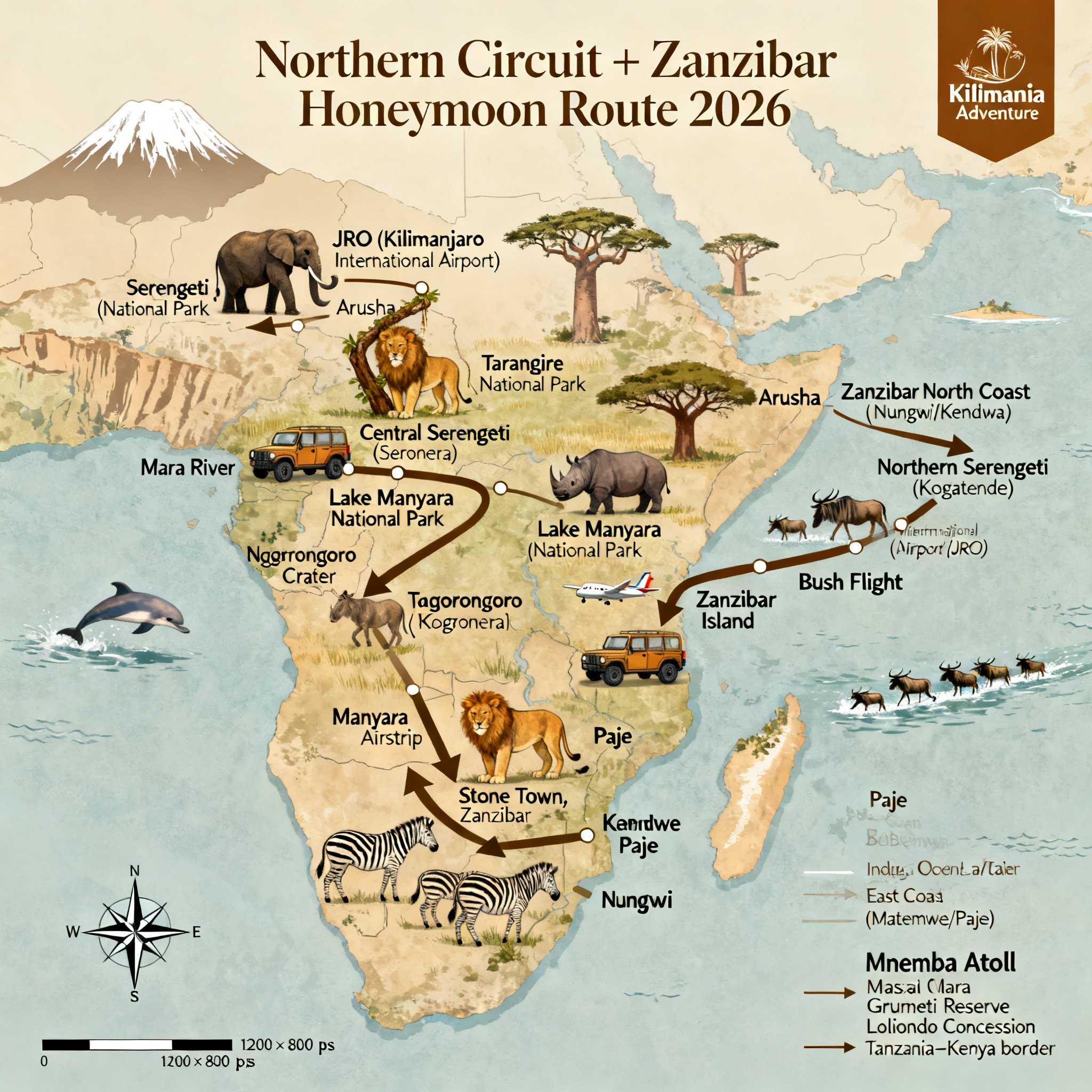
Route Map: Northern Circuit + Zanzibar
What Recent Honeymoon Couples Say
“We saw all Big Five within three days and the Serengeti balloon safari was the highlight of our honeymoon. Everything ran exactly as planned.”— Sarah & James, United Kingdom, September 2025
“The transition from Serengeti to Zanzibar was seamless. Safari first and beach second was absolutely the right decision.”— David & Emma, Canada, February 2026
Tanzania Honeymoon Safari & Zanzibar FAQ
Is Tanzania or the Maldives better for a honeymoon?
Tanzania offers safari + beach (Serengeti wildlife migration + Zanzibar). Maldives offers private overwater villas and clear ocean only. Tanzania + Maldives combo is possible in 10 days but costs about $14,000–$22,000 per couple excluding international flights.
Is Tanzania more expensive than Kenya?
Yes, about 10–20% higher. The main reason is Serengeti park fees ($82 per person/day vs Kenya’s ~$43–$60) and strict wildlife viewing limits, creating fewer crowds and better exclusivity.
Can we see the Big Five in Tanzania?
Yes, easily. Ngorongoro Crater is the best place in East Africa for Big Five sightings, including rare black rhino. Serengeti and Tarangire add lion, leopard, elephant, buffalo, and cheetah.
Is Zanzibar safe for honeymooners?
Yes. North coast (Nungwi, Kendwa) and east coast (Paje, Matemwe, Jambiani) are safe tourist zones. Dress modestly in Stone Town and avoid isolated beaches at night. Zanzibar travel insurance is required (~$44 per person).
Do we need malaria tablets?
Yes. Tanzania and Zanzibar are malaria zones. Common options: Malarone, doxycycline, or mefloquine. Use mosquito repellent and bed nets in all lodges.
How much extra spending money is needed?
Budget $800–$1,500 per couple for extras:
Tips: $180–$300
Zanzibar insurance: ~$88
Visa: $50–$100 per person
Balloon safari: ~$1,198 per couple (optional)
Carry USD (post-2009 notes only).
Safari first or Zanzibar first?
Safari first, Zanzibar second. Safari is early mornings and high activity; Zanzibar is relaxation and recovery. This order improves overall experience and reduces fatigue.
How far in advance should we book?
Book 9–12 months ahead for peak seasons (July–October, December–February). Luxury honeymoon lodges and balloon safaris sell out early.
Can we combine Kilimanjaro, safari, and Zanzibar?
Yes. Standard itinerary:
Kilimanjaro climb (6–8 days)
Safari (5–7 days)
Zanzibar (4–5 nights)
Total: 17–22 days
Budget: $9,500–$18,000 per couple depending on luxury level.
Are honeymoon perks included?
Yes at luxury camps (Asilia, &Beyond, Sanctuary, Singita) if requested in advance. Includes champagne, flowers, and decorated rooms. Must be confirmed before arrival.
What is the minimum honeymoon budget?
From $5,800 per couple for a 7-day safari + Zanzibar mid-range package. Anything under $4,500 should be carefully checked for missing park fees (Serengeti $82/day + Ngorongoro $354 vehicle fee).
How much does a Tanzania honeymoon safari cost?
Most honeymoon safaris cost between $2,500 and $12,000 per couple, depending on luxury level and duration.
Sabinus Msimba is a senior safari guide and co-founder of Kilimania Adventure based in Moshi, Tanzania. He has guided travelers across Serengeti, Ngorongoro Crater, Tarangire, and Lake Manyara for more than 17 years and has led over 300 successful Mount Kilimanjaro summits.
This guide combines field experience from honeymoon safaris operated between 2023 and 2026, direct feedback from guests, and current operational data from Tanzania’s Northern Safari Circuit.
Data verification notice: Park fees and visa costs are set by government authorities and subject to change. All figures reflect published May 2026 rates. Verify current fees at tanzaniaparks.go.tz. Request a gate receipt itemizing fees during your safari.
Final Recommendation
The 10-day structure works for most couples: Tarangire (2 nights) → Ngorongoro (1 night, full crater day) → Central Serengeti (2 nights) → Northern Serengeti or Ndutu (2 nights) → Zanzibar (4 nights). September is the strongest all-round month — Mara crossings still active, Zanzibar dry and warm. The most cost-effective single upgrade is the private safari vehicle: it costs less per trip than one additional luxury-suite night and improves every game-drive hour of the safari.
For International Travelers
All prices are USD. Approximate conversions: $1 ≈ £0.78 | €0.93 | AU$1.50.
Flights to Kilimanjaro International Airport (JRO): New York/LA $800–$1,400 return · London £550–£900 · Sydney AU$1,400–$2,200.
Tanzania e-visa: $50 for most nationalities | $100 for US citizens. Apply to immigration.go.tz at least 7 days ahead. Use Visa/Mastercard on Chrome or Firefox.
Yellow fever: Not required if arriving directly from the USA, UK, EU, or Australia. Verify if you have transited a risk country.
Zanzibar travel insurance: Mandatory since 2024 — ~$44 per adult, paid at ZNZ arrival.
Moshi accommodation: $35–$80 per night. Book one night before your safari.
Our reply time: Within 12 hours, 7 days a week. We operate on East Africa Time (EAT, UTC+3).
Disclosure: This guide is written by Kilimania Adventure, a registered safari and Kilimanjaro operator based in Moshi, Tanzania. We operate the itineraries described here. All figures reflect real 2026 costs from our own operations. We encourage you to compare our quotes with at least two other TATO-registered operators before paying any deposit.
Last reviewed: May 2026. Park fees verified within 72 hours of any TANAPA or NCAA change.
Continue your research:
Your Safari Partner in Tanzania
Your honeymoon safari is operated by Kilimania Adventure, a licensed Tanzania tour operator based in Moshi, Kilimanjaro Region.
We operate:
- Daily departures from JRO and ARK airports
- Private and group safari vehicles
- Kilimanjaro climbs and Tanzania safari circuits
📍 Moshi, Tanzania
📞 WhatsApp: +255 756 449 990
📧 info@kilimania.co.tz
Guides: Sabinus Msimba, Kanti Kessy, Saimon Bashemera, Louis Salvatory, Isack Mlala, John Akaro
- Explore Serengeti migration safaris in Tanzania →
- See best luxury lodges in Serengeti for honeymoon stays →
- Ngorongoro Crater safari packages with Big Five game drives →
- Tarangire National Park safari (elephants & baobab landscapes) →
Plan Your Honeymoon Safari

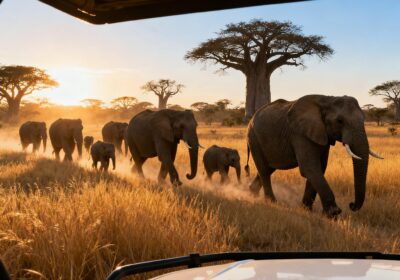
What destinations are included in a Tanzania honeymoon safari?
For a Tanzania honeymoon safari, the classic northern circuit can include several destinations, depending on how many days you have:
Tarangire National Park – elephants, baobab landscapes and excellent game viewing.
Ngorongoro Crater – spectacular crater scenery and a high concentration of wildlife.
Serengeti National Park – vast plains, abundant wildlife and, depending on the season, opportunities to follow the Great Migration.
Lake Manyara National Park – can be added for its wildlife, scenery and birdlife.
Zanzibar – many couples finish the safari with a relaxing beach stay, making a safari-and-beach honeymoon.
For a romantic 5–7 day honeymoon safari, I would normally look at a combination such as Tarangire → Ngorongoro → Serengeti, with the exact order and number of nights adjusted to your travel dates and interests. Tanzania’s tourism authorities also highlight Tarangire, Ngorongoro and Serengeti as the signature northern safari circuit.