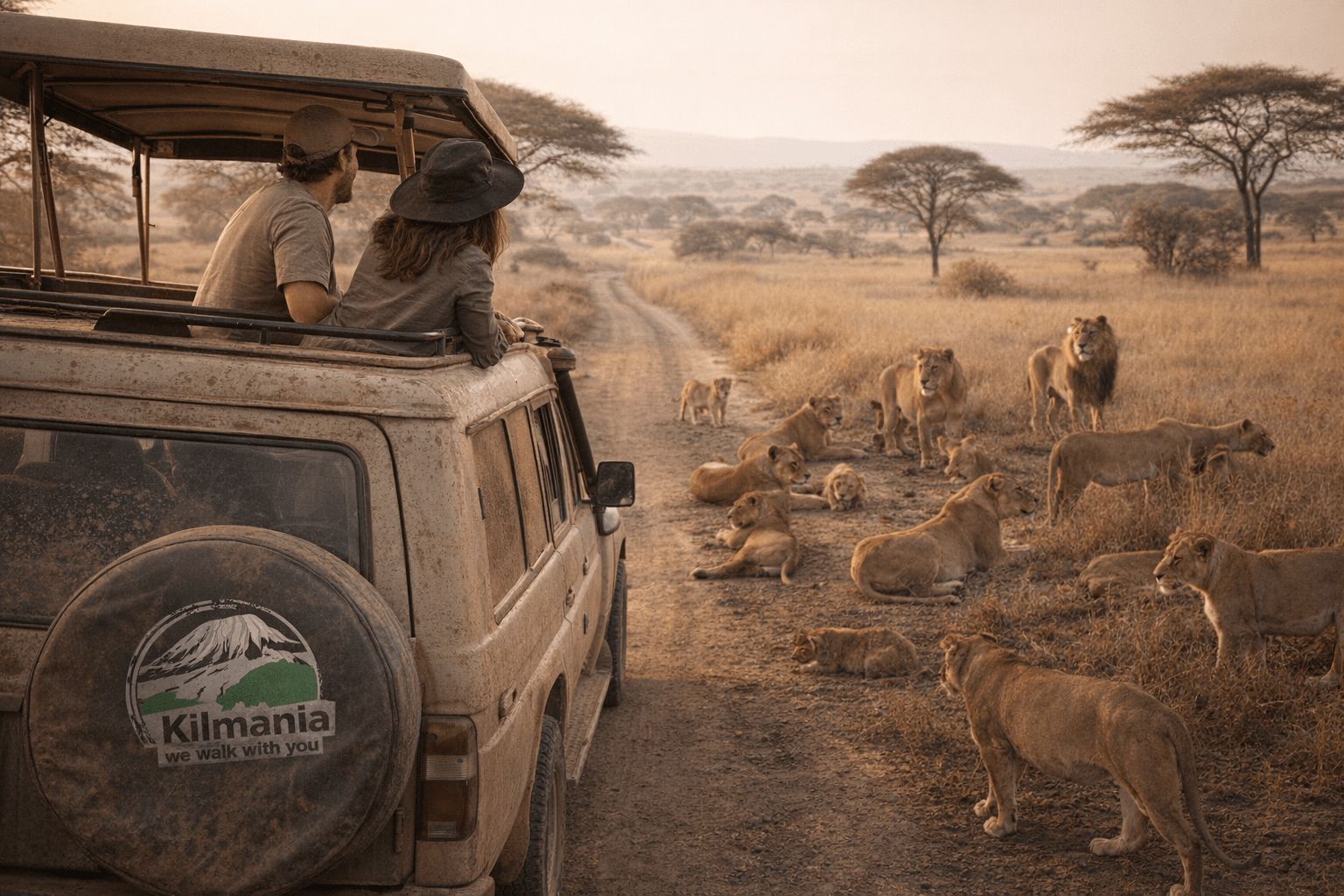
Key takeaways:
- Park fees are fixed and non-negotiable
- Accommodation is the highest variable cost
- Group size dramatically changes per-person vehicle cost
- April–May and November offer 30–50% lodge discounts
Table of Contents
INTRODUCTION
A Tanzania safari in 2026 typically costs between $6,500 and $11,000 per person for a 7-day trip.
However, strategic travelers reduce this to $2,800–$4,200 per person without losing access to Serengeti, Ngorongoro, Tarangire, or Lake Manyara.
The difference is not the wildlife — it is how you manage park fees, accommodation season, group size, and booking method.
How to Reduce Tanzania Safari Cost
Most travelers reduce Tanzania safari costs by combining four strategies:
- Travel during low season (April–May or November)
- Join a shared group safari instead of private
- Book directly with a Moshi-based local operator
- Choose mid-range lodges instead of luxury camps
Using these strategies, a 7-day Northern Circuit safari can realistically cost approximately:
- $1,800–$2,200 per person in Tanzania
- $3,300–$3,800 including international flights
without reducing wildlife quality or park access.
Tanzania safari pricing has fixed costs and variable costs. Understanding which is which determines how much room you have to work with.
Tanzania Safari Costs: Fixed vs Flexible
Costs You Cannot Reduce
- Park entry fees
- Ngorongoro Crater descent fees
- Government VAT
- Licensed guide requirements
These are government-regulated and apply equally to all travelers.
Costs You Can Control
- Lodge category
- Travel season
- Private vs group safari
- Internal flights
- Balloon safaris and add-ons
- Booking directly vs. an international agent
Most safari savings come from adjusting these flexible costs — not from reducing park access or wildlife quality.
For the full explanation of why Tanzania safari costs are structured this way, see our guide on why Tanzanian safaris are so expensive. For a comparison of what each price tier delivers, see our Tanzania safari cost 2026 breakdown.
Smart Ways to Lower Tanzania Safari Costs
- Travel during April and May to save 30% to 50% on Tanzania safari costs.
- Join a shared group safari to reduce expenses by 15% to 40%.
- Book directly with a local Tanzania safari operator and save 15% to 25%.
- Choose mid-range safari lodges instead of luxury camps to save $450 to $900 per night.
- Skip internal bush flights and reduce safari transport costs by $1,200 to $1,800.
- Limit Ngorongoro Crater descents to avoid the additional $295 vehicle fee.
Strategy 1: Travel Low Season (Save 30–50% on Accommodation)
Lodge and tented camp rates are not fixed. They follow a seasonal schedule. Park fees — fixed by the government — do not move. The entire saving comes from accommodation.
In practice, many travelers are surprised by how green and wildlife-rich Tanzania remains during April and May. Our guides regularly operate clear morning game drives in Central Serengeti before afternoon rain develops later in the day. Wildlife viewing continues year-round — the main difference is road condition and lower vehicle density around sightings.
2026 Tanzania safari month-by-month lodge rate guide:
Best Time to Go: Season, Pricing & Wildlife
| Month | Season | Lodge Rate vs August Peak | Wildlife | Weather |
|---|---|---|---|---|
| January | High | Baseline | Calving season at Ndutu, Southern Serengeti | Dry and warm |
| February | High | Baseline | Calving season peak; wildebeest with young | Dry |
| March | Shoulder | −15% | Good across all parks | Light rains begin |
| April | Low | −40% to −50% | Good; fewer vehicles at sightings | Afternoon rain |
| May | Low | −40% to −50% | Good; some roads muddy | Afternoon rain |
| June | Shoulder | −20% | Dry season starts; excellent predator activity | Dry |
| July–October | Peak | +20% to +40% | Migration in Northern Serengeti (river crossings) | Dry |
| November | Low | −25% to −30% | Good; short rains less disruptive than April | Light showers |
| December | High | +10% to +20% | Excellent; dry and clear | Good; short rains are less disruptive than April |
Price volatility notice: Lodge rate schedules are set by individual properties and can change without notice. The percentages above represent typical market movements, not guaranteed discounts. Confirm rates at time of booking.
For most travelers, accommodation season and vehicle-sharing create the biggest safari savings. Park fees remain fixed regardless of how you travel, but lodge rates and vehicle splitting can reduce total safari cost dramatically without reducing wildlife access.
Real saving: 7-day luxury safari for 2 people
Lodge Accommodation (6 nights)
Park Fees
Vehicle + Guide
TOTAL
Low-season practical notes: Mornings in April–May are typically clear and cool — optimal for game drives. Afternoon rain arrives after 2–3 PM. Serengeti, Tarangire, Ngorongoro Crater, and Lake Manyara remain accessible year-round. Some Southern Serengeti and Ndutu roads become difficult during peak rains. A few luxury camps close for maintenance in April. Confirm your specific lodge’s closure dates before booking.
November is the stronger option for travelers who want savings without the rain trade-off. Short rains are lighter and less predictable than the long rains. Savings reach 25–30% with better road conditions than April–May.
For most travelers, accommodation season and vehicle-sharing create the biggest safari savings. Park fees remain fixed regardless of how you travel, but lodge rates and vehicle splitting can reduce total safari cost dramatically without reducing wildlife access.
Strategy 2: Join a Group Safari — The Vehicle Cost Mathematics
A safari vehicle seats 4–6 people. The vehicle hire and guide cost is the same regardless of how many people are in it. Joining an existing group departure is the single highest-impact lever for solo travelers and couples. For a comparison of group vs. private safari guide.
How per-person vehicle cost changes with group size:
Your safari vehicle and guide costs stay almost the same whether you travel solo or in a group. The difference is how much each person pays as the group grows.
1 person (solo private safari)
Total vehicle + guide cost: $1,960
Per person: $1,960
No shared savings
2 people (couple private safari)
Total vehicle + guide cost: $1,960
Per person: $980
You save about 50% compared to solo travel
4 people (family private safari)
Total vehicle + guide cost: $1,960
Per person: $490
You save about 75% compared to solo travel
6 people (full group safari)
Total vehicle + guide cost: $1,960
Per person: $327
You save about 83% compared to solo travel
A solo traveler joining a full-group departure saves $1,633 in vehicle costs alone compared to a private solo safari. Park fees and accommodation remain unchanged.
Families planning with children should also read our detailed breakdown of Tanzania Safari Family Cost 2026 | What Families Actually Pay, which includes child park fees, private vehicle costs, age restrictions, and realistic family safari budgets by tier.
For most travelers, accommodation season and vehicle-sharing create the biggest safari savings. Park fees remain fixed regardless of how you travel, but lodge rates and vehicle splitting can reduce total safari cost dramatically without reducing wildlife access.
Full cost comparison: private couple vs. 6-person group (7-day mid-range Northern Circuit)
Private vs Group Safari: Cost per Person (7-day Northern Circuit)
| Component | Private (2 people) | Group (6 people) | Saving per Person |
|---|---|---|---|
| Vehicle + guide | $980/person | $327/person | $653 |
| Park fees | $1,140/person | $1,140/person | $0 |
| Mid-range accommodation | $1,800/person | $1,800/person | $0 |
| Total per person | $3,920 | $3,267 | $653 (17%) |
Trade-offs: Group safaris run on fixed departure dates. You share the vehicle with travelers you have not met. Game drive timing follows the group’s consensus — you cannot stay indefinitely at a sighting if others in the vehicle want to move on.
Best for: Solo travelers, backpackers, couples on controlled budgets who are comfortable with shared logistics.
For the complete analysis of both options, including family considerations, read our Group Safari vs Private Safari Tanzania guide.
Strategy 3: Book Directly with a Moshi-Based Local Operator (Save 15–25%)
International travel agencies — based in London, New York, Sydney, or Amsterdam — do not own vehicles or employ guides in Tanzania. They resell itineraries from Tanzania-based operators at a 15–25% margin added on top.
Price comparison: same 7-day itinerary, different booking channel
Price Comparison: International Agent vs Moshi Operator Direct
| Itinerary | International Agent | Moshi Operator Direct | Saving |
|---|---|---|---|
| 7-day luxury (2 people) | ~$12,000 | ~$10,000 | ~$2,000 (17%) |
| 7-day mid-range (2 people) | ~$8,500 | ~$7,000 | ~$1,500 (18%) |
| 5-day mid-range (1 person) | ~$3,200 | ~$2,600 | ~$600 (19%) |
The $2,000 saving on a 7-day luxury safari for two covers: two hot air balloon flights over Serengeti ($1,300) plus one night’s upgrade to a Ngorongoro Crater rim lodge.
How to verify a local operator before booking:
- Check TATO registration at tatotz.org — the Tanzania Association of Tour Operators maintains a searchable member list
- Confirm a physical office address in Moshi or Arusha (not just a website)
- Request a direct phone number and call it before paying any deposit
- Ask for an itemized, VAT-inclusive quote — not a headline “from” price
Strategy 4: Limit Ngorongoro Crater to One Descent (Save $295)
The Ngorongoro Crater descent fee is $295 per vehicle per trip — charged each time the vehicle drives to the crater floor. Most travelers cover the highlights of the Crater floor (lion prides, elephant herds, black rhino, hippo pool, flamingo lake) in a 5–6 hour drive. A second descent adds $295 without doubling the experience.
Two-day vs. one-day Ngorongoro cost comparison (2 people in a private vehicle):
Ngorongoro Crater: 1 Day vs 2 Days (Fees per person)
| 1 Crater Day | 2 Crater Days | Saving | |
|---|---|---|---|
| Conservation Area entry (per person) | $70.80 × 2 = $141.60 | $70.80 × 4 = $283.20 | — |
| Crater descent fee | $295 | $590 | $295 |
| Total Ngorongoro fees | $436.60 | $873.20 | $436.60 |
The $436 saving covers two nights at a mid-range tented camp.
The rim alternative — a saving nobody mentions:
You can visit the Ngorongoro Conservation Area and choose not to descend at all. The $295 vehicle descent fee is only charged when the vehicle descends. Rim viewing, Empakaai Crater day walks, and Maasai cultural visits are available without a crater descent. Conservation Area entry ($70.80/person/day) still applies, but the descent fee is fully avoided.
For a full breakdown of conservation fees, crater descent charges, vehicle fees, and current NCAA regulations, read our complete guide to Ngorongoro Crater Fees 2026: Complete Guide to Every Charge
This is not a compromise on the Northern Circuit — it is a legitimate itinerary variant that works well for travelers combining Ngorongoro rim overnight with a stronger Serengeti allocation.
If you choose to descend, a single morning is sufficient for the crater floor highlights. Spend the second Ngorongoro day in Tarangire National Park ($59 entry vs. $70.80 + $295 descent) — elephant herds and baobab landscape included.
For most travelers, accommodation season and vehicle-sharing create the biggest safari savings. Park fees remain fixed regardless of how you travel, but lodge rates and vehicle splitting can reduce total safari cost dramatically without reducing wildlife access.
Strategy 5: Mid-Range Lodges Over Luxury (Save $450–$900 Per Person Per Night)
Luxury lodges charge $800–$1,200 per person per night. Mid-range lodges charge $250–$550. The wildlife in the park outside is the same.
What actually changes between tiers — and what does not:
Mid-Range vs Luxury Lodges: Key Differences
| Feature | Mid-Range Lodge | Luxury Lodge | Affects Wildlife? |
|---|---|---|---|
| En-suite bathroom with hot water | Yes | Yes | No |
| Real bed with linen | Yes | Yes | No |
| Three meals per day | Yes (buffet or set menu) | Yes (à la carte, private chef) | No |
| Private 4WD with dedicated guide | Yes | Yes | No |
| Location relative to park gate | Outside park (15–30 min) | Inside park or boundary | Marginally |
| Off-road driving | No (national parks only) | Yes (private concessions) | Yes — access to night drives, walking |
| Schedule control | Full (private vehicle) | Full | No |
| Plunge pool or butler service | Rarely | Usually | No |
The only meaningful operational difference: luxury lodges positioned inside parks or in private concessions save 15–30 minutes of morning driving and enable off-road game drives and night drives — activities not permitted in standard national parks.
For a 7-day safari, those 15–30 minutes per morning add up to 2–3 extra game drive hours. Whether that is worth $450–$900 per night more depends on your priorities.
For photographers, the off-road and night drive access at luxury concessions has clear value. For first-time safari travelers, a mid-range private tented camp with a dedicated vehicle and senior guide delivers the full Northern Circuit experience.
Our Luxury vs Mid-Range Tanzania Safari guide compares both tiers day-by-day with specific lodge examples. Our Budget Safari Tanzania Cost Guide sets expectations for the tier below mid-range.
Compare Tanzania Safari Costs by Tier
Get a Personalised Tanzania Safari Quote
Speak to a Local Tanzania Safari Expert
Request a detailed Tanzania safari quote comparing budget camping, mid-range tented camps, and luxury fly-in itineraries for your travel dates. Based in Moshi, Kilimanjaro — operating Serengeti, Ngorongoro, Tarangire, and Lake Manyara safaris year-round. Most quotes are returned within 12 hours.
Strategy 6: Drive the Northern Circuit Instead of Flying (Save $1,200–$1,800)
Internal flights from Arusha to Serengeti cost $250–$400 per person each way. For 2 people on a round-trip fly-in itinerary, that totals $1,000–$1,600 — before connecting flights to smaller airstrips.
The road from Arusha or Moshi to Serengeti Central (Seronera) takes 6–8 hours. The drive passes through the Rift Valley escarpment, Tarangire National Park access roads, and the Ngorongoro highlands before descending to the plains. Experienced guides cover this route daily and read the landscape throughout.
Cost comparison for 2 people:
Transport Options: Cost, Time & Trade-offs
| Transport Mode | Cost (2 people) | Travel Time | Trade-off |
|---|---|---|---|
| Fly-in (Arusha → Serengeti return) | $1,000–$1,600 | 90 minutes total | Fast; no scenic transition |
| Road safari (full circuit) | $0 additional (fuel in vehicle rate) | 12–16 hours over 7 days | Scenic; requires tolerance for long drives |
When flying makes genuine sense:
- Itineraries of 5 days or fewer, where road time becomes disproportionate to game drive time
- Combining the Northern Circuit with Ruaha National Park or Nyerere (Selous) — southern parks that are genuinely impractical by road
- Travelers with physical limitations that make 8-hour drives uncomfortable
For 7-day Northern Circuit itineraries, the road safari is the rational cost choice. The drive is part of the experience — our guide Louis Salvatory regularly spots hartebeest, ostrich, and giraffe on the road sections between Tarangire and Ngorongoro that passengers would miss in an aircraft window seat.
What Budget Strategies Do Not Change
Choosing a lower-cost safari does not mean reducing wildlife quality. Public roads inside Serengeti, Tarangire, Ngorongoro Crater, and Lake Manyara are shared by both budget and luxury vehicles.
However, lower-cost safaris usually involve:
- Longer road transfers
- Simpler accommodation
- Shared vehicles on group departures
- Less privacy
- Fewer premium add-ons
The wildlife itself remains the same. The difference is mainly comfort, exclusivity, and logistics.
Strategy 7: Be Selective with Activity Add-Ons (Save $300–$1,200)
“All-inclusive” packages rarely include optional activities. Each add-on is charged separately. Some are worth the cost. Most can be deprioritized without reducing the safari’s core value.
Activity add-ons: what each costs and what it delivers
Optional Activities: Cost, What It Adds & Priority
| Activity | Cost Per Person | What It Adds | Priority |
|---|---|---|---|
| Hot air balloon (Serengeti) | $595–$650 | Dawn flight over the plains; 45–60 mins airborne | High — genuinely different perspective |
| Night game drive (private concession) | $80–$150 | Nocturnal predators: serval, porcupine, aardvark, lion hunting | High — not available in national parks |
| Walking safari (Serengeti buffer) | $100–$200 | Ground-level perspective; tracking, insects, plants | Medium — best for those who hike |
| Maasai cultural village visit | $50–$100 | Context for the landscape and people | Medium — varies by authenticity of the visit |
| Premium spirits and imported wine | $12–$25 per drink | N/A | Low — standard drinks adequate |
| Laundry service | $5–$10 per item | Convenience | Low — hand-washing in room works for 7 days |
Strategic approach: Choose one or two activities that match your specific interest. For most travelers, the balloon safari over Serengeti and a one-night drive cover everything, and optional activities add. Skip the rest.
Budget for 1–2 activities: $700–$800 per person. Skipping everything optional: saves $300–$1,200 depending on what was in scope.
Our 6-day balloon safari includes the balloon flight within the itinerary — so the cost is built in rather than added as a surprise at camp.
Strategy 8: Avoid the Solo Traveler Supplement
A private safari vehicle seats 4–6 people. A solo traveler on a private safari pays for empty seats. The supplement is not an arbitrary charge — it reflects the real cost of unused vehicle capacity.
Three routes around it:
Route A — Join a group departure. The most direct solution. Group departures to Serengeti, Ngorongoro, and Tarangire depart regularly from Moshi and Arusha. You share vehicle costs with 3–5 other travelers. Contact us at info@kilimania.co.tz for the current group departure schedule.
Route B — Find a travel partner. Split a private vehicle with one other person. The per-person vehicle cost drops from $1,960 to $980 for a 7-day safari. Travel forums and hostel notice boards in Arusha and Moshi are practical places to connect with other solo travelers planning the same dates.
Route C — Travel in low season. In April–May and November, group departure spaces are easier to access and some operators fill remaining private vehicle spots at group rates to maximize vehicle utilization.
Strategy 9: Multi-Day Itinerary Efficiency — Getting More Days for the Same Vehicle Cost
The $280/day vehicle-and-guide rate is charged per day regardless of which park you are in. A 7-day itinerary covering four parks costs the same in vehicle fees as a 7-day itinerary covering one park. Adding parks to your itinerary does not increase vehicle costs — it reduces the per-park vehicle cost.
Per-park vehicle cost by itinerary length:
Vehicle Cost Efficiency by Itinerary
| Itinerary | Vehicle Cost (7 days total) | Parks Covered | Vehicle Cost Per Park |
|---|---|---|---|
| 3-day Serengeti only | $840 | 1 | $840 |
| 5-day Tarangire + Manyara + Ngorongoro | $1,400 | 3 | $467 |
| 7-day Northern Circuit (4 parks) | $1,960 | 4 | $490 |
Choosing a 7-day Northern Circuit over a 3-day Serengeti-only trip means four parks for only $1,120 more in vehicle costs — versus paying $840 for a single park.
Our 4-day Serengeti and Ngorongoro Crater safari covers two signature parks in four days. Our 5-day Manyara, Serengeti, and Ngorongoro safari covers three parks — the strongest per-day value on the Northern Circuit.
Which Cost Strategy Fits Your Travel Style?
Keep a Private Vehicle, Save Elsewhere
| Traveler Type | Best Savings Strategy |
|---|---|
| Solo travelers | Join group safari departures |
| Couples | Travel in shoulder or low season |
| Families | Split private vehicle across 4–5 people |
| Honeymooners | Choose mid-range luxury instead of ultra-luxury |
| Photographers | Keep private vehicle, save elsewhere |
| Short itineraries | Avoid internal flights where possible |
Strategy 10: Fly Smart — Use Points and Miles for International Flights
International flights to Kilimanjaro International Airport (JRO) cost $1,200–$2,000 per person from the USA, UK, Germany, France, the Netherlands, and Australia. Frequent flyer programs and travel reward points can cover part or all of this cost.
Main airline routes to JRO:
Popular Routes to JRO (Dar es Salaam & Around)
| Airline | Alliance | Route | Frequency |
|---|---|---|---|
| KLM | SkyTeam | Amsterdam (AMS) → JRO | Daily |
| Ethiopian Airlines | Star Alliance | Addis Ababa (ADD) → JRO | Daily |
| Qatar Airways | Oneworld | Doha (DOH) → JRO | 4× weekly |
| Kenya Airways | SkyTeam | Nairobi (NBO) → JRO | Daily |
| Turkish Airlines | Star Alliance | Istanbul (IST) → JRO | 4× weekly |
Points programs by traveler region:
- USA: Chase Ultimate Rewards, Amex Membership Rewards, Capital One Miles transfer to KLM, Air France, Turkish Airlines
- UK: Avios (British Airways Executive Club) — transfers to Qatar Airways; Virgin Atlantic points transfer to Ethiopian Airlines
- Germany/Netherlands: Miles & More (Lufthansa Group); Flying Blue (KLM/Air France)
- Australia: Qantas Points and Velocity transfer to partner airlines serving JRO
Typical round-trip economy redemption: 60,000–80,000 points from most major programs. At $1,400 average cash price, this represents the highest per-strategy saving in this article for travelers who already hold points.
This is general information only. Reward program terms, transfer ratios, and redemption availability change. Verify directly with your airline program before booking.
Strategy 11: Book 6 or More Months Ahead for Peak Season
Tanzania’s most-requested lodges during the migration (July–October) and calving season (January–February at Ndutu) sell out 8–12 months ahead. Late bookings either pay premium last-minute rates or accept lower-preference lodges.
Park fee changes also favor early bookers. TANAPA and NCAA review fees periodically. Early booking locks in the fee schedule at the time of booking confirmation — operators typically include the current rate in the signed contract.
Practical rule: for any July or August departure, start planning in October–December of the prior year. For low-season travel (April–May, November), 2–3 months of lead time is usually sufficient.
Strategy 12: Request an Itemized, VAT-Inclusive Quote Before Paying Any Deposit
This is the strategy most travelers skip — and it is where price surprises happen.
Tanzania applies 18% VAT on most tourism services. Some international operators present “from” prices excluding VAT, then add it at final invoicing. On a $7,000 base price, 18% VAT adds $1,260 — a material surprise at the payment stage.
Before signing any contract, request:
- A full itemized line-by-line cost breakdown
- Explicit confirmation that the quoted price is VAT-inclusive
- Clarification of which activities and fees are included versus optional
- The operator’s TATO registration number
A reputable TATO-registered operator provides all four of these without hesitation. Any operator who cannot or will not provide an itemized VAT-inclusive quote before deposit is a risk.
The Honest Savings Waterfall: What $2,950 Per Person Actually Looks Like
This is the arithmetic from Document 3 — rebuilt correctly.
Starting point: 7-day mid-range Northern Circuit, private vehicle, peak season (August), 2 people
Safari Component Cost Breakdown
| Component | Cost Per Person |
|---|---|
| Accommodation (mid-range lodge, 6 nights) | $1,800 |
| Park fees (4 parks, 7 days) | $1,140 |
| Vehicle + guide (7 days, split 2 ways) | $980 |
| Ngorongoro Crater descent (split 2 ways) | $148 |
| Base total per person | $4,068 |
Applying strategies sequentially:
How These Savings Stack Up (Cost per person)
| Strategy Applied | Per-Person Saving | Running Total |
|---|---|---|
| Base (Standard Mid-Range) | — | $4,068 |
| Travel April instead of August (−35% lodge) | −$630 | $3,438 |
| Join group departure (split 6 ways) | −$653 | $2,785 |
| Book Moshi operator direct (−18% margin) | −$251 | $2,534 |
| Limit Ngorongoro to 1 descent | $0 (already applied) | $2,534 |
| Skip balloon and night drive add-ons | −$700 | $1,834 |
| Realistic Optimized Cost | Total Savings: ~$2,234 | ~$1,834–$2,200 |
Add international flights ($1,200 cash or points), visa ($50–$100), and tips ($175–$280 for 7 days), and the all-in total reaches $3,300–$3,800 per person — versus $6,500–$8,000 at standard rates.
What does that $3,300–$3,800 per person still deliver:
- 7 days across Serengeti, Ngorongoro, Tarangire, and Lake Manyara
- All park entries included
- Mid-range en-suite tented camp accommodation
- Experienced licensed guide
- All game drives included
- Three meals per day
What it does not deliver: private vehicle, luxury lodge, balloon safari, or peak-season rim lodge proximity. Those are available at higher tiers — and they are worth it for specific traveler profiles.
Which Strategies Work Best for Your Situation?
| Traveler Type | Highest-Impact Strategies | Expected Saving |
|---|---|---|
| Solo traveler | Join group departure + book local + travel November | 35–45% |
| Couple | Travel low season + book local + skip add-ons | 30–40% |
| Family of 4 | Private vehicle (split 4 ways) + child fee rates + travel low season | 25–35% |
| Honeymooners | Book local operator + choose mid-range not luxury + travel June (shoulder) | 20–30% |
| Photographer | Private vehicle mandatory; save on season and booking channel instead | 15–25% |
For family-specific cost calculations, including child park fee rates, see our Tanzania safari family cost 2026 itinerary guide.
The One Thing Strategies Cannot Change — And Why It Matters
Park fees fund anti-poaching patrols, ranger salaries, wildlife monitoring programs, and community benefit schemes in areas surrounding Tanzania’s national parks. The $82.60/day Serengeti entry fee is not going to a hotel group or a tour operator. It goes directly to TANAPA, which maintains the ecosystem.
The wildlife density that makes Tanzania’s Northern Circuit worth traveling for — 1.5 million wildebeest on the Serengeti plains, 25,000 animals inside the Ngorongoro Crater, 3,000 elephants in Tarangire during the dry season — exists because these fees fund the conservation that keeps it intact.
Strategies that reduce accommodation costs, agent margins, and unnecessary add-ons are sensible. Strategies that would reduce the money reaching park authorities are not available — and that is appropriate.
FAQ: How to Afford a Tanzania Safari
Q: What is the minimum realistic cost for a Tanzania safari per person?
A: A 5-day budget group safari on the Northern Circuit — covering Tarangire, Manyara, and Ngorongoro — costs approximately $1,500–$1,900 per person in-Tanzania during low season (April–May). This uses public campsites, a shared vehicle with 5–6 passengers, and no activity add-ons. Add international flights ($1,200–$1,600 from Europe) and the all-in cost reaches $2,700–$3,500.
Q: Are park fees negotiable in Tanzania?
A: No. Park entrance fees are set by TANAPA and NCAA — government authorities — and are identical for every visitor regardless of operator, group size, or season. The $82.60/day Serengeti fee applies to every traveler. Operator margins, lodge accommodation rates, and activity costs are where negotiation and strategy actually work.
Q: Is April a genuinely worthwhile month to visit Tanzania?
A: Yes — with realistic expectations. Mornings in April are typically dry, clear, and cool. Game drives run normally from 6 AM to noon before the rain arrives. Wildlife is abundant; vehicle density at sightings is 50–70% lower than in July and August. Ndutu roads in Southern Serengeti can flood during heavy rains, but Central Serengeti, Ngorongoro, and Tarangire remain accessible throughout April.
Q: Does a budget safari see the same animals as a luxury one?
A: In national parks, yes — completely. Both vehicle types use the same gates, the same roads, and the same game drive areas. The same lion prides appear to public campsite guests and $1,500/night lodge guests. The exception: private concessions attached to luxury camps permit off-road driving and night drives not available on standard park roads.
Q: How much do tips add to the total safari cost?
A: Budget $175–$280 for guide gratuity over 7 days ($25–$40 per vehicle per day). Lodge staff gratuity adds $105–$175 per person ($15–$25/day). Total tipping budget for 7 days: $280–$455 per person. See our Tanzania safari tipping guide for a full per-role breakdown.
Q: How far in advance should I book?
A: For peak season (July–October): 8–12 months. Rim lodges at Ngorongoro and migration-area camps in Northern Serengeti sell out first. For low season (April–May, November): 2–3 months. Group departures fill faster than private itineraries — contact us early for group departure schedules.
Q: Is it worth combining the Northern Circuit with a southern park like Ruaha?
A: For 10+ day itineraries, yes. Ruaha National Park has higher lion density than Serengeti and no crowds — but requires internal flights from Arusha ($400–$600 per person each way). For 7-day itineraries, the road-accessible Northern Circuit (Serengeti, Ngorongoro, Tarangire, Manyara) delivers more park variety per dollar than a Northern Circuit + Ruaha combination requiring $800–$1,200 in flights.
Compare Tanzania Safari Costs by Tier
Get a Personalised Tanzania Safari Quote
Speak to a Local Tanzania Safari Expert
Request a detailed Tanzania safari quote comparing budget camping, mid-range tented camps, and luxury fly-in itineraries for your travel dates. Based in Moshi, Kilimanjaro — operating Serengeti, Ngorongoro, Tarangire, and Lake Manyara safaris year-round. Most quotes are returned within 12 hours.
Conclusion
The biggest misconception about Tanzania safaris is that lower cost automatically means lower-quality wildlife experiences. In reality, the parks, animals, and landscapes remain the same across most budget levels. The real differences are accommodation style, level of exclusivity, travel season, and logistical comfort.
Travelers who understand how safari pricing actually works — especially the difference between fixed conservation fees and flexible travel costs — can often reduce total safari cost dramatically without sacrificing the core experience that makes Tanzania exceptional.
If you have a specific budget and want to know exactly which itinerary it supports, our Moshi team builds that calculation daily. Browse our Tanzania Safaris page for current itineraries, or call us directly.
We Walk With You.
Plan Your Safari Within Your Budget
Starting points by budget:
- Under $2,500/person (in-Tanzania): Budget Safari Tanzania Cost Guide — public campsites, group vehicle, Northern Circuit
- $2,500–$4,000/person: 5-day Manyara, Serengeti & Ngorongoro — mid-range tented camps, private vehicle
- $3,500–$5,000/person: 4-day Serengeti & Ngorongoro Crater — high-impact, shorter itinerary
- With balloon included: 6-day balloon safari — balloon cost built into the itinerary, no surprise add-on
We Walk With You.
- Tanzania National Parks Authority (TANAPA) — current park fee schedules
- Ngorongoro Conservation Area Authority (NCAA) — Ngorongoro fees and regulations
- Tanzania Association of Tour Operators (TATO) — operator registration verification
- UNESCO Serengeti World Heritage Site — Serengeti conservation designation
“Kilimania Adventure was founded by Sabinus Msimba, a Tanzanian safari guide with 22 years on the Northern Circuit. We don’t outsource—our vehicles, guides, and office are all based in Moshi.”
Kilimania Adventure is a Moshi-based Tanzania safari operator specializing in Northern Circuit safaris across Serengeti, Ngorongoro Crater, Tarangire, and Lake Manyara. Our guides and operations team work year-round inside Tanzania’s national parks, building itineraries across budget, mid-range, luxury, family, honeymoon, and migration-focused safaris.
This guide was operationally reviewed using the current 2026 TANAPA and NCAA fee schedules, together with real itinerary pricing from active Northern Circuit departures.