The Serengeti migration happens year-round. The herd moves through four main zones: Ndutu Plains (December–March), Western Corridor/Grumeti (April–June), Northern Serengeti/Kogatende (July–October), and Eastern/Southern Serengeti (October–November). First-time travelers can see the migration in every month — only the wildlife behavior changes.
Best months by experience:
- January–February: Calving season and predator action at Ndutu Plains
- June–July: Grumeti River crossings
- July–September: Mara River crossings at Kogatende
- April–May: Lowest safari prices and fewest vehicles
The Serengeti Great Migration is the annual circular movement of approximately 1.3 million wildebeest, 200,000 zebra, and thousands of gazelle across Serengeti National Park in Tanzania and Kenya’s Masai Mara ecosystem. The migration follows seasonal rainfall and fresh grass rather than fixed calendar dates.
| If You Want | Best Months | Best Serengeti Zone |
|---|---|---|
| River crossings | July–September | Kogatende (Northern Serengeti) |
| Predator action | January–February | Ndutu Plains |
| Lowest safari prices | April–May | Western Corridor |
| Fewer safari vehicles | March–May | Western Serengeti |
| Best family safari | January–February | Ndutu Plains |
In summary, January–February suits travelers focused on predator behavior and calving season. July–September suits travelers prioritizing Mara River crossings. April–May offers the lowest prices and lightest vehicle traffic across Serengeti National Park.
The Serengeti migration month by month follows four zones — Ndutu Plains (December–March), Seronera Valley (year-round), Grumeti River (April–June), and Kogatende/Mara River (July–October). The herd of 1.3 million wildebeest never leaves the ecosystem. First-timers who arrive in any month witness the migration — only the location and wildlife event change. See our complete Tanzania safari packages 2026 guide for month-specific itineraries.
Key Stats
- 1,300,000 — wildebeest completing the annual migration
- 12 months — migration is active in Serengeti year-round
- 4 zones — Ndutu, Seronera, Grumeti, Kogatende
- $82.60 — TANAPA Serengeti daily park fee per adult
- 470,000 — wildebeest calves born at Ndutu in February
- 35–40% — accommodation savings in low-season months
Most first-timers assume the migration only happens in July and August. It does not. The migration is a 12-month ecosystem event. Your month of choice determines which wildlife spectacle you witness — calving, river crossings, or dispersal — not whether you see the migration at all. Budget $1,800+ per person for 7 days.
TANAPA park fees alone total $578.20 per person for 7 days. For a complete breakdown of park fees, accommodation tiers, vehicle costs, and seasonal pricing differences, read our Serengeti Safari Cost Guide 2026.
Introduction
This guide explains the Serengeti migration month by month for first-time safari travelers — what the migration physically is, where the herd moves across each season, and what you will genuinely experience on the ground. From our base in Moshi, Kilimanjaro Region, Kilimania Adventure runs 200+ field days annually, tracking herd movement through Serengeti National Park and Ngorongoro Conservation Area. Our guides follow the migration actively — they do not read about it from a desk. Tanzania’s Tourism Board recorded 517,000 Serengeti visitors in 2023, making migration zone knowledge essential before booking.
Serengeti Migration
What month is best for the Serengeti migration?
July to September is best for Mara River crossings. January and February are best for calving season and predator sightings.
Can you see the migration all year?
Yes. The migration moves through different Serengeti zones every month of the year.
Where are the wildebeest in February?
Most wildebeest gather at the Ndutu Plains and the southern Serengeti during calving season.
What is the cheapest migration season?
April and May usually offer the lowest safari prices and the lowest lodge occupancy.
How many days are needed?
Five days suit calving season. Seven days are better for northern Serengeti river crossing safaris.
Serengeti Migration Ecosystem Areas Explained
The Serengeti migration ecosystem spans northern Tanzania and southern Kenya across multiple protected wildlife areas:
- Serengeti National Park (TANAPA) — Tanzania’s primary migration ecosystem
- Ngorongoro Conservation Area (NCAA) — Ndutu calving grounds and seasonal migration habitat
- Masai Mara National Reserve — Kenya section of the migration ecosystem
- Mara River — Main northern crossing point during July–September
- Grumeti River — Western corridor crossing area during May–June
The migration follows rainfall and grass availability rather than national borders or fixed dates.
What Is the Serengeti Migration and What Will First-Timers Actually See?
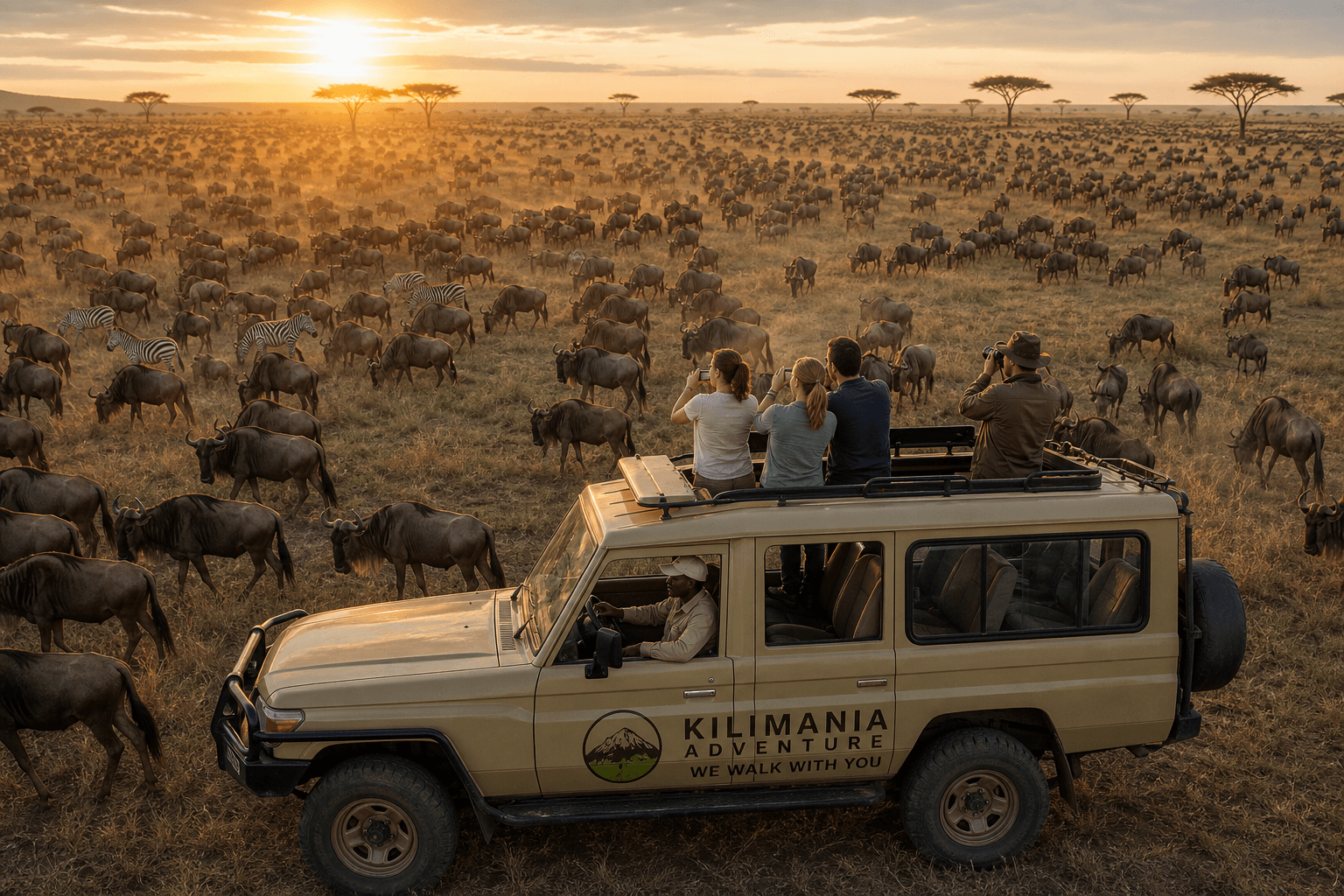
The Serengeti Great Migration is a continuous 1,200-mile circular movement of 1.3 million wildebeest (Connochaetes taurinus) and 200,000 zebra (Equus quagga) following seasonal rainfall across Serengeti National Park in Tanzania and the Masai Mara National Reserve in Kenya. The herd itself is always present somewhere in the ecosystem. The specific wildlife event — calving, river crossings, or dispersal — changes by month.
The migration is not a parade. It is not a single event you can miss. It is a biological process driven by rainfall and grass availability that runs without pause across 12 months.
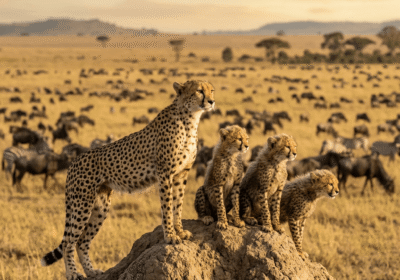
Most first-timers arrive imagining an orderly column of animals moving at a set time. Reality is different. You encounter the migration when your vehicle enters a landscape covered by wildebeest in every direction. You sit with lions watching a crossing point. You watch cheetahs hunt newborn calves at dawn while zebras graze 200 meters away.
Serengeti National Park covers 30,000 km² and is managed by TANAPA (Tanzania National Parks Authority). Its ecosystem includes four primary migration zones:
- Ndutu Plains — southern Serengeti calving grounds (NCAA jurisdiction)
- Seronera Valley — central Serengeti year-round wildlife hub
- Grumeti River / Western Corridor — western crossing zone
- Kogatende / Mara River — northern Serengeti crossing zone
Practical tip: Tell your guide which zone you want to visit before departing Moshi. Seronera and Kogatende are 5–7 hours apart by road. A guide who does not ask this question before your first game drive has not planned your safari to your goals.
Serengeti Migration Month by Month Calendar 2026
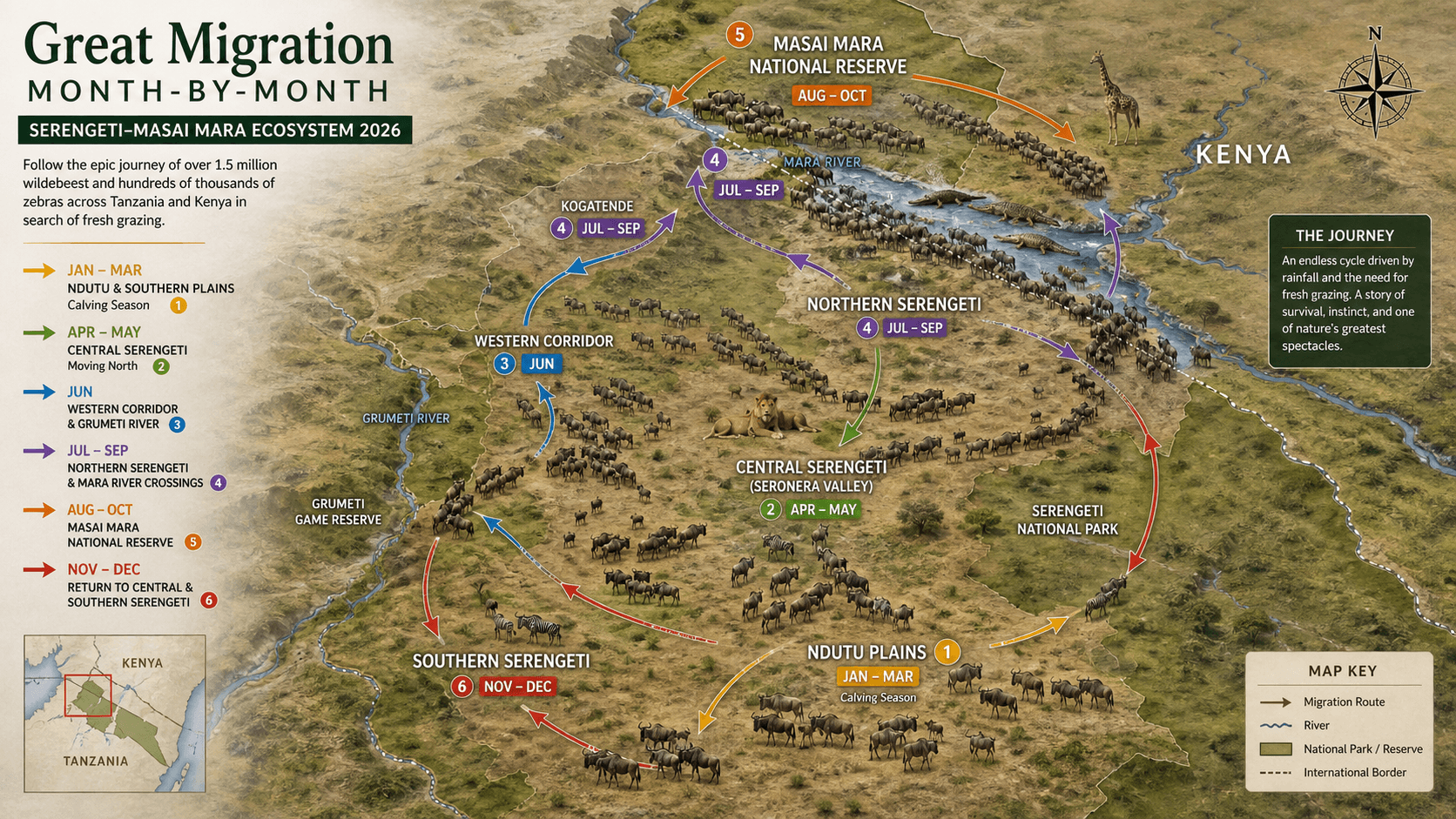
Wildebeest occupy the Ndutu Plains from December to March for the calving season. They move through the western corridor near the Grumeti River from April to June. They concentrate at Kogatende and the Mara River in northern Serengeti from July to October. They return south through the eastern Serengeti in October–November. The herd is in Serengeti National Park or NCAA territory every month without exception.
Understanding the Serengeti migration month by month is the foundation of planning a first safari. The table below simplifies the four primary migration seasons:
“`html| Month | Herd Location | Main Wildlife Event | Crowd Level | Best For |
|---|---|---|---|---|
| January | Ndutu Plains | Peak calving season and predator activity | 3–4 vehicles | Families and wildlife photography |
| February | Ndutu Plains | Calving continues with intense predator action | 3–4 vehicles | Predator sightings and budget safaris |
| March | Eastern Serengeti | Migration begins moving northeast | 2–3 vehicles | Green season and fewer crowds |
| April | Western Corridor | Green season with scattered herds | 1–2 vehicles | Budget travel and landscape photography |
| May | Grumeti Area | Migration concentrates before crossings | 1–2 vehicles | Solitude and lower safari costs |
| June | Grumeti River | First river crossings begin | 4–5 vehicles | River crossing experiences |
| July | Kogatende | Peak migration and Mara crossings | 6–8 vehicles | Classic migration safaris |
| August | Northern Serengeti | Largest Mara River crossings | 6–8 vehicles | Wildlife photographers |
| September | Northern Serengeti | Late-season crossings continue | 4–6 vehicles | Crossings with fewer crowds |
| October | Eastern Serengeti | Herd begins southern movement | 3–5 vehicles | Predator sightings and value trips |
| November | Southern Serengeti | Migration returns toward Ndutu | 2–3 vehicles | Solo travelers and budget safaris |
| December | Ndutu Plains | Herd arrives for calving season | 3–4 vehicles | Holiday safaris and families |
In summary, January–February suits travelers focused on predator behavior and calving season. July–September suits travelers prioritizing Mara River crossings. April–May offers the lowest prices and lightest vehicle traffic across Serengeti National Park.
The migration cycle explained:
The 1.3 million wildebeest herd follows rainfall patterns, not calendar schedules. December–March concentrates the herd at Ndutu Plains in southern Serengeti and NCAA territory because grasslands remain green and water is plentiful. Calves born in February are vulnerable to predators — lions, spotted hyenas, and cheetahs are as concentrated as the herd itself.
As dry season arrives (April–June), the herd moves northwest toward the Grumeti River following green grass. June through July brings the first major river crossings at Grumeti as the herd pushes north into Kenya’s Masai Mara. July through October concentrates the herd at the Mara River on Serengeti’s northern border — the most photographed and highest-cost migration event.
October through November sees the herd returning south through eastern Serengeti toward Ngorongoro Conservation Area, completing a full annual cycle and setting the stage for December calving.
Why first-timers misunderstand migration timing:
The migration is marketed globally as a July–August spectacle because Grumeti and Mara River crossings generate the highest accommodation prices and attract the most international visitors. This marketing created a false narrative: that the migration only happens July and August.
The herd is in the Serengeti every month. The specific zone and wildlife event change monthly. February at Ndutu offers sustained predator action with minimal crowds at 30% below peak cost. April offers solitude and landscape beauty. November offers budget value with group departures. Missing July means missing the largest single crossing event, not missing the migration.
Practical tip: If you are undecided about which month to visit, ask yourself one question: do you want sustained wildlife behavior over 6 hours per day, or do you want a single dramatic visual moment? Behavioral → February, Ndutu. Dramatic spectacle → August, Kogatende. Everything else falls on a spectrum.
What Do First-Timers Consistently Get Wrong About Migration Timing?
The three most common first-timer misconceptions are: (1) the migration only happens in July and August, (2) missing river crossings means missing the migration, and (3) the herd is easy to predict to a specific day. All three are wrong. The migration is a year-round ecosystem event. Calving season delivers equal drama to river crossings at a lower cost. Even experienced guides with 17 years of Northern Circuit experience cannot guarantee crossings on a specific date.
Misconception 1: “I have to go in July, or I’ll miss the migration.”
The migration exists in the Serengeti every month. In April, 800,000+ wildebeest move through the western corridor. In February, 300,000+ mother wildebeest and newborns concentrate at Ndutu Plains under heavy predator pressure. In October, the herd moves south through eastern Serengeti.
July is marketed aggressively because it generates the highest accommodation revenue, not because the herd disappears any other month. Our Serengeti safari cost 2026 guide breaks down exact pricing differences by month. February safaris cost $1,800–$2,100. August safaris cost $2,400–$2,800. Same herd, different price point.
Misconception 2: “River crossings are the migration. If I don’t see one, I’ve missed it.”
River crossings are one of four primary migration events. Calving season, predator hunting, and the green dispersal are equally valid migration experiences.
Kanti Kessy, 17 years on the Northern Circuit, has guided travelers who rate their February Ndutu calving safari above any July crossing they later witnessed — specifically because newborn calves and hunting predators deliver sustained 6-hour game drive action, while a river crossing lasts 5–15 minutes before the herd disperses.
Misconception 3: “My operator guaranteed I’ll see a river crossing.”
No legitimate operator can guarantee a river crossing date. The herd follows rainfall patterns, not calendar schedules. Operators who guarantee crossings on specific dates either fabricate certainty to close bookings or plan to fabricate the experience.
What a legitimate operator can guarantee: they will position your vehicle at the correct zone for the current herd location and maintain ranger contact to know when the herd approaches crossing points.
Practical tip: Ask your operator this question before booking: “Where was the herd last week and where do your rangers expect it this week?” A legitimate operator answers with a specific zone name — Kogatende, Grumeti Hills, Ndutu airstrip — within 48 hours. An operator who cannot answer is not tracking the migration actively.
What Does a Migration Game Drive Actually Feel Like?
Short answer: A calving season game drive in February at Ndutu Plains delivers 4–6 predator interaction events in a single morning — lion hunts, cheetah stalks, hyena pursuits — within 5 km of camp. A river crossing game drive at Kogatende in August requires arriving at the Mara River by 6:00 AM, waiting on the bank for 30 minutes to 3 hours, then witnessing a 5–15 minute crossing event. Both are genuinely rewarding. The experience type is fundamentally different.
February at Ndutu Plains (Calving Season):
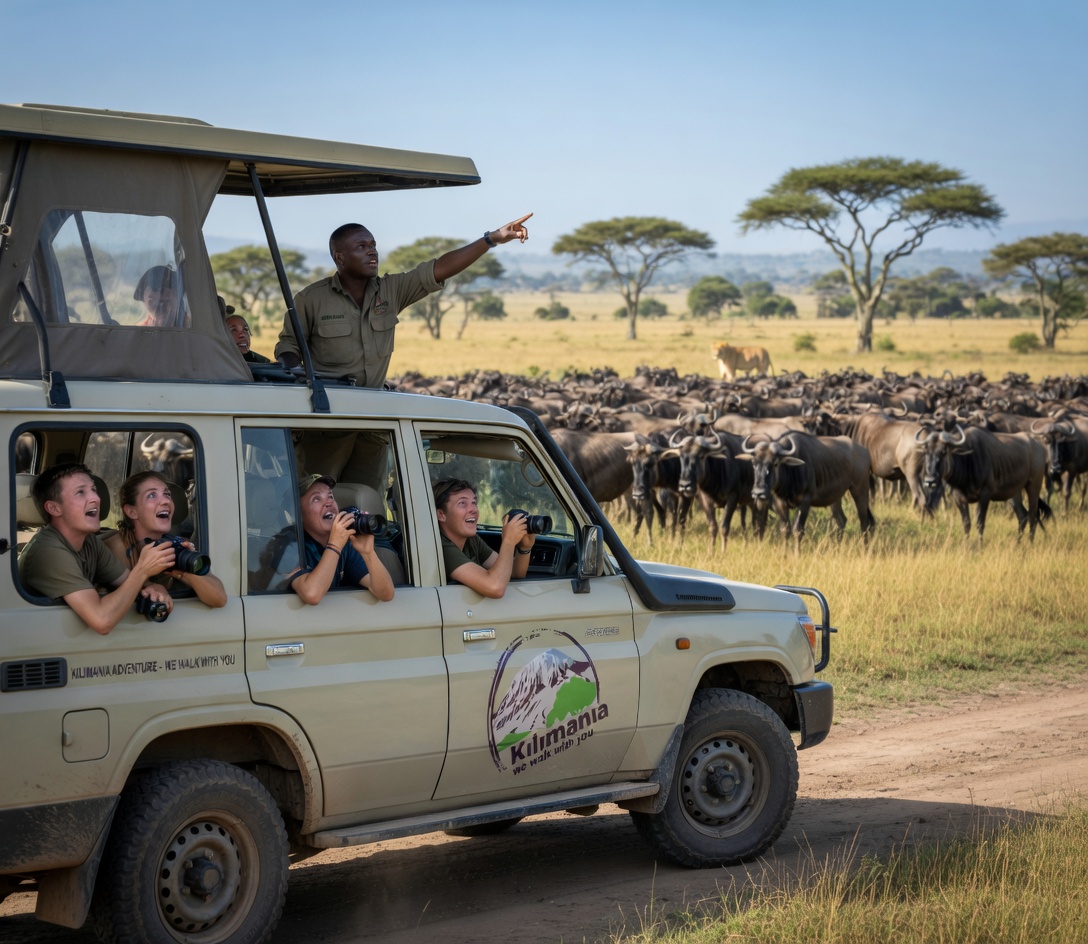
Your guide departs camp at 6:00 AM. Within 15 minutes, the vehicle enters a landscape covered by wildebeest in every direction. Calves born that morning are standing on weak legs beside their mothers. Predators — lions (Panthera leo), spotted hyenas (Crocuta crocuta), cheetahs (Acinonyx jubatus) — are already active.
By 9:00 AM, you have watched two hunting sequences. Lunch at camp. Depart again at 3:30 PM for a 3-hour evening drive. Vehicle density at sightings: 3–4 vehicles on average.
This is behavioral wildlife photography — long observation periods, repeated predator activity, mother-calf interactions, jackal opportunism.
August at Kogatende (Mara River Crossing):
Your guide departs camp at 5:30 AM. You reach the Mara River bank by 6:15 AM. The opposite bank shows 40,000+ wildebeest gathering. You wait. The wait ranges from 20 minutes to 3 hours.
When the crossing begins, it lasts 8–12 minutes — wildebeest plunging, crocodiles striking, water churning. Vehicle density at the crossing: 6–8 vehicles at TANAPA regulation capacity. You reposition for the next potential crossing point by midday.
This is action wildlife photography — compressed, dramatic visual moment, heavy vehicle competition.
April–May at Western Corridor (Green Season):
Wildebeest are scattered across wide grassland — herds of 500–2,000 animals visible in multiple directions but not concentrated. You encounter elephants, buffalo, giraffe alongside dispersed migration animals.
Vehicle density: 1–2 vehicles at any sighting. The landscape is green. The experience is spacious and unhurried.
Practical tip: If you are a first-timer with no fixed preference between calving and crossings, book February at Ndutu. Predator interaction density is highest, vehicle crowding is lowest, and cost is 30% below peak August pricing.
Which Migration Season Suits Your Traveler Type?
Short answer: Families with children under 14 suit calving season (January–February) best — the herd is concentrated, game drives are shorter, and wildlife is visible within 15 minutes of camp. Solo travelers suit November or April for budget value with complete vehicle flexibility. Couples suit June for river crossings at 15% below peak cost. Photographers suit February (predator behavior) or August (river crossing spectacle) based on their photographic focus.
Families with children (first safari):
Calving season at Ndutu Plains (January–February) suits families with children under 14. The herd is stationary, sightings come quickly, and game drives cover less distance per day. Children see animals within minutes of departure.
A 5-day family safari in February costs $1,900–$2,200 per person. Our 4-day Tanzania safari Lake Manyara Serengeti Ngorongoro combines family-friendly durations with complete wildlife access.
Solo travelers (budget focus):
November is the optimal first safari month for solo budget travelers. Vehicle sharing is easiest in shoulder season — fewer travelers means joining group departures without the solo supplement.
Accommodation rates run 25–35% below peak. The herd moves through eastern Serengeti with reliable sightings at 75% probability. Budget: $1,600–$1,900 per person for 7 days.
Couples (experience focus):
June suits couples who want river crossing spectacle without July’s premium pricing. Grumeti River crossings in June deliver an 85% sighting probability, at $1,700–$2,100 per person for a 7-day budget safari.
Vehicle density runs 5–6 vehicles per sighting — below TANAPA’s 8-vehicle maximum.
Wildlife photographers:
February at Ndutu Plains for behavior photography — predator hunts, mother-calf bonding, jackal opportunism — at 4–5 vehicles per sighting average. Our 4-day Tanzania big cats and balloon safari combines ground-level predator photography with aerial perspectives.
August at Kogatende for crossing spectacle — dynamic crossing sequences, dust and water contrast — at 6–8 vehicles per sighting.
Tanzania Safari & Kilimanjaro Experts, WhatsApp: +255 756 449 990, Email: info@kilimania.co.tz
What Does a Real 7-Day Migration Safari Cost in 2026?
Short answer: A 7-day Serengeti migration safari costs $1,800–$2,200 per person in low season (April–May, November) and $2,200–$2,800 per person in peak season (July–September) at the budget camping tier. TANAPA park fees ($82.60/adult/day) are a fixed government cost — they represent $578.20 per person of your 7-day budget before vehicle, guide, or accommodation.
First-timers consistently underestimate two fixed costs. Both appear in every legitimate quote. Both are omitted from fraudulent quotes.
Fixed cost 1: TANAPA Serengeti park entry
$82.60 per adult per 24-hour period (2026 TANAPA published rate).
Non-negotiable. Every licensed operator pays this. Seven days = $578.20 per person.
Fixed cost 2: Ngorongoro Crater descent fee
$295 per vehicle — not per person — charged by the NCAA at the crater rim gate.
Divided among 4 passengers, this adds $73.75 per person. Divided among 2 passengers, it adds $147.50.
Any quote that lists this fee per person is mathematically wrong. Any quote that omits it plans to demand it at the crater rim.
Cost breakdown for a real 7-day budget camping safari:
| Cost Category | 2 Travelers | 4 Travelers |
|---|---|---|
| TANAPA Serengeti entry (7 days) | $578.20 | $578.20 |
| Ngorongoro entry fee | $71.00 | $71.00 |
| Crater descent fee | $147.50 | $73.75 |
| Camping accommodation (6 nights) | $180.00 | $180.00 |
| 4×4 vehicle & guide | $350.00 | $280.00 |
| Meals & safari cook | $280.00 | $280.00 |
| Subtotal (before VAT) | $1,606.70 | $1,462.95 |
| VAT (18%) | $289.20 | $263.33 |
| Total per person | $1,895.90 | $1,726.28 |
| Typical operator margin | $100–$200 | $100–$200 |
| Realistic final quote | $1,995–$2,095 | $1,826–$1,926 |
Consult our detailed Serengeti safari cost 2026 guide for month-by-month pricing, tier comparisons, and itemized breakdowns by park and by day.
In summary, January–February suits travelers focused on predator behavior and calving season. July–September suits travelers prioritizing Mara River crossings. April–May offers the lowest prices and lightest vehicle traffic across Serengeti National Park.
How to Spot a Fake Serengeti Migration Safari Quote
Any 7-day Serengeti safari quote under $1,800 per person usually excludes mandatory Tanzania park fees. TANAPA and Ngorongoro fees alone already exceed $570 per adult before transport, guide, fuel, or accommodation.
Common safari scams first-time travelers face:
- Deposit taken, operator disappears before departure
- “Park fees excluded” was added later at the Serengeti gate
- Ngorongoro Crater descent fee ($295 per vehicle) is hidden from the quote
- Cheap quote increases after arrival with fuel or camping surcharges
- Unlicensed operator or uncertified guides
How to verify a legitimate Tanzania safari operator:
- Check active TATO registration
- Request itemized park fees by park and day
- Confirm VAT inclusion in writing
- Ask for named accommodations and guide credentials
- Avoid operators demanding more than 30% deposit upfront
Testimonial:
Laura and Mike, UK, November 2025 (Verified Google Reviews): “Priced the same 7-day safari through an Australian agent: $2,950. Emailed Kilimania directly: $2,100 for the same itinerary. The $850 we saved paid our Zanzibar flights.”
FAQ: Serengeti Migration for First-Timers
Does the Serengeti migration happen all year?
Is January good for first-time visitors?
Can I see the migration in April or May?
What is the difference between Grumeti and Mara River crossings?
How many days do I need for a migration safari?
Can I combine Serengeti with other parks?
How do I verify a legitimate safari quote?
Safety & Financial Accuracy Statements
Safety information in this article: Serengeti National Park sits below 2,000 meters elevation — a malaria-endemic zone. Consult your travel physician 6–8 weeks before departure. Antimalarial medication (atovaquone-proguanil or doxycycline) is recommended. Use DEET-based insect repellent. All Kilimania Adventure vehicles are 4×4 Land Cruisers, mechanically serviced every 5,000 km and compliant with TANAPA annual safety inspection requirements.
Financial accuracy: All prices reflect May 2026 TANAPA and NCAA published fee schedules and Kilimania Adventure’s verified operational costs. Any changed figure will be updated within 72 hours of official announcement per our review schedule.
Final Verdict for First-Time Travelers
The Serengeti migration is a year-round wildlife movement, not a single July event. Your safari month determines the type of experience you receive:
- January–February: Calving season and predator behavior
- June–July: Grumeti River crossings
- July–September: Mara River crossings
- April–May: Lowest prices and fewest safari vehicles
For most first-time travelers, February delivers the best balance of wildlife density, predator action, lower accommodation costs, and manageable vehicle traffic.
Explore our complete Tanzania safari packages 2026 for month-specific itineraries across every tier and duration.
We Walk With You.
Disclosure: This article is written by Kilimania Adventure, a TATO-registered safari and Kilimanjaro operator based in Moshi, Tanzania. We have a direct commercial interest in Tanzania safari bookings. All prices reflect real 2026 costs from our own operations. We encourage you to compare our quotes with at least two other TATO-registered operators before booking.
Written by: Sabinus Msimba — Senior Safari Guide, Kilimanjaro Climb Guide and Co-founder, Kilimania Adventure
Credential: 22 years guiding Northern Circuit safaris from Moshi. 300+ Kilimanjaro summits. KINAPA-licensed mountain guide. 200+ Serengeti field days annually.
Last reviewed: May 2026
Review schedule: Updated each November following TANAPA’s annual tariff announcement.
Data Verification Notice: Park fees, visa costs, and conservation area charges are set by government authorities and can change without advance notice. All figures reflect published May 2026 rates. Verify current fees at tanzaniaparks.go.tz before booking. Request a gate receipt during your safari to confirm your operator paid the correct published amount.
Response times: Kilimania Adventure operates on East Africa Time (EAT, UTC+3) from Moshi, Tanzania. All quote requests receive a reply within 12 hours, 7 days per week.
We return a full itemized quote within 12 hours — park fees by park and by day, crater descent calculation by passenger count, VAT treatment stated in writing, complete inclusion and exclusion list. No costs were discovered at the gate.
Verify our credentials:
- TATO Registration: tatotz.org
- Official park fees: tanzaniaparks.go.tz
- NCAA crater fees: ncaa.go.tz
- Tanzania e-visa: immigration.go.tz
We Walk With You.
Tanzania Safari & Kilimanjaro Experts, WhatsApp: +255 756 449 990, Email: info@kilimania.co.tz
Why Trust Kilimania Adventure for This Information
- Base: Moshi, Kilimanjaro Region, Tanzania — physical office and daily operations
- TATO registration: Registered member of Tanzania Association of Tour Operators — verify at tatotz.org
- Field experience: 22 years guiding, 300+ Kilimanjaro summits, 200+ Serengeti field days annually
- Transparency: We publish real park fee data, honest seasonal limitations, and fraud warnings — not marketing language
- Direct contact: +255 756 449 990, EAT (UTC+3), 7 days per week, 12-hour response guarantee
For International Travelers
All prices in USD. Current conversions: $1,800 ≈ £1,400 | €1,680 | AU$2,700.
Flights to Kilimanjaro International Airport (JRO):
- New York/Los Angeles: $800–$1,400 return
- London: £550–£900 return
- Sydney: AU$1,400–AU$2,200 return
Tanzania e-visa: $50 for most nationalities | $100 for US citizens. Apply to immigration.go.tz at least 7 days before departure. Use Visa or Mastercard, Chrome or Firefox browser.
Yellow fever: Required only if arriving from an endemic country. Not required for direct flights from the USA, UK, EU, or Australia.
Pre-safari accommodation in Moshi: $35–$250 per night. Book one night before and one night after your safari.